Chilat Doina
July 8, 2026
Retail media advertising is no longer a side channel. It's moving into the center of the growth equation. Global retail media advertising is projected to hit $160 billion by 2027 and is on track to account for 25% of all global digital ad spending by 2028, overtaking social media ad spend according to Fugo's retail media growth analysis.
That changes how smart operators should think about media.
This isn't just another acquisition lever to test alongside search, Meta, and email. It's the point where merchandising, media buying, and conversion optimization collapse into one operating system. The brands that understand that early don't just buy traffic better. They defend share better, launch products better, and hold rank better when competition gets ugly.
Many practitioners still treat retail media advertising as a narrow on-site tactic. They run sponsored products, watch ROAS, and call it a day. That leaves a lot of money on the table, especially once you start looking at off-site activation and the measurement layer required to justify it.
Retail media matters because it sits closest to the money.
A shopper on Amazon, Walmart, Target, Instacart, Kroger, or a category-specific retailer isn't casually browsing the way they might on a social feed. They're already in a shopping environment. That changes the economics of attention. You're not interrupting entertainment. You're influencing purchase decisions inside a buying session.
That's why the channel has become a strategic priority for serious brands. When a customer searches inside a retailer ecosystem, every placement has consequences. Paid visibility can change click share. Click share can change sales velocity. Sales velocity can strengthen organic positioning. That flywheel is why retail media advertising punches above its weight.
If you run a growing brand, retail media isn't optional anymore for three reasons:
Practical rule: If your retail media strategy is disconnected from your pricing, inventory, reviews, and PDP quality, you don't have a strategy. You have ad spend.
The winning posture is simple. Treat retail media advertising as a profit center, a market share weapon, and a defensive moat at the same time. Brands that only optimize to short-term ad efficiency usually get outplayed by brands that understand shelf control.
The edge isn't “running ads.” Everybody runs ads.
The edge comes from coordinating four things better than the next brand:
That's the difference between a brand that participates and a brand that compounds.
In physical retail, brands fought for eye-level placement, end-caps, and feature displays. Online, the mechanics changed, but the game didn't. Retail media advertising is the modern version of buying better shelf position.
A sponsored placement on a search result page is digital shelf space. A banner on a category page is digital shelf space. A branded placement that pushes your hero SKU in front of a ready-to-buy customer is digital shelf space. The difference is that placement is now controlled by auctions, data, and algorithms instead of store planners alone.
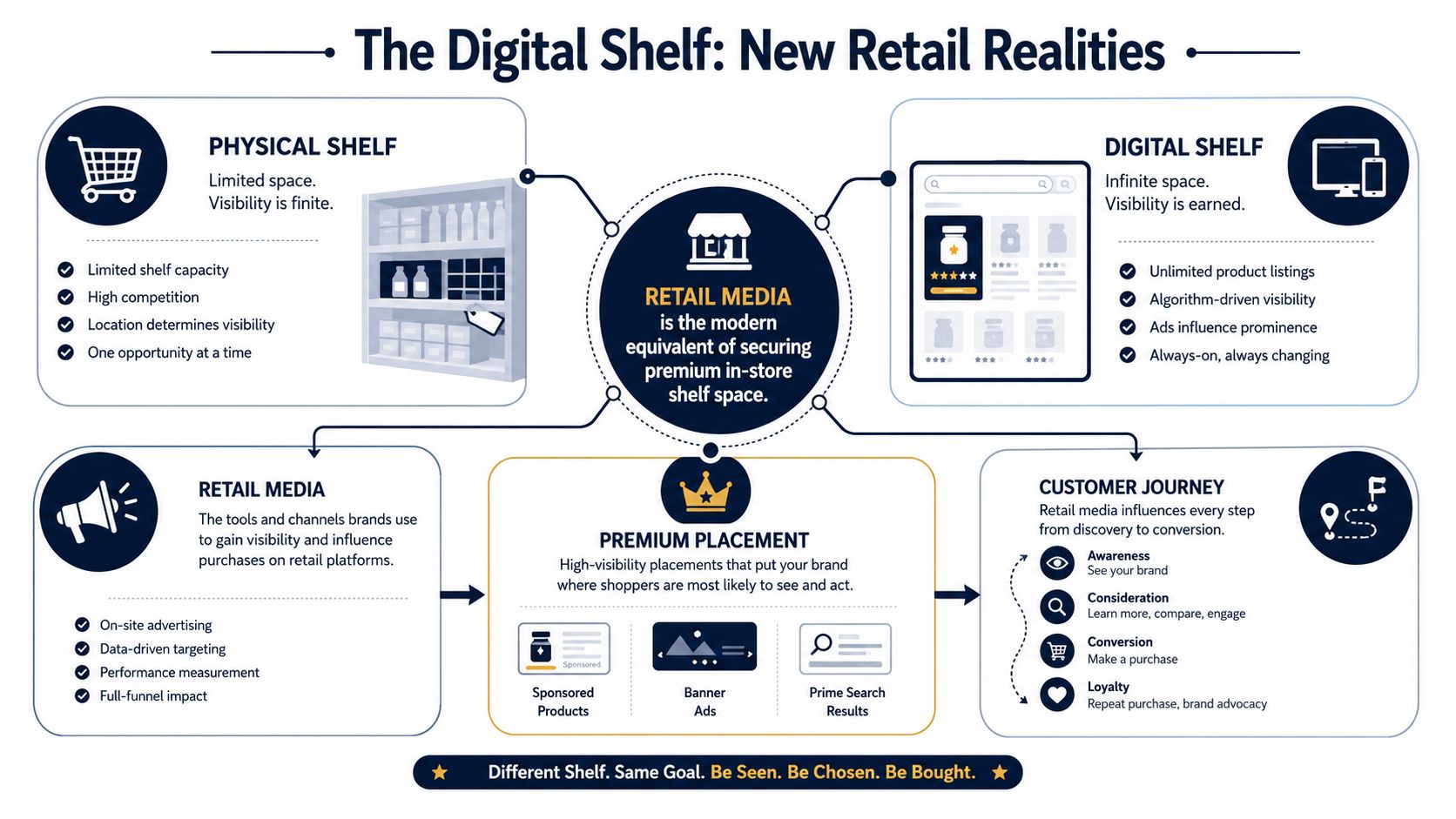
The core advantage sits beneath the placement layer. Retailers now hold first-party behavioral and transaction data that most brands can't replicate on their own. That gives them a cleaner view into what shoppers browse, compare, and buy.
As privacy rules tighten and cookie-based targeting weakens, retailer data becomes more valuable. It's based on actual shopping activity inside commerce environments. That's why mature advertisers are shifting budget in this direction. In the U.S., CPG companies now allocate 39% of their advertising budgets to retail media, compared with 19% in Europe, according to Oberlo's retail media ad spend data.
That budget split tells you something important. The most developed e-commerce markets already treat retail media as core infrastructure.
The digital shelf doesn't reward brands equally. It rewards brands that line up the full system.
Here's what usually separates strong operators from weak ones:
Retail media is merchandising with a media budget attached. Teams that forget the merchandising side usually overpay for mediocre outcomes.
A lot of wasted spend comes from pushing traffic into weak detail pages or trying to scale ads before assortment and inventory are stable. The retailer platform won't save a broken offer. It will just expose the weakness faster.
Most brands make one of two mistakes with retail media networks. They spread budget too thin across too many platforms, or they stay overconcentrated in one ecosystem long after returns start compressing.
The better move is to group networks by strategic role.
The Titans include Amazon and Walmart Connect. These networks offer scale, deep shopper intent, and enough ad inventory to support both brand defense and expansion. They're usually the first place large brands build process discipline.
The Grocery Giants include platforms like Instacart Ads and Kroger Precision Marketing. These are especially relevant for CPG, replenishable products, and basket-based shopping behavior where retailer data is unusually valuable.
The Niche Specialists include retailers like Sephora and Best Buy. These matter when category context changes conversion quality. A beauty customer in Sephora behaves differently from a general marketplace shopper. So does an electronics buyer in Best Buy.
If you want a broader primer on how retail media networks are structured and why retailers are building them so aggressively, Headline Marketing's retail media insights are a useful companion read.
| Network | Primary Audience | Key Ad Formats | Measurement Maturity |
|---|---|---|---|
| Amazon | Broad marketplace shoppers with strong search intent | Sponsored products, sponsored brands, display, video, DSP-connected formats | High |
| Walmart Connect | Mass-market omnichannel shoppers | Sponsored search, display, onsite placements, off-site extensions | High |
| Instacart Ads | Grocery and convenience shoppers | Sponsored products, display, shoppable placements | Medium to high |
| Kroger Precision Marketing | Loyalty-rich grocery audiences | Search, display, audience-based media | Medium to high |
| Sephora | Beauty-focused shoppers | Sponsored placements, category visibility, brand storytelling units | Medium |
| Best Buy | Consumer electronics and high-consideration shoppers | Search placements, display, brand-led placements | Medium |
The right network depends less on total scale and more on fit.
A few decision filters work well:
For Amazon-heavy brands, retailer-native data should inform more than ads alone. Teams that use Amazon Brand Analytics workflows to guide keyword coverage, competitor pressure, and catalog prioritization usually make better retail media decisions because they're reading the shelf, not just the ad console.
Don't ask which network is best. Ask which network gives your hero products the cleanest path to profitable visibility.
That framing keeps teams from chasing novelty. The best network is the one where your product, price point, and purchase cycle match the platform's native shopping behavior.
On-site retail media is where most brands start, and it's still where many of the easiest wins live. But default settings won't get you there. The brands that dominate on-site don't manage campaigns like isolated ad sets. They manage them like shelf-control systems.
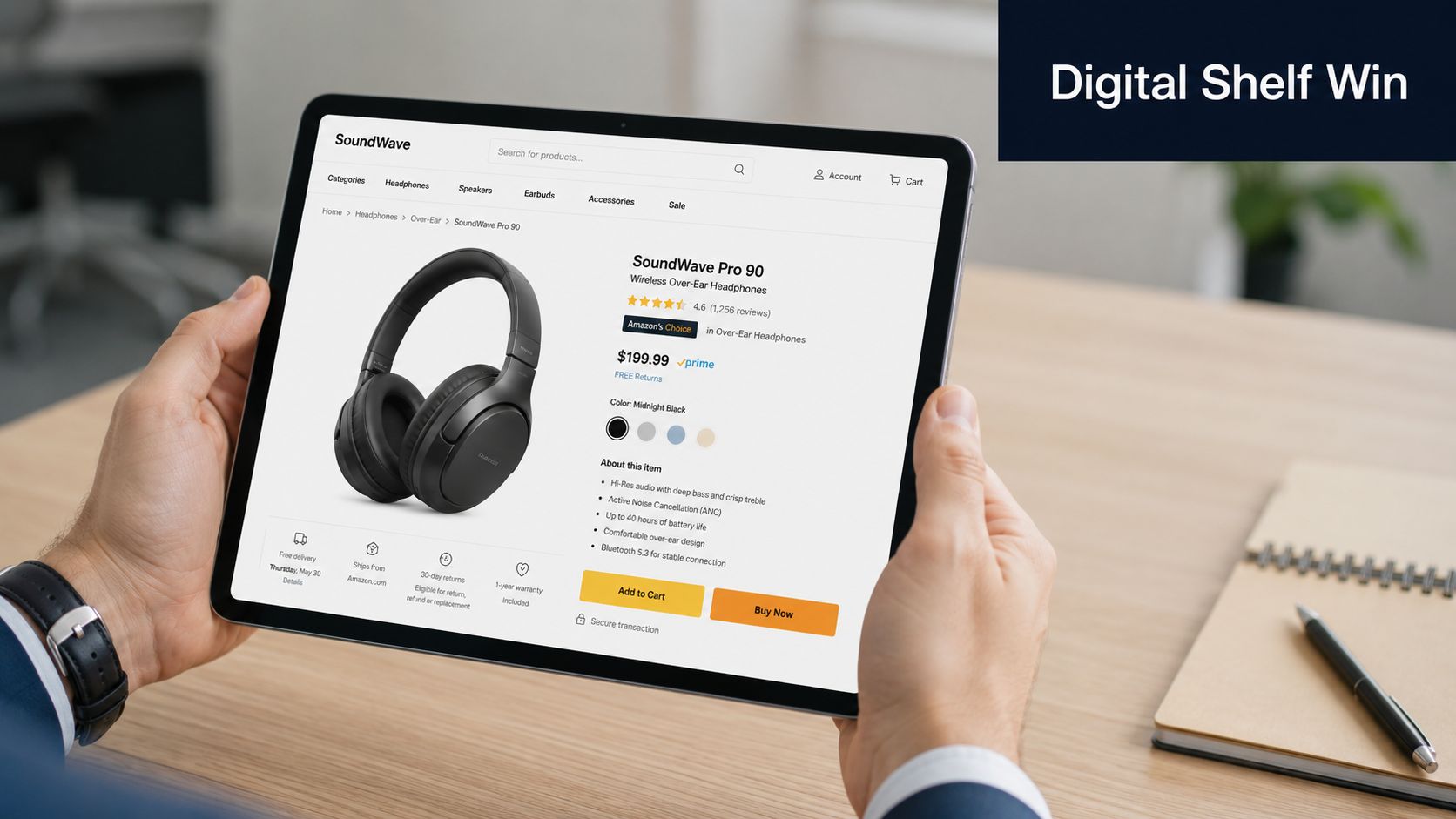
Most accounts are overbuilt and underthought. They separate campaigns by ad format but never define the job of each SKU.
A better structure starts with roles:
When you assign a role to each product, bidding gets cleaner. Budget allocation gets less emotional. Teams stop expecting every SKU to do the same job.
Strong on-site execution usually comes from a handful of habits repeated well.
Harvest search terms aggressively
Mine winning queries from auto, broad, and category exploration campaigns, then graduate them into tighter exact-match or high-control structures. Don't leave your best converting terms inside catch-all campaigns where they compete with weaker traffic.
Separate defense from discovery
Branded terms, category terms, and competitor terms shouldn't live under the same logic. They have different economics. They need different budgets and different expectations.
Use dayparting where platform behavior supports it
Some categories convert differently based on time of day or day of week. If your retailer tools and internal reporting support it, align spend with the windows that produce stronger order quality.
Refresh creative before performance collapses
Display and video placements fatigue. Brands often wait until efficiency drops hard before rotating assets. By then, the market has already moved on.
Later in the funnel, creative matters more than many operators admit. This walkthrough covers the mechanics from the platform side:
The best on-site creative tends to follow simple discipline:
The ad didn't fail because CPCs got expensive. It failed because the shopper clicked and didn't see a compelling reason to choose you.
On-site domination comes from reducing friction after the click as much as winning the click itself. That means your retail media lead, content team, and marketplace operator need to work off the same playbook, not separate dashboards.
Most brands overinvest in the part of retail media they can see easily and underinvest in the part that expands reach. That's why off-site matters.
While 76% of retail media dollars are still activated on-site, the bigger growth opportunity sits in off-site channels like social and CTV, which McKinsey highlights as a rapidly growing area that many brands still underuse, as summarized in The Trade Desk's guide to off-site retail media growth.
That gap creates room for disciplined operators.
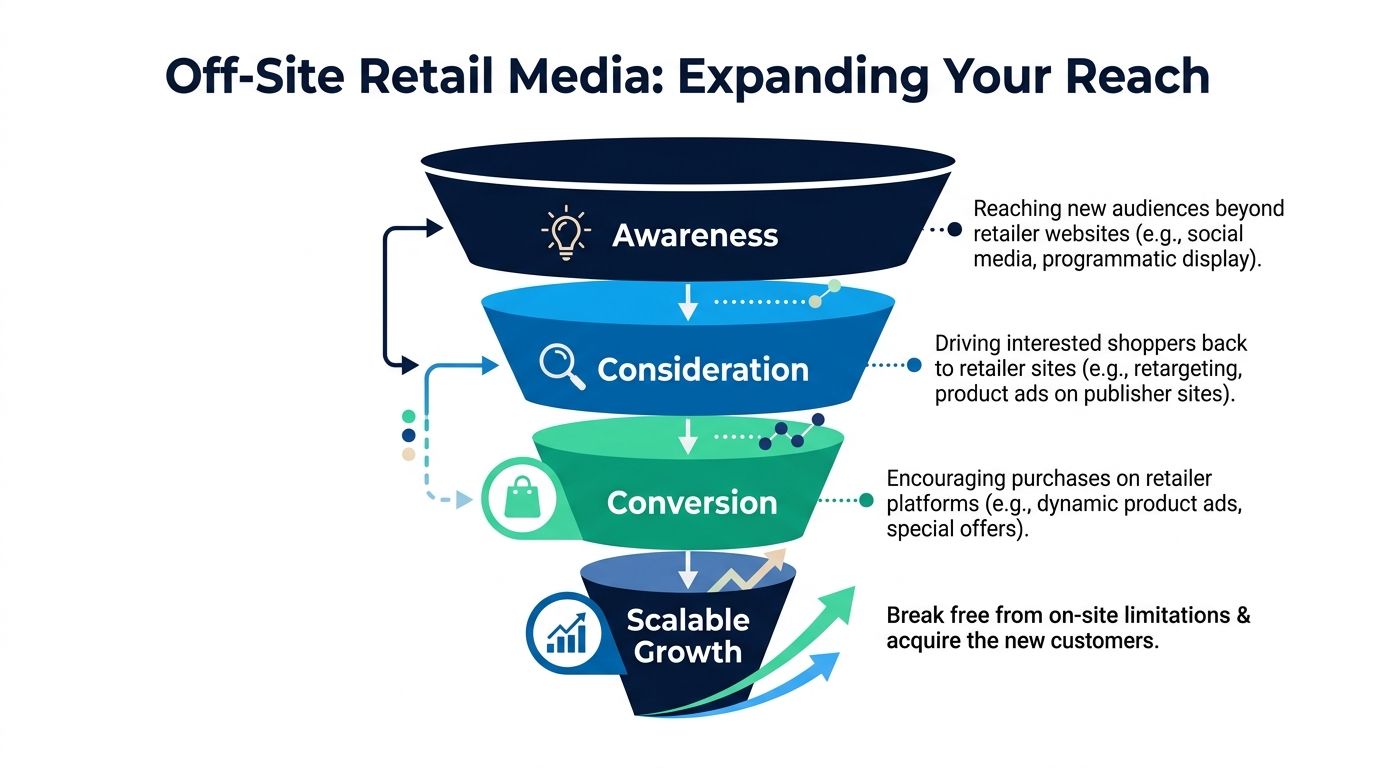
On-site auctions get crowded. Every brand in the category can see the same shelf and bid against the same intent. Over time, that compresses easy wins.
Off-site retail media advertising gives you another route. You use retailer first-party data to reach relevant shoppers beyond the retailer's own site, then pull them back into the commerce environment when they're ready to buy. That extends the value of retailer data into discovery, consideration, and retargeting.
The play isn't to replace on-site. It's to stop asking on-site to do every job.
Off-site is strongest in a few situations:
The infrastructure behind this is getting more advanced. Retail media networks can integrate with DSPs and SSPs to activate retailer audiences across external inventory, and identity layers can map retailer IDs to broader activation environments. Amazon DSP advertising is one of the clearest examples for operators who want to understand how retailer-linked off-site buying expands beyond owned marketplace placements.
They judge off-site by last-click logic.
That's a bad fit for the job. Off-site often influences demand before the final retail session begins. If you force every campaign to justify itself only through immediate last-touch conversion, you'll underfund the very layer that creates future search, future branded demand, and stronger retargeting pools.
A better operating model is to give off-site clear roles:
If you don't define those roles up front, teams start arguing about attribution instead of learning from it.
Retail media becomes much more powerful when you stop treating attribution as a dashboard problem and start treating it as a decision system.
The core advantage here is closed-loop measurement. Retail media's closed-loop attribution delivers ROAS of 8:1 to 12:1, compared with the 3:1 to 5:1 average of traditional digital channels, because it links ad exposure directly to first-party transaction data, according to Equativ's retail media guide.
That doesn't mean every campaign will hit those returns. It means the measurement framework is stronger because it connects media exposure to actual purchase behavior inside the retailer ecosystem.
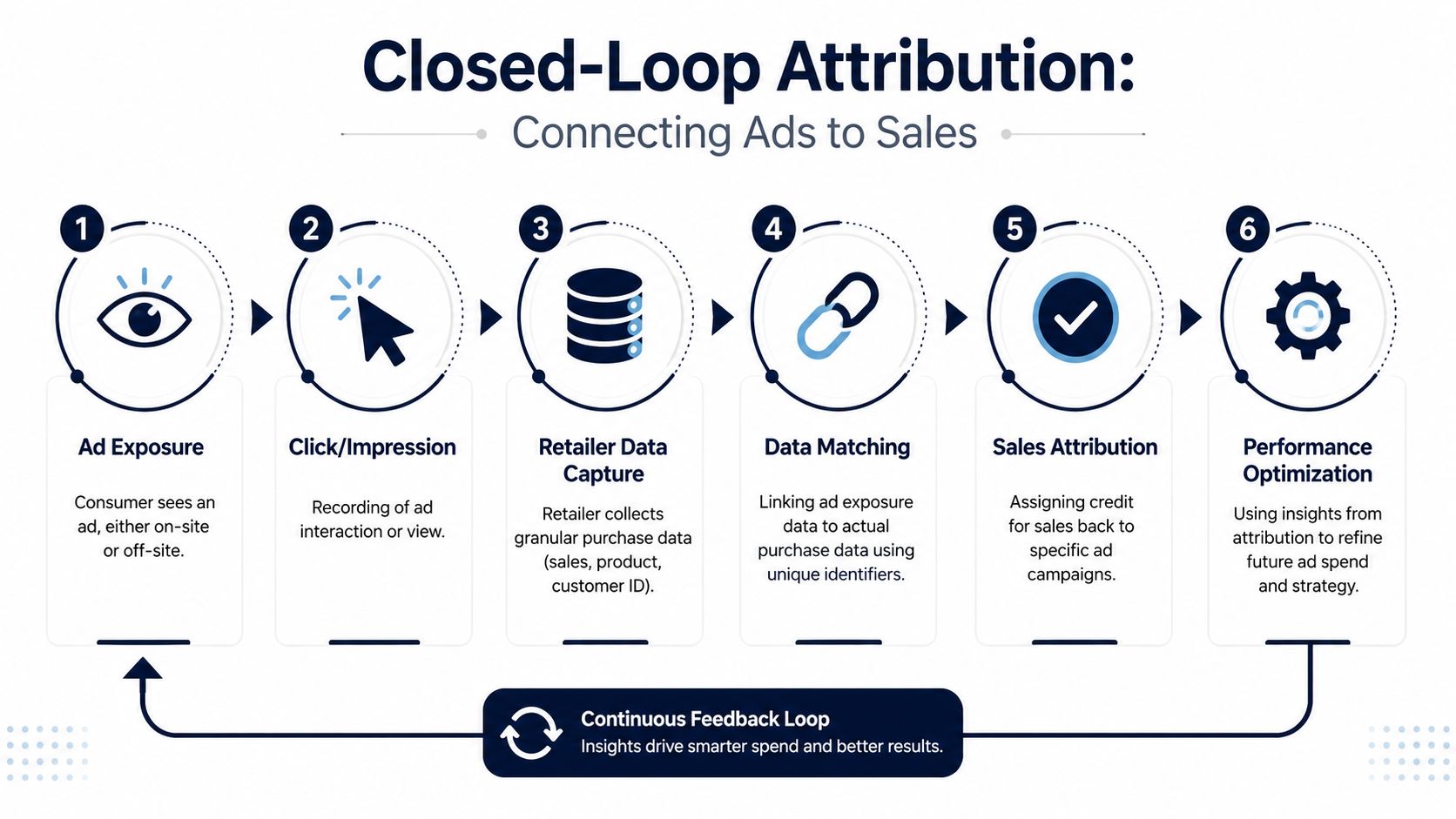
Platform-reported ROAS is useful, but it's not enough for operators making real budget decisions.
A practical model should look at:
Many brands struggle with off-site, as traditional attribution models often break down once the journey spans multiple surfaces. A shopper might see a retailer-powered ad on a social platform, remember the product, then convert later through retailer search or a direct product page visit.
You don't need perfect attribution. You need attribution that helps you allocate capital better.
A practical approach usually includes these layers:
Holdout thinking
Compare exposed versus non-exposed audience behavior where the retailer or platform supports it.
Time-window analysis
Look at what happens to retailer sales during and after campaign periods, not only at immediate click windows.
Audience-specific reporting
Separate prospecting pools from retargeting pools. If you blend them, the strongest retargeting results will hide weak prospecting logic.
Retailer-level scorecards
Review on-site and off-site performance together for each network. Don't isolate them into separate political silos.
If your team needs a broader framework for evaluating channel efficiency across a wider mix, this guide on how to measure marketing ROI is useful background. For operators trying to unify paid media and commerce data into one clearer view, Triple Whale reporting workflows can also help connect ad-level thinking with business-level decision making.
A good attribution model doesn't answer every question. It helps you stop funding the wrong answers.
Winning teams don't worship any single metric. They triangulate.
They read platform attribution, retailer sales trends, category movement, branded search behavior, and inventory health together. Then they decide whether a campaign created profitable momentum or just flattering dashboard output.
This is key. Closed-loop attribution works best when finance, media, and marketplace teams use the same definitions for success.
The brands that win retail media in 2026 won't be the ones with the biggest budget. They'll be the ones with the cleanest operating system.
Get ruthless about on-site execution. Prioritize hero SKUs, tighten campaign structure, separate defense from discovery, and stop sending paid traffic to weak PDPs. On-site is still your closest lever to immediate retail conversion, so it has to be sharp.
Don't launch off-site because it sounds advanced. Launch it because you need reach, retargeting depth, or partner-specific demand creation that on-site can't deliver efficiently on its own. Keep the role of each campaign obvious before the first dollar goes out.
Tie on-site and off-site together at the retailer level. Review incrementality, new-to-brand behavior, and total commercial impact. If your team only looks at channel dashboards in isolation, budget decisions will stay reactive.
A lot of general paid media advice falls apart inside commerce ecosystems. If you want a wider lens on channel strategy, creative, and offer alignment, this piece on mastering e-commerce advertisement is worth reading alongside a retail-media-specific plan.
Retail media advertising has matured past the test budget stage. The next wave of winners will treat it as infrastructure. They'll control the shelf, extend reach off-site, and prove value with tighter measurement than competitors can match.
If you're building at scale and want to compare notes with operators who are already navigating these shifts across Amazon, DTC, and omnichannel, Million Dollar Sellers is where high-level e-commerce founders share what works behind the scenes.
Join the Ecom Entrepreneur Community for Vetted 7-9 Figure Ecommerce Founders
Learn MoreYou may also like:
Learn more about our special events!
Check Events