Chilat Doina
January 29, 2026
Amazon DSP advertising is a game-changer for established brands. It's a programmatic ad platform that lets you reach new and existing audiences both on and off Amazon—a powerful tool for sellers who are ready to move beyond basic keyword targeting and start building real, long-term brand equity.
In short, it’s about creating demand, not just capturing it.
If you've built a solid brand using Sponsored Ads, you've already mastered the art of setting up shop inside the mall. You're catching shoppers who are already there, actively looking for products just like yours. That's fantastic for driving sales right now.
But what about the millions of potential customers who haven't even walked into the mall yet? The ones who don't know they need what you're selling?
This is where Amazon DSP advertising completely shifts the strategy.
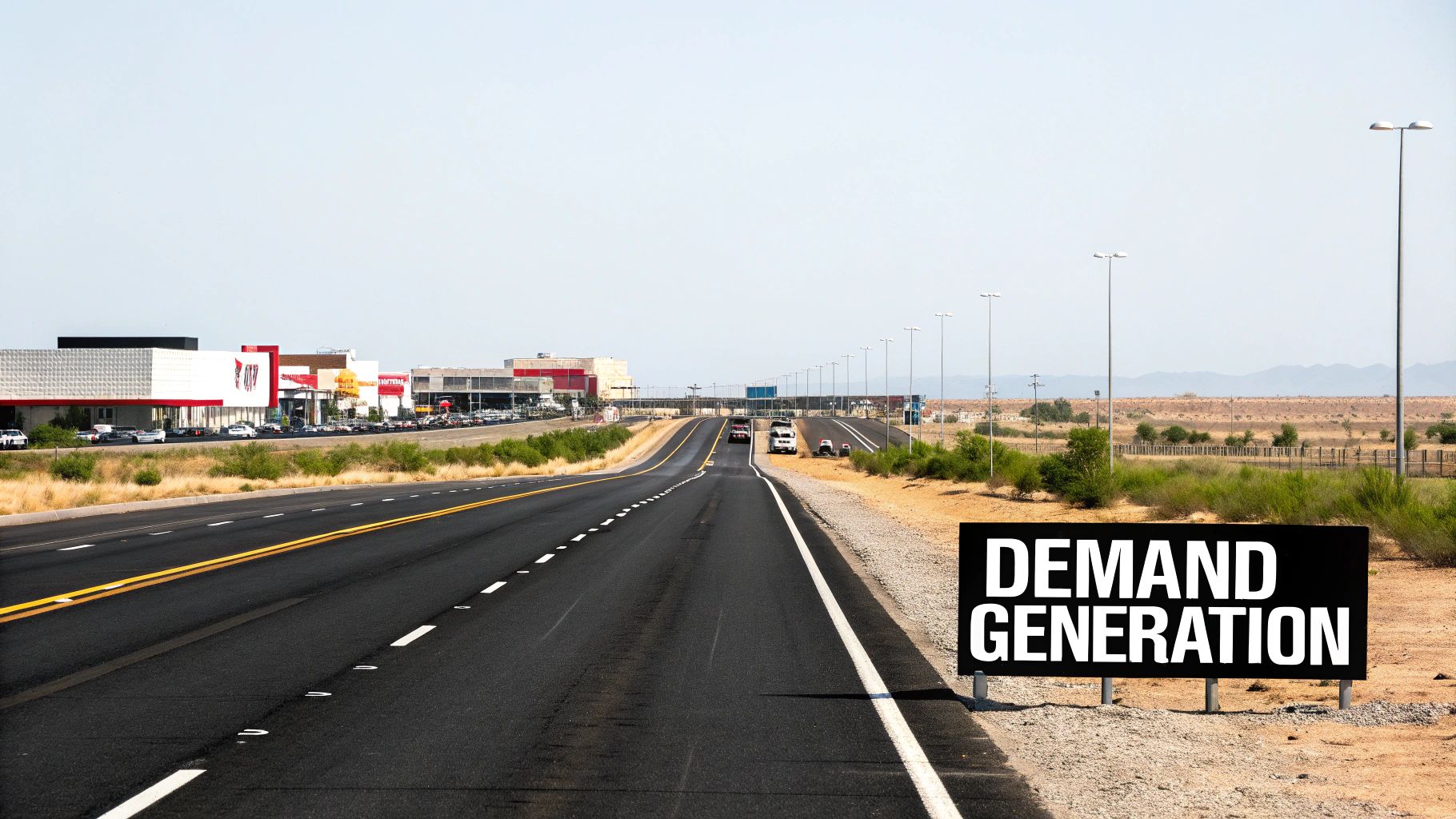
Think of Amazon DSP as placing massive billboards on every major highway leading to that mall. It’s all about building brand recognition and creating that spark of desire before a customer even thinks to search. For seven-figure brands, this isn't just another ad channel; it's the engine for truly scalable growth.
Sponsored Ads are brilliant at converting existing demand. Someone searches "running shoes," and your ad pops up. Easy enough.
DSP, on the other hand, is all about creating that initial interest in the first place. It lets you find audiences based on their lifestyle, past purchases, and what they browse across the web. Then, you can show them compelling ads on sites they already visit, like news outlets, favorite blogs, or even streaming TV apps.
The key functions that make DSP such a growth driver are:
In essence, Sponsored Ads win the immediate sale, but DSP wins the long-term customer relationship. It shifts your focus from short-term ROAS to building a brand that customers seek out by name.
To really get a handle on Amazon DSP, you need to understand the concept of programmatic advertising, which is basically the automated buying and placing of digital ads. This automation is what gives DSP the precision and scale to be so effective. A smart DSP strategy doesn't replace what you're already doing; it enhances it, creating a flywheel effect for sustainable growth. To see how it all fits together, check out our guide on building a holistic Amazon advertising strategy.
Don't just take my word for it—look at the numbers. Amazon's advertising division is exploding, hitting $17.7 billion in revenue in Q3 2025 alone, a 24% jump from the previous year. Projections show the division could rake in $67 billion in 2025 and over $90 billion within two years. This isn't just a fleeting trend; it’s a fundamental shift in how the biggest brands are scaling on the platform.
If you've successfully scaled your brand using Amazon Sponsored Ads, you've probably hit a point where you're asking, "What's next?" That next frontier is often Amazon DSP, and understanding where it fits in is crucial for continued growth.
It's easy to get bogged down comparing features, but the real key is grasping the fundamental strategic difference between these two platforms. They aren't rivals fighting for your ad budget; they're partners designed to work together on a full-funnel marketing strategy.
Think of Sponsored Ads as your all-star sales team on the shop floor. They operate at the very bottom of the funnel, targeting shoppers who are already in the store, actively searching, and ready to buy. They are masters of demand capture. These ads work on a Cost-Per-Click (CPC) basis, meaning you only pay when a highly interested shopper clicks. It's direct, efficient, and built for immediate sales.
Amazon DSP, on the other hand, is your brand's storyteller. Its job is to get people excited about your brand long before they even think about shopping. It operates at the top and middle of the funnel, building awareness and consideration. This is pure demand generation—creating future customers, not just converting current ones.
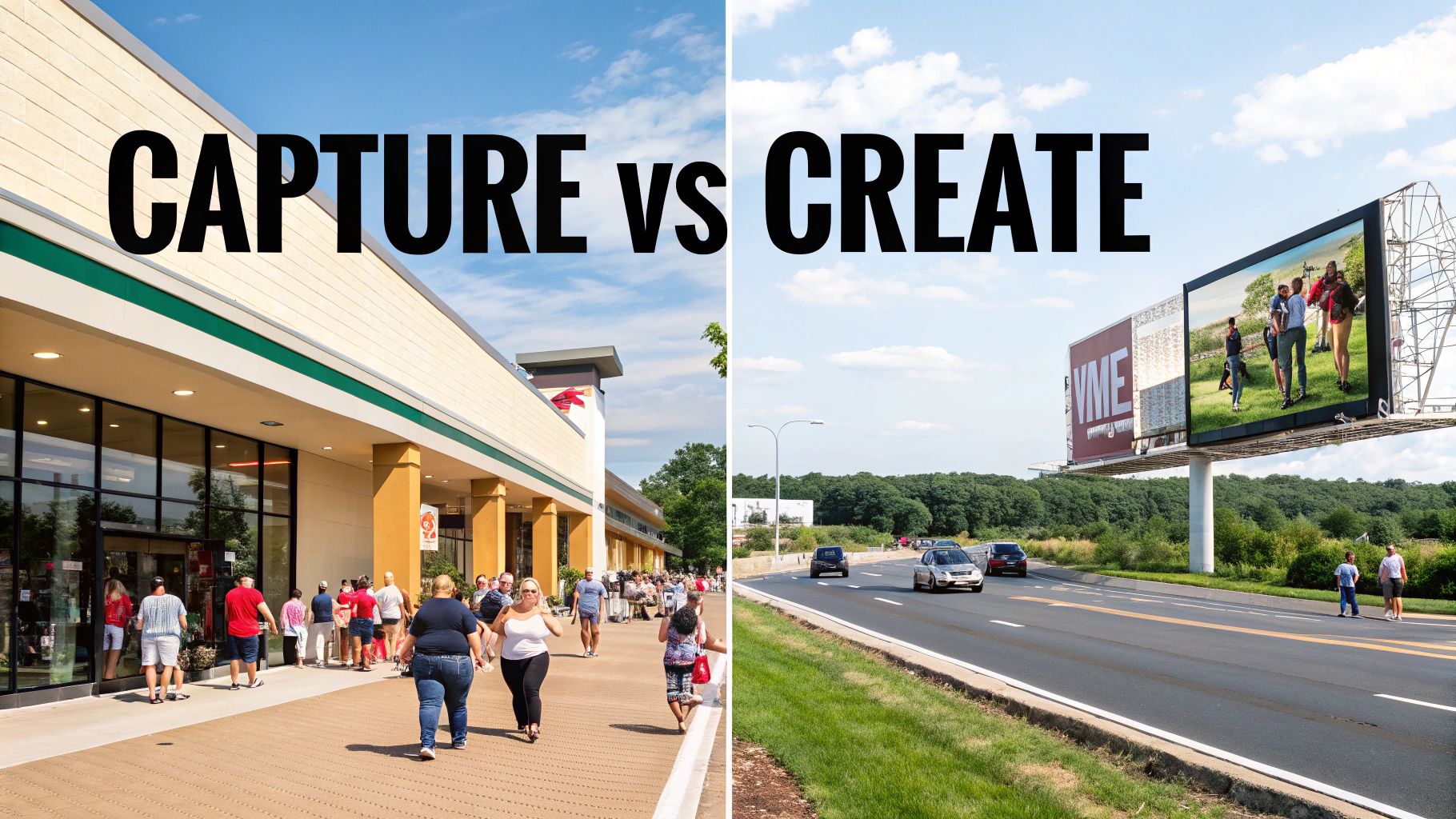
This simple distinction—capturing existing demand versus creating new demand—is the most important concept to understand.
The core difference really comes down to their reach and approach. Sponsored Ads are native to Amazon's world. They live on search result pages and product detail pages, capitalizing on their proximity to the "Add to Cart" button.
Amazon DSP breaks out of those digital walls. It lets you run display, video, and even audio ads across a massive network of third-party websites, mobile apps, and connected TV services. You're reaching people where they live online, not just where they shop. This broader reach is powered by a Cost-Per-Mille (CPM) model, where you pay for every thousand impressions. The goal is visibility and brand exposure, not just clicks.
The strategic choice isn't about which one is "better." It's about allocating your budget to both capture existing demand with Sponsored Ads while simultaneously creating new demand with Amazon DSP.
To really nail this down, let’s put them head-to-head.
This table breaks down the core differences between Amazon's two main advertising platforms. Use it to see where each tool fits into your broader growth strategy.
FeatureSponsored Ads (PPC)Amazon DSP (Programmatic)Primary GoalDemand Capture (Immediate Sales)Demand Generation (Brand Awareness)Ad PlacementsOn-Amazon (Search, Product Pages)On & Off-Amazon (Websites, Apps, CTV)Pricing ModelCost-Per-Click (CPC)Cost-Per-Mille (CPM)Targeting BasisKeywords & ProductsAudiences & LifestylesRetargetingOn-Amazon Shoppers (e.g., viewed product)Pixel-Based (Website Visitors, Customer Lists)Ideal Funnel StageBottom-of-Funnel (BOFU)Top & Mid-Funnel (TOFU/MOFU)
As you can see, they are two sides of the same coin, each with a distinct role to play in driving both immediate revenue and long-term brand equity.
Understanding this framework is the key to smart budget allocation. A brand that relies only on Sponsored Ads is constantly battling competitors for the same finite pool of active shoppers. It's a vital strategy, but it has a ceiling. Once your campaigns are fully optimized, growth can flatline. If you want to dive deeper into this model, our guide on what PPC is in Amazon gives you a complete breakdown.
Adding DSP to the mix is like building an entirely new pipeline of future customers. By reaching audiences based on their browsing habits, past purchases, and demographic profiles all over the web, you're warming them up to your brand.
When those shoppers eventually do land on Amazon, they're not cold leads anymore. They're searching for your brand by name. This creates a powerful flywheel effect where your Amazon DSP advertising makes your Sponsored Ad campaigns more efficient and profitable over the long run.
If you think of Sponsored Ads as targeting keywords, then Amazon DSP is all about targeting people. This is where the platform really flexes its muscles, giving you a backstage pass to Amazon's incredible vault of first-party shopping data. Instead of crossing your fingers and hoping the right person searches for your product, you can proactively find them based on who they are and what they do online.
The true magic of Amazon DSP advertising is its power to build a surprisingly detailed portrait of your ideal customer. It goes way beyond simple demographics to get at the heart of their intent, lifestyle, and brand affinities. Nailing these audience segments is how you shift from just capturing existing demand to actually creating a predictable pipeline of future customers.
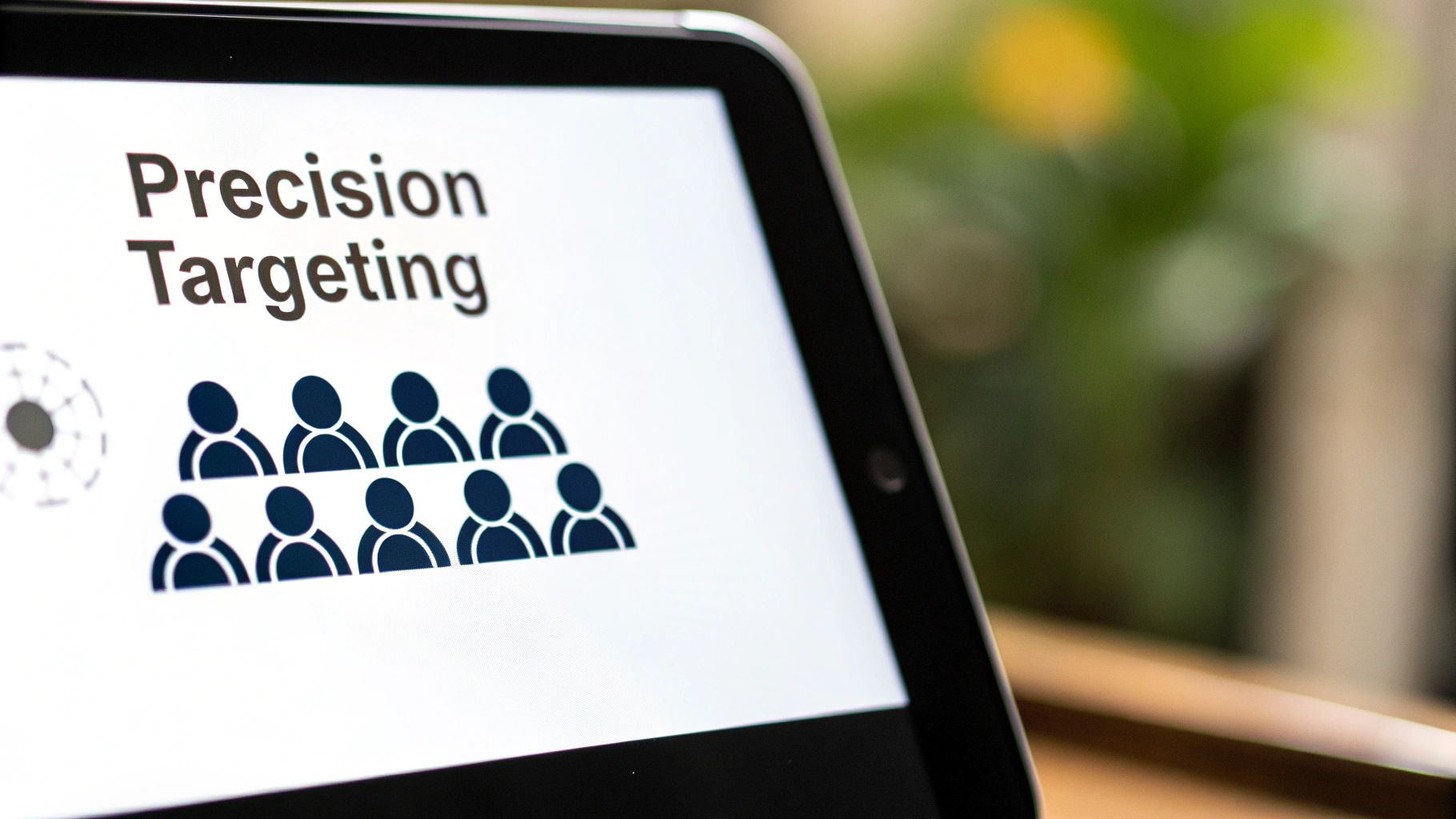
Amazon buckets its powerful data into several core audience types. Think of these as your building blocks. Understanding how to use them—and, more importantly, how to layer them—is fundamental to any successful campaign.
These pre-built segments are your go-to for reaching new customers at scale. They let you cast a wide—but still highly relevant—net to introduce your brand to people who are primed to be interested.
Once you’ve got the basics down, DSP opens up even more precise ways to connect with customers by tapping into your own data. This is where you can build razor-sharp retargeting and loyalty campaigns.
The most profitable audiences are often the ones you build yourself. By combining Amazon's data with your own customer insights, you can create campaigns that are incredibly relevant and effective.
Here are the custom audience types you need to know:
For a deeper dive into improving your campaign results through data, explore our detailed guide on Amazon advertising optimization.
The real art of DSP targeting isn't about just picking one audience. It's about strategically layering them to create a hyper-specific profile of exactly who you want to reach. You don't just target "in-market for home audio." You target people who are in-market for home audio, and have an income over $100k, and have shown interest in premium electronics.
This layering technique lets you do three crucial things:
For example, a brand-new prospect might see an awareness video, while someone who abandoned their cart on your website sees a display ad with a 10% off coupon. This is the level of precision that separates a decent DSP campaign from a truly great one, turning broad reach into profitable results.
A well-structured Amazon DSP advertising account is the difference between controlled, scalable growth and a chaotic mess of overlapping audiences and confusing reports. Without a clear framework, you're just throwing money at the wall and hoping something sticks. A smart structure isn't just about being tidy; it’s about controlling your budget, measuring what actually works, and making strategic decisions with confidence.
Think of your DSP account like a filing cabinet. You wouldn't just toss every document in randomly and hope for the best. You'd create distinct drawers for different purposes—one for prospecting, one for retargeting, and so on. This is exactly how your campaigns should be set up, using Amazon’s own hierarchy to keep everything in perfect order.
Every DSP campaign is built on a simple three-level system. Getting a handle on how these pieces fit together is the first step toward building a system that can actually scale.
This hierarchy is your best friend. It stops your account from descending into chaos and lets you see, at a glance, how your top-funnel efforts are performing compared to your bottom-funnel retargeting.
The most effective way to organize your DSP campaigns is to mirror the actual customer journey. This means creating separate Orders for each stage of the marketing funnel. This approach lets you deploy entirely different strategies, messages, and budgets based on how familiar a shopper is with your brand.
Here’s a blueprint for a battle-tested, full-funnel campaign structure:
1. Prospecting Order (Top of Funnel)
The one and only goal here is to find and attract brand-new customers—people who have likely never heard of you. Success isn't measured by immediate Return on Ad Spend (ROAS). Instead, we’re looking at metrics like reach and Detail Page View Rate (DPVR) to see if we're capturing attention.
2. Retargeting Order (Middle of Funnel)
This is where you re-engage shoppers who've shown interest but haven't pulled the trigger yet. These are warm leads, and your job is to give them a gentle nudge toward the "buy now" button.
The Retargeting Order is your second chance to make a great impression. It's designed to bring back high-intent shoppers who are already familiar with your brand, making it one of the most efficient parts of your entire DSP strategy.
3. Loyalty Order (Bottom of Funnel)
This final Order is all about your most valuable asset: your existing customers. The mission is to drive repeat purchases, cross-sell other products in your catalog, and ultimately increase customer lifetime value.
By separating your campaigns into these three distinct Orders, you create a powerful and scalable system. This framework lets you manage budgets strategically, tailor your messaging perfectly, and turn your Amazon DSP advertising into a predictable engine for growth.
Jumping into Amazon DSP means you have to fundamentally change how you think about advertising costs and what "success" really looks like. If you're used to the instant, click-based results from Sponsored Ads, DSP is a different game entirely. It's a long-term investment in your brand's growth, where success is measured not just by today's sales but by the audience you're building for tomorrow.
Before you even think about launching a campaign, you need to set some realistic budget expectations. While you can go the self-service route, most serious, high-growth brands opt for a managed-service approach to get expert guidance. This usually means a minimum commitment of around $50,000 over a few months, and for good reason. DSP isn't a channel for quick, cheap tests; it's designed for sustained brand building.
To get your head around budgeting and tracking, you first need to understand the campaign hierarchy. It flows from the top-level Order down to individual Line Items and Creatives.
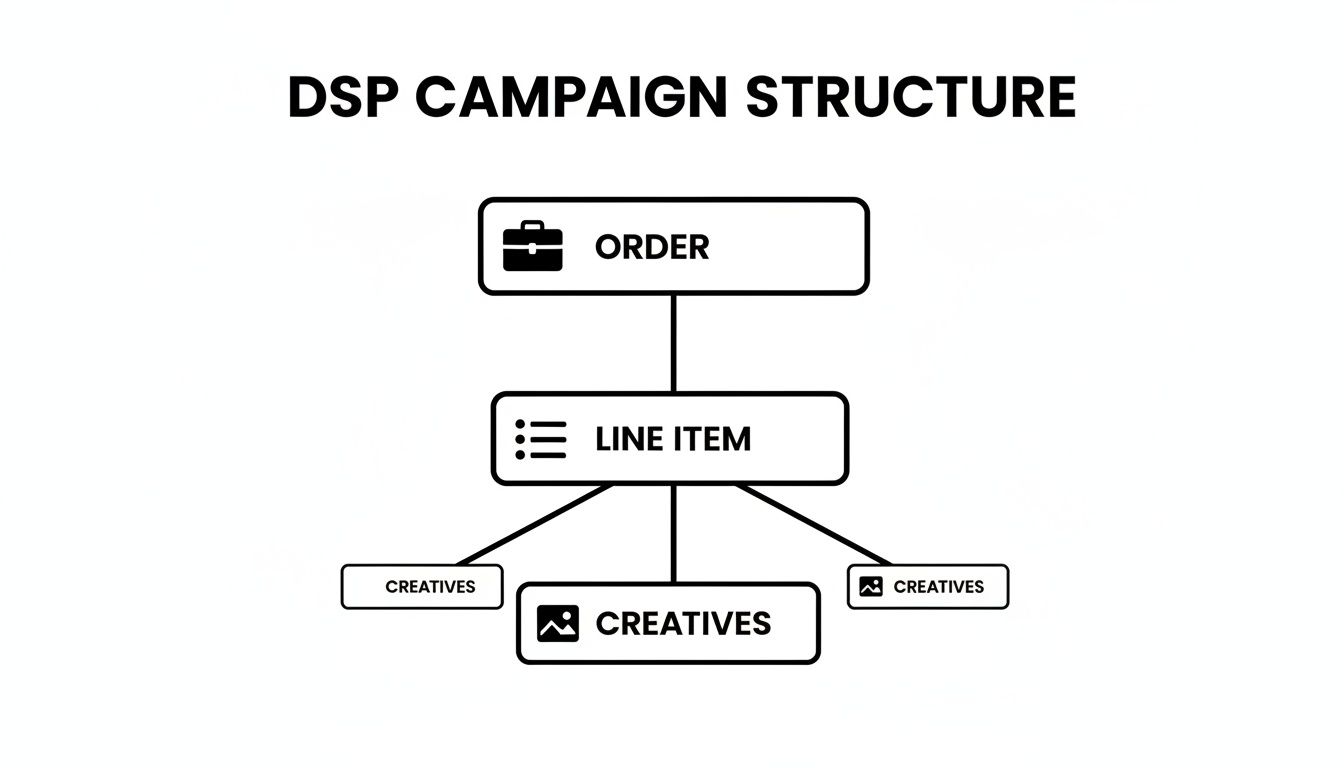
This structure is crucial because it allows you to set specific budgets and goals for different parts of your marketing funnel, whether you're prospecting for new customers or retargeting warm leads.
The metrics that matter in DSP are a world away from the last-click attribution you see in PPC. Sure, immediate sales are great, but the true power of DSP is its ability to influence customers all along their buying journey. You have to start valuing metrics that signal growing brand awareness and consideration.
This means you need to get comfortable with metrics that tell a much bigger story:
Your bidding strategy has to match your campaign goals. If you're running a top-of-funnel awareness play, vCPM (viewable cost per mille) is your best friend—you only pay when your ad is actually seen. But for mid-funnel retargeting, you'll want to use goal-based bidding to optimize for conversions or a specific target ROAS.
Performance benchmarks will also look very different. The average click-through rate for DSP hovers around 0.42%, but ROAS expectations can swing wildly. A well-tuned retargeting campaign can often pull in a 3-5x ROAS. In contrast, a prospecting campaign focused on brand building might only see a 1.5-2.5x ROAS, and that's perfectly okay. If you want to really get to the bottom of this, it's worth digging into different ways of measuring advertising effectiveness to connect your spend to real business outcomes.
The real art of DSP measurement is connecting the dots between your upper-funnel ad spend and the long-term value of a customer. A lower ROAS on a prospecting campaign isn't a failure; it’s the cost of acquiring a new, loyal customer who will buy from you for years to come.
Amazon's recent platform updates are already showing some impressive results. Advertisers using the new Performance+ campaigns have seen their customer acquisition costs improve by 51%, while some using Brand+ are reporting sales lifts over 10% and a 70% jump in website traffic. This all points to one crucial takeaway: success with DSP requires patience and a focus on long-term brand health over chasing short-term, direct-response returns.
Diving into Amazon DSP advertising can feel like unlocking a new level of growth, but it comes with a steep learning curve. Even savvy sellers stumble, making costly mistakes that drain budgets and kill momentum. Knowing what these common pitfalls are ahead of time is the fastest way to get on the right track.
The biggest mistake we see? Treating DSP like just another Sponsored Ads campaign. Brands often bring their search ad mindset to DSP, setting unrealistic Return on Ad Spend (ROAS) goals for top-of-funnel prospecting campaigns. They judge them with the same last-click yardstick they use for their search ads. This just doesn't work. Prospecting isn't about immediate sales; it’s about building an audience you can talk to later.
When you demand a high ROAS from a campaign that’s supposed to be finding new people, you're essentially strangling it before it can even get started. Your targeting becomes way too narrow, and you miss the entire point—building the brand awareness that fuels all your future growth.
Another classic blunder is just grabbing static, product-heavy creative from PPC campaigns and tossing it into dynamic display placements. An ad meant to convert someone actively searching for your product is a completely different beast from one trying to catch the eye of someone scrolling through their favorite news site.
Your DSP creative needs to tell a story and spark a connection. If you use generic, hard-sell ads in an awareness campaign, you'll just get ignored, which hurts both your budget and your brand.
Key Takeaway: Think of your Amazon DSP ads like a conversation. A prospecting ad is your "hello," a friendly introduction. A retargeting ad is the follow-up, a gentle reminder. Getting the message wrong for the audience is like asking for the sale before you've even shaken hands.
Here are a couple more critical mistakes to watch out for:
The fix for all this comes down to good planning and a change in mindset. You have to embrace a full-funnel strategy where every stage has its own job to do and its own way of measuring success.
To keep your campaigns humming, stick to these simple rules:
By sidestepping these common blunders, you can make sure your investment in Amazon DSP advertising is actually working for you—building a stronger brand and a reliable pipeline of future customers.
Even for seasoned sellers, diving into Amazon DSP advertising can feel like learning a new language. It just operates on a different wavelength than Sponsored Ads, which means you need a fresh approach to budgeting, strategy, and even how you think about success.
Let's clear up some of the most common questions we see brands asking before they take the plunge.
While Amazon has become more flexible over the years, the numbers can still feel intimidating. For a managed-service campaign—which I highly recommend for the expert support—you're typically looking at a minimum commitment of around $50,000, often spread over a few months. That number isn't pulled out of thin air; it’s what’s needed to feed the algorithm enough data to start making smart, effective decisions.
If you’re going the self-service route, the barrier to entry is technically lower. But to get any real traction and see results that actually move the needle, a monthly spend of $10,000 to $15,000 is a more realistic starting point. It’s best to think of this as an investment in a powerful brand-building engine, not just another direct-response ad channel.
Absolutely. This is probably one of the biggest misconceptions out there. Amazon DSP can be an incredibly powerful tool for brands that don't even have a single listing on the marketplace.
The setup is pretty straightforward: you simply drive all the traffic from your display and video ads to your own direct-to-consumer (DTC) website. The one non-negotiable step is installing the Amazon Ad Tag on your site. This little piece of code is the key to everything—it lets you build retargeting audiences from your site visitors and, most importantly, track on-site conversions. Without it, you’re flying blind and can’t measure the true ROI of your campaigns.
Patience is the name of the game here. If you're used to the instant feedback loop of Sponsored Ads, where you can see results in a few days, DSP requires a mental shift. This is a long-term, strategic play. It usually takes a good 4-6 weeks for the platform's machine learning to gather enough data and really start dialing in your campaigns.
For your top-of-funnel prospecting campaigns, success isn't measured in days or weeks, but over months. You'll be looking at things like audience growth and engagement metrics. While you might see a quicker sales lift from your retargeting campaigns, the real power of DSP comes from its cumulative effect on your brand’s footprint in the market.
Think of it as planting a tree, not just picking the low-hanging fruit. It's a sustained investment in where your brand will be a year from now.
At Million Dollar Sellers, we see top entrepreneurs master these advanced strategies every day. If you're ready to scale your brand with insights from the best in the business, find out if you qualify for our exclusive community. Learn more at https://milliondollarsellers.com.
Join the Ecom Entrepreneur Community for Vetted 7-9 Figure Ecommerce Founders
Learn MoreYou may also like:
Learn more about our special events!
Check Events


