Chilat Doina
September 16, 2026
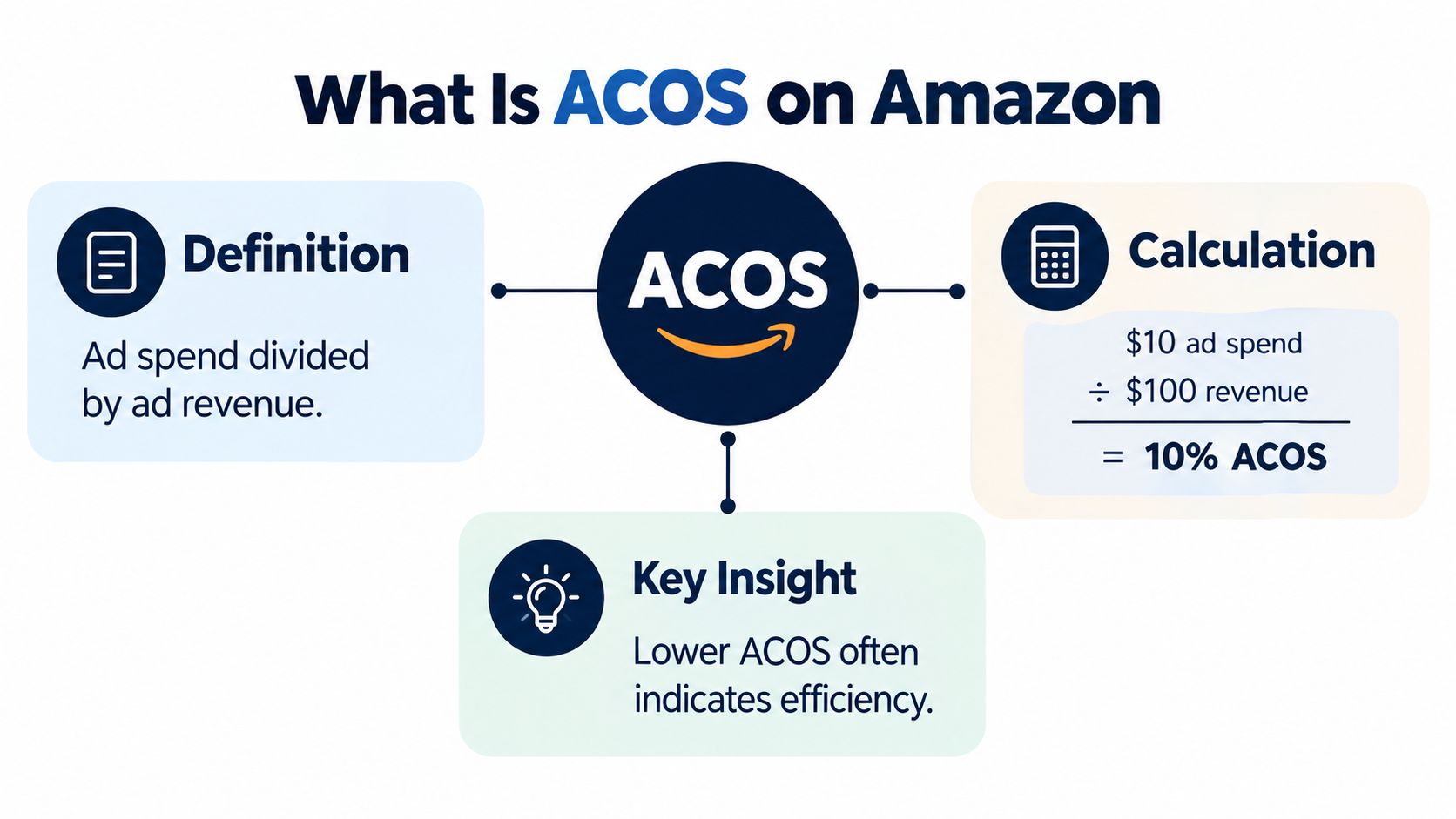
ACOS is ad spend divided by ad revenue, expressed as a percentage. A 20% ACOS means you spent $20 in ads to generate $100 in attributed sales, so it measures campaign efficiency, not complete product profitability.
The most popular Amazon advertising advice is also the most damaging: “Always lower your ACOS.” That rule sounds disciplined, but it can push you to cut profitable visibility, abandon ranking opportunities, and judge a launch campaign by the standards of a mature product.
ACOS on Amazon is useful, but it's only one lens. The right target depends on whether you're launching, expanding, defending market share, or harvesting profit. You also need to watch organic sales, total revenue, margins, conversion rate, and the role your campaigns play in building demand.
The lowest ACOS is not always the best result. Independent benchmark data places launch-phase ACOS commonly between 30% and 60%, while mature campaigns can sit closer to 10% to 25%, according to 2025 Amazon PPC benchmark research. These ranges serve different business objectives. A launch campaign pays for data, visibility, and early sales velocity. A mature campaign should usually capture existing demand more efficiently.
Set the target around the product's lifecycle stage and the account's total economics. Ask, “What level of ACOS supports this product's current objective without damaging profitability or limiting future growth?”
A campaign can report an attractive ACOS while generating too little volume to matter. Cutting bids, removing broad discovery terms, and retaining only branded or proven exact-match keywords may clean up the dashboard while reducing visibility and organic momentum.
Higher ACOS can be the correct choice when you fund non-branded discovery, test competitive terms, or push a new ASIN into a crowded category. If total sales and organic contribution improve, the ratio reflects a deliberate growth investment rather than poor management.
Practical rule: Set an efficiency floor from your margins, then assign a growth budget to campaigns with a defined strategic role.
Break-even economics still set the boundary. Use a break-even ROAS calculation framework to calculate how much advertising your margin can support, then treat that threshold as a guardrail, not the target for every campaign. A product launch, mature hero ASIN, and seasonal defense campaign require different ACOS decisions. Review them by lifecycle stage, total account revenue, organic lift, and contribution margin.
Amazon defines Advertising Cost of Sales, or ACOS, as the relationship between ad spend and ad revenue. The calculation is:
ACOS = ad spend ÷ ad revenue × 100
If you spend $20 and generate $100 in attributed ad sales, your ACOS is 20%. In practical terms, the ratio tells you how much advertising expense was required to produce each dollar of attributed revenue. Amazon explains the metric in its official ACOS advertising guide.
ACOS is a campaign efficiency benchmark, not a full profit-and-loss statement. It uses attributed ad revenue, so it doesn't include:
That's why a low ACOS doesn't automatically mean a product is highly profitable. A seller with thin margins can lose money at a ratio that looks efficient, while a seller with stronger economics may rationally tolerate a higher ratio to build demand.
ACOS also isn't identical across ad formats. For Sponsored Products, Amazon measures ad spend against sales from the promoted products. For Sponsored Brands, the measurement can relate spend to overall brand sales. Compare like with like, or you'll draw the wrong conclusion from a blended dashboard.
A falling ACOS generally indicates improved paid efficiency, but the direction alone isn't enough. Check whether revenue is growing, whether organic sales are holding up, and whether you're buying useful search-term data.
If you're learning the wider advertising system, start with this practical explanation of what PPC means on Amazon. Then connect ACOS to the campaign's role, rather than treating the metric as a standalone verdict.
A benchmark is useful only when it changes your decision. Treating the average ACOS as a universal target will push you to cut profitable growth campaigns and preserve inefficient ones. Recent 2026 Sponsored Products data reports a median ACOS of around 28.2%, with roughly 0.7% CTR, a 6% conversion rate, and ROAS near 3.5, according to this 2026 Amazon advertising benchmark analysis.
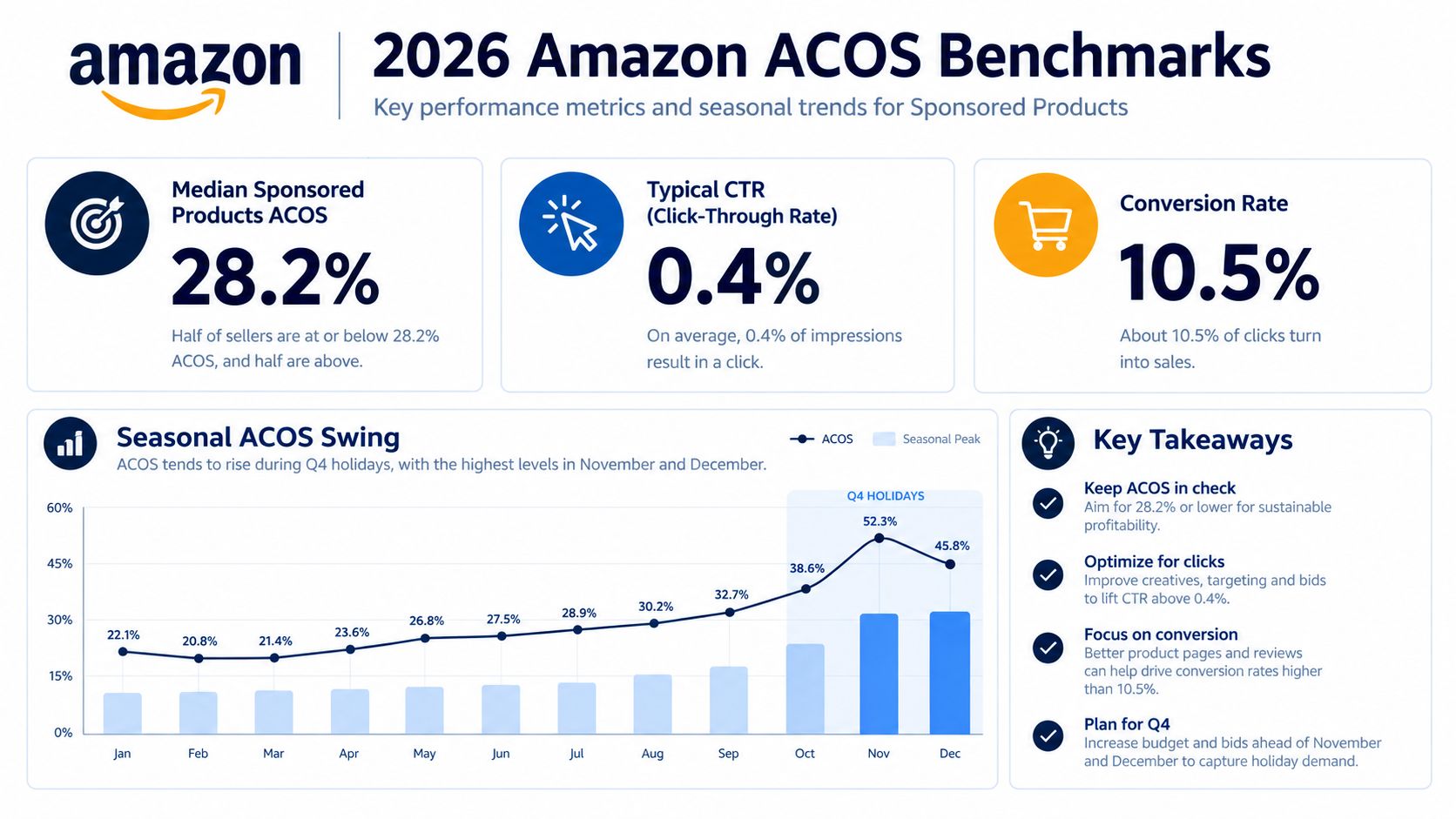
Use those figures as a reference, not a bidding rule. Category economics, product maturity, country, competition, listing quality, and campaign mix can shift your result substantially. A new product with weak conversion should not be judged against a branded campaign with years of sales history. A higher ACOS can be the correct choice during launch or aggressive category expansion if the account economics support it.
Competitive benchmark sets place Sponsored Products ACOS commonly in the 15% to 25% or 20% to 35% range, depending on category and account maturity. CPC often reaches $0.75 to $3.50 or higher. The Sponsored Products benchmark data shows how category competition affects traffic costs.
The relationship is mechanical. If CPC rises while conversion rate stays flat, each order costs more to acquire and ACOS worsens. Raising bids cannot fix that problem by itself. Improve conversion on high-intent searches through stronger listing relevance, better imagery, clearer benefits, competitive pricing, and tighter targeting.
A click is not a win. A relevant click that becomes an order is a win.
A 2026 seller panel study reported an average ACOS of 27.2% over the twelve months through August 2026. Its analysis showed December improving to 23.8% in the United States and 20.2% in the United Kingdom, while other months ran higher. It also reported movement from a January peak of 37.1% to a November low of 22.6%.
Retail demand and ad competition drive those swings. Do not slash bids because January looks inefficient, and do not assume November performance will continue after holiday demand fades. Compare equivalent periods, separate branded from non-branded campaigns, and judge seasonal spend against that month's commercial purpose.
ACOS answers a narrow question: how much ad spend produced attributed ad revenue? TACoS, or Total Advertising Cost of Sales, measures how much of total revenue went to advertising.
That difference changes how you judge growth. Ads can produce attributed orders now while improving visibility, ranking, and organic sales later. ACOS captures the direct ad result. TACoS shows whether advertising is becoming a heavier or lighter burden across the business.
Recent guidance places healthy mature-account TACoS around 5% to 12%, while growth-stage accounts often operate around 12% to 20%, according to Amazon advertising benchmark guidance on TACoS. Use those ranges as review points, then check contribution margin, fees, discounts, and inventory costs before setting a target.
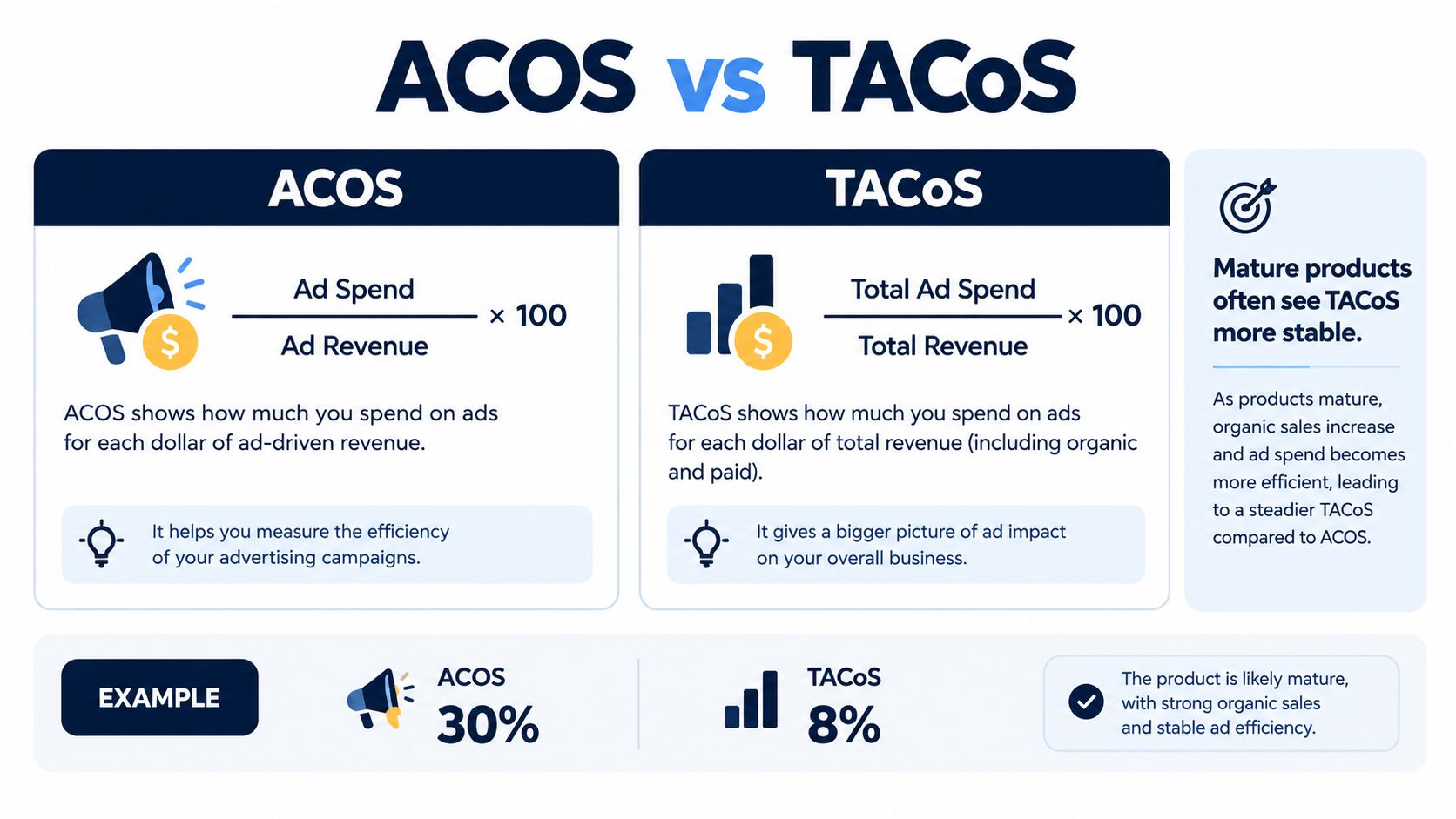
| Metric | Revenue base | Best use |
|---|---|---|
| ACOS | Attributed ad revenue | Campaign and keyword efficiency |
| TACoS | Total revenue | Account-level advertising dependence |
A higher ACOS can be the right decision during expansion. Suppose difficult, non-branded searches raise ACOS, but total revenue grows, organic sales strengthen, and TACoS stays stable or improves. Cutting those campaigns only to restore ACOS would protect a ratio while weakening the account's growth engine.
The warning signal runs in the opposite direction. Stable ACOS alongside rising TACoS and flat total revenue suggests that advertising is replacing organic demand instead of creating incremental sales. Review the listing, ranking, targeting, and product-market fit before adding more budget.
Founders comparing revenue production with advertising cost can also review return on ad spend strategies. ROAS does not replace margin analysis, but it helps compare campaigns by the revenue they generate.
Track both metrics by lifecycle stage, campaign type, and branded versus non-branded demand. A worse ACOS is acceptable when the account is becoming less dependent on ads. A low ACOS means little if the product cannot sell without them.
An acceptable ACOS depends on the product's job today. A launch, an expansion campaign, a mature listing, and a defensive branded campaign should not share one target. Applying a mature-product threshold to a new ASIN forces discovery spend to pay for itself before the listing has enough data to convert efficiently.
Use lifecycle ranges as guardrails, not automatic permission to spend. Launch campaigns often require higher ACOS, while mature campaigns should move toward tighter unit economics. The right question is whether the spend advances the current business objective and has a clear stop or scale condition.
| Lifecycle stage | Primary objective | ACOS posture |
|---|---|---|
| Launch | Generate discovery, sales history, and search-term data | Tolerate higher ACOS when the spend has a defined learning purpose |
| Expansion | Enter new queries, placements, or markets | Accept selective inefficiency where incremental demand is credible |
| Mature | Harvest existing demand and protect profitable volume | Tighten targeting and push toward stronger unit economics |
| Defense | Protect a valuable branded or category position | Judge spend against the revenue and visibility being defended |
A new product needs traffic before it has enough conversion history to win efficiently across every query. Run broader tests, collect search-term evidence, and accept that some spend buys information rather than immediate profit. Set a test budget and define the evidence required to continue, such as relevant queries, improving conversion, or sales that support organic growth. High ACOS alone is not a failure during this stage. Uncontrolled learning spend is.
Give expansion campaigns their own budget and reporting view. Test new queries, placements, or markets without letting exploratory costs distort proven campaign performance. Keep a test running when it produces credible incremental demand, then cut it when clicks accumulate without stronger sales or useful search-term evidence.
Mature products have more conversion history and proven search terms, so waste deserves less tolerance. Move converting terms into tighter structures, protect profitable placements, and reduce exposure where clicks repeatedly fail to produce attributed sales. A lower ACOS is useful here only when it supports profitable volume rather than shrinking reach.
Defensive spend protects branded demand and valuable category positions. Judge it against the revenue and visibility at risk, not ACOS alone. Market, quarter, and product stage can change the target, so set thresholds by lifecycle, market, and objective together.
High ACOS rarely comes from bids alone. It usually reflects a mismatch between traffic cost, shopper intent, and conversion strength. A rising CPC becomes expensive when the listing cannot convert the clicks it attracts. Diagnose that gap before cutting bids across the account.
Use ACOS as a symptom, not a verdict. A costly click on a high-converting term may support profitable growth, while a cheaper click from weak intent can waste budget. Start by identifying where spend grows faster than orders.
Export the search-term report and sort for spend without attributed sales. Inspect the actual queries, not only the parent keyword. A target can appear healthy while its search-term variations reveal poor intent or weak relevance.
Then compare CPC, conversion rate, and order value by campaign, placement, and match type. High CPC with healthy conversion can indicate a valuable term that deserves controlled exposure. High CPC with weak conversion points to poor relevance, weak creative, or an offer problem. Clicks without detail-page conversions mean the listing needs attention before advertising receives another budget cut.
Check whether the issue is isolated or systemic. If one placement, query group, or product variation drives the waste, apply a targeted correction. Broad bid cuts can suppress profitable demand while leaving the source of leakage untouched. Review the search-term report weekly and turn repeated waste into negatives, tighter targeting, or a listing test.
ACOS is a steering metric, not a verdict on account health. Review it alongside TACoS, total revenue, organic contribution, and lifecycle stage. A launch campaign can justify a higher ACOS while it builds demand. A mature campaign should earn tighter control.
Make each campaign answerable to a clear job. Record its lifecycle stage, objective, budget role, priority search terms, conversion behavior, and current ACOS. Then choose one action: scale, isolate, optimize, or stop. This prevents a single account-wide target from forcing the wrong decision on every campaign.
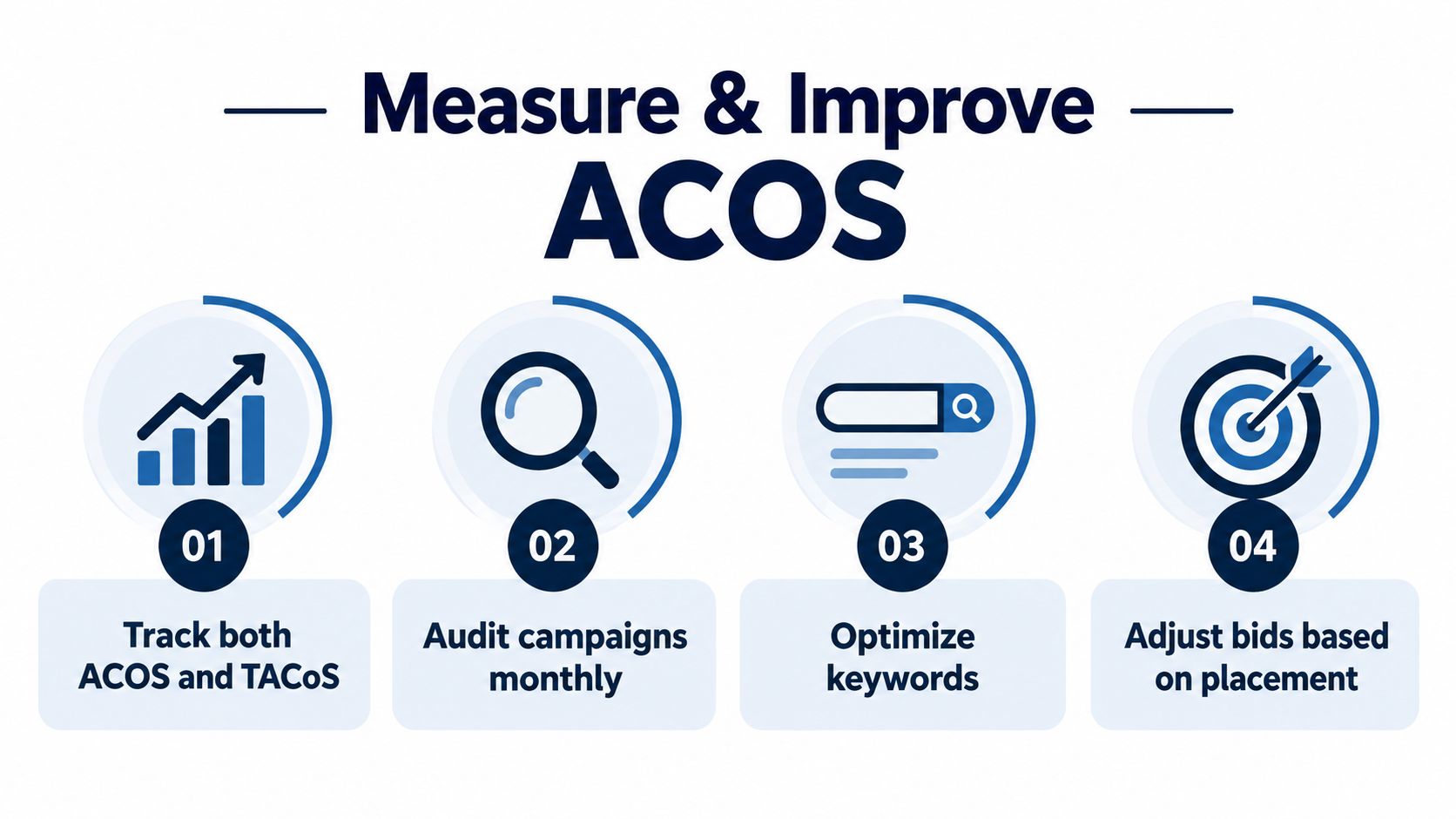
Use this guide to Amazon advertising optimization for a deeper operating process. Make one meaningful change at a time, record the reason, and give the account enough clean data to judge the result.
Rising CPCs make conversion improvement more valuable than reflexive bid reduction. Competitive auctions can push acceptable ACOS higher, so judge the number against margin, campaign purpose, and account-level growth rather than treating a lower ratio as automatic success.
ACOS on Amazon is a useful operating metric, but it isn't your business model. It measures the cost of attributed ad revenue. It doesn't tell you whether organic sales are growing, whether the product is profitable after all costs, or whether a launch campaign is building a stronger position.
Use a lifecycle framework. Give launch and expansion campaigns room to gather demand and data, then demand tighter control from mature campaigns. Review ACOS with TACoS, total revenue, organic contribution, and the campaign's strategic purpose.
Use benchmarks as context, not commandments. The recent data puts Sponsored Products median ACOS around 28.2%, while seller-panel results show meaningful seasonal movement, so an account that looks weak in one period may be operating under different demand and auction conditions. Category, market, season, margin, and maturity still determine whether the number is acceptable.
The best optimization sequence is also clear. Fix relevance, improve conversion, remove wasted queries, isolate campaign roles, and then adjust bids. Don't sacrifice profitable growth to make one dashboard ratio look attractive.
Treat advertising as an investment with a job to perform. When the job is clear and the measurement is broad enough, a higher ACOS can be a rational growth decision, while a lower ACOS can expose a business that's losing momentum.
Million Dollar Sellers gives serious e-commerce founders access to a trusted peer network, strategic discussions, and practical insight from operators scaling at the highest level. Visit Million Dollar Sellers to learn how the community can help you make sharper advertising and growth decisions.
Join the Ecom Entrepreneur Community for Vetted 7-9 Figure Ecommerce Founders
Learn MoreYou may also like:
Learn more about our special events!
Check Events


