Chilat Doina
January 11, 2026
For an 8-figure ecommerce brand, your CRM isn't just another tool—it's the absolute core of your operation. Forget simple contact management. At this level, it becomes the single source of truth for the metrics that actually matter: LTV, CAC, and repeat purchase rates across every single one of your sales channels.

Once your brand blows past the seven-figure mark, complexity skyrockets. You're not just running a Shopify store anymore. You're trying to conduct an orchestra of sales channels, marketing platforms, and customer support tools, and it gets messy fast.
This is where a heavy-hitting CRM becomes completely non-negotiable. It stops being a "nice-to-have" and turns into the most important infrastructure decision you'll make. Its main job? To wrangle all your disconnected data streams into one, unified customer view that you can actually use.
Without that central hub, your customer data is all over the place. Shopify has order history, Klaviyo knows about email clicks, Gorgias holds the support tickets, and Amazon keeps its data locked down in its own little world. This kind of fragmentation makes it impossible to confidently answer even the most basic questions about your business.
A modern ecommerce CRM fixes this by building what's called a unified customer graph. It pulls data from all those sources to create one complete, 360-degree profile for every customer, letting you see their entire journey from start to finish.
A unified customer view isn't just about better marketing. It's about operational clarity. It allows you to accurately model predictable revenue, defend your margins, and make strategic decisions based on a single source of truth rather than fragmented spreadsheets.
With everything in one place, you can finally calculate and track the KPIs that drive long-term growth. No more guessing. You get precise measurements across your entire business.
This move toward a data-first approach isn't just a trend; it's a fundamental shift. The global CRM software market is expected to blow past $112 billion in 2025 and is on a trajectory to hit somewhere around $262–$263 billion by 2032. For top operators today, the best CRM is the one that gives them a real-time, crystal-clear view of these critical growth metrics.
Getting a handle on these numbers is foundational. For a deeper look at one of the most vital metrics, check out our guide on how to master your customer lifetime value calculation. This unified data becomes the engine for powerful segmentation and predictable revenue modeling, turning your CRM into a true growth system.
To find the right CRM for your ecommerce brand, you first have to understand the players on the field. The market isn't just a simple list of tools; it’s a landscape of distinct categories, each built with a specific type of business in mind. Picking the right one means matching a platform’s core philosophy to your brand’s operational complexity and growth goals.
For most high-growth ecommerce brands, these platforms fall into three strategic tiers. Getting a handle on these categories gives you the context you need to decide if an all-in-one giant or a specialized tool is the right fit.
At the top, you have the enterprise titans like Salesforce. These platforms are built for ultimate customizability and designed to manage immense complexity across multiple channels, business units, and international markets. Think of them less as a plug-and-play tool and more as a foundational operating system for your entire business.
Their real power lies in creating deeply customized data models that can pull together information from DTC storefronts, Amazon, physical retail, and B2B sales channels into a single, cohesive view. But this power comes at a cost—complexity. You'll need to invest heavily in implementation and have the technical expertise on hand to manage it effectively.
Next up are the growth-focused platforms, with HubSpot being a prime example. These systems are fantastic at aligning marketing, sales, and service functions under one roof, making them a strong choice for DTC brands that are scaling aggressively. Their interfaces are generally much more user-friendly, and they focus on providing powerful automation and reporting right out of the box.
This category is ideal for brands whose biggest challenge is scaling their marketing and sales efforts efficiently. While they integrate well with ecommerce platforms, they might not have the deep, native ecommerce functionalities you’d get from more specialized tools.
The interface below shows a typical sales pipeline view within a powerful CRM, designed for managing deals and opportunities.
This kind of visualization really highlights how enterprise-level CRMs give you granular control over every single stage of the customer lifecycle.
Finally, we have the ecommerce-native specialists like Drip or Klaviyo. These platforms are built from the ground up with one goal: to serve ecommerce businesses. Their main advantage is a deep, seamless integration with platforms like Shopify, which lets them pull in rich customer and order data automatically.
These tools are masters of email and SMS automation triggered by specific ecommerce events, like abandoned carts or first-time purchases. Their focus is laser-sharp, but they often lack the broader sales pipeline management or service features you'd find in the other categories.
The market data shows a clear hierarchy, but the best CRM for ecommerce is the one that maps to a brand’s unique channel mix. While Salesforce dominates with a 23.9% global market share, making it a go-to for 8- and 9-figure omnichannel brands, powerful alternatives are gaining serious ground. Competitors like Microsoft Dynamics 365, which saw 23% revenue growth, are proving that specialized needs often demand specialized solutions. Discover more insights about CRM market trends.
Once your brand hits the 8-figure mark, picking a CRM isn't about ticking off feature boxes. It’s about a brutally honest, task-based analysis. You're past wondering if a platform has a feature; you need to know how well it performs the specific, high-stakes jobs your business depends on every single day. Generic pro/con lists are useless here. It's time to get under the hood and see how these systems handle real-world ecommerce chaos.
This isn't a theoretical exercise. We're going to compare the non-negotiable functions for any scaling brand, looking at how the top platforms execute critical tasks side-by-side. This is about getting a clear picture of their true capabilities, not just their marketing promises.
The absolute foundation of a powerful ecommerce CRM is how flawlessly it syncs data with your sales channels. For a scaling brand, this means way more than just grabbing a customer's name and email after a purchase. The real value—and the real differentiator—is in the granularity and real-time accuracy of that data sync.
Think about a common, everyday headache: a customer places an order, realizes they fat-fingered the size, and your support team issues a partial refund before the item ships. How does your CRM handle that?
The gold standard is a CRM that treats every single order event—partial fulfillment, exchange, refund, store credit—as its own distinct, reportable data point. If it doesn't, your segmentation and LTV models are built on a foundation of sand.
To make sense of the options, it helps to see a direct comparison of how these platforms handle the ecommerce functionalities that really matter. This matrix cuts through the noise and shows you where each type of CRM shines—and where it falls short—for your day-to-day operations.
This matrix highlights a key tradeoff: enterprise systems offer unparalleled depth at the cost of complexity, while ecommerce-native tools provide incredible ease-of-use for marketing automation but may lack the all-encompassing data model your operations team needs as you scale.
Once that data is flowing cleanly, the next job is putting it to work with segmentation. For an 8-figure seller, basic lists like "customers who bought product X" are child's play. The real profit comes from creating dynamic, behavior-driven audiences that trigger hyper-relevant automated flows.
Let's look at a sophisticated win-back campaign: targeting high-value customers who haven't bought in 90 days but recently browsed a specific product category.
Customer retention is the engine of profitable scaling, and your CRM needs to be the command center for it. Some platforms come with native loyalty programs, while others force you to use third-party tools. This is a massive difference in both cost and day-to-day efficiency.
A built-in loyalty engine lets you seamlessly segment customers by their VIP tier or point balance and drop that info right into your marketing. For example, you can create an email that shows a customer they are only 50 points away from their next reward. Simple, powerful, and effective.
When you're stuck with a third-party tool, you're in a constant state of syncing data back and forth. This creates delays. A customer who just earned VIP status might not get added to the right segment for hours, meaning they miss the timely, exclusive offer you sent out. It’s a small friction point that adds up to a clunky customer experience.
Finally, every customer support ticket is a goldmine of data. A top-tier CRM has to plug directly into helpdesks like Gorgias or Zendesk to merge this information with a customer's purchase history. This gives you the complete customer story, arming both your marketing and support teams with the context they need.
Imagine a customer has sent three support tickets this month about a defective product.
This kind of cross-departmental coordination is the hallmark of a mature tech stack. To see how this fits into the bigger picture, our guide on building an omnichannel retail strategy explains how to connect all these touchpoints. When you're choosing the best crm for ecommerce, remember that the quality of these integrations is every bit as important as the platform's core features.
Let's get one thing straight: the best crm for ecommerce isn't a one-size-fits-all product. It's a strategic decision. Your business model, how complex your operations are, and where you are in your growth journey will determine which platform becomes a genuine growth engine versus an expensive, clunky roadblock.
The single most critical factor is your brand’s trajectory. A direct-to-consumer (DTC) brand grinding its way from seven to eight figures has entirely different needs than an established omnichannel seller juggling inventory across Shopify, Amazon, and brick-and-mortar stores. Getting this choice right means matching your real-world problems to a platform’s core strengths.
This decision tree gives you a visual guide to the core questions you should be asking yourself.
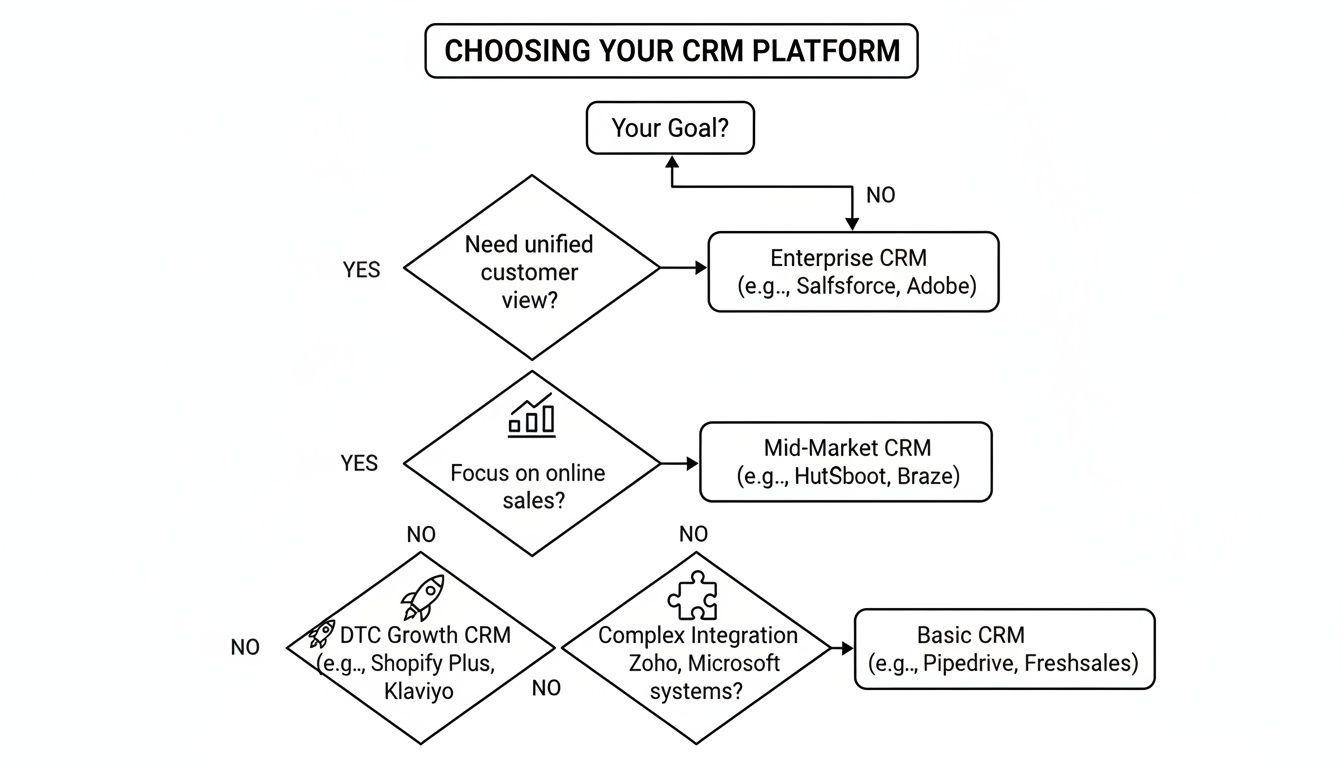
Ultimately, your choice boils down to what your biggest headache is right now. Is it scaling your DTC marketing, wrangling data from multiple channels, or getting a deeper integration with your specialized tech stack?
When you're in that rapid growth phase, the main challenge is keeping your marketing, sales, and support teams aligned. You need to create a seamless customer experience without getting drowned in technical debt. You need power, but you also need a tool that your team can actually use without a dedicated dev on standby.
This is where a growth-focused platform like HubSpot really shines. It delivers robust automation inside a unified interface that your whole team can get up to speed on relatively quickly.
Why It Works
The Tradeoff: HubSpot isn’t built from the ground up for ecommerce. Critical functions like loyalty programs or advanced subscription management will depend on third-party app integrations. Be prepared for the occasional data sync delay or workflow hiccup.
Once you're managing serious volume across your own site and marketplaces like Amazon, the CRM game changes completely. Your biggest problem is no longer marketing automation; it’s data chaos. You need one system to pull everything together and create a single source of truth for every customer, no matter where they shop.
This is where an enterprise titan like Salesforce becomes a strategic asset, not overkill. Its infamous complexity is precisely what allows it to map to the messy reality of a modern omnichannel brand.
Why It Works
The Tradeoff: Don’t underestimate the commitment. Salesforce is a significant investment in both time and money. Implementation is a specialized skill, and you'll need dedicated internal resources to manage it long-term. It's less of a tool and more of an operating system for your business.
If recurring revenue is your lifeblood, your CRM needs to be obsessed with retention. Forget fancy lead scoring; you need features that help you understand customer health, predict who's about to cancel, and automate the painful process of dunning and recovering failed payments.
While most CRMs can integrate with subscription tools, a platform with a heavy focus on retention metrics is your best bet. You should be looking for a system that can natively track Monthly Recurring Revenue (MRR), churn rate, and customer lifetime value in a subscription context.
Why It Works
The Tradeoff: Platforms that specialize in subscriptions might be weaker in other areas, like traditional sales pipeline management or broad marketing automation. You may end up needing to integrate them with other tools to get the best of both worlds.
It’s one thing to pick a CRM that solves your problems right now. It's a completely different ballgame to pick one that anticipates the challenges you’ll face two years from now. That’s where AI and automation come in, turning your CRM from a simple database into the brain of your growth strategy. And this isn't some far-off fantasy; it's happening as we speak.
The best platforms are already moving past simple, trigger-based workflows. They're using AI to spot opportunities and manage customer relationships at a scale that's flat-out impossible for a human team. You’re not just investing in software; you're investing in a long-term competitive edge.
We're seeing a massive shift from looking at past data to predicting future behavior. A basic CRM tells you a customer's lifetime value (LTV) so far. An AI-driven CRM predicts what their LTV will be, often based on just a few initial interactions or browsing habits.
That single capability changes everything. You can stop waiting for customers to prove their loyalty and start rolling out the red carpet for your future VIPs from day one.
Keep an eye out for these key AI applications:
The best CRM for ecommerce is quickly becoming the one that can translate data into foresight. The global AI in CRM market is projected to hit $11.04 billion in 2025 and soar toward $48.4 billion by 2033. This isn't a trend; it's the new standard.
Ecommerce automation used to just mean sending an abandoned cart email. Now, we’re talking about building entire customer journeys that twist and turn based on real-time behavior. The goal is to make every single interaction feel timely and personal, even when you're managing tens of thousands of them.
Think of it as building systems, not just one-off campaigns. A modern post-purchase flow, for example, can do so much more than just ask for a review. It can send tips on using the product, suggest the perfect add-on a month later, and even spot signals of buyer's remorse to get ahead of a potential return.
To really be prepared for the future, your CRM needs to pull in insights from other AI developments in ecommerce, like those powering AI for fashion and visual shopping experiences. This kind of external data gives a smart CRM even more fuel to perfect its personalization engine.
This is exactly why your choice of platform is so critical. You need a powerful workflow builder that can handle complex logic, connect to your other tools, and run long-term sequences without breaking a sweat. For more on this, check out our guide on the top AI tools for ecommerce. This level of automation is what separates the good brands from the ones people never forget.

Choosing the best CRM for ecommerce is only half the battle. The real work—and where things can go wrong—starts with implementation. A rushed or disorganized rollout will absolutely torpedo your investment before you see a single dollar of ROI.
This checklist isn't just a series of steps; it's a strategic framework to de-risk the process and ensure you actually get what you paid for.
First things first: audit your data. Before you even think about migrating a single contact, you need to get your house in order. That means diving into your existing data from platforms like Shopify or Klaviyo and ruthlessly cleaning it up. Correct formatting errors, merge duplicate profiles, and archive irrelevant contacts. Migrating garbage just gives you a more expensive, powerful garbage can.
Next, get crystal clear on your core data properties. What specific information do you actually need to sync for the kind of segmentation that moves the needle? This goes way beyond standard fields like first_name and email. Think about custom properties like first_product_purchased or LTV_tier. Map these out meticulously before you start.
Whatever you do, avoid a "big-bang" launch. It’s a recipe for disaster. A phased rollout is infinitely safer and more effective. Start small. Pick one department—customer service is often a great pilot group—and get them live first. This approach lets you squash integration bugs and workflow kinks in a controlled environment before they can wreak havoc across the entire company.
Once your pilot group is up and running, your entire focus pivots to validation.
The goal isn't just to launch a new tool; it's to drive adoption. If your team doesn't understand the 'why' behind the switch and how it makes their jobs easier, they will inevitably revert to old habits and spreadsheets.
Finally, you need to invest heavily in team training. Don't just show them where the buttons are. Explain the strategy behind the CRM. Show them how a single, unified customer view helps everyone—from marketing to support—make smarter, faster decisions. Giving them that context is the key to getting real buy-in and unlocking the platform's value from day one.
Diving into the world of ecommerce CRMs always kicks up a few questions. I've heard these from countless founders, so let's get you some straight answers to help you lock in this critical piece of your tech stack.
For a brand hitting that $5M to $10M revenue mark, you should be thinking in the ballpark of 1% to 3% of your annual revenue for a CRM. So, a $5M brand is looking at a budget between $50,000 and $150,000 a year. This number needs to cover everything—licensing fees, implementation help, and any must-have third-party apps.
And don't get tunnel vision on the monthly subscription price. Think about the total cost of ownership. That includes the hours your own team will spend managing the system. A platform that looks cheap on paper might end up costing you a fortune in developer time just to keep it running.
Yes, but it’s not magic. A CRM won’t directly slash your ad spend, but it makes every single dollar you do spend work harder by jacking up your customer lifetime value (LTV). When you get better at retention, you don’t have to constantly chase new customers just to hit your revenue targets.
A great ecommerce CRM flips the script from expensive acquisition to profitable retention. You use its data to drive up repeat purchase rates and average order value, creating a much more sustainable and profitable growth engine that isn't so reliant on paid ads.
The single biggest mistake I see is picking a platform based on a giant feature list instead of how your team actually works. A CRM with a thousand features is totally useless if your team only ever touches ten of them because the rest are too confusing or just don't fit their day-to-day.
Before you even book a single demo, map out your most important workflows.
Find the platform that solves these real-world problems in the cleanest, simplest way. When you prioritize your operational reality over a bloated feature set, you end up with a tool that people actually use and that delivers a real return.
At Million Dollar Sellers, we know that the right systems are crucial for scaling past eight figures. Our exclusive community connects you with top ecommerce entrepreneurs who have navigated these exact challenges. Learn more about how MDS helps you scale smarter.
Join the Ecom Entrepreneur Community for Vetted 7-9 Figure Ecommerce Founders
Learn MoreYou may also like:
Learn more about our special events!
Check Events


.webp)