
Chilat Doina
August 22, 2026
You log in expecting an ordinary morning and find a cluster of one-star reviews, a complaint spreading through a social thread, and a product-safety claim you've never seen before. Your support team is answering questions one by one, your advertising is still running, and nobody can tell whether the issue is a genuine product problem, a fulfillment failure, or a coordinated attack.
That's the operating reality of brand reputation management for e-commerce sellers. Reputation isn't confined to public relations. It lives in Amazon review sections, Google results, Reddit discussions, customer-service exchanges, creator videos, and increasingly, AI-generated summaries that may shape a buyer's opinion before they reach your product page.
A reputation issue rarely stays in one channel. An Amazon seller may see several reviews mention a broken component, while a DTC brand faces a post claiming that support ignored a refund request. Both signals require operational investigation before anyone drafts a public reply.
Brand reputation management is the operating system for how buyers perceive and evaluate a company across public and private touchpoints. It covers monitoring customer conversations, identifying the operational causes behind complaints, responding in ways that build confidence, and publishing accurate information that makes the brand's strengths easier to find.
The work extends beyond polished responses. Teams may need to inspect inventory, fulfillment records, product instructions, support tickets, and the language customers use to describe a failure. A recurring review theme can point to a product defect, unclear expectations, a shipping problem, or an inaccurate claim. Each cause calls for a different owner and remedy.

A useful reputation program connects four jobs:
This separates reactive damage control from proactive reputation architecture. Damage control starts after a threat appears. Reputation architecture makes accurate information, reliable service, and authentic customer experiences visible before a crisis tests the brand.
Online reviews show why both functions matter. In a 2016 Pew Research Center survey, 82% of U.S. adults said they at least sometimes read online ratings or reviews before buying something new, while 40% said they always or almost always do so. The same source reported that 51% of review readers believed reviews generally gave an accurate picture of product quality, while 48% found it often difficult to judge whether reviews were truthful and unbiased (Pew review behavior data). Buyers seek customer evidence, then assess whether that evidence deserves trust.
That makes reputation a manageable business asset rather than an abstract public-relations concern. Assign owners, define escalation rules, track recurring patterns, and connect feedback to changes in product, service, merchandising, and communication.
Practical rule: Treat every public complaint as both a customer issue and a message to future buyers.
A product can lose sales before a shopper reaches the detail page. On Amazon, a listing with strong images and competitive advertising may still see weak click-through when its rating is lower than nearby offers or recent reviews repeatedly mention damaged packaging. Buyers scan the visible evidence first, then decide whether the product deserves further attention.
Reviews affect revenue by changing perceived purchase risk. Shoppers cannot directly inspect your warehouse, quality-control process, or support queue. They infer reliability from star ratings, review detail, recency, volume, response quality, and consistency across marketplaces, social channels, and your own site.
Customer evidence often carries more immediate weight during a buying decision than formal assurances. Pew Research data on review confidence found that 46% of Americans said ratings and reviews help consumers feel confident about purchases “a lot,” compared with 25% who said government regulations help a lot (Pew Research data on review confidence). Reviews do not replace compliance or product quality. They influence whether shoppers believe those foundations are working in practice.
A 2024 survey cited in industry review research found that 54% of consumers trusted online reviews first, ahead of friends and family at 24%, company claims at 18%, and social media influencers and media reviews at 2% each (consumer trust trends in online reviews). The same research reported that 77% considered online reviews mostly trustworthy. For operators, the implication is direct: review collection, complaint handling, and product fixes belong in the same operating loop.
On Amazon, review quality can determine whether a shopper clicks from search, compares your offer seriously, and completes checkout after reading objections. Recurring complaints about fit, missing parts, delivery, or packaging create friction that advertising cannot reliably overcome. A sudden cluster of similar complaints can also signal a fulfillment or product issue that should be investigated before the next campaign increases traffic.
On a DTC site, the same signals appear in product-page testimonials, review widgets, creator content, support transcripts, and branded search results. A paid visitor may arrive ready to buy, then look for proof that the product works for people with similar needs and that the company responds when something goes wrong. The customer experience and the public record reinforce each other.
A 2025 review-based study found that review valence, average star rating, review volume, informativeness, and perceived authenticity can increase consumer trust, with trust mediating the relationship between review evidence and purchase intention (research on review authenticity and purchase intention). Raising the average rating alone is therefore an incomplete goal. A smaller set of detailed, credible reviews may answer objections better than a larger collection of vague praise.
| Trust Signal | Consumer Behavior | Impact on Purchase |
|---|---|---|
| Review valence | Buyers assess whether experiences are broadly positive or negative. | Shapes perceived product risk. |
| Average star rating | Shoppers use the score as a fast comparison shortcut. | Influences initial confidence and click intent. |
| Review volume | Buyers look for evidence that the product has been used by others. | Provides context for the rating. |
| Informativeness | Detailed reviews answer questions about use, fit, durability, and delivery. | Reduces uncertainty before checkout. |
| Authenticity | Readers examine whether feedback appears balanced and credible. | Determines whether social proof is trusted. |
For budgeting, treat reputation as a conversion system. A practical brand equity measurement framework can connect perception signals to commercial outcomes, while the operating team identifies the complaints and trust barriers affecting each channel.
A reputation dashboard should drive an assigned action, not collect attractive charts. Break results out by marketplace, product, market, and issue type. A stable blended rating can conceal a serious defect or service failure in one high-volume SKU.
Track these measures:
Set thresholds from your own baseline. A rating decline, repeated complaint across platforms, sharp growth in refund requests, or negative thread with unusual engagement should create an assigned review task. Avoid copying another seller's threshold. A mature category and a new product with limited review history need different escalation rules.
A practical stack can combine marketplace notifications, Google Alerts, social listening, and a shared issue log. Larger teams may add Brandwatch, Sprout Social, Talkwalker, Meltwater, or Brand24. Automated sentiment classification can sort high-volume mentions, while a person verifies sarcasm, product names, quoted claims, and AI-generated misinformation before escalation.
Every alert should carry the source, timestamp, author context, available reach or engagement, issue category, owner, and next action. Without those fields, monitoring produces a queue rather than an operating system.
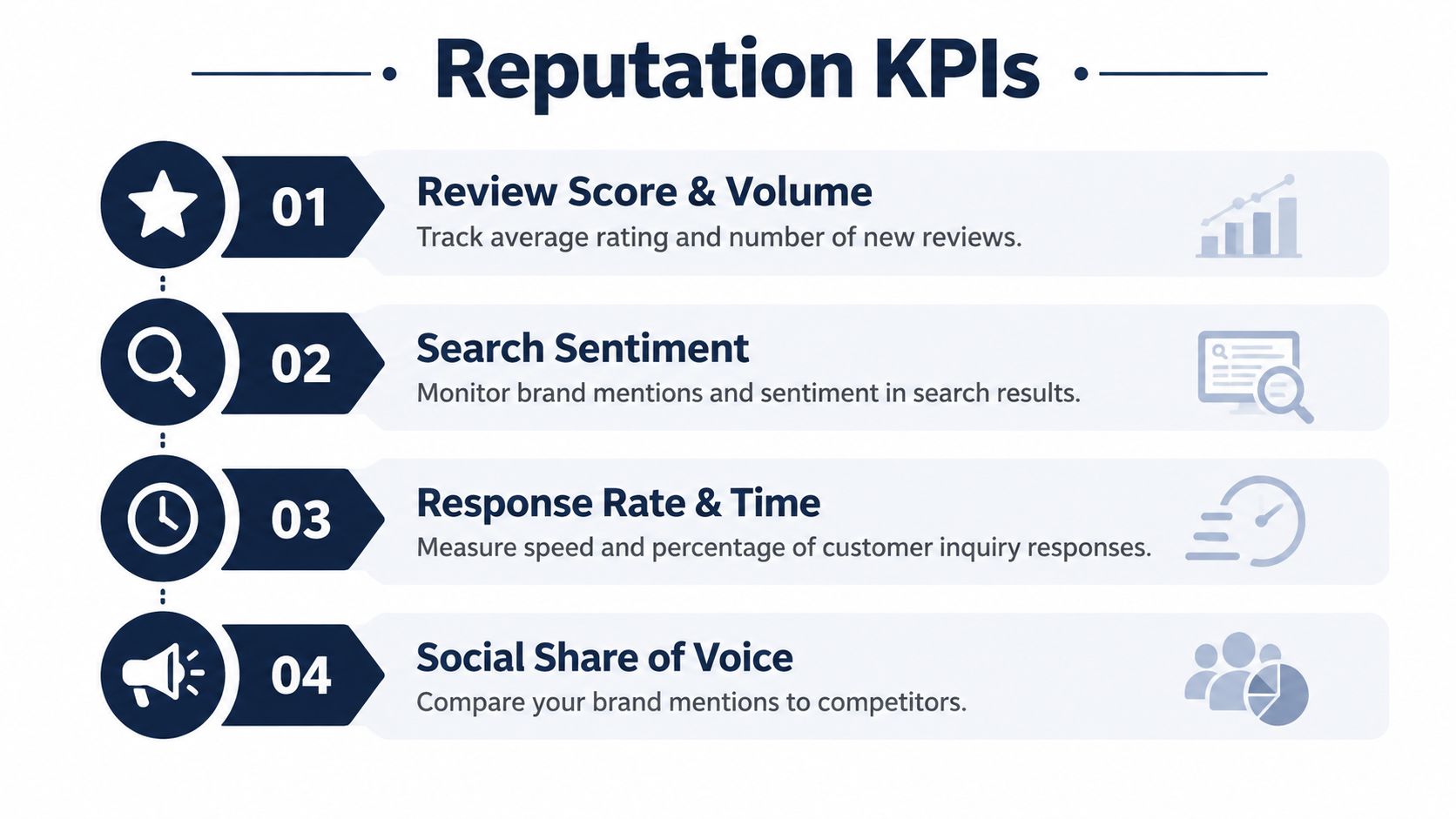
Use different review cadences. Check urgent mentions and fresh marketplace reviews daily. Inspect themes, threshold breaches, and response performance weekly. Run a broader branded-search and sentiment audit monthly. The dashboard proves its value when recurring signals change a product page, packaging insert, supplier requirement, support macro, or crisis-response decision.
Proactive reputation work starts with operations buyers can verify. Product quality, useful information, and dependable service must appear consistently across reviews, listings, support conversations, and public discussions. Treat these channels as one system, because a misleading claim can spread faster when the brand's own information is incomplete or inconsistent.
Use compliant post-purchase flows to request honest reviews. On Amazon, use approved communication tools and follow marketplace policies. On DTC, a delivery follow-up, product-use guide, or customer-success check-in creates a natural opportunity to ask for feedback. Keep the request neutral. Never condition support on a positive review or offer an incentive for changing one.
A strong program captures structured feedback before and after publication. If buyers repeatedly report confusing setup instructions, support can identify the pattern while there is still time to help. Route those findings to product, content, and operations owners. Reviews should influence packaging, instructions, inventory decisions, and support macros, rather than sit unused inside a marketplace dashboard.
Owned content should answer questions that third-party conversations raise repeatedly. Publish comparison guidance, setup instructions, care information, return policies, sourcing details, and product limitations. Demonstration videos and customer testimonials can clarify concerns that a short product description leaves unresolved.
Check those claims against marketplace listings, packaging, customer-service replies, social profiles, and AI-generated summaries. A single outdated specification can create doubt across several channels. Assign an owner to review high-risk claims when products, suppliers, policies, or positioning change.
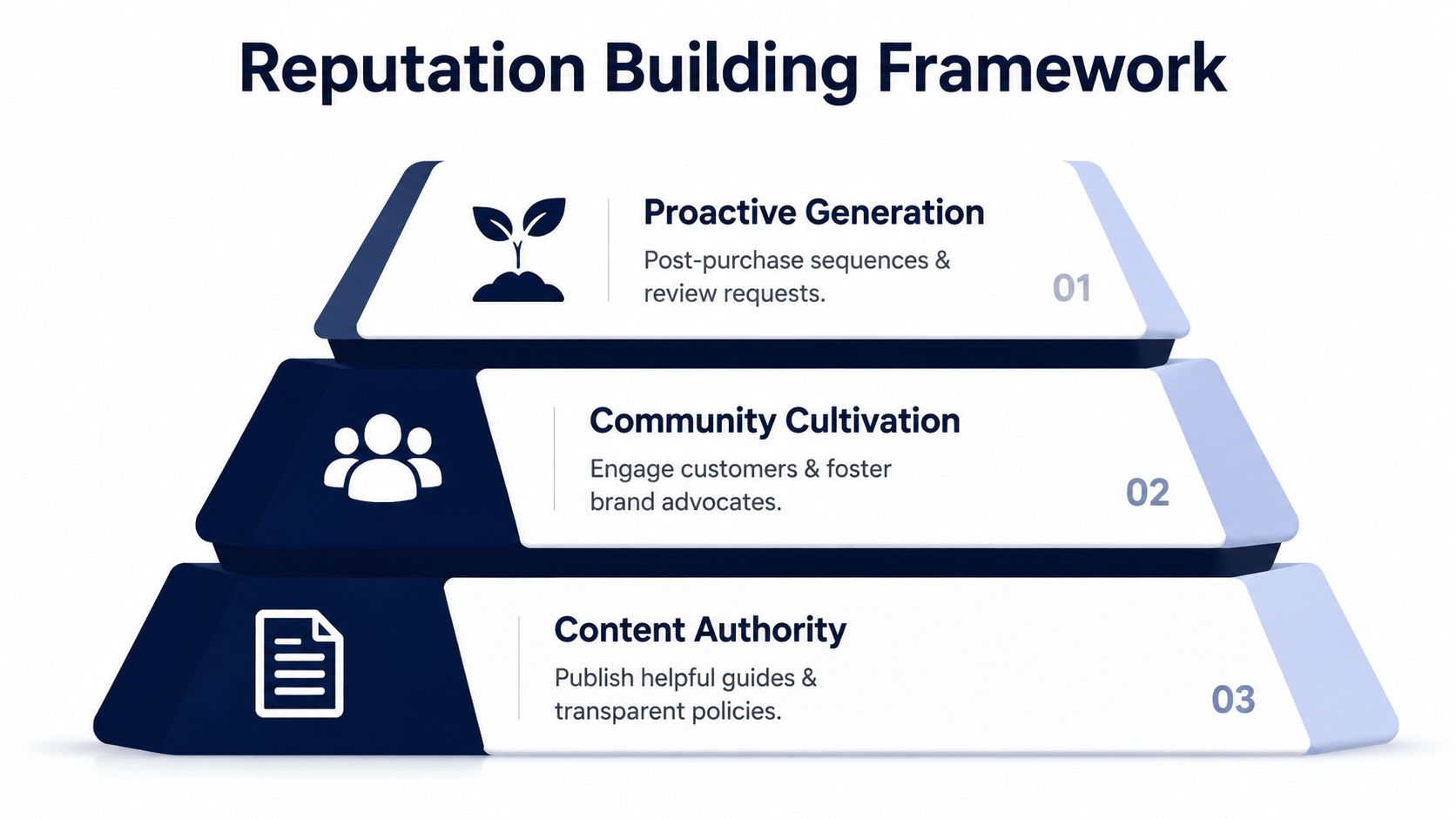
Reddit, Quora, specialist forums, and creator communities expose objections before they become formal reviews. Participate transparently, identify the company connection when relevant, answer the question asked, and provide evidence without turning every exchange into a sales pitch. Track recurring questions so content and product teams can address the underlying confusion.
Customer service completes the loop. A public reply should acknowledge the experience, explain the next step, and move order details into a private channel. After resolution, ask whether the customer wants to update the review, without pressure.
The goal is durable authority, supported by useful proof rather than a wall of praise. Guidance on building brand authority through useful proof can help structure that content, provided every claim stays accurate and customer-centered.
A negative review starts spreading across Amazon, social media, and support tickets. The team cannot choose a credible response until it knows what happened. Classify the incident first: is the brand responsible, partly responsible, accidentally involved, or being targeted with false information?
A Kansas State University study on crisis-response strategy effectiveness found that response strategy affects organizational reputation, with rebuild-style responses generally better suited to preventable crises and diminish-style responses more appropriate for accidental crises. Match the response to the level of responsibility buyers assign to the brand.
Capture the original post, review, video, listing, or message before it changes or disappears. Confirm whether the claim is specific, repeated, spreading, or connected to a genuine customer event. Pull order records, batch information, carrier data, support conversations, and product documentation before making a public assertion.
Record the incident in one shared case file. Include timestamps, affected channels, screenshots, order references, and the person responsible for each follow-up. This prevents support, operations, and marketing from working from different versions of the facts.
Pause scheduled promotional content if it conflicts with the incident. Give one person authority to approve public statements while support and operations work on the underlying issue. If facts are incomplete, issue a holding response that acknowledges awareness and states when the team will provide an update. Do not speculate, accuse competitors, or ask customers to delete criticism.
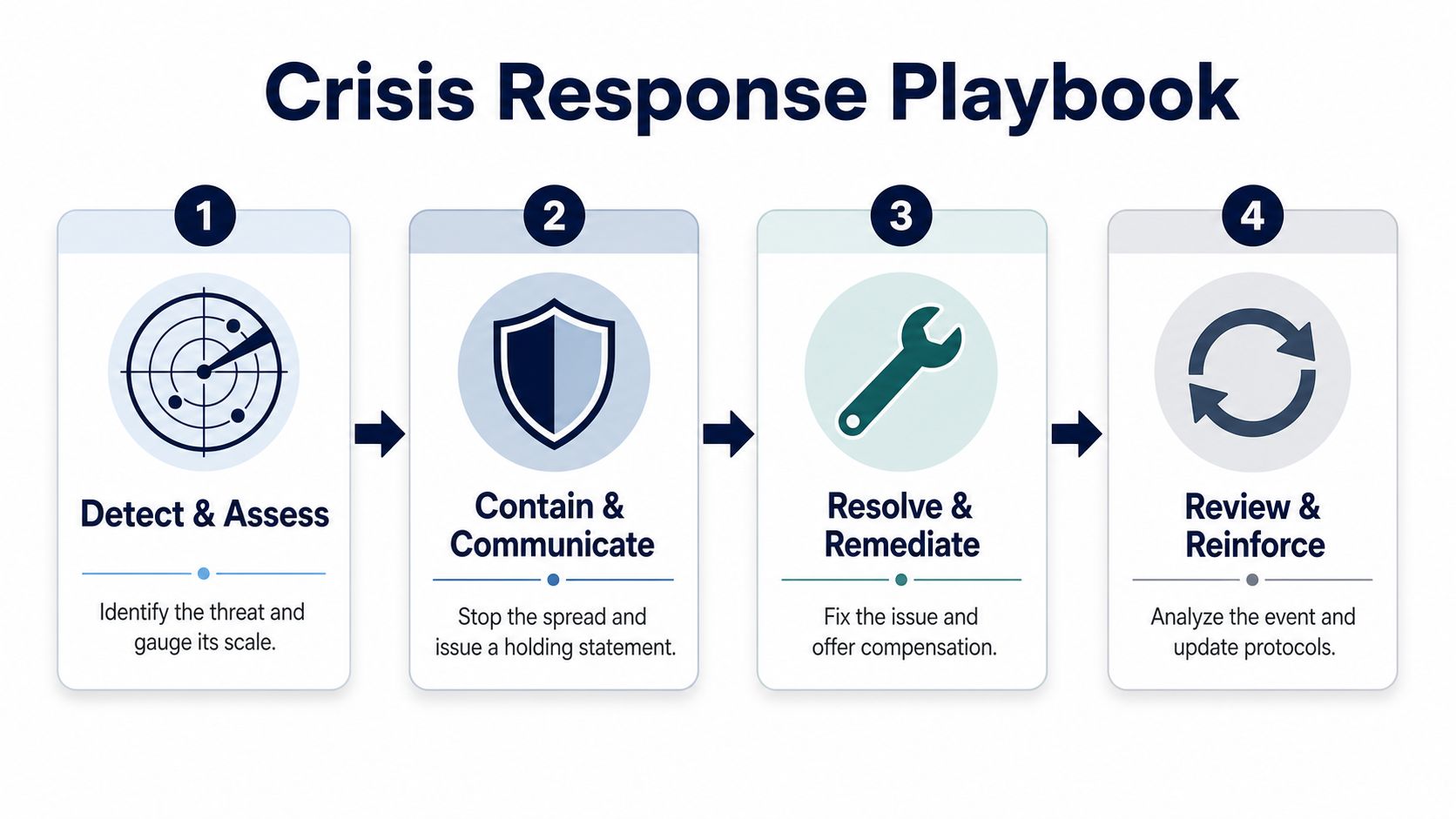
For a preventable product or service failure, use a rebuild response:
For an accidental carrier disruption or an externally caused error, explain the verified context, identify what the brand is doing to help, and avoid accepting responsibility for facts outside its control. Explanation is credible when paired with a concrete remedy.
Fake-review clusters and smear campaigns require evidence preservation, platform reporting, and careful language. Do not call a review fake merely because it is negative. Compare the claim with order records, repeated wording, account behavior, and policy violations, then document the basis for escalation. Teams handling public criticism can use this guide to protect your brand with bad review responses while keeping replies calm and visible.
For a suspected Amazon review attack, use the platform's reporting process and maintain an evidence file. A dedicated fake Amazon review checking workflow can organize relevant signals, but it does not replace human verification or platform rules.
After the incident, record the trigger, first detection point, response time, decisions, customer impact, and unresolved risks. Update templates, ownership, supplier controls, product instructions, and escalation contacts. A crisis creates operational value only when the next response becomes faster and more accurate.
A shopper searching an Amazon product, a brand name, or a safety concern may encounter an AI summary before reaching the seller's site. That summary can combine reviews, forum posts, marketplace listings, and news coverage, while fabricated allegations, deepfakes, and bot-driven outrage spread faster than a conventional public-relations response.
AI misuse creates a reputational risk that requires more than narrative monitoring. E-commerce teams need verification workflows, cross-platform detection, and clear escalation paths for claims affecting product safety, seller integrity, or customer confidence, as outlined in this analysis of AI and reputation-management risks.
Create a fact file for each major product and brand. Include approved specifications, safety documentation, manufacturing and testing records, seller identities, support contacts, return terms, and current public statements. When a suspicious claim appears, preserve the original post, inspect the account and media context, compare the allegation with internal records, and seek independent confirmation.
Avoid repeating a false allegation across every channel. Correct the material point in plain language, publish supporting evidence where appropriate, report manipulated content through the relevant platform, and send legal or safety concerns to qualified professionals.
Zero-click search adds another operational risk. AI summaries and review snippets may shape an opinion before a shopper visits your site, which means a polished homepage cannot correct every inaccurate or incomplete impression. Reputation analysis reports that 94% of consumers place some trust in local business reviews, 55% trust reviews more than what a business says about itself, and 53% trust reviews and brand messaging equally (reputation shifts and AI search).
Narrative consistency should drive publishing and correction decisions. Keep factual descriptions aligned across Google, Reddit discussions, marketplace listings, video descriptions, support documentation, press pages, and structured site content. AI answer engines assemble impressions from available sources, so teams should publish clear, authoritative information and correct material inaccuracies at their origin.
This video provides context for the changing relationship between online narratives and brand trust:
Scaling sellers need a fixed operating rhythm that connects marketplace feedback, search visibility, support issues, and crisis response.
Compare complaint themes with returns, refunds, delivery problems, support contacts, and product changes. Examine whether the same factual description appears across marketplace listings, support documentation, and public channels. Update the escalation file when products, suppliers, policies, or platform procedures change.
Run a crisis exercise with the people who approve, investigate, report, and communicate. Test a product-safety concern, a manipulated review pattern, or an inaccurate claim spreading across channels. Measure time to detection, evidence gathering, approval, platform reporting, and customer communication. Record gaps and assign fixes.
A credible brand can have criticism. The operating standard is visible investigation, accurate correction, and responsible follow-through.
Build these reviews into launch planning, supplier meetings, support training, and weekly operating meetings. That cadence turns reputation management into an operating control system rather than a last-minute communications task.
Join the Ecom Entrepreneur Community for Vetted 7-9 Figure Ecommerce Founders
Learn MoreYou may also like:
Learn more about our special events!
Check Events