Chilat Doina
May 18, 2026
You're probably dealing with one of two situations right now.
Either a competitor's listing looks wrong, with reviews piling in too cleanly and too fast, or your own catalog just got hit with a weird cluster of ratings that doesn't match what customers usually say in support tickets, returns, or post-purchase feedback. In both cases, the consumer version of a fake amazon review checker won't get you very far.
At brand level, the question isn't “does this one review look fake?” The better question is whether the pattern points to coordinated abuse, a messy but legitimate launch, or a tool overreacting to normal marketplace noise. That distinction matters because if you treat every strange spike as fraud, you waste time. If you ignore a real attack, you lose rank, conversion, and trust.
The practical move is to use checkers as one layer inside a broader review integrity workflow. That means reading the listing, the reviewer behavior, the timing, the variation structure, and the seller context together. That's how serious operators protect a catalog instead of chasing screenshots one ASIN at a time.
A fake amazon review checker becomes useful only when you stop treating reviews as isolated comments and start treating them as signals inside a system.
The scale alone tells you this is no longer edge-case noise. In 2024, Amazon said it blocked or removed more than 275 million fake reviews, and industry research cited by Capital One Shopping also notes that about 30% of online reviews are fake or ungenuine on average, while 82% of consumers encountered fake reviews at least once in a 12-month period according to its fake review statistics roundup. That's why a brand-level review process matters. You're not preparing for a rare anomaly. You're operating inside a marketplace where review manipulation is persistent.
A lot of sellers still look at average star rating first. That's understandable, but it's not enough. A manipulated listing can carry a believable average and still be compromised. The bigger tell is often in the shape and behavior of the review profile.
A mature review audit asks questions like these:
That last point gets missed constantly. Product-level review scores can be helpful, but they don't tell you whether the issue lives at listing level or whether it connects to a broader seller pattern. If you need that wider context, reviewing the storefront and ownership signals matters just as much as reading the reviews themselves. A quick seller lookup process like the one outlined in this guide on how to look up a seller on Amazon can add context that most browser-based checker tools miss.
Practical rule: A suspicious review profile usually looks coordinated before it looks obviously fake.
The old mental model was simple. One fake reviewer leaves one fake comment. That's not how advanced abuse usually works now.
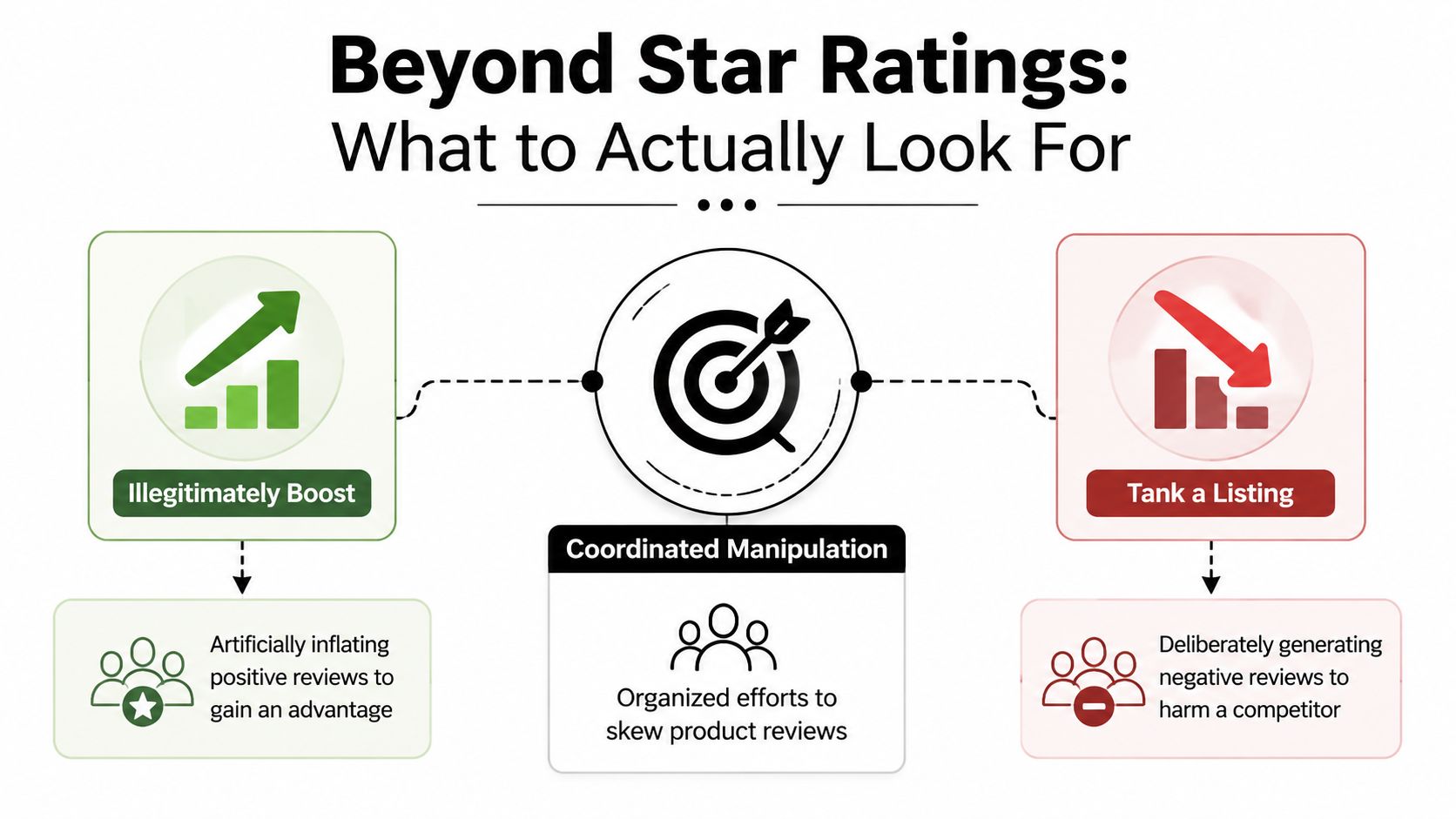
Modern manipulation often aims to do one of two things. Illegitimately boost a listing with positive volume and sentiment, or tank a competitor with negative pressure at the worst possible time. In both cases, the operator is trying to move rank, conversion, perceived product quality, or all three.
That's why star averages are a weak first filter. They show result, not mechanism.
When I review suspicious listings, I care less about whether a comment sounds exaggerated and more about whether the listing shows a combination of these traits:
| Signal | What it suggests |
|---|---|
| Review bursts | Organized push rather than steady customer flow |
| Repeated phrasing | Shared templates, outsourced copy, or AI-assisted volume posting |
| Reviewer overlap | Potential network behavior across ASINs |
| Skewed star distribution | Reputation engineering instead of normal customer spread |
| Mismatch with product lifecycle | Reviews behaving differently than launch, relaunch, or seasonality would predict |
The biggest upgrade in mindset is this. A fake amazon review checker is not there to certify truth. It's there to help you identify marketplace abuse patterns faster than a manual-only process can.
That shift changes how you use the tool. You stop asking, “Is this review fake?” and start asking, “What kind of system would produce this review pattern?”
Before you trust any checker score, build your own eyes for this work.
The most useful manual audit habits come from looking at review behavior the way an investigator would, not the way a shopper would. You're not trying to decide whether you personally believe a comment. You're testing whether the listing behaves like a normal product with normal customers.

A peer-reviewed study using Amazon data found that fake-review activity is often concentrated, not evenly distributed. In that research, two product clusters representing only 3.4% of the dataset accounted for about 70% of the products identified as buying fake reviews, according to the published analysis in PMC. That's a strong reminder that you're often looking for connected behavior, not random weirdness.
Don't read reviews in isolation. Read them against time.
Open the listing and scan for clustering. If a product gets a dense run of very positive or very negative reviews inside a narrow window, that's your first signal. Then ask whether that timing lines up with anything legitimate you already know, such as a launch push, an inventory restock, outside traffic, a creator mention, or a major promo.
If the timing doesn't fit a real business event, mark it.
A useful companion habit is to document your audit process the same way you'd document a broader listing review. Teams that already use a structured operational checklist for catalog health tend to spot review anomalies faster. This brand audit checklist is a good example of the kind of disciplined review process that helps surface integrity issues before they become expensive.
Click into reviewer profiles when something feels off. You won't always get a full picture, but even partial visibility can tell you a lot.
Look for these behaviors:
Experience is a valuable asset. Real customers write messy, inconsistent, narrow reviews. Coordinated review farms often produce cleaner language than actual users do.
Real buyers usually anchor on one or two lived details. Fake review campaigns often anchor on broad approval.
AI-written review text has made lazy detection harder, but it also creates a new kind of sameness.
You'll see reviews that are grammatically fine, emotionally flat, and oddly interchangeable. They don't contain obvious errors. They just don't feel tied to the product in front of them. If five different reviewers all sound like they attended the same copywriting workshop, slow down and inspect deeper.
A few text cues I watch closely:
Manual audits get sharper when you stop staying inside the review tab.
Check the variation family. Sometimes the manipulation sits across child ASINs, not on the specific variation you first opened. Also look at seller feedback patterns, storefront breadth, and whether multiple related listings show similar review timing.
Use a simple field checklist:
| Audit area | What to inspect |
|---|---|
| Review dates | Clusters, gaps, sudden reversals |
| Rating mix | Overly clean positive run or abrupt negative flood |
| Reviewer profiles | Category spread, tone consistency, account behavior |
| Media reviews | Whether images and videos fit the exact product |
| Variation structure | Spillover patterns across child ASINs |
| Seller context | Whether similar signals appear across the account |
Algorithms are good at bulk screening. Humans are still better at nuance.
A person can notice when a review burst came right after a product refresh, when the wording sounds coached but not automated, or when media proofs don't line up with the current offer. That kind of judgment is what keeps you from chasing false alarms or missing a coordinated attack hiding behind plausible text.
Manual review builds judgment. It doesn't scale well across a large catalog.
That's where a fake amazon review checker earns its place. The tool's job is not to replace your judgment. Its job is to scan faster than your team can, surface outliers, and help you decide what deserves a human look.
One reason these tools remain relevant is that platform enforcement and third-party screening solve different problems. Amazon blocked over 250 million suspected fake reviews in 2023, but manipulation keeps evolving, and many third-party checkers still rely on heuristics that may struggle with complex abuse, low-review ASINs, or niche categories, as discussed in this review-checker reliability overview. In practice, that means you should expect value from these tools, but not certainty.

The best way to think about ReviewMeta, Savinoo-style filtering, and similar tools is this: they try to model unnaturalness.
They're usually looking at some mix of:
ReviewMeta publicly says it runs 12 different tests and statistical modeling on a product URL. Savinoo describes its approach as filtering reviews an algorithm deems unnatural. Those descriptions matter because they tell you something important. These tools are not proving fraud. They are testing whether the review set behaves unlike what they expect from organic customer activity.
A lot of sellers waste checker tools by using them casually. They drop in a URL, read a grade, and move on. That's not enough.
Use a tighter process instead:
Run the ASIN through one checker
Start with a product URL and capture the raw output. Don't interpret yet.
Note the type of flag, not just the final grade
Timing flags, reviewer-behavior flags, and phrase repetition flags matter more than a broad pass-fail label.
Compare against your manual observations
If the tool flags a burst and you already saw an odd cluster, confidence goes up. If the tool flags the listing but your manual review shows a legitimate launch event, slow down.
Check nearby listings
Run adjacent child ASINs, close competitors, or other products from the same seller if available. A pattern across related listings is more informative than one noisy output.
Document and queue
The output should route the ASIN into one of three buckets: ignore, monitor, or escalate.
If your team already uses software stacks for catalog management and marketplace analytics, plug review screening into that system instead of treating it like a separate hobby. A broader toolset review like this guide to best Amazon seller tools can help frame where review checking belongs operationally.
A checker is most useful in these situations:
| Good use case | Why it works |
|---|---|
| Screening many ASINs quickly | It catches obvious outliers fast |
| Spotting unnatural timing | Bursts and compressed patterns are machine-friendly |
| Flagging repeated language | Statistical repetition is easier to detect at scale |
| Triage for manual review | It narrows the list your team needs to inspect |
The weak points are just as important.
A checker can struggle when:
Field note: If a tool can only tell you a product looks odd, but can't tell you whether the behavior connects across a seller or variant family, treat the output as incomplete.
Think of checker outputs as triage labels.
A harsh score means “this listing deserves inspection,” not “this seller is guilty.” A clean score means “the tool didn't find enough to worry about,” not “this listing is unquestionably authentic.”
That distinction matters most on competitor research. Sellers often overreact to a bad grade on a rival's listing and assume enforcement is around the corner. In reality, the tool may be reacting to noisy launch behavior, category seasonality, or a heuristic mismatch. Use the alert to investigate. Don't use it to fantasize.
The hardest part of using a fake amazon review checker isn't running it. It's knowing when not to believe it.
Most bad decisions happen after the tool has already done its job. The software flags a listing as unnatural, and the seller treats that output like a verdict instead of a prompt. That's how teams misread healthy launches, overestimate competitor fraud, and miss the deeper pattern sitting outside a single product page.

A major gap in many checkers is their product-level focus. As Savinoo's positioning points out, the better seller question isn't just whether a product looks spammy, but whether the pattern reflects a broader abuse network or an unlucky early burst, which most consumer-facing tools don't distinguish well in their seller-level framing of review analysis.
A listing can look suspicious for good reasons.
A strong launch can compress review timing. So can a relaunch after stock returns. A product picked up by a creator, newsletter, or off-Amazon community may produce a wave of reviews that looks algorithmically awkward while still being legitimate. In some categories, a narrow customer base also creates uneven review cadence that software can misread.
That's why checker interpretation needs context from the business itself.
Here's a simple decision table I use mentally:
| Checker output | Business context | Likely interpretation |
|---|---|---|
| Burst of positive reviews | Launch, promo, external traffic | Needs review, not automatic suspicion |
| Sudden negative cluster | No product issue, no support spike | Possible attack or coordinated pressure |
| Repeated phrase flags | Listing copy mirrors review wording | Could be coached or could be buyer mimicry |
| Low trust score on sparse review count | New or niche ASIN | Often noisy data, low confidence |
Don't ask whether the pattern is weird. Ask whether the pattern is weird for this listing, in this moment, for this seller.
That one shift cleans up a lot of false positives.
If your own brand just ran a clean launch and a checker hates the review profile, compare the tool output against what you know about traffic source, promo timing, and post-purchase customer behavior. If everything else is healthy, the tool may be reacting to abnormal but legitimate momentum.
A checker sees surface behavior. You need to supply commercial context.
Here, experienced operators separate themselves.
If one ASIN gets flagged, I want to know whether the same timing, reviewer style, or rating shape appears elsewhere in the account. If it does, the issue may be systemic. If it doesn't, I look harder at listing-specific explanations.
That's also why some of the cleanest fraud escapes consumer tools. Clever operators avoid cartoonish behavior. They spread activity over time, vary language, and avoid making the product page look too perfect. A simplistic score may miss that. On the other side, a simplistic score can punish honest sellers who had a successful week.
I trust a conclusion more when three things line up:
If only one of those is true, I don't escalate hard. If all three are true, I treat it as a serious signal.
That's the discipline. Use the software to narrow the field. Use your judgment to decide what the field means.
Ad hoc checking is fine when you have five ASINs. It breaks when you have a real catalog, active competitors, and multiple launches across the year.
Brand protection gets better when review integrity becomes a standing operating process instead of a reactive task. That means setting baselines, defining escalation criteria, and making sure your team knows the difference between a monitor event and a reportable event.

Practical screening guidance points to a combined workflow that uses velocity, reviewer behavior, and post-purchase signals together. That same guidance cites useful thresholds such as review bursts with 80%+ five-star ratings in under 2 weeks and review velocity exceeding category norms by 300%+, while also noting that automated tools often show false positive rates around 15% to 25%, manual review can reduce that to about 5% to 8%, and hybrid workflows can get down to roughly 3% to 5%, according to this operational fake review screening guide. Those numbers matter because they support the basic operating principle: automation for triage, humans for judgment.
The first mistake teams make is hunting suspicious behavior without defining normal behavior.
You need a baseline for your category, your own catalog, and a short list of competitors. Not a perfect model. Just enough to recognize when review flow breaks character. Review velocity, rating mix, and the usual lag between purchase activity and review activity all matter.
For each priority ASIN, keep a simple baseline record:
Without that, every spike looks dramatic.
A workflow only works if your team knows when to act.
Use a small number of practical triggers. Not an encyclopedia. The point is consistency.
Here's a workable model:
| Trigger type | Action |
|---|---|
| Mild anomaly | Add to watchlist and recheck |
| Repeated checker flags across review cycles | Manual audit by analyst or brand manager |
| Clear timing burst plus suspicious reviewer behavior | Escalate for evidence capture |
| Negative attack pattern during key sales period | Immediate response and reporting prep |
Not every trigger needs the same owner. Some belong with marketplace operations. Others should move to brand protection, legal, or executive review depending on severity.
A fully manual process is slow. A fully automated process is noisy.
The hybrid approach wins because each side covers the other's weakness. Software scans your catalog and competitor set broadly. Humans inspect the subset that matters. If your team skips the second layer, false positives pile up. If your team skips the first, real abuse stays hidden too long.
Operating principle: The tool should widen your visibility, not replace your standards.
These are different jobs and should be treated differently.
Routine monitoring is scheduled. It covers your main ASINs, launches, and your competitor watchlist. The output is trend-based.
Incident response is urgent. It starts when you see a suspicious burst, a sudden ratings drop, or behavior that could affect conversion during a critical window. In that case, move fast on evidence capture. Take screenshots, export dates, log review text patterns, and record what changed and when.
A simple weekly workflow looks like this:
The strongest workflows don't stop at product pages.
They look for recurring signals across child ASINs, related products, and the seller account itself. That's where you start seeing whether the issue is a one-off anomaly or part of a broader pattern. And once you start thinking that way, review integrity becomes part of brand defense, competitor intelligence, and launch risk management all at once.
Once you've identified a likely manipulation pattern, the next move is discipline.
First, package the evidence cleanly. Don't send Amazon a vague complaint that “these reviews look fake.” Send a concise record of what you observed: dates, review clusters, screenshots, reviewer overlaps you could verify, wording repetition, and why the pattern doesn't fit normal business context. The more structured your report, the easier it is for an internal team to evaluate.
Second, separate platform action from internal action. Platform action means reporting suspected abuse through the channels available to sellers and documenting follow-up. Internal action means checking whether the event changed conversion, ad efficiency, support contacts, or return behavior. If the review pattern is hurting a live launch or a high-volume ASIN, your response should include operational adjustments, not just a complaint ticket.
Third, know when the issue moves beyond marketplace ops. If you're seeing defamatory content, direct competitor pressure, or a repeated pattern aimed at your brand rather than a single listing, legal review may make sense. Not every ugly review deserves escalation. Coordinated attacks against reputation can.
The last piece is strategic. Review monitoring shouldn't live only in the defensive bucket. It should inform how you evaluate competitors, how cautiously you interpret their momentum, and how you stress-test your own launch tactics so legitimate growth doesn't accidentally resemble manipulation. Sellers who build that feedback loop make better decisions across sourcing, ranking strategy, and brand protection.
A fake amazon review checker is useful. A repeatable operating system around it is what protects your business.
If you're running a serious Amazon brand and want sharper operator-level insights like this from founders who've already solved these problems at scale, Million Dollar Sellers is where high-level e-commerce entrepreneurs compare notes, pressure-test strategy, and get real-world answers beyond surface-level seller advice.
Join the Ecom Entrepreneur Community for Vetted 7-9 Figure Ecommerce Founders
Learn MoreYou may also like:
Learn more about our special events!
Check Events