Chilat Doina
August 6, 2026
Most ecommerce brands confuse visibility with authority, and that mistake is expensive. Brand authority is built through consistent proof signals, not awareness alone, and consistent branding can lift revenue by 10% to 20% while a signature brand color can raise brand recognition by 80% (source).
A founder can buy reach, rack up impressions, and still lose the sale at checkout because the brand never looked dependable enough to trust. The brands that win do the boring work well, they repeat the same message, visual identity, and product promise across ads, email, PDPs, packaging, and support, then they make sure the first experience is strong enough to earn a second one, since 89% of people are likely to purchase again after a positive first brand experience (source).
Awareness gets people to notice you. Authority gets them to believe you, and in ecommerce that difference shows up the moment a shopper compares three similar products and one brand feels safer, sharper, and more established.
I've seen brands spend heavily on traffic while their competitors outperformed them by looking more credible at every touchpoint. The second brand didn't always have better ads or louder campaigns, it had tighter proof. Its product pages matched its social creative, its support tone matched its packaging, and its reviews reinforced the same promise customers saw on the homepage.

That is the key distinction. Awareness can be fleeting, but authority is the accumulation of repeated, credible signals across owned, earned, and customer-facing channels. The more often shoppers see the same positioning backed by proof, the less effort they need to spend deciding whether to trust you.
A simple visual identity choice can matter more than founders expect. A signature color, a consistent tone of voice, and the same product promise across channels help people recognize the brand faster, and that recognition becomes a trust shortcut when they see the name again in search, social, or marketplace listings (source).
Shoppers don't evaluate authority with a brand strategy deck. They read it in the first five seconds on a PDP, in the clarity of a FAQ, in whether a review page feels real, and in whether the packaging matches the marketing claim. If the promise feels inconsistent, they infer the product will be inconsistent too.
Practical rule: if a shopper has to work to understand what your brand stands for, your authority is too weak to carry the sale.
This is why authority compounds better than awareness. A positive first experience increases the odds of repeat purchase, which means the first sale is only the beginning of the credibility loop, not the end of the funnel (source). If you're already doing a brand audit, pair it with the brand audit checklist so the review covers messaging, visual consistency, and customer touchpoints, not just traffic.
Do the audit before you publish another batch of content. Without a position map, “more content” just creates more generic pages, and generic pages rarely move perception, search differentiation, or trust.
Start with your closest organic competitors, not your aspirational peers. Pull Domain Rating, organic traffic, and referring domains in Ahrefs or a similar suite, then compare those numbers side by side with the brand you sell against in search. The goal isn't to copy them, it's to see where they're earning credibility faster than you are.
Run a content-gap analysis next. Look for queries and themes where your competitors are visibly stronger, then separate those from the topics where your team has genuine subject-matter depth. If you're an ecommerce brand with deep product knowledge, customer usage insights, or category-specific troubleshooting expertise, that advantage belongs in the audit.
A useful filter is to choose 3 to 5 pillar topics that match your real expertise, not the topics that merely attract traffic. One published framework recommends pillar pages of at least 2,000 to 3,000+ words as foundational resources, which gives you enough room to cover intent, proof, FAQs, objections, and comparisons without turning the page into fluff (source).
You're looking for expertise signals fast. That means checking whether you already have customer stories, product demonstrations, founder perspective, or original insights that can support those pillar topics. If you don't, the topic probably isn't ready for authority building yet.
Authority gaps are usually not content gaps. They're proof gaps.
Use this brand-equity measurement guide if you want a parallel lens for perception, because authority and equity often move together even when teams track them in separate dashboards. The strongest brands usually know where they stand before they start scaling output, which keeps them from mistaking activity for progress.
Brand authority doesn't come from one channel doing all the work. It comes from each channel reinforcing the same claim in a different way, with each proof point making the next one easier to believe.
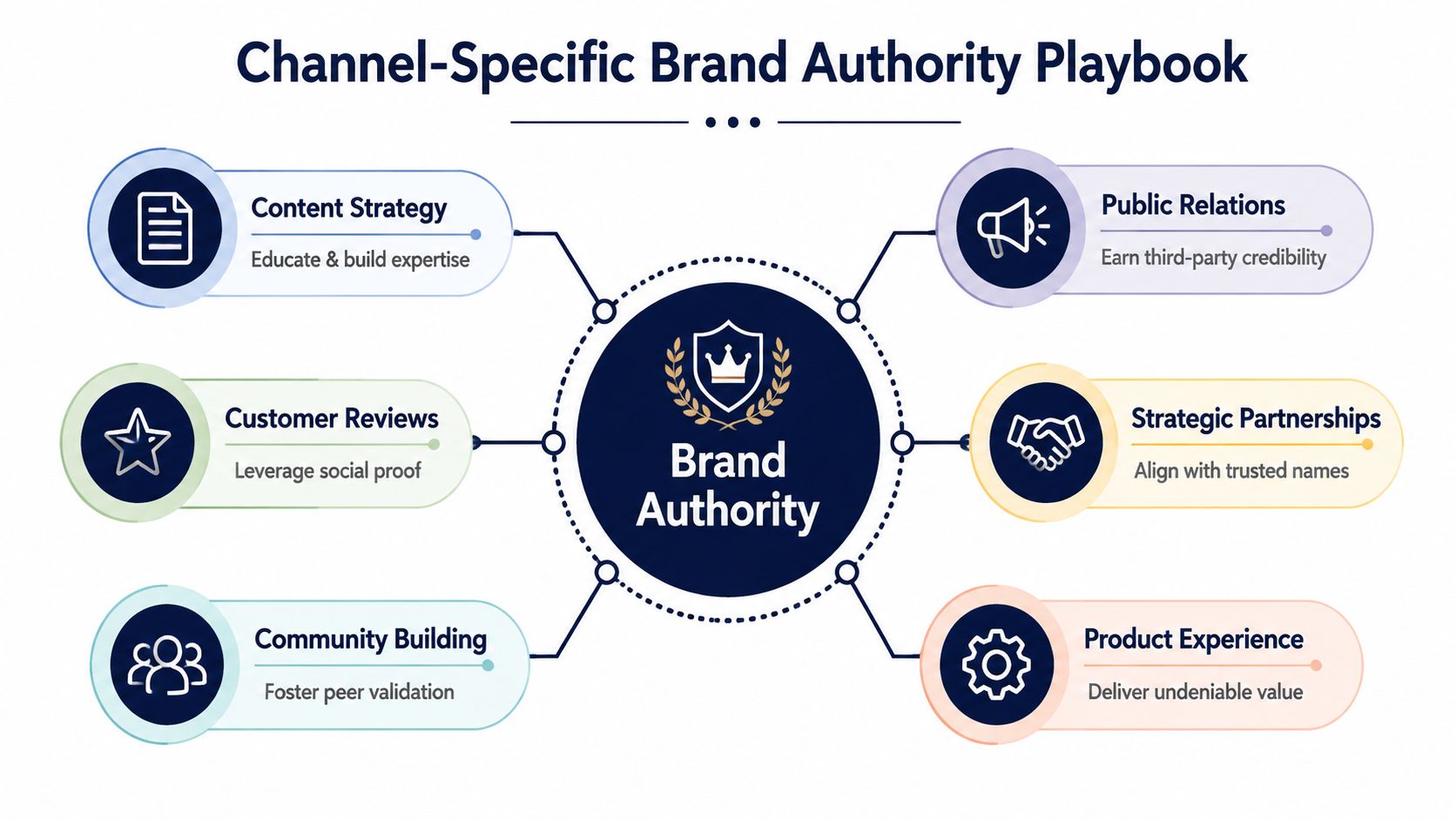
The best authority content answers hard questions better than commodity competitors do. That usually means original research, sharper product education, contrarian takes, and clear evidence, not another recycled list post. Search Engine Land's guidance on building authority when you're still unknown points in the same direction, depth and corroboration matter more than blanket volume (source).
For ecommerce, that often looks like PDP-adjacent education, comparison pages that openly address trade-offs, or category guides that explain why a product fits one use case but not another. If your content feels interchangeable with everyone else's, it won't build authority, it will just fill the blog.
Public relations works when it lends your brand borrowed credibility. A mention in a relevant outlet, a byline on an industry site, or a thoughtful quote in a trade publication says, “this brand belongs in the conversation.” Partnerships should do the same thing, because association is part of authority.
That is also why product-page strategy matters. If your product pages are weak, no amount of earned coverage will hold the line once shoppers land there, and a solid resource like Presidio's product page strategy is useful because it keeps the final proof point aligned with the rest of the funnel.
Reviews scale trust because they sound like customers, not marketers. Community strengthens authority because peers validate the brand in public. Product experience matters most, because external credibility collapses fast when the product underdelivers.
Here's the practical split:
If you're looking for a peer environment where founders trade operating advice and credibility tends to be earned through execution rather than hype, Million Dollar Sellers is one option to consider alongside your other community and partnership channels. It's not a substitute for strong branding, but it can reinforce authority when the room is full of serious operators.
A lot of brands overinvest in design polish and underinvest in clarity. The strongest product pages show the claim, show the evidence, and show the limits. That kind of honesty builds trust faster than vague superlatives ever will.
If you can't measure it, you can't improve it. Vanity metrics like follower count and raw page views are easy to celebrate, but they don't tell you whether the market sees you as credible.
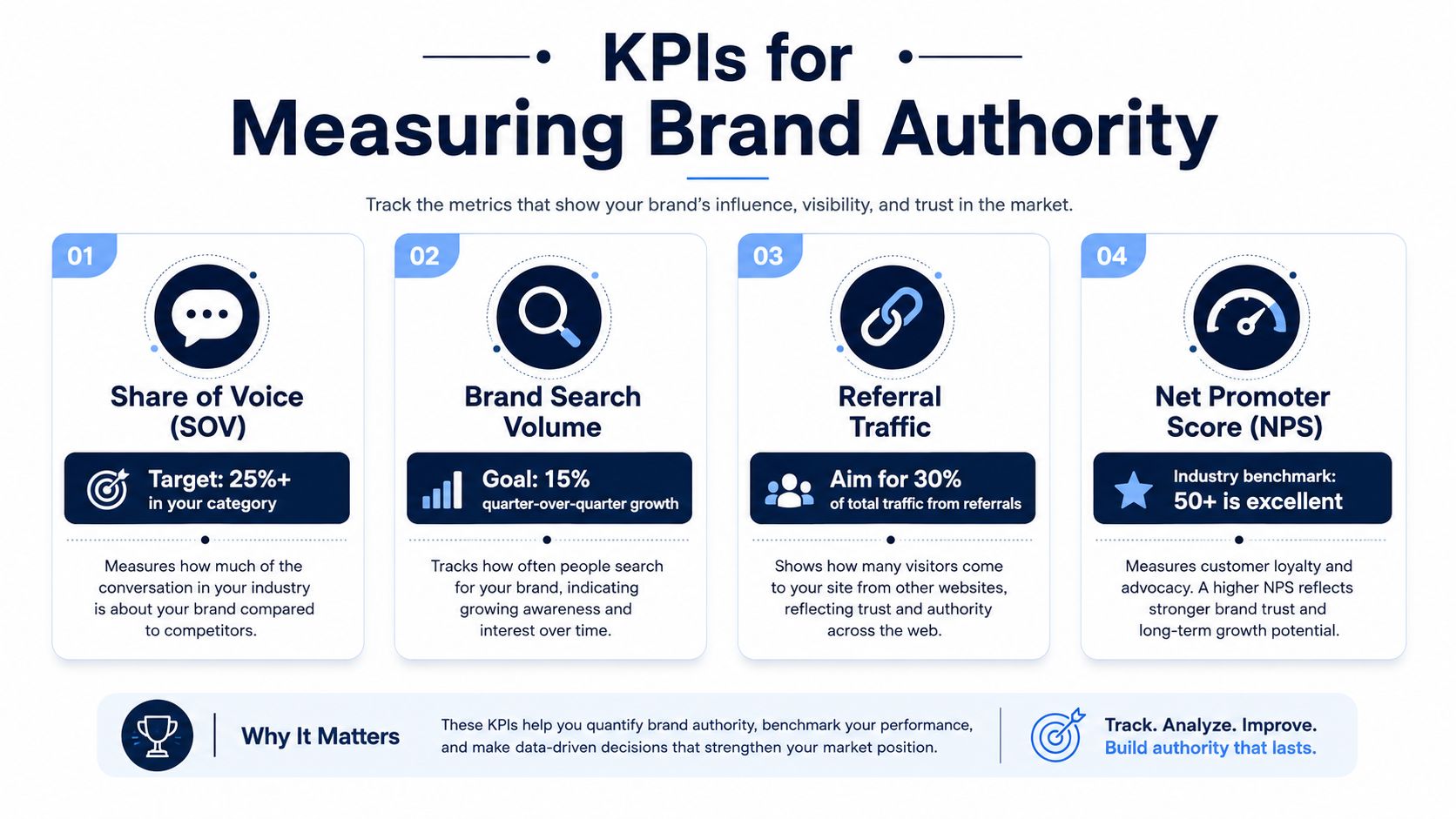
The best authority dashboards combine search, reputation, referral quality, and retention. I'd rather see a brand with modest traffic but rising branded search and better repeat behavior than a brand with unstable spikes from one-off campaigns.
| Brand Authority KPI | How to Measure | Target Benchmark |
|---|---|---|
| Branded search volume | Google Search Console, search trend tools, branded query reports | Rising over time |
| Share of voice | Compare visibility against direct competitors in SEO and social listening tools | Increasing category presence |
| Media mentions | Track earned coverage, quotes, and third-party references | More relevant mentions from credible outlets |
| Review velocity and sentiment | Monitor review platforms, star distribution, and review text quality | Steady inflow with mostly positive sentiment |
| Partnership quality | Assess audience overlap, credibility of partner, and relevance to your category | Fewer, stronger partnerships |
| Repeat purchase behavior | Use ecommerce analytics and cohort tracking | Repeat buying should strengthen over time |
The point isn't to optimize every metric at once. A rise in branded search with flat review sentiment might mean awareness is growing faster than trust. More mentions with weak referral quality might mean the brand is getting talked about, but not by the right people.
That is why how to measure brand equity matters as a companion framework. Equity and authority aren't identical, but both depend on whether people consistently see your brand as credible, relevant, and worth returning to.
Short-term traffic jumps can come from launches, discounts, or paid media. Authority gains usually show up more slowly, through stronger branded demand, better referrals, and more useful third-party validation. Treat those as the key signals, because they tell you the brand is becoming the default choice, not just a visible one.
The fastest way to weaken authority is to chase tactics that look busy but don't change belief. A lot of brands do this for years, then wonder why awareness never converts into preference.
Publishing more articles won't help if all of them say the same thing everyone else says. Authority content needs a point of view, evidence, or a practical framework that a competitor can't easily copy. If your blog reads like a summary of the market, shoppers won't remember you as a source.
Links matter, but the wrong kind of link-building turns into noise. A relevant mention from a respected publication can shape perception, while a pile of weak placements mostly signals desperation. The same goes for shortcuts that are meant to improve profitability on marketplaces without strengthening the brand behind the listing, because reputation problems still show up in conversion behavior.
Partnerships can be hollow when the only goal is reach. If the partner's audience doesn't view them as credible, your association won't lift trust. The same is true for community efforts that are built around promotion instead of peer validation.
No brand can brand its way out of a weak product. Fast shipping, clear usage, honest expectations, and responsive support are all part of authority because customers experience them as proof. When those basics slip, the marketing starts to feel like overpromise.
Self-audit: if your best-looking channel is also the one with the weakest proof, your authority is probably leaking there.
Check whether your current effort leans more toward volume, visibility, or verification. The brands that build durable authority invest in depth over breadth, proof over polish, and consistency over virality.
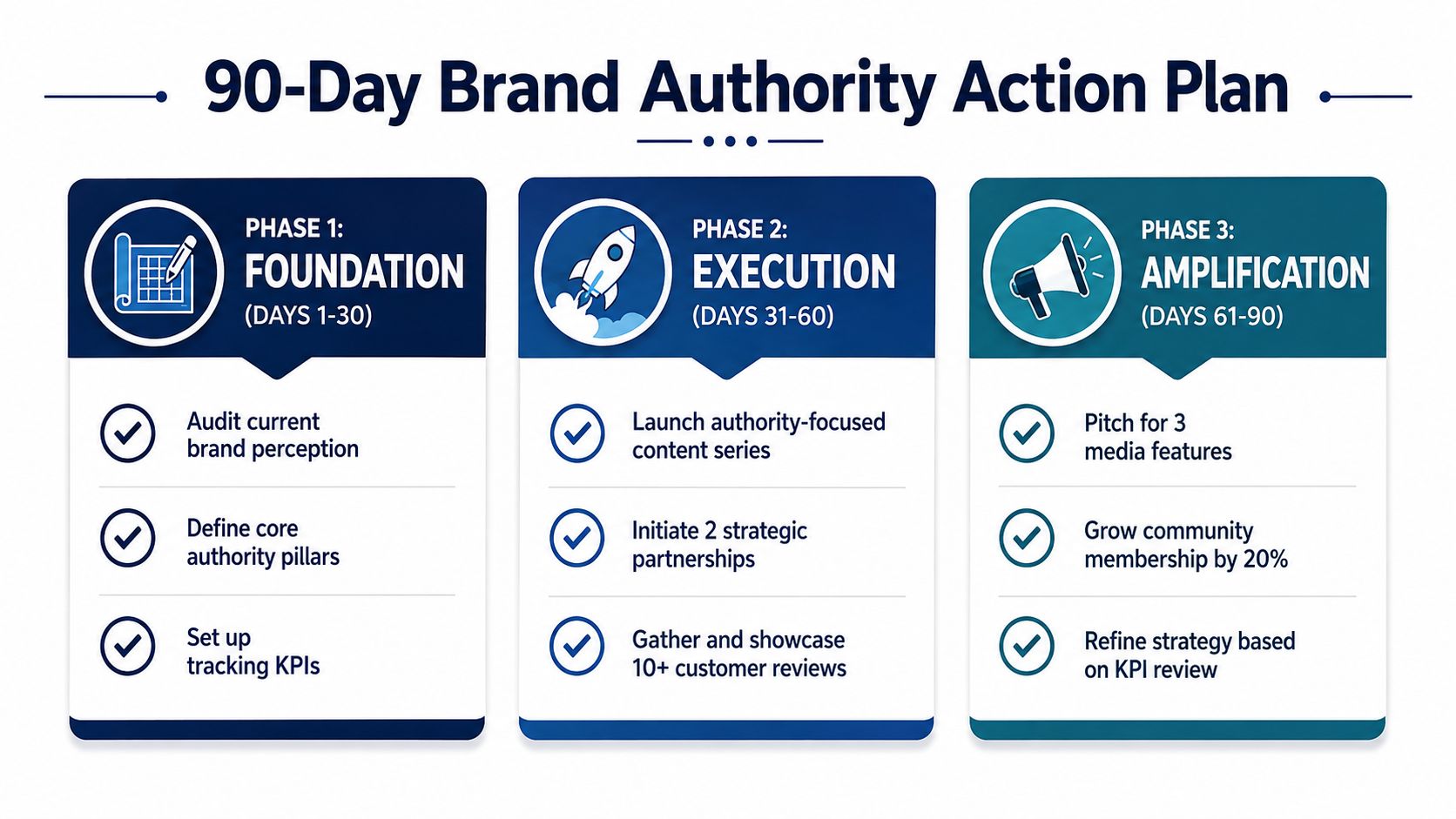
Audit your current brand perception, pull your competitor set, and define the 3 to 5 authority pillars you can genuinely own. Set up your tracking for branded search, mentions, reviews, and repeat purchase behavior so you're not guessing later.
Launch one authority-focused content series, push one or two partnerships that create association, and gather customer proof you can display. Tighten your product pages so the claims on the page match the claims in the creative.
Pitch for media features, activate your community, and review the KPI dashboard for gaps in trust, reach, or conversion quality. Refine what's working, cut what's noisy, and keep the same message visible across every touchpoint.
Build authority like a system, not a campaign. The brands that keep winning are the ones that repeat proof until the market stops needing convincing.
Million Dollar Sellers gives ecommerce founders a vetted peer environment where strategy, execution, and credibility get pressure-tested by operators who are building real businesses. If you want sharper brand authority through better peer feedback, stronger positioning, and more accountable execution, visit Million Dollar Sellers and see whether the community fits the stage you're at.
Join the Ecom Entrepreneur Community for Vetted 7-9 Figure Ecommerce Founders
Learn MoreYou may also like:
Learn more about our special events!
Check Events