Chilat Doina
December 17, 2025
Building an online brand is about so much more than a slick logo or a catchy tagline. It’s about carving out your unique space in a crowded market, telling a story that connects, and showing up consistently everywhere your customers are. It's the whole process of shaping how people see, feel, and talk about your business.
If you're an ecommerce founder trying to build a brand that people actually care about, you're in the right place. This isn't a high-level, theoretical guide. It's a hands-on playbook packed with the kind of tactical advice that actually moves the needle, taking you from a simple idea to a brand people genuinely love and recommend.
The goal here is to create a real emotional connection that turns first-time buyers into lifelong fans. We'll walk through the essential pillars for building your brand from the ground up, and for a deeper dive, you might want to check out these 10 actionable brand development strategies.
Here's what we'll cover:
Having a strong online presence isn't just a "nice to have" anymore—it's everything. As of early 2025, there are 5.56 billion people online, which is nearly 68% of the entire world. If you’re not building your brand where they are, you're invisible to most of your potential market.
This massive online audience is why social ad spend is set to blow past $276.7 billion in 2025. These platforms are where your brand comes to life, mixing content, community, and commerce all in one place.
I like to break down the brand-building journey into three core stages: Define, Create, and Grow.
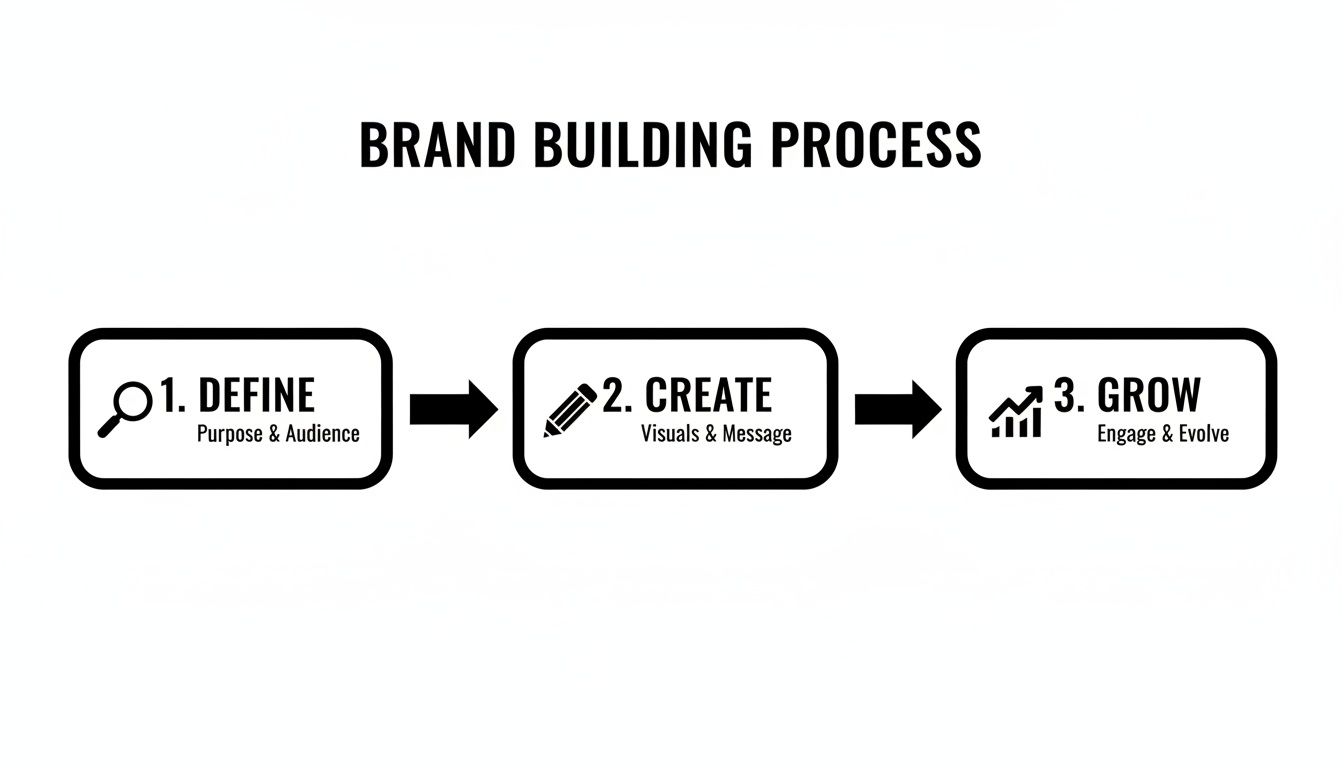
This simple flow is my go-to framework. You start with strategy and clarity, move into the creative work of building your identity, and then you scale it all with smart, consistent marketing.
Let's get started.
Before you even think about logos or color schemes, the real work of building an online brand starts with a deceptively simple question: what do you actually stand for? A brand that lasts is built on a solid strategic foundation. This is where you carve out your unique space in the market and get crystal clear on why you exist in the first place.
This first phase isn't about creative brainstorming; it's about strategic clarity. It means digging deep to understand not just who your customers are, but what they truly need and desire—both on a functional and emotional level. Get this right, and everything else falls into place.
You can't build a brand for everyone. It’s a classic mistake. The most successful ecommerce brands are laser-focused on a specific group of people. Your first job is to go way beyond basic demographics and build out a detailed ideal customer profile.
Think about their daily lives, their biggest headaches, and their quiet aspirations. What keeps them up at night? What are they really trying to accomplish when they buy a product like yours? Answering these questions helps you build a brand that speaks their language, making them feel seen and understood on a whole new level.
A DTC brand selling sustainable activewear, for instance, isn't just targeting "women who exercise." They’re targeting the eco-conscious professional who demands performance but refuses to compromise her values. She reads ingredient labels, follows sustainability influencers, and wants every purchase to be a statement.
Key Takeaway: A brand that tries to be for everyone ends up being for no one. Hyper-focusing on a niche audience lets you craft a message so specific and relevant that it feels like a one-on-one conversation.
This deep customer insight is your most valuable asset. It will guide your product development, your marketing copy, and the entire customer experience you create.
Once you know who you’re talking to, you need to understand who else is trying to get their attention. A competitor analysis isn’t about copying what others are doing. It’s about finding the gaps they’ve left wide open for you.
Pick your top three to five direct and indirect competitors and put them under the microscope. Look at:
Those complaints you find? That's pure gold. If a competitor is constantly getting dragged for slow shipping or cheap-feeling materials, you’ve just found a powerful angle for your own brand. This process is all about defining what makes you different—your unique selling proposition (USP). Before diving into the creative stuff, it’s critical to lock down your branding strategy and market positioning.
With a sharp view of your customer and the competition, you’re ready to write your brand positioning statement. This isn't a catchy tagline for your website. Think of it as an internal compass that keeps every single marketing decision pointed in the right direction.
It’s a simple, concise statement that answers four critical questions:
To help organize these thoughts, a simple framework like a Brand Positioning Canvas can be incredibly useful. It forces you to distill your strategy into its most essential components.
A framework to help you define the core elements of your brand's market position.
ComponentGuiding QuestionExample (Sustainable Activewear Brand)Target AudienceWho is the one person you are trying to reach? Be specific.The ethically-minded modern athlete who values performance and planetary health.CategoryWhat market or frame of reference do you operate in?Performance activewear.Key DifferentiatorWhat is the single most compelling thing that makes you unique?We use innovative, plant-based materials that outperform traditional synthetics.Reason to BelieveWhat tangible proof supports your differentiator?Our proprietary fabric is scientifically proven to be more durable and breathable.
Filling this out gives you all the raw material you need.
Let’s put it all together for our sustainable activewear example. A solid positioning statement might look like this:
"For the ethically-minded modern athlete, our brand is the performance activewear that uses innovative, plant-based materials to deliver superior comfort and durability without compromising the planet."
Boom. That single sentence clarifies everything. It names the person ("ethically-minded modern athlete"), defines the category ("performance activewear"), highlights the key difference ("plant-based materials"), and makes a clear promise ("superior comfort and durability"). Every ad, every email, and every product description can be measured against this statement to ensure you’re always on-brand. It’s the single most important sentence in your entire brand strategy.
Alright, you've done the hard work of figuring out who your brand is and what it stands for. Now for the fun part: giving it a face and a voice.
This is the point where your brand stops being an abstract idea on a whiteboard and starts to feel like something real your customers can see, hear, and connect with. We're translating your core strategy—the "why"—into the tangible "what" that people will interact with every single day.
Think of it this way: your visual and verbal identity are the sensory translators for your brand's soul. Get them right, and you create an instant, intuitive connection. Get them wrong, and you’ll just confuse people.
Your visual identity is your brand's silent ambassador. It's everything from your logo and color palette to your font choices and the style of your product photography.
A strong visual system means that no matter where someone finds you—a social media ad, your website, or the box that lands on their doorstep—the experience is instantly, recognizably you. It’s a seamless thread connecting every touchpoint.
A brand's visual identity should be a direct reflection of its personality. If your brand is a witty, no-nonsense friend, your visuals shouldn't look like they belong to a formal, corporate institution. Consistency here is non-negotiable.
This consistency is what builds trust. When customers see the same colors, fonts, and logo style everywhere, it creates a feeling of reliability and professionalism. It subtly tells them you've got your act together, which makes them more confident in buying from you.
If your visuals are how your brand looks, your brand voice is how it sounds. It's the unique personality that shines through in every word you write, whether it's on your website homepage, in a marketing email, or in a quick social media reply.
So, who are you? Are you the expert guide, the inspiring mentor, the witty best friend, or the supportive partner? Your brand voice should feel like an authentic extension of your core values.
A great way to pin this down is to brainstorm a list of adjectives that describe your brand. Whittle that list down to just three or four core traits. From there, create a simple "We are this, not that" chart for each one.
We Are...We Are Not...ConfidentArrogantPlayfulChildishKnowledgeablePreachyDirectAbrupt
This little exercise brings immediate clarity for anyone creating content for your brand. It ensures every piece of communication, from a product description to a customer service email, reinforces who you are. The goal is to make your customers feel like they're talking to a person, not a faceless company.
Ultimately, you'll want to pull all these visual and verbal elements together in one central document. To get this right, our guide breaks down exactly how to create brand guidelines that will keep your entire team on the same page as you grow. Think of it as your brand's single source of truth.
Your website isn’t just a digital catalog—it's the home of your brand. This is where your story, your visuals, and your brand voice all converge to create a real, tangible experience for your customers. Getting this right is about so much more than just looking good. A clean, fast, and intuitive website builds trust and has a direct line to your bottom line.
Think of your website as your flagship retail store. You wouldn't want cluttered aisles, confusing signs, or a painfully slow checkout line there, would you? The same principles apply online. Every single element needs to work together to guide visitors, answer their questions, and make the buying process feel completely effortless.

User Experience (UX) is all about making your website a genuine pleasure to use. When you’re trying to build a brand people love, a great UX reinforces the quality and care you want your name to be known for. On the flip side, a clunky, frustrating experience can shatter that trust in an instant.
The thing is, great UX is practically invisible. Customers don't consciously notice when navigation is logical or when a page loads in a flash—they just feel comfortable and at ease. It's only when things go wrong that the design becomes a glaring issue.
Here are the absolute non-negotiables:
A frictionless user experience isn't a "nice-to-have" feature; it's a fundamental requirement. It’s the digital equivalent of a clean, well-lit store with helpful staff. It tells your customers you respect their time.
Your product page is your best salesperson. It has one critical job: give a potential customer all the information and confidence they need to click "buy." This is where your brand’s personality and visual identity have to really work their magic.
A powerful product page must include:
While your own Direct-to-Consumer (DTC) site gives you total control over the brand experience, selling on marketplaces like Amazon or Etsy can put your products in front of a huge new audience. The trick is to stay true to your brand while playing by each platform's rules.
You have to treat each marketplace as its own unique channel. Tweak your images and copy to fit the platform's style, but make sure your core brand voice and key visuals remain consistent. This multi-channel approach helps you meet customers wherever they already are, building a brand that feels present and accessible.
Of course, choosing the right foundation for your main storefront is the critical first step. For a deep dive into your options, exploring the best ecommerce platforms for small business is a great place to start your homework. It’ll help you pick a platform that can actually grow with you.
A brilliant brand deserves an audience. Once your digital storefront is polished and ready to go, the real work of driving consistent traffic and sales begins. This growth engine has two critical, interconnected parts: compelling content that builds trust and smart paid acquisition that throws gas on the fire.
When they work in harmony, you create a powerful, sustainable system for growth.
Content is your brand’s voice out in the wild. It’s how you prove your expertise, share what you stand for, and start a relationship with people long before they even think about buying something. The goal isn’t just to sell; it's to become the go-to resource for your ideal customer.
Paid acquisition, on the other hand, is your accelerator. It lets you strategically place your brand right in front of highly targeted audiences, turning brand visibility from a slow burn into a controlled blaze.

Killer content marketing starts with a simple philosophy: give more than you take. Instead of a constant sales pitch, focus on solving your audience's problems, answering their questions, and maybe even entertaining them. This approach builds authority and creates a loyal following that actually wants to buy from you when the time is right.
Your content strategy should be a direct map of the customer's journey. Just think about what a potential buyer needs at each stage:
And please, don't just stick to one format. A healthy content mix is what keeps your audience hooked. A deep-dive blog post can cement your expert status, while a quick, behind-the-scenes Instagram Reel can show the human side of your brand. For a masterclass on getting your content to rank, our article on ecommerce SEO best practices is a must-read.
Paid acquisition is all about precision and measurement. It’s an incredible tool for scaling your brand, but only if you have a clear game plan. Forget the old "spray and pray" method. Instead, focus your ad spend on the platforms where your ideal customer actually hangs out, whether that's Instagram, TikTok, or good old Google Search.
Kick off every campaign with a crystal-clear objective. Are you trying to drive website traffic, capture leads, or make direct sales? Your goal dictates everything—your ad creative, your targeting, and your budget.
For most e-commerce brands, two platforms are non-negotiable:
Pro Tip: Don't let your content and paid strategies live in separate worlds. Use paid ads to boost your best content, like a super-helpful guide or a video that's getting traction. This builds your audience and fills your retargeting pools with people who are already warmed up to your brand.
The data doesn't lie—social engagement is a direct pipeline to sales. A whopping 77% of consumers are more likely to buy from brands they follow on social media, and 64% have made a purchase after watching a branded video. It all comes back to trust, a factor that 86% of U.S. consumers rate as highly important.
By weaving together value-packed content and targeted paid campaigns, you create a powerful flywheel. Content warms up the audience and builds trust. Paid ads put that amazing content in front of the right people at the perfect moment. That's how you drive real, sustainable growth.
Making that first sale feels like crossing a finish line, but for the brands built to last, it’s really just the starting gun. The real magic happens after the purchase. This is where you have the chance to turn a one-time buyer into a raving fan who keeps coming back for more.
Sure, getting new customers is crucial, but keeping the ones you already have is way more profitable. Your post-purchase experience is the single biggest opportunity you have to build a real relationship that’s about more than just a transaction.
Think of smart automation as your secret weapon. It’s how you make every customer feel seen and valued, even as you scale. This isn't about blasting out generic, robotic emails. It's about delivering the perfect message at the perfect moment to pull them closer to your brand.
For any ecommerce brand, these automated flows are non-negotiable:
Key Takeaway: Retention marketing is a conversation, not a monologue. The best brands use data and automation to create personalized touchpoints that feel like they were crafted for an audience of one.
Speaking of personalization, it's not a "nice-to-have" anymore—it's what customers expect. We’ve seen brands that invest in data-driven messaging get huge lifts in performance. For instance, personalized calls-to-action can convert over 200% better than generic ones. On top of that, tailored messaging can bump up consumer spending by as much as 38%.
It just makes sense. When a message is actually relevant to you, it feels like a service, not an interruption. You can dig deeper into how branding statistics influence growth on ourownbrand.co.
This is where you use a customer's purchase history to recommend other products they'll actually love, or send them a special offer on their birthday. These small, thoughtful gestures show you’re paying attention and build a ton of goodwill over time.
Beyond individual tactics, the ultimate goal is to build a genuine community. This is how your brand stops being just a place to buy things and becomes a hub for people who share the same interests and values.
A great community doesn't just spring up on its own. You have to build the space and nurture it. That could be a private Facebook Group, a dedicated channel on Slack or Discord, or even hosting regular virtual events.
The real key? You have to get your customers talking to each other, not just to you. When they start swapping tips, sharing their experiences, and forming real friendships, your brand becomes a core part of their identity.
That kind of community becomes your most powerful asset. It’s an engine for authentic word-of-mouth, a goldmine of product feedback, and the strongest moat you can build against your competitors. Your people aren't just buying your products anymore; they're bought into what your brand stands for.
As you start piecing together your online brand, a few big questions always seem to pop up. Every founder hits these roadblocks. Instead of letting them stall your progress, let's clear the air with some straight-up advice so you can keep moving forward.

There’s no magic number here; this is a marathon, not a sprint. Getting the foundation right—your positioning, story, and visual identity—is a solid 1-3 month job. Don't rush it.
From there, expect to spend 6-12 months of consistent, focused work to see real traction and brand recognition. Building a truly iconic brand with a die-hard community is a forever project. The only shortcut is unwavering consistency, day in and day out.
In the beginning, it's all about engagement. These are the signals that tell you if your message is actually connecting with people.
Once you have some momentum, the focus has to shift to business outcomes. Now you’re looking at Customer Acquisition Cost (CAC), Customer Lifetime Value (CLV), and your repeat purchase rate. You also want to watch for a rise in direct website traffic and branded searches—clear signs that you're building real brand equity, not just running ads.
Key Insight: Early on, you track attention and connection. Later, you track profitability and loyalty. The priority shifts as your brand matures, but both are always important.
This is a classic trap. Spreading yourself too thin guarantees mediocre content and weak results everywhere. Start by picking one or two channels where your ideal customers actually hang out and go deep.
If you’re a visually-driven fashion brand, mastering Instagram and TikTok first is a no-brainer. But if you're a B2B brand selling high-ticket items, you’ll get way more mileage out of LinkedIn. Once you've built a solid following and a content system that works, then you can think about expanding to other platforms.
At Million Dollar Sellers, our members tackle these exact questions every single day. They lean on a private network of elite ecommerce founders to get real-world answers and short-circuit the painful trial-and-error phase. Discover how MDS helps top entrepreneurs scale smarter and stay ahead.
Join the Ecom Entrepreneur Community for Vetted 7-9 Figure Ecommerce Founders
Learn MoreYou may also like:
Learn more about our special events!
Check Events