Chilat Doina
January 6, 2026
Competitive intelligence is really just the formal name for ethically gathering and analyzing information about your rivals to get a business edge.
For ecommerce founders, it’s about creating a system. A proactive way to track what your competitors are doing with their pricing, marketing, and products so you can make smarter, faster decisions in a crowded market. It’s the difference between reacting to market shifts and actually anticipating them.

Forget about dusty reports and vague market summaries. For seven- and eight-figure ecommerce sellers, competitive intelligence isn't some side project—it's a core business function that directly drives strategic growth.
In fast-moving spaces like DTC and the Amazon marketplace, knowing a rival's pricing shifts, ad spend, or inventory levels is what separates scaling from stagnating.
Think of this guide as a practical playbook. It’s for building an intelligence system that gives you actionable insights, not just more data to sift through. It’s designed for founders who value execution and need a clear path to gaining a sustainable edge.
A lot of founders I know rely on gut feelings or just casually checking in on competitor websites. While that’s not useless, it’s a purely reactive and incomplete approach. A structured competitive intelligence gathering process, on the other hand, turns those random observations into a predictable system. One that helps you spot opportunities and threats before they hit your bottom line.
Here's a better way to think about it: you wouldn't manage your inventory without data, right? So why would you manage your market position with guesswork? A formal CI system helps you:
This shift toward systematic intelligence isn't just a trend; it's a massive market movement.
In 2023, the global competitive intelligence industry hit a market size of $8.2 billion. It's projected to more than double, reaching $16.8 billion by 2030. This explosion tells you one thing: top-performing companies see CI as non-negotiable. They know that ignoring what the competition is doing can lead to huge, preventable revenue leaks.
In today's ecommerce environment, your biggest unmonitored competitor action is your biggest blind spot. A single, unexpected 20% price drop from a rival can erode your margins overnight if you're not prepared to respond strategically.
Ultimately, building this capability is about more than just spying on competitors; it's about deeply understanding the entire ecosystem you operate in. By systematically gathering and analyzing data, you can develop powerful competitive advantage strategies that are built on hard evidence, not assumptions.
This playbook will show you exactly how to build that system from the ground up.
Jumping into competitive intelligence without a plan is like sailing without a map. You'll end up drowning in a sea of random, useless data, which is a common trap that buries the very insights you're trying to find. The real goal here is to build a structured, repeatable system where every piece of information you gather actually serves a purpose.
It all starts with defining what you want to achieve. What decisions are hanging in the balance? Are you trying to figure out your pricing, spot a gap for a new product, or fight back against a competitor's latest marketing blitz? Your goals will tell you where to point your flashlight. Just "seeing what competitors are doing" isn't a strategy—it's a recipe for wasting a ton of time.
With clear objectives in hand, it's time to zero in on your Key Intelligence Topics (KITs). These are the specific, high-priority areas you absolutely need to be watching. Think of KITs as the core questions your entire intelligence operation is designed to answer.
For an ecommerce brand, your KITs could look something like this:
These topics act as your filter, making sure you’re only collecting data that will actually help you make smarter decisions. Without them, you’re just collecting noise.
Before you can truly understand your competitors, you need a clear breakdown of the signals that matter most for your specific sales channels. Whether you're focused on Amazon, your own DTC site, or a mix of both, the data points you need to track will differ.
The table below breaks down some of the most critical KITs for each type of ecommerce operation.
Intelligence CategoryAmazon SignalsDTC/Shopify SignalsOmnichannel SignalsPricing & PromotionsBuy Box ownership, coupon clipping rates, lightning deal frequency.On-site discount codes, email-exclusive offers, abandoned cart promotions.In-store vs. online pricing, BOPIS (Buy Online, Pickup In-Store) offers.Product & AssortmentBest Seller Rank (BSR), new product variations, A+ Content updates.New arrivals section, "back in stock" notifications, product bundling.Store-exclusive products, cross-channel inventory levels.Marketing & AdvertisingSponsored Brands video ads, keyword ranking changes, storefront updates.Meta Ad Library creatives, influencer collaborations, SEO content strategy.Geotargeted social ads, local event sponsorships, direct mail campaigns.Customer ExperienceReview velocity and sentiment, seller feedback rating, FBA vs. FBM.Website load speed, checkout process friction, unboxing videos.In-store customer service, return policy consistency, loyalty program perks.
Use this as a starting point. Your own KITs will be unique to your business, but this gives you a solid foundation for what to look for, no matter where you sell.
A smart competitive intelligence framework goes way beyond just your obvious rivals. The market is always more complicated than it looks, with threats—and opportunities—popping up from the most unexpected places. You need to map out the entire landscape.
I usually break it down into a few tiers:
A huge piece of this puzzle involves performing a thorough SEO competitor analysis to really see what's happening in the market. This process uncovers who’s winning on search and why, giving you a clear picture of the digital battleground. A broader view like this helps you avoid blind spots and see market shifts coming before they hit you. Believe me, the biggest threat often comes from the player you weren't even watching.
Your framework isn't just a document; it's an operational blueprint. It should clearly define who is responsible for gathering intel, how frequently it will be collected, and how insights will be shared with key decision-makers.
A simple table is one of the most effective ways to get this organized. It ensures everyone on the team is on the same page and keeps your intelligence gathering focused and purposeful.
Intelligence CategoryKey Intelligence Topics (KITs)Primary Competitors to MonitorData Sources to TrackFrequencyOwnerPricing & PromotionsDiscount frequency, bundle offers, seasonal sale timingCompetitor A, Competitor BWebsite, Email newsletters, Ad LibraryWeeklyMarketing LeadProduct & AssortmentNew product launches, category expansion, top sellersCompetitor A, Indirect CAmazon listings, Social media, Press releasesMonthlyProduct ManagerMarketing & AdsAd creatives, campaign messaging, influencer partnershipsCompetitor A, Aspirational DMeta Ad Library, Google Search, TikTokBi-WeeklyMarketing LeadCustomer ExperienceReview sentiment, shipping policies, unboxing experienceCompetitor BCustomer reviews, Website UX, Social commentsQuarterlyFounder
Once you've got your strategic framework locked in, it's time to get your hands dirty with the actual data collection. Real competitive intelligence gathering isn't about aimlessly scrolling through your rivals' websites. It's about building a solid, repeatable system that ethically and efficiently pulls in the signals that matter.
The best approach is a smart mix of manual spot-checks and automated monitoring. This creates a constant, reliable flow of information you can actually use.
Think of this as the foundational layer of your intelligence—the ground truth. A routine for manual checks on publicly available assets is a fantastic starting point.
Here's what that should look like:
Manual checks are great for gut checks, but they won't scale. As a founder, your time is your most valuable asset, and this is where automation becomes a total game-changer. Automated tools don't just save you hours; they catch things a human would miss, like a 2 a.m. price drop or a tiny tweak to a product listing that signals a bigger shift.
This is how you build a system that alerts you to important changes, freeing you up to focus on strategy instead of mind-numbing data entry.
The biggest shift I've seen in this space is the move toward specialized, cloud-based tools built for ecommerce. These platforms give you deep, channel-specific insights that are nearly impossible to get manually. They plug directly into marketplace APIs and other data sources, giving you a real-time view of what’s happening.
And the market reflects this. Cloud-based competitive intelligence tools are on track to grab a 75.9% market share by 2025. This market is set to explode from $495.2 million to $1,123.0 million by 2032. For founders like us, this is huge. These platforms offer scalable ways to monitor a rival's sales velocity, review patterns, and even supply chain status without needing a massive IT budget. You can see more detailed market insights on Coherent Market Insights if you want to dig deeper.
An Amazon seller can use a dedicated tool to see a competitor's daily sales for a specific ASIN, their Buy Box win rate, and their estimated inventory levels. A DTC brand can track every single discount code a competitor drops and analyze how their email campaigns are performing.
These tools turn data collection from a reactive chore into a proactive, strategic weapon. They're the engine of a modern CI program. And as you build out your toolkit, it's worth checking out our guide on AI tools for ecommerce to find even more ways to automate and sharpen your analysis.
To keep everything straight, it helps to visualize the whole process. This simple flow shows how a well-oiled CI framework operates, from high-level goals to on-the-ground data collection.
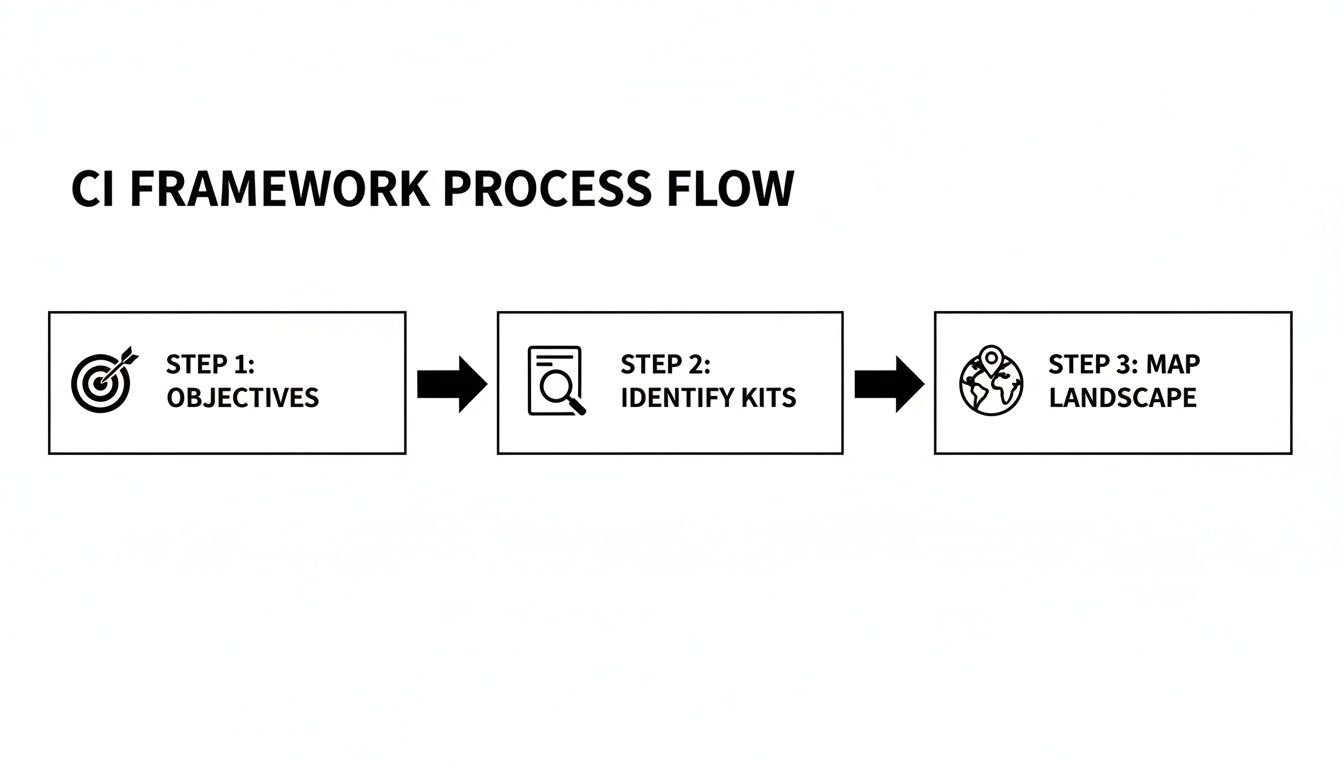
This simple flow—defining objectives, identifying what you need to track, and mapping the landscape—makes sure your data collection efforts are always tied to a clear strategic purpose.
Collecting data is the easy part. The real work—the part that actually moves the needle—is turning all that raw information into a game-changing strategy.
The whole point of competitive intelligence gathering isn't to build massive spreadsheets full of numbers. It’s about finding the story hidden inside the data. This is where you start decoding your competitor's behavior, spotting their patterns, identifying their weaknesses, and uncovering your next big opportunity.
True analysis goes way beyond just noting what a competitor did. You have to dig deeper to understand why they did it and what that move signals about their larger strategy. Think of the data you've gathered as a collection of clues. Your job is to piece them together and see the bigger picture.
Pricing is one of the most powerful and visible signals a competitor sends. Trust me, it’s rarely random. By tracking their pricing over time, you can essentially reverse-engineer their entire approach and use it to your advantage.
Look for recurring patterns in their promotional calendar. For example, does a rival consistently drop prices by 10-15% on the 15th of every month? That's not just a random sale. It could be a deliberate strategy to boost mid-month cash flow or clear out inventory right before a new product drop. It becomes a predictable event you can plan around.
Don't just match prices; understand the strategy behind them. A competitor using penetration pricing to grab market share requires a different response than one using dynamic pricing to maximize margins on best-sellers.
Keep an eye out for these common pricing models:
Once you identify their playbook, you can start anticipating their moves instead of just reacting to them.
Your competitor's ads aren't just there to sell a product; they're a direct window into their customer acquisition strategy. By dissecting their ad copy, creative, and landing pages, you can effectively map out their entire marketing funnel.
Start with the messaging. Are they hammering on features, benefits, or pain points? An ad screaming "50% off" is talking to a completely different customer than one that whispers "sustainably sourced materials." This tells you exactly who they’re trying to attract and what they believe resonates most with that audience.
From there, follow the journey. Click their ads. Where do you land? Is it a product page, a long-form sales page, or an email capture form? This flow reveals their primary goal—are they going for an immediate sale, a lead, or just brand awareness? It’s an invaluable peek into their campaign objectives and conversion tactics.
On marketplaces like Amazon, a competitor’s product listings are a goldmine of strategic intelligence. How they present their products tells you a ton about their operational strengths and where they see market opportunities.
First, look at their product assortment. Are they a niche specialist with a deep but narrow catalog, or are they a generalist trying to be everything to everyone? A sudden expansion into a totally new category could signal a major strategic pivot or an attempt to capture a new customer segment.
Next, get granular with their listing optimization.
This kind of detailed evaluation will quickly reveal gaps in their strategy. If their images are blurry or their copy is weak, that's a weakness you can exploit with superior merchandising.
This space is evolving fast as technology plays a bigger role. The competitive intelligence tools market is forecasted to surge by $27.95 billion between 2024 and 2029, accelerating at a 9.5% CAGR, as AI supercharges data-driven advantages. For brand managers, this means getting real-time intel on competitor ad spends spiking during peak seasons or new product drops that threaten market share.
Ultimately, all this analysis has to lead to action. The insights you generate are only valuable if they actually inform your decisions and you track their impact. Building out a performance metrics dashboard is a fantastic way to measure the results of the strategic changes you make. To get these findings into the hands of your team, a B2B Competitive Battlecard Template can be an indispensable tool for sales and marketing, making sure everyone is aligned and equipped to win.

Alright, this is where all that digging and data analysis really pays off. The final—and most important—part of any competitive intelligence gathering is actually doing something with what you've learned. An insight just sitting in a spreadsheet is worthless. Its value only gets unlocked when it triggers a smart decision that actually improves your spot in the market.
The whole point is to build a simple, repeatable process for turning those "aha!" moments into action. You need a system to decide what to tackle first, who owns it, and how you’ll know if it even worked. Without that bridge from analysis to execution, all your great intel is just interesting trivia.
Let's be real: not every discovery demands a five-alarm fire response. The trick is to prioritize ruthlessly. I always come back to two simple questions: What’s the potential impact on the business, and how much effort will it take?
This approach gives you a powerful but straightforward grid for making decisions. You can quickly sort every opportunity and threat, making sure your team's limited time and energy are spent on the stuff that will truly move the needle.
A simple priority matrix usually shakes out like this:
Priority LevelImpactEffortExample ActionQuick WinsHighLowYour main competitor’s top seller just went out of stock. You can spin up a targeted ad campaign for your alternative right now, hammering home its availability and better features.Major ProjectsHighHighYour analysis shows a growing customer segment your competitors are totally ignoring. Creating a new product line for them is a huge investment, but it could open up an entirely new revenue stream.Fill-InsLowLowA competitor's product page has some really weak, uninspired copy. You can have your team optimize your own listing's bullet points and description. It's a small job that can bump up conversion rates over time.Re-evaluate LaterLowHighAn aspirational competitor launched a super complex loyalty program. It's interesting, for sure, but the development effort is massive and the direct impact on your sales is a total question mark. Best to monitor its success before you even think about building something similar.
This kind of framework stops you from chasing every shiny new thing your competitors do. Instead, it focuses your entire team on what actually matters.
Once you know your priorities, it's time to get tactical. This is where your competitive intelligence directly shapes your day-to-day operations and your bigger strategic bets.
Think of your competitor’s marketing as a live playbook showing you what works with your shared audience.
The best marketing isn't about being the loudest. It’s about saying the right thing to the right person. Competitive intelligence tells you what that "right thing" is by showing you the conversations your rivals are already having—and, more importantly, the ones they're completely missing.
Smart pricing doesn't happen in a vacuum; it’s a direct result of solid intel. Instead of just reacting and price-matching every move, you can get ahead of the game.
Imagine your intelligence shows that a key competitor always runs a big 20% off sale during the first week of every quarter. Armed with that knowledge, you can launch your own "VIP Early Access" sale the week before, capturing all that demand before their promotion even goes live. Just like that, you've shifted from defense to offense.
Sometimes, the most valuable insights aren't about what your competitors are doing, but what they aren't doing.
Ultimately, your intelligence system should be a complete circle. You gather data, find insights, act on them, and then measure the impact on your sales and market share. This creates a powerful cycle of continuous improvement, ensuring your brand isn't just keeping up, but is always one strategic step ahead.
Even with a solid plan, actually digging into competitive intelligence can bring up some real-world questions. I see founders get stuck on the same few hurdles all the time. Getting straight answers is the key to building a CI program that actually helps, instead of just becoming another time-sucking task on your to-do list.
Let's get into some of the most common questions I hear from ecommerce entrepreneurs when they start getting serious about CI.
There's no magic number here. The real secret is consistency over intensity. Forget about boiling the ocean with some massive, one-off research project. It’s way more effective to build a routine you can actually stick with.
A great place to start is just a few focused hours a week.
This approach keeps you in the loop without pulling you away from the million other things you have to do. And as your system gets better, you'll find it all gets faster and more efficient.
This one comes up a lot, and it’s a big deal. The answer is a clear yes, as long as you stick to publicly available information. The goal of competitive intelligence isn't corporate espionage. It’s about systematically looking at the data your competitors are already putting out there for the world to see.
Think of it like this:
The line is crystal clear. Stick to public data sources, and you'll be building your program on a solid, ethical foundation.
Competitive intelligence is really just about being a smarter, more informed player in your market. You're reading the public signals of the competitive landscape, not trying to peek behind the curtain through shady methods.
Easy. The number one mistake is gathering data without a clear purpose. So many founders fall into the "collector's trap," where they hoard mountains of competitor info that just sits there in a spreadsheet. This is a fast track to information overload and total paralysis.
Every single piece of data you collect should help answer a specific question tied to your goals—your Key Intelligence Questions (KIQs). If the data doesn't help you make a decision about your pricing, marketing, or product, you probably don't need it.
Another huge blind spot is focusing only on your direct competitors. The most dangerous threats often come from indirect players or completely new business models you weren't even watching. Just ask Nokia or Blockbuster—failing to see the bigger picture can have catastrophic results. Always keep one eye on the entire market.
At Million Dollar Sellers, our members share real-time competitive insights to stay ahead in the fast-paced world of ecommerce. It's where top founders collaborate to turn intelligence into market-leading action. Learn more about the power of a peer network.
Join the Ecom Entrepreneur Community for Vetted 7-9 Figure Ecommerce Founders
Learn MoreYou may also like:
Learn more about our special events!
Check Events