Chilat Doina
July 29, 2026
Most founders ask how to scale team, then reach for the fastest lever they can see, hiring. That's usually the wrong order. If your growth is being throttled by unclear ownership, broken handoffs, or repeated questions in Slack, adding another body just makes the mess more expensive.
The better move is to treat scaling as a bottleneck-removal problem first and a hiring problem second. Headcount matters, but only after you know what each person is supposed to produce, where work is getting stuck, and whether your current structure can absorb more volume without dragging speed and culture down. In e-commerce, that's the difference between real operating advantage and a payroll bill that outruns the business.
The usual advice says hire faster, delegate more, and build while flying. That sounds aggressive, but it hides the actual problem: weak operational efficiency. If revenue rises and the team has to keep adding headcount just to stay afloat, the company is not scaling cleanly. It is buying more labor to hold the line.
Treat scaling as a capacity planning problem first. A useful framework is Revenue per Employee = Current Revenue ÷ Current Team Size, then Required Team Size = Target Revenue ÷ Revenue per Employee, then Total Hires Needed = Required Team Size - Current Team Size. Use it to pressure-test every hiring decision against output, not ego. If a hire does not raise throughput enough to justify the cost, it is a drag, not growth. For a tighter way to measure that trade-off, a performance metrics dashboard helps track output, support load, and team speed together instead of treating culture as soft HR language. That is the same pressure BambooHR points to when revenue climbs but hiring climbs with it, leaving the business less scalable, not more. In e-commerce, fast sales can hide weak operational efficiency for a long time.

At this size, the founder usually becomes the bottleneck before the company admits it. Everyone starts asking the founder for exceptions, approvals, and final calls, and the whole team moves at the speed of the slowest decision. Add a few hires too early and you often create another bottleneck, managers who are learning on the fly while the founder still holds most of the authority.
There is also a cultural cost. Premature hiring dilutes the working norms that made the first team effective, because new people do not inherit a clear operating system, they inherit a pile of informal explanations. The strongest operators do not start with who to hire next. They start with what is blocking output right now, and what can be fixed without adding payroll.
Practical rule: if you cannot explain the bottleneck in one sentence, you are not ready to hire against it.
A good scaling model starts with diagnosis. Once you know whether the constraint sits in fulfillment, creative, customer support, or management bandwidth, you can decide whether to systemize, upskill, outsource, automate, or hire. That sequence is the difference between disciplined growth and expensive improvisation.
Start with the revenue-per-employee number, but don't use it like a vanity metric. Use it as a diagnostic. If you calculate it against last quarter's revenue and this quarter's headcount, you'll fool yourself, because the timing mismatch makes the company look more efficient or less efficient than it really is.
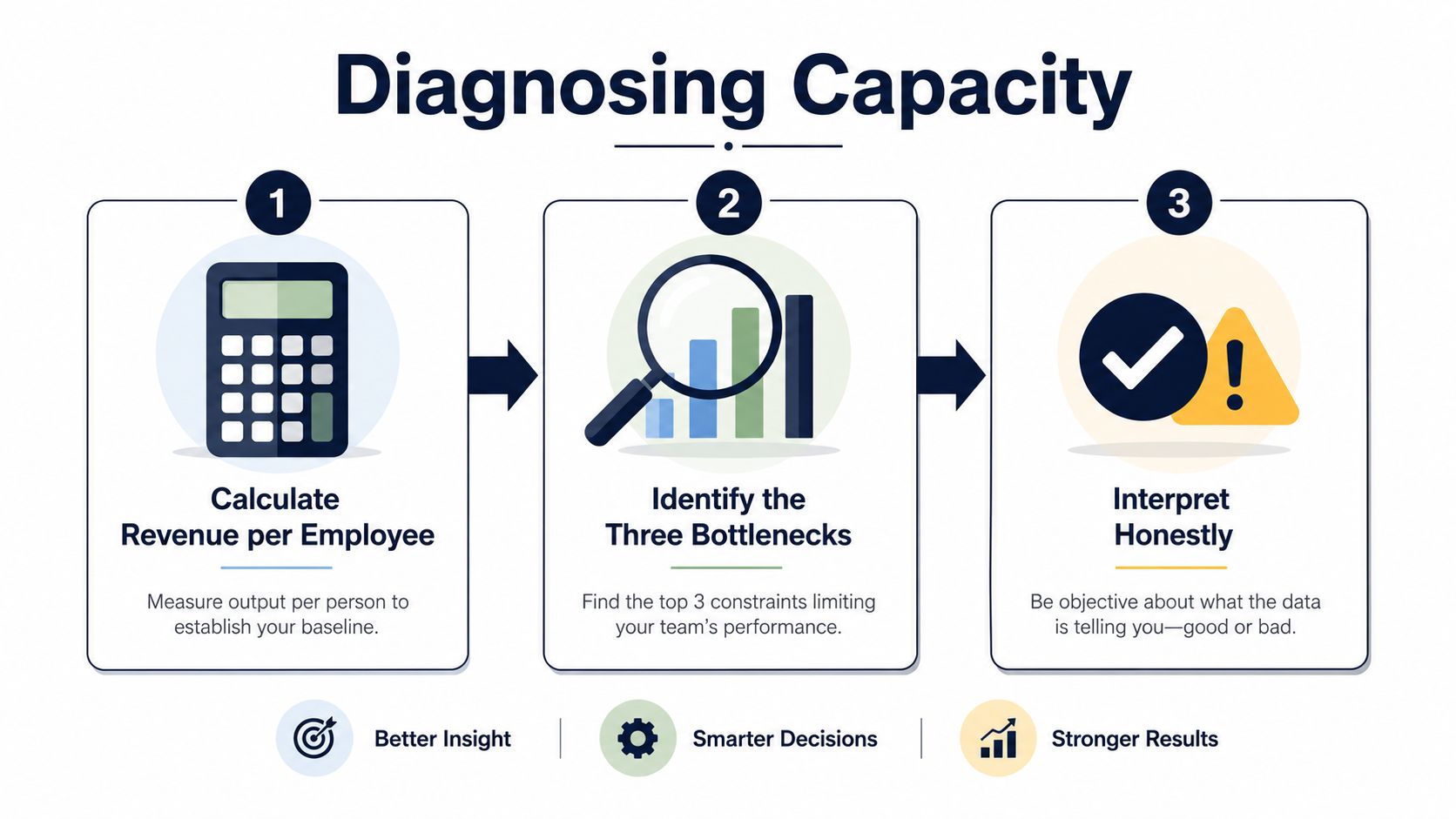
In e-commerce, the constraint usually shows up in one of three places. The first is fulfillment and ops, where orders, warehousing, inventory, or vendor coordination slow everything down. The second is creative and merchandising, where the team can't produce enough winning assets, listings, or launch support. The third is customer and marketplace support, where response load, ticket volume, or marketplace issues eat the day.
The fastest way to spot the core problem is to look at what people are waiting on. If work sits in queue, you have a process or capacity issue. If Slack is full of repeated questions, you have a decision-rights issue. If the team is leaning on overtime to ship normal work, you've got an overloaded system, not a heroic culture.
You don't need a consulting project. Sit down with the core team and write down the work that keeps moving late, gets escalated, or depends on one person's memory. Then map three signals: how long critical work stays in queue, how often the same questions show up in Slack, and whether people are working beyond normal hours just to keep pace.
That gives you a clean baseline to discuss with a cofounder or investor. It also gives you a better answer than “we need to hire.” If you can show that the issue is a creative queue, a fulfillment backlog, or repeated marketplace escalations, the conversation becomes about fixing the constraint, not just adding payroll.
For a useful way to build a working dashboard around this, the performance metrics dashboard guide is a sensible companion reference.
The best diagnostic question is simple. If you froze hiring for 30 days, would the business still be able to increase output by cleaning up process and decision-making, or would it hit a wall? If the first answer is yes, you don't have a headcount problem yet.
Scaling requires adding clarity alongside people. Jonathan Swanson's framework shows the path from ad hoc problem-solving to company philosophies, and the speed of that shift matters. A team of about 10 people can usually operate on a one-page philosophy, but that document often grows into several pages as the company approaches 100+ employees. The point is not paperwork. The point is making decisions repeatable as the founder's reach gets weaker. Source framework
Most founders do this backward. They sketch an org chart, then hunt for people to fit the boxes. Define the work first, assign ownership second, then decide where a manager layer is needed. If a role cannot be described by outcomes, decision rights, and a weekly rhythm, it is not ready for a hire.
The first management layer should appear when coordination starts slipping, not when headcount hits some arbitrary target. The documented engineering guidance suggests a rough span of 1 engineering manager per 8 engineers, with monthly and quarterly review cadences to catch breakdowns early. That ratio matters because management is a throughput tool, not a status layer. Team scaling guidance
Use roles to remove confusion, not to decorate the org chart.
E-commerce teams often break themselves by over-separating too early. Splitting Amazon and DTC into separate P&L owners before the team is ready can create duplicate priorities and slower execution. Centralizing creative under one director too soon can create the same problem, because the brand ends up waiting on one queue for every campaign, PDP refresh, and launch asset.
Keep ownership close to the work until the system is stable. The founder or general manager owns cross-channel decisions. Functional leads own output quality and cadence. Managers step in only when direct oversight has become a bottleneck, not as a reward for tenure.
Remote teams need even tighter structure. The managing remote teams playbook is useful because remote coordination falls apart fast when roles, communication cadence, and escalation paths are vague. If your team spans time zones, write down who decides what, who gets pulled in early, and what waits for the next meeting.
Use the talent planning guide to pressure-test whether each role improves output or just adds another layer between the founder and the work.
The org shape you want is boring in the best way. Clear roles, a narrow number of decision makers, and a written operating philosophy that gets more detailed as headcount grows. That is what lets you add people without turning speed into bureaucracy.
Ad hoc recruiting is expensive optimism. If you want a team that stays, build a pipeline that checks quality before the offer and keeps checking after day one. Use a hiring system that treats retention as a screening problem, not a surprise problem. The hiring pipeline guidance gives the right operating targets for that system, with time-to-fill at 4 to 6 weeks, offer acceptance at 80%+, and 90-day retention at 95%+ as the benchmarks that matter.
Do not depend on one channel and hope it works. Build referrals, targeted outbound, and role-specific communities into the mix, then track which source brings in people who stay and perform. A channel that fills seats but loses people is a bad channel, plain and simple.
Use a hiring channel map to pressure-test where candidates come from and whether each source produces operators or just resumes. Keep the pipeline tied to outcomes, not volume.
Interview for judgment, ownership, and decision-making under pressure, not polish. Reference checks should probe how the person handles ambiguity, deadlines, and cross-functional friction, because that is where scaling teams usually break.
If time-to-fill drags, the problem is usually weak sourcing or a requirement list that is too broad. If offers get declined, the issue is compensation, title, mission fit, or a process that takes too long. If 90-day retention is weak, you hired for the resume instead of the operating style.
The sequence matters too. At a 10 to 15 person team, the playbook points to about 1 to 2 hires per month, which works out to roughly 20 to 30% annual growth. At 15 to 25 people, the pace moves to 2 to 3 hires per month. That keeps hiring controlled instead of swinging between drought and binge, which is how teams end up with bad onboarding and too many half-finished roles. Hiring cadence guidance
For founders who want a vetted peer network while making those calls, Million Dollar Sellers is one option among others. It is built around e-commerce operators sharing advanced resources, events, and experience from larger brands.
Onboarding functions as a throughput system. The job is to move a new hire from orientation to real output fast, without creating avoidable errors, and that only happens when the work is written down, checked, and updated as the team changes.
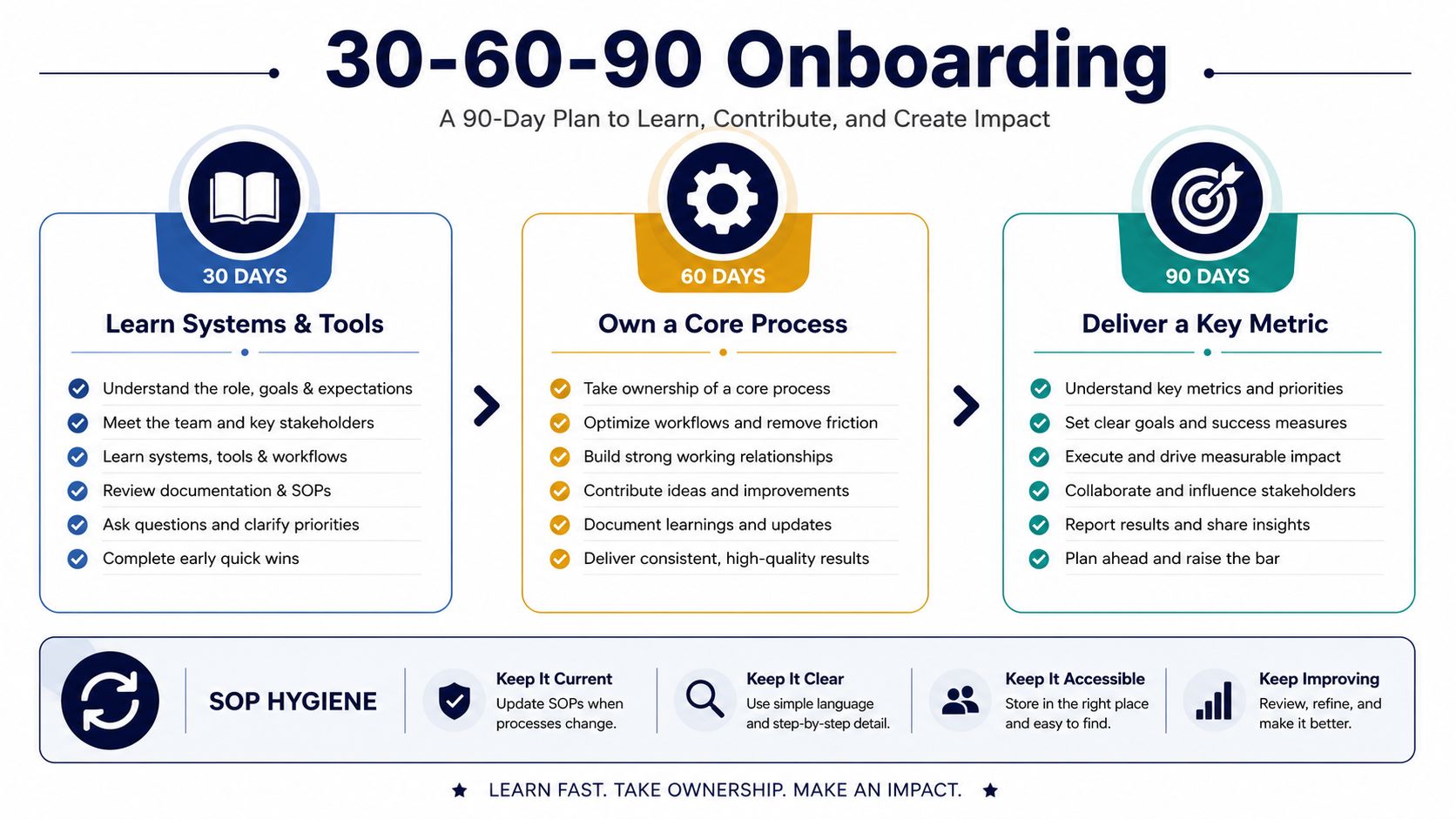
Start with a 30-60-90 day ramp that turns onboarding into a measurable system. In the first 30 days, the person should learn the tools, workflows, and decision paths. By 60 days, they should own a core process without constant rescue. By 90 days, they should be delivering against a key metric tied to the role, not just “getting comfortable.”
That sequence forces clarity. If a new hire still cannot own a process by day 60, the role is vague or the training is weak. If they cannot produce a meaningful metric by day 90, the team has confused activity with output.
Tie that ramp to a simple dashboard. Track onboarding speed, output velocity, and support load together so you can see whether the hire is becoming productive or just consuming management time. That is the test of whether scaling is working, because headcount alone tells you very little.
The worst SOP problem is dead documentation. Good SOPs are short, current, and tied to real work. When a process changes and the document does not, the team falls back on memory, and memory is where scaling breaks.
SOPs should answer one question, what does good look like when this task is done right?
The rhythm matters as much as the document. Weekly manager one-on-ones catch stalled work early. Monthly process reviews expose repeated friction. Quarterly all-hands meetings reset priorities and give leaders a chance to correct drift before it turns into culture.
Use a standard operating procedures guide as a reference if you are building this from scratch. Do not overbuild the system. Make it easy to find, easy to update, and impossible to ignore during training.
A first layer of management should help with this, not bury it. One manager per roughly eight direct reports keeps feedback close enough to the work that problems do not sit unnoticed for a quarter. If people keep asking the same questions, the SOP is incomplete or the manager layer is too thin.
Stop treating every capacity problem as a hiring signal. Sometimes the right move is to clean up the process. Sometimes it's to upskill someone already on the team. Sometimes it's to buy capacity from outside. If you hire first, you often solve the symptom and keep the cause.
| Capacity Model by Function and Revenue Stage | Under $5M | $5M to $25M | Above $25M |
|---|---|---|---|
| PPC | Often outsourced with close founder oversight | Hybrid, in-house strategy with outside execution support | More in-house control with specialist external support |
| Customer Support | Small internal team or managed support partner | Blend of internal leads and outsourced coverage | Strong internal leadership with selective outsourcing |
| Creative | Use freelancers or niche agencies for bursts | Core internal creative plus outside specialists | More in-house ownership, outside capacity for overflow |
| Listing Optimization | Founder-led or outsourced help | Internal owner with external support for specific tasks | Strong internal ownership and process automation |
| Finance | External support is usually enough | Hybrid bookkeeping and internal oversight | In-house finance leadership with specialist support |
If the work is repetitive, rules-based, and easy to verify, automation should be on the table. If the work requires judgment but doesn't need deep institutional knowledge, outsourcing can work well. If the work shapes strategy, customer insight, or cross-functional decision-making, keep it in-house.
PPC is a good example. Early on, a strong external operator can move faster than a half-trained internal generalist. Creative tends to be more mixed, because brand context matters, but overflow production can still live outside the core team. Finance usually starts external and becomes internal only when the complexity justifies it.
The decision rule is blunt. Systemize first, upskill second, hire third. If a process keeps breaking, don't assume the answer is a new person. Ask whether the work can be standardized, whether an existing team member can own it, or whether outside capacity can handle the load without making the company slower.
Retention is a capacity issue. If strong people keep walking, every hiring win gets erased by ramp-up time, lost context, and manager churn. Compensation, promotion paths, and title decisions should reinforce the behavior you want, not protect egos or create status games.
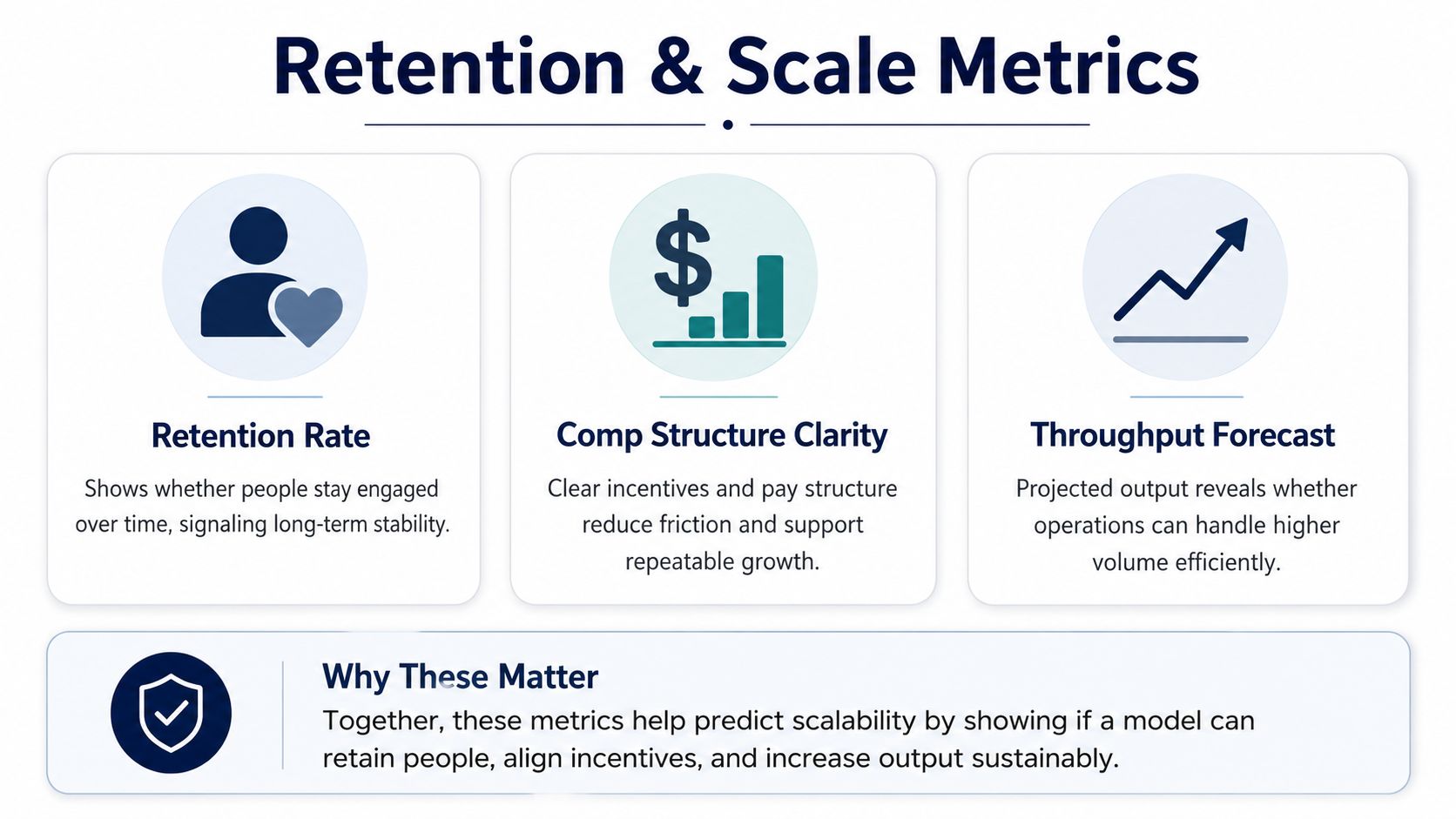
Run a weekly review around three things, onboarding speed, output velocity, and support load. If onboarding is slow, new hires are taking too long to contribute. If output velocity stays flat while headcount rises, the team is absorbing complexity without producing more. If support load keeps climbing, the system is creating more questions than answers.
Use that dashboard instead of a culture survey. It shows whether the company is getting easier to run. A team can sound healthy and still be losing execution speed. If your weekly numbers show that new hires are ramping faster, work is moving faster, and support requests are falling or staying controlled, you are scaling. If those signals are moving the wrong way, headcount is just making the mess bigger.
Compensation should support that outcome. Base pay should remove anxiety, variable comp should reward the right output, and equity should anchor longer-term ownership. The moment titles get inflated faster than responsibility, culture starts to rot from the inside.
Retention improves when people can see a fair path, clear expectations, and a team that doesn't waste their time.
The founders who scale well are not the ones who hire the most aggressively. They are the ones who know when to add people, when to remove friction, and when to keep the org lean enough to move. That is the answer to how to scale team, and it keeps the company fast enough to matter.
Join the Ecom Entrepreneur Community for Vetted 7-9 Figure Ecommerce Founders
Learn MoreYou may also like:
Learn more about our special events!
Check Events