Chilat Doina
December 29, 2025
If you want to build a lasting e-commerce brand, you need to know your numbers. And I don’t just mean top-line revenue. I’m talking about unit economics.
At its core, unit economics is a simple gut-check that answers one critical question: are you actually making money on a single sale? It's the only way to know if more sales will lead to more profit or just dig you into a deeper hole.

Trying to scale an e-commerce brand without understanding unit economics is like trying to build a skyscraper without knowing if a single brick can hold any weight. You might be building something big, but it’s fundamentally unstable and could all come crashing down.
Let's break it down with a simple analogy. Imagine you own a coffee shop. Before you even think about franchising, you have to figure out the profit on one single latte. You’d take the price, then subtract the cost of the beans, the milk, the cup, and even a tiny slice of the barista's wage. If each latte costs more to make than you sell it for, opening more shops just means you lose money faster.
That’s exactly what unit economics does for your brand. It forces you to confront the most important question in business: "Am I profitable on one transaction?"
Getting this right is what separates the brands that fizzle out from the ones that become powerhouses. For both Amazon sellers and DTC brands, the math is straightforward: contribution margin = price per unit – variable costs per sale. This isn't just a helpful metric; it's a non-negotiable skill for anyone trying to compete in an industry set to hit $6.8 trillion in sales by 2025, according to the latest e-commerce transaction data.
By focusing on the profitability of a single unit, you ensure that every dollar you spend on growth is an investment in future profits, not a subsidy for hidden losses. It shifts your mindset from vanity metrics like revenue to the one thing that truly matters: sustainability.
To get a clearer picture of these foundational concepts, let’s quickly break them down.
This table provides a quick rundown of the core terms you'll encounter. Think of it as your cheat sheet for understanding the moving parts of your brand's financial health.
ConceptSimple DefinitionWhy It Matters for Your BrandCustomer Acquisition Cost (CAC)How much it costs, on average, to get one new customer.If your CAC is higher than what a customer spends, you're buying customers at a loss.Customer Lifetime Value (LTV)The total profit you can expect to make from a single customer over time.A high LTV means you can afford to spend more to acquire customers, fueling growth.Contribution MarginThe revenue left over from a single sale after all variable costs are paid.This is the money that contributes to paying your fixed costs (like rent) and generating profit.Payback PeriodThe time it takes for you to earn back the money you spent to acquire a customer.A shorter payback period means healthier cash flow and faster, more sustainable scaling.
Understanding these pieces individually is the first step. Next, you have to see how they work together to paint a full picture of your business.
Nailing your unit economics does more than just confirm you're in the black. It becomes the data-driven bedrock for almost every major decision you'll make.
Ignoring these numbers is one of the top reasons so many brands end up scaling their losses instead of their profits. Before we get into the nitty-gritty of the calculations, just remember this: your business can only grow for the long haul if each and every sale is profitable.
To really get a handle on unit economics, you have to zoom in on three core numbers. These aren’t just entries in a spreadsheet; they’re the vital signs of your ecommerce business. The magic happens when you understand how they dance together—that’s the real key to unlocking profitable, sustainable growth.
Think of it like a recipe. If you get the proportions wrong, the whole dish is a bust, no matter how good the individual ingredients seem on their own. Let's break down each one.
Your Customer Acquisition Cost (CAC) is simply the price you pay to get a new customer in the door. It’s all your sales and marketing costs divided by the number of new customers you brought in during that time.
For example, say you spend $5,000 on a Facebook ad campaign and it nets you 200 new customers. Your CAC is a quick calculation:
$5,000 (Ad Spend) / 200 (New Customers) = $25 CAC
This number tells you the immediate cost of growth. Without it, you're just flying blind—pouring money into marketing channels without a clue if they're actually building your business or just draining your bank account.
While CAC is what you pay to get a customer, Lifetime Value (LTV) is the total profit you expect to make from them over their entire relationship with your brand. It’s the long-term payoff for that initial investment.
A customer might make a single $100 purchase, but if they fall in love with your product, they could keep coming back for years. Their LTV isn't just that first sale; it's the sum of everything they'll ever buy. Nailing this prediction is crucial for making smart decisions today. For a deeper dive, you can check out our guide on calculating customer lifetime value.
These two metrics don't live on separate islands. Their relationship is what truly tells the story of your business's health.
The LTV to CAC ratio is the ultimate health score for your business model. It answers the single most important question: "Are we spending our marketing dollars wisely?"
This ratio compares the total value you get from a customer to what you spent to get them. A healthy ecommerce business should be shooting for a ratio of 3:1 or higher. In plain English, for every dollar you spend on acquisition, you should be generating at least three dollars in profit over that customer's lifetime.
In the world of ecommerce, where the "unit" is often the customer, this ratio is the make-or-break benchmark for scaling. And the stakes are huge. U.S. Census Bureau data shows e-commerce sales hit a staggering $310.3 billion in Q3 2025, a 5.1% jump from the previous year. If you want a profitable piece of that pie, your LTV/CAC ratio has to be rock solid.
Let’s look at what different ratios mean for your business:
Of course, LTV and CAC are just part of the picture. To get a complete view of your company's health, you need to understand broader metrics like the net profit margin. While unit-level numbers guide your day-to-day decisions, these bigger financial indicators ensure the entire ship is sailing in the right direction.
Alright, let's move from theory to action. It’s one thing to know what the terms mean, but actually crunching the numbers is where you seize control of your business's profitability. This is your hands-on guide to figuring out the math for both Amazon FBA and your own Direct-to-Consumer (DTC) store.
To make this super tangible, we’ll stick with a simple product example for both scenarios.
Let's imagine you're selling a high-quality face cream for $50. Using the same price point for both Amazon and a Shopify store will really highlight how the variable costs stack up differently on each channel.
The goal here isn't just to see what's left over at the end. It's to dissect every single cost that nibbles away at your revenue for each unit you sell. Getting this level of detail is what unlocks smarter, more strategic decisions.
Selling on Amazon FBA gives you incredible reach, but that access comes with a very specific set of fees you absolutely have to account for. These aren't overhead—they are direct, variable costs tied to every single sale.
Here’s the breakdown for our $50 cream:
Now, let's pull it all together.
Amazon Unit Economics Formula:
Retail Price - COGS - Referral Fee - FBA Fee - Ad Spend = Contribution Margin Per Unit
Plugging in our numbers:
$50.00 (Price) - $10.00 (COGS) - $7.50 (Referral) - $5.50 (FBA) - $10.00 (Ads) = $17.00
In this scenario, your contribution margin is $17.00 every time you sell a cream on Amazon. This is the cash each sale generates to help cover your fixed costs (like software, salaries, and rent) and then, finally, become profit. Getting a handle on this number is a game-changer, and you can dive deeper into what contribution margin is to understand just how powerful it is for driving profitability.
When you sell directly from your own site on a platform like Shopify, the cost structure looks a little different. You dodge Amazon’s fees, but you pick up new variable costs like payment processing and handling your own shipping.
Let's run the numbers for the same $50 skincare cream on a DTC channel:
Time to calculate the DTC contribution margin.
DTC Unit Economics Formula:
Retail Price - COGS - Payment Processing - Shipping - CAC = Contribution Margin Per Unit
Plugging in our numbers:
$50.00 (Price) - $10.00 (COGS) - $1.75 (Processing) - $7.00 (Shipping) - $15.00 (CAC) = $16.25
For every DTC sale, you’re adding $16.25 to your contribution margin.
Putting the two models next to each other instantly clarifies where your money is going. This kind of visibility is crucial when you're deciding where to focus your strategy and resources.
MetricAmazon FBA ModelDTC (Shopify) ModelRetail Price$50.00$50.00COGS-$10.00-$10.00Platform/Processing Fees-$7.50-$1.75Fulfillment & Shipping-$5.50-$7.00Marketing/Ad Cost-$10.00-$15.00Contribution Margin$17.00$16.25
As you can see, one channel isn't automatically "better" than the other—they just have completely different levers and costs. Armed with this per-unit breakdown, you can now make truly informed decisions on everything from pricing and ad spend to operational tweaks that will boost your profitability on every single sale.
Running the numbers on your unit economics is like a doctor running diagnostics. The real magic happens when you use that diagnosis to write a prescription for your business. Once you have these metrics, they become your brand’s compass, pointing you toward profitable growth and steering you away from costly dead ends. This isn't just about filling up a spreadsheet; it's about building the foundation for every big move you make.
When you see a healthy contribution margin and a strong LTV to CAC ratio, that’s your green light. It’s a sign that your business model is solid and ready to scale. This is your cue to confidently pour more fuel on the fire—investing in marketing knowing that every new customer will actually make you money over time.
On the flip side, weak numbers are a flashing red light. If your contribution margin is razor-thin or your LTV to CAC is hovering below the healthy 3:1 benchmark, it's a clear signal to pump the brakes on growth. Trying to scale a broken model just means you lose money faster. This is when you pivot from acquisition to optimization.
This flow chart breaks down the simple but powerful math at the heart of it all.
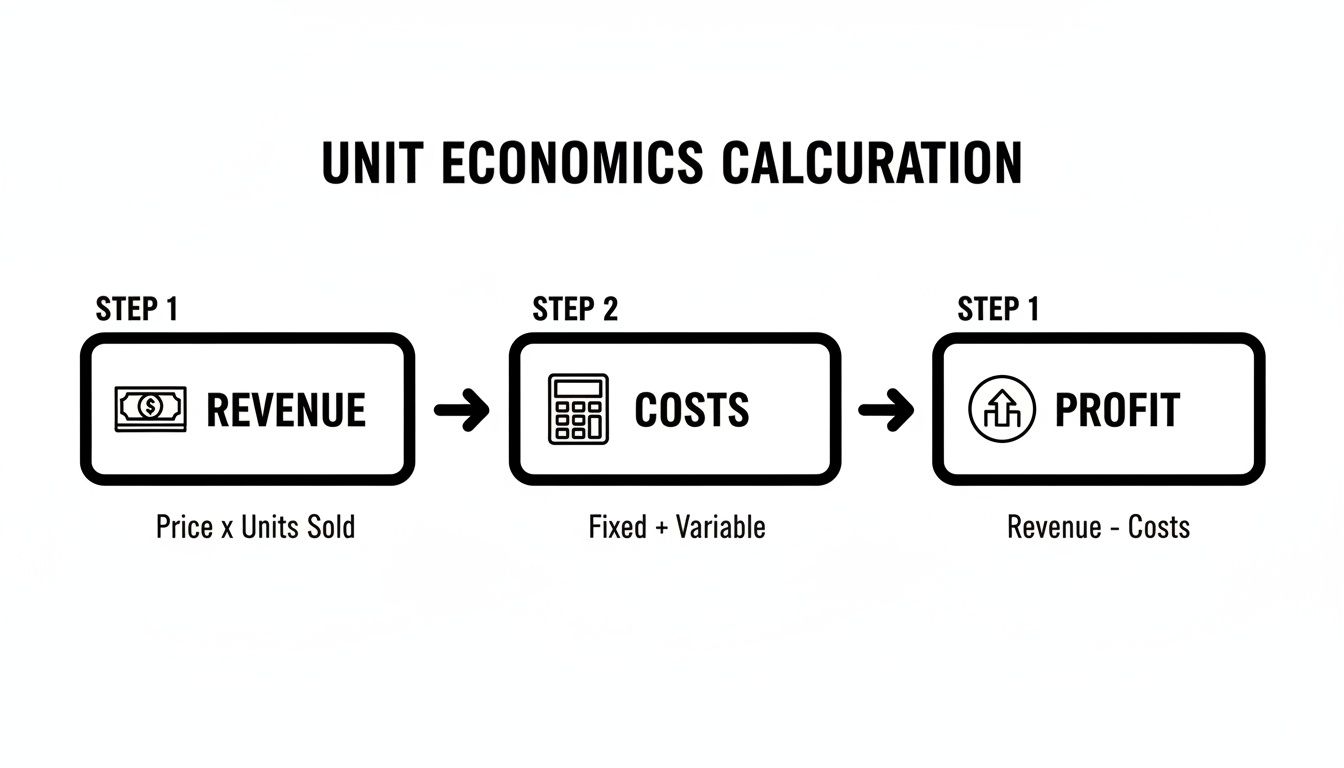
It shows exactly how you strip away the variable costs from your revenue to find your true per-unit profit—the number that should drive every single decision you make.
Understanding what your unit economics are telling you is one thing, but knowing what to do about it is what separates the brands that thrive from those that just survive.
To help you connect the dots, here’s a quick guide to translating those signals into concrete actions.
Unit Economics Signal (The Problem)Potential Root CauseStrategic Action to TakeLow Contribution MarginProduct is underpriced; Cost of Goods Sold (COGS) is too high; Shipping costs are eating into profits.Test strategic price increases; Renegotiate with suppliers or find new ones; Optimize packaging to reduce shipping weight/dimensions.High Customer Acquisition Cost (CAC)Inefficient ad spend; Targeting the wrong audience; Low-performing marketing channels.Audit marketing channels and reallocate budget to top performers; Refine audience targeting; Improve ad creative and landing page conversion rates.Low Lifetime Value (LTV)Poor customer retention; No strategy for repeat purchases; Product is seen as a one-time buy.Implement an email marketing flow for post-purchase engagement; Create a loyalty program or subscription model; Develop and launch complementary products.Long Payback PeriodHigh initial CAC combined with low initial order value.Focus on increasing Average Order Value (AOV) through bundles and upsells; Optimize marketing for channels with faster conversion cycles.
This framework isn't just a checklist; it's a way of thinking. It forces you to look at a problem (like a high CAC) and immediately start digging for the root cause so you can apply the right solution.
One of the fastest ways to fix your unit economics is by adjusting your price. If your contribution margin is squeezed, there's a good chance your product is simply underpriced for the value it delivers. Even small, strategic price increases can have a massive impact on your bottom line, often without scaring away too many customers.
Start testing. Does a 10% price bump improve your margin enough to make up for a tiny dip in sales volume? More often than not, the answer is a resounding "yes," leading to a much healthier and more sustainable business.
Not all traffic is created equal. Your blended CAC can easily hide the fact that one channel is a goldmine while another is just burning cash.
By breaking down your unit economics on a per-channel basis, you’ll quickly see which sources are bringing in high-LTV customers for cheap. This lets you double down on what’s working and mercilessly cut what isn’t.
Imagine you find out your Google Ads CAC is $15, but your Facebook Ads CAC is $40. That insight is pure gold. It tells you to shift budget from Facebook to Google, instantly making every new customer you bring in more profitable. If you’re struggling with high acquisition costs, our guide has several strategies on how to lower customer acquisition cost.
If acquiring customers is expensive, the logical next move is to make more money from the ones you already have. Your unit economics will tell you when it’s time to focus on strategies that increase LTV.
This is where you can get creative. Consider things like:
For e-commerce brands, especially those on Amazon, these calculations are critical when planning new launches. An A to Z guide for new product launches on Amazon can help you map out the entire process. In a global e-commerce market projected to hit $6.8 trillion in 2025, getting your fulfillment and supply chain costs right is non-negotiable. The top Amazon sellers consistently hit 30-50% gross margins after all the fees because they’ve mastered these details, giving them a huge advantage.
Even the sharpest entrepreneurs can get tripped up when analyzing their unit economics. It's easy to do. But these common mistakes can paint a dangerously misleading picture of your profitability, causing you to scale your losses instead of your wins.
Getting your numbers right means being ruthlessly honest about every single cost. Think of it like the difference between a rough sketch and an architectural blueprint. The sketch gives you the general idea, but you can't build a stable business on it. The blueprint, on the other hand, accounts for every last wire and pipe.
One of the most frequent errors I see is underestimating the Cost of Goods Sold (COGS). A lot of founders just look at the factory price of the product and stop there. That's only the beginning of the story.
Your true COGS has to include every single expense it takes to get that product into a fulfillment center, ready to be picked, packed, and shipped.
This includes some sneaky but significant costs that often get missed:
Forgetting these costs makes your margins look much healthier than they actually are. A product that seems profitable on paper might actually be a money-loser with every single sale.
This is a huge one. It’s a critical distinction that trips up a ton of sellers. Gross Margin (Revenue - COGS) is a useful, high-level number. But Contribution Margin (Revenue - All Variable Costs) is what truly defines your unit economics.
Contribution margin subtracts every cost associated with a single sale, not just the physical cost of the product itself.
Your gross margin tells you if your product is profitable. Your contribution margin tells you if your business model is profitable at the unit level. It’s the cash left over to pay for all your fixed operating expenses and, eventually, become profit.
Forgetting to subtract variable costs like payment processing fees, shipping supplies, pick-and-pack labor, and your ad spend will give you a false sense of security. Always, always focus on contribution margin for the real story on per-sale profitability.
Finally, relying on a single, blended Customer Acquisition Cost (CAC) across all your marketing channels is a recipe for disaster. It's a vanity metric that can easily mask deeply unprofitable campaigns.
You might have one channel that brings in customers for $10 and another that costs a whopping $70. A blended CAC of $40 completely hides the fact that you should be killing the expensive channel and pouring every last dollar into the efficient one.
To get an honest read on your marketing, you have to calculate CAC on a channel-by-channel basis. It's the only way to make smart, data-driven decisions about where your ad budget should go. Without that level of detail, you're just flying blind and throwing money at campaigns that are actively destroying your unit economics.
Once you start digging into your unit economics, you're bound to have questions. This isn't just theory—it’s about getting your hands dirty and applying these concepts to the real world of your e-commerce brand. Let's tackle the most common hurdles and questions founders run into, so you can move forward with confidence.
For any e-commerce business, you should be looking at your unit economics at least monthly. Think of it as a regular health checkup for your business. Things like ad costs, supplier pricing, and shipping rates are always in flux, and a monthly review lets you react before small shifts turn into big problems.
Now, during make-or-break periods—like a big product launch or the Q4 holiday rush—you’ll want to ramp that up to a weekly review. That’s just smart, proactive management. The end goal is to build a simple dashboard where your key metrics are always visible. That way, you can spot trends early and make adjustments on the fly.
A sudden spike in your Customer Acquisition Cost (CAC) or a drop in your contribution margin is a fire alarm. It’s a signal to dig in right now, not at the end of the quarter. And if you're selling across multiple channels, like your own DTC store and on Amazon, a channel-specific monthly review is non-negotiable. You have to know where your resources are most profitable.
The gold standard for a healthy, scalable e-commerce brand is an LTV to CAC ratio of 3:1 or higher. It’s the magic number that signals a sustainable, profitable business model. Plain and simple, it means that for every dollar you spend to get a customer, you make at least three dollars in profit from them over their lifetime.
Here's how to think about the different ratios:
But remember, context is everything. A brand-new company might accept a lower ratio for a short period just to grab market share. Likewise, a subscription business might be fine with a lower initial ratio because they know LTV will grow predictably over time.
A strong LTV to CAC ratio is your proof that the business model works. It's the ultimate green light, giving you the confidence to invest aggressively in growth because you know that scaling up will lead to more profit, not just more revenue.
With subscription models, the "unit" is almost always the customer. The whole game is about accurately predicting their Lifetime Value (LTV). The approach is a little different from a one-off purchase, but the core logic is the same.
First, you need to know your Average Revenue Per Account (ARPA), which is usually just your average monthly or annual subscription price.
Next, you have to nail down your customer churn rate. This is the percentage of subscribers who cancel each month, and it's absolutely critical for figuring out how long the average customer sticks around.
The basic formula for LTV is straightforward:
LTV = ARPA / Customer Churn Rate
Let's say your monthly subscription box costs $40, and your monthly churn rate is 5% (or 0.05). The math looks like this:
$40 / 0.05 = $800 LTV
This tells you that you can expect to bring in $800 in revenue from the average subscriber before they leave. Your CAC is calculated just like any other business. The key to a winning subscription model is making sure your CAC is way, way lower than this LTV, creating a fat, sustainable margin.
Seeing a negative contribution margin is a five-alarm fire. It means you are losing money on every single sale you make—before you even pay for fixed costs like rent or salaries. You have to fix this immediately. Scaling a business with a negative margin only makes you lose money faster.
Take these two steps, right now:
Don't panic, but act with urgency. The first job is to stop the bleeding by finding the biggest cost drains. From there, you can make clear-headed decisions about cutting costs, raising prices—or both—to get your unit economics into the black and build a business that can actually last.
Ready to scale smarter with insights from the top minds in e-commerce? Million Dollar Sellers is an exclusive community where 7-, 8-, and 9-figure founders share the strategies that work. If you're serious about growth, see if you qualify to join MDS.
Join the Ecom Entrepreneur Community for Vetted 7-9 Figure Ecommerce Founders
Learn MoreYou may also like:
Learn more about our special events!
Check Events