Chilat Doina
May 3, 2026
If you're already running a real e-commerce business, you know the feeling. Your ad costs climb, your usual wholesale channels get tighter, and the easy inventory is long gone. You don't need another side-hustle video telling you to buy a random pallet and hope for treasure. You need a sourcing channel that can plug into an actual operation, survive scrutiny from your finance team, and scale without wrecking your margins.
That's where amazon warehouse return pallets get interesting. Not because they're glamorous. Because they can become a durable inventory input if you treat them like procurement, not entertainment.
A lot of established sellers hit the same wall. Revenue is healthy, but sourcing gets brittle. One supplier slips, one hero SKU slows down, or one marketplace policy change compresses your margin. You start looking for inventory pools other operators ignore because they're messy.
Amazon returns are one of those pools. Amazon processes approximately 1.2 to 1.5 billion returned packages annually, equal to a 5 to 15% return rate across most categories, based on 4.8 billion global package deliveries in 2024. Returns also rose 39.2% from 2023 to 2024, with reverse logistics costs estimated at $40 to $88 billion yearly, according to Red Stag Fulfillment's breakdown of Amazon return volume.
That matters for one reason. Volume creates continuity. Serious operators don't need a one-time score. They need repeatable access to inventory with enough depth to build systems around it.
Amazon isn't sentimental about low-value returned goods. If the cost to inspect, restock, relabel, and route an item back into sellable inventory exceeds the likely recovery, that item gets pushed into liquidation channels. That's how return pallets exist in the first place.
For resellers and brand operators, that creates a strange but useful mismatch. An item that doesn't justify Amazon's handling cost can still make sense for a business with lower labor costs, better refurbishment workflows, a different sales channel, or stronger category knowledge.
The winners usually aren't beginners chasing retail value screenshots. They're operators who already have some combination of:
Practical rule: Return pallets become attractive when your team can create value after the buy. If you can't inspect, repair, repackage, or reroute inventory better than the average buyer, you're just paying for uncertainty.
The big mistake is treating this market like a lottery. The key opportunity is treating it like distressed inventory acquisition. That's a very different business.
Many investors enter this market with the wrong mental model. They think a pallet is a mysterious bulk box. It isn't. It's the end result of a logistics decision.
A customer returns an item. Amazon receives it, routes it through internal handling, and decides whether the item belongs back in sellable stock, in a lower-priority channel, or in liquidation. Once enough similar or mixed goods accumulate, those units get bundled into bulk lots that resellers can buy.
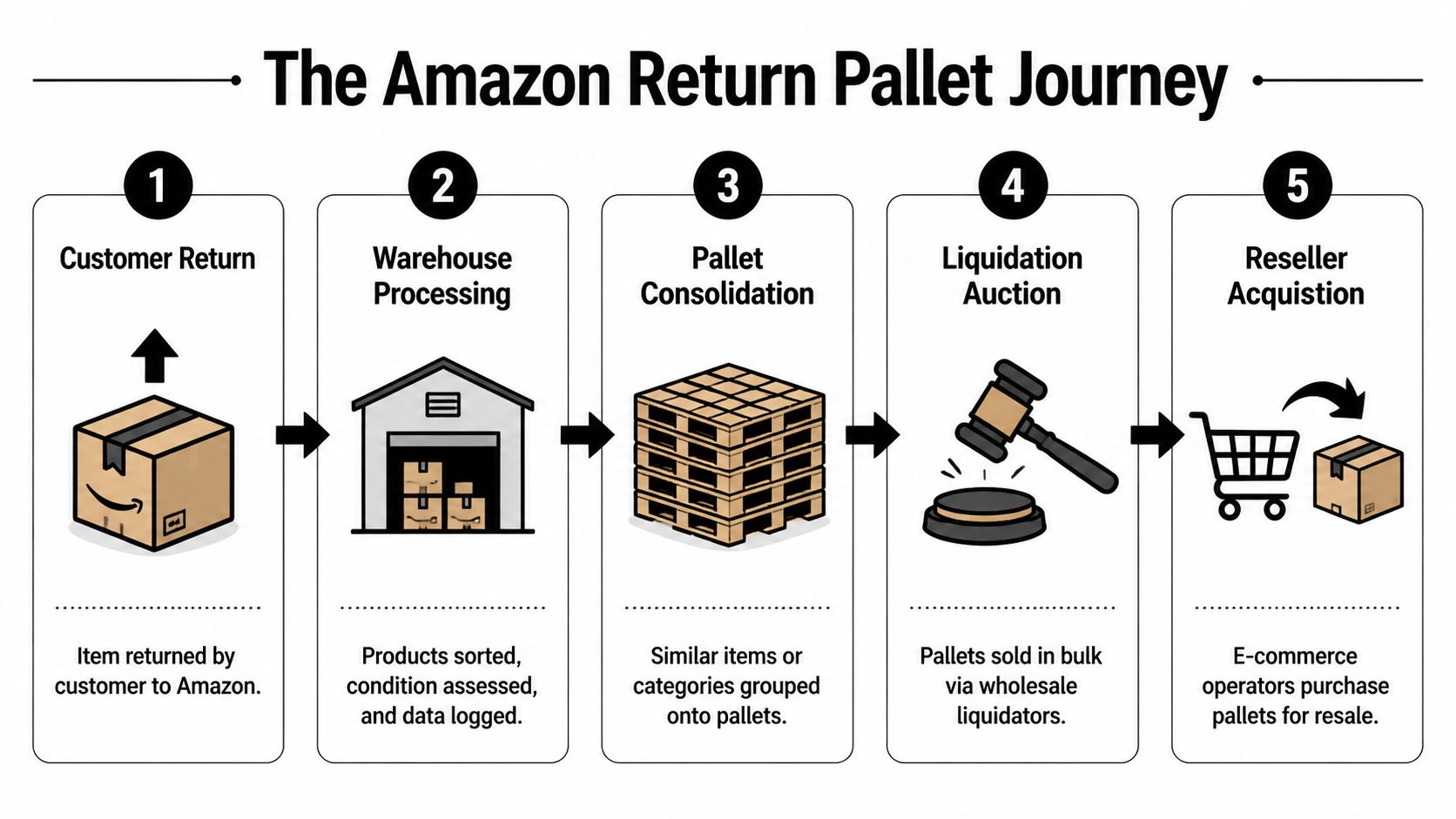
The practical path looks like this:
Customer return arrives
The item comes back through Amazon's return network.
Warehouse handling begins
Staff or systems log the return, check basic status, and route it according to internal recovery economics.
Items get grouped
Goods may be sorted by category, condition range, or mixed into broad merchandise lots.
Bulk liquidation listing goes live
A liquidation marketplace or partner offers the lot to business buyers.
Reseller takes over
The buyer now owns the recovery problem and the profit opportunity.
The key point is that pallets aren't uniform. Two electronics pallets can have completely different risk profiles depending on handling quality, manifest accuracy, and item condition.
Not all amazon warehouse return pallets deserve the same bid strategy.
These are usually the easiest entry point for professional buyers. You can evaluate item mix, check whether the lot aligns with your existing workflows, and estimate resale routes before bidding.
Best fit: operators with tight buy rules and channel discipline.
These can work if you know the category cold and your receiving team is fast. They can also wreck your economics if you're relying on listed retail value that doesn't exist.
Best fit: buyers who can absorb variance.
These look attractive because they spread category risk. In practice, they often create labor drag. Your team has to identify, test, list, and route completely different product types.
Best fit: liquidation stores, local resale, or broad secondary-market operators.
These are the most strategic for established businesses. If the product family overlaps with what you already sell, you can use existing listing knowledge, packaging standards, and customer support rules to recover more value.
Best fit: omnichannel brands with category specialization.
The exact wording varies by marketplace, but this framework is the one that matters operationally.
| Grade | Description | Typical % of Pallet | Resale Strategy |
|---|---|---|---|
| New or like new | Sealed, unused, or opened with minimal signs of handling | Higher-yield portion in stronger lots | Route to Amazon or premium channels after verification |
| Open box | Packaging opened, item may be complete and functional | Common in many pallets | Test, repackage if needed, then sell on marketplaces that tolerate open-box inventory |
| Used | Functional but shows wear, handling, or missing noncritical packaging | Often a meaningful share of real-world lots | Sell on secondary channels with clear condition notes |
| Damaged | Needs cleaning, parts, repair, or repackaging | Present in many return streams | Recover only if your labor and parts economics make sense |
| Salvage | Non-working, incomplete, or not worth full refurbishment | Lowest-value layer | Harvest parts, bundle, liquidate again, recycle, or write off |
A manifest tells you what the seller says is there. Your margin depends on what your team verifies after the pallet hits the floor.
Before placing a bid, experienced operators read for friction, not just upside.
They ask simple questions. Does this lot match a channel I already control? Can my team test these items without building a new workflow? Will this create listing risk on Amazon? Can I resell the lower-grade tail somewhere else, or will it sit?
That last question matters more than beginners think. The top line on a pallet isn't the issue. Disposal strategy is.
The safest way to start is boring. That's good. You want documented business sellers, real manifests when available, freight clarity, and dispute procedures that at least resemble a process.

The operators who lose money early usually skip that discipline. They buy from social sellers, chase mystery lots, or trust photos instead of documentation. That's not sourcing. That's gambling with freight attached.
For most businesses, the shortlist starts with the major liquidation marketplaces tied to real inventory pipelines.
| Platform | Best use case | Buying model | What to watch |
|---|---|---|---|
| B-Stock | Buyers who want the closest thing to an official channel | Auction | Competitive bidding, freight planning, and manifest review discipline |
| Liquidation.com | Broad marketplace access across categories | Auction and other lot formats | Lot quality varies, so listing review matters |
| BULQ and similar reputable platforms | Teams that prefer simpler procurement and smaller operational surprises | Often more structured than pure auction environments | You still need a receiving and grading process |
If you're evaluating B-Stock specifically, this MDS look at B-Stock Amazon pallets is useful because it frames the buying process more like inventory procurement than a flip play.
A good first pallet does not need the highest theoretical upside. It needs the highest operational fit.
Start with a category your team already understands. If you already sell home goods, don't buy mixed consumer electronics because the manifest looks exciting. If your staff doesn't know how to test electronics, identify missing accessories, or spot model-specific defects, that pallet will eat labor and create returns downstream.
A smart first buy usually has these traits:
Buy the pallet your current operation can process well, not the pallet that looks best in a thumbnail.
There are a few patterns I wouldn't negotiate with.
For a quick visual on how some sellers talk through the channel, this overview is useful as a market primer before you start bidding:
Many businesses assume access is the moat. It isn't. The moat is disciplined bidding.
Set a max bid before the auction heats up. Build in freight. Assume some listed items will disappoint. Assume your team will spend real time receiving and sorting. If the pallet only works when everything goes right, it doesn't work.
That's the first professional shift in this business. You don't ask, "How much retail value is on this pallet?" You ask, "At what number does this lot still make sense after friction?"
Profit is made before the bid clears, but it gets protected on the receiving dock. A lot of businesses fool themselves at this stage. They think buying below retail creates margin automatically. It doesn't. Margin shows up when your team converts a chaotic pile of returns into correctly graded, correctly routed inventory with a known cost basis.
Amazon return pallets typically cost $300 to $400 per pallet for standard lots. Higher-value lots can cost more, and freight is where beginners get punished. As noted in AI Journal's report on Amazon return pallet economics, profitable flips can generate $3,000 to $15,000 on a $5,000 investment, but $250 to $450 in LTL freight shipping can double landed cost for inexperienced buyers who don't model the full stack.
If your first touchpoint is confusion, your numbers will be fiction.
Use a simple floor process:
Check shipment against purchase records
Confirm pallet count, labels, visible damage, and receiving notes.
Break down by disposition lane
Create separate zones for immediately sellable, test required, repairable, parts harvest, and discard.
Verify against manifest if one exists
Reconcile what arrived with what was promised. Flag missing or substituted items fast.
Assign internal grade
Don't rely on marketplace labels. Use your own grading standards tied to resale channel.
Record actual recovery path
Every unit should end up tied to a lane and expected outlet.
Use a plain internal formula:
Landed cost per sellable unit = pallet cost + freight + receiving labor + testing labor + packaging inputs + repair inputs + marketplace prep costs, divided by units you can sell
That last part matters. Not total units. Sellable units.
A pallet with a low purchase price can still be expensive if too many items require labor, sit unsold, or get downgraded into low-recovery channels. Teams that miss this usually overstate margin by counting every item as monetizable inventory.
Operator note: The fastest way to lose money is to spread pallet cost across every item instead of the items that will realistically recover value.
When you have a detailed manifest, valuation is a filtering exercise. You're checking whether the lot fits your business model and whether your likely recovery beats your cost stack with room for error.
When you don't have a strong manifest, valuation becomes a category bet. In that case, buy only where your existing experience creates an edge. If you already know the resale patterns, common defects, packaging needs, and return reasons for a category, you can tolerate more uncertainty than a generalist buyer can.
A disciplined review usually includes:
A lot of bad pallet buying can be traced to one of three habits.
The first is using listed retail value as if it were revenue. It isn't. The second is ignoring labor because the owner plans to "do it themselves." That's still labor. The third is failing to separate premium recovery inventory from grind-heavy low-value stock.
If a pallet only looks attractive because you're pretending processing is free, skip it. If the lot depends on dozens of tiny low-value listings to make the math work, skip it. If your team has no clean path for the bottom layer of the pallet, skip it.
One pallet can live in a garage. A real pallet program can't. Once you move past occasional buys, your bottleneck shifts from sourcing to operations. Freight, dock access, storage discipline, resale documentation, and accounting controls become part of the margin equation.
Experienced operators separate themselves from hobby buyers. They don't just buy better pallets. They run better systems around the pallets.
Your processing space doesn't need to be fancy. It needs to be predictable.
At minimum, set up dedicated zones for inbound receiving, inspection, test bench work, repackaging, ready-to-list inventory, and low-value hold inventory. If pallets are arriving regularly, loading access matters too. Teams that haven't worked through dock design should review a complete guide to dock levelers because pallet unloading gets expensive fast when your physical setup fights the freight process.
For operators considering outsourced logistics, this overview of what 3PL fulfillment means helps frame when to keep processing in-house and when to split receiving, prep, and outbound across partners.
If you're routing any recovered inventory back into Amazon, the pallet itself has to meet Amazon inbound standards. Amazon warehouse return pallets that re-enter FBA need to be built to the same structural expectations as standard inbound pallets.
According to UniCargo's summary of Amazon pallet requirements, the standard pallet size is 40 x 48 inches, single pallets can't exceed 72 inches in height, double-stacked pallets are capped at 100 inches, and the weight limit is 1,500 lbs in major US and EU markets. The same source notes requirements around four-way forklift access, clear stretch wrap, and pallet construction that supports acceptance at receiving.
That sounds technical until a shipment gets rejected, delayed, or manually handled. Then it becomes expensive.
The unglamorous side of this business protects margin just as much as sourcing does.
Use this checklist:
If finance can't tell what you bought, what became sellable, what got harvested, and what got written off, your pallet operation isn't scalable yet.
There are also tax and accounting complications once volume rises. Panda Boom's discussion of return pallet gaps points out issues around sales tax nexus, inventory valuation methods such as FIFO and LIFO, shrinkage treatment, and the need for stronger bookkeeping as pallet volume scales. The exact setup depends on your business structure and states of operation, so this is CPA territory, not forum-advice territory.
They standardize decisions.
They don't let every receiver decide condition grades ad hoc. They don't let every channel manager improvise where inventory goes. They don't treat repairs as a side project with no labor cost. And they don't confuse sales volume with profitable recovery.
The more pallets you process, the more dangerous inconsistency becomes. One sloppy grading rule can create bad reviews. One weak inbound SOP can create hidden inventory. One messy accounting policy can distort the entire program's profitability.
Once your intake process is stable, the true game begins. You're no longer trying to squeeze value out of a random pile of returns. You're trying to place each item into the channel where it earns the highest clean margin with the lowest downstream risk.
That's where most of the upside lives.
Not every recovered item belongs on Amazon. In fact, forcing too much pallet inventory into FBA is one of the easiest ways to turn a good buy into a customer-experience problem.
The stronger approach is to sort by channel suitability:
Smart operators win here. They don't ask one channel to solve every problem.
The highest-skill buyers extract value at the SKU and sub-SKU level. They know when to relist, when to bundle, when to salvage components, and when to move inventory out fast to protect cash flow.
Az Big Media's overview of advanced pallet buying notes that top sellers achieve 50%+ margins by integrating pallets into an omnichannel strategy, routing high-value electronics to DTC sites and using parts from Grade C items for private label products. The same source warns that sending untested products directly to FBA can trigger 15 to 25% return rates that damage ASIN performance.
That's the strategic divide. Professionals protect the core brand first, then monetize the pallet around that rule.
If you already run a brand, pallet inventory should support the business, not pollute it.
Good uses include:
Bad uses are just as clear:
If you're building a broader strategy around liquidation sourcing, this guide to buying bulk and reselling is a useful companion because the same margin logic applies across channels.
The best pallet operators don't maximize resale price on every item. They maximize business-level profit while protecting listing health, brand trust, and operational speed.
A lot of operators stop at refurbishment. That's leaving money on the table.
Grade C inventory can still matter if it feeds a profitable system. Parts harvesting works especially well when your team repeatedly sees the same product families and can identify reusable components, packaging inserts, accessories, or subassemblies that support another SKU, a bundle, or an in-house product line.
This only works with process. You need labeling, storage discipline, and a clear rule for how long harvested parts stay in inventory before they get cleared out. Otherwise, parts become warehouse clutter disguised as optionality.
The last lever isn't sexy. It's speed.
Pallet businesses slow down when teams overanalyze every borderline unit. Set thresholds. Decide what gets tested, what gets repaired, what gets broken down for parts, and what gets exited immediately. A slower, more "thorough" process often destroys more value than it protects.
Not as commonly understood. In practice, buyers access amazon warehouse return pallets through liquidation partners and marketplaces that move this inventory into the secondary market.
For most serious operators, yes. A manifest doesn't remove risk, but it gives you a basis for underwriting the buy. Unmanifested pallets can work when you know the category well and your business can absorb more variance.
Ignoring full landed cost. Buyers focus on the bid price and forget freight, labor, repackaging, testing, disposal, and the time cost of slow-moving inventory.
Only after your team verifies condition against your own standards. Untested returns can create avoidable customer issues, negative reviews, and listing headaches.
Start where your team already has operational knowledge. Existing category familiarity matters more than headline upside because it affects testing speed, resale confidence, and channel selection.
Keep it simple. Confirm whether the location has dock access or liftgate needs, verify receiving hours, document visible damage on arrival, and make sure someone owns check-in. Freight mistakes usually come from vague handoffs, not complicated logistics.
Yes, if you use it selectively. The best fit is usually strategic inventory recovery, parts harvesting, off-channel resale, and niche replenishment. It's a weaker fit when you try to blend inconsistent returns into your primary customer offer.
If you're operating at a level where pallet sourcing needs to fit real P&Ls, real channel strategy, and real peer-tested execution, Million Dollar Sellers is where high-level founders compare notes. It's an invite-only community for serious e-commerce operators who want sharper thinking, better systems, and access to people who've already solved the next set of problems.
Join the Ecom Entrepreneur Community for Vetted 7-9 Figure Ecommerce Founders
Learn MoreYou may also like:
Learn more about our special events!
Check Events


