Chilat Doina
December 2, 2025
Before you even think about creating your first listing, there are a few foundational pieces you need to nail down. Getting this right from the start is what separates the sellers who succeed from those who just spin their wheels. It really boils down to three things: making your profile look trustworthy, deciding if you're selling as a person or a business, and knowing the rules of the road.
Let's get one thing straight: before you list a single item, your number one job is building credibility. Facebook Marketplace isn't like other anonymous platforms. It's tied directly to your social identity, and buyers aren't just looking at your product—they're looking at you.
A sketchy, private, or empty profile is a huge red flag. It makes buyers hesitate and scroll right past your stuff. Think of your profile as your digital handshake. It has to inspire confidence in a split second. This is where so many new sellers mess up; they jump straight into taking photos and writing descriptions, totally ignoring the fact that a solid seller profile is their best conversion tool.
A professional and friendly profile is non-negotiable. It shows buyers you're a real, reliable person they can feel comfortable dealing with. In a peer-to-peer world, the small details make all the difference.
Next, you need to decide how you're going to operate. Are you just cleaning out your garage, or are you trying to build a real side hustle or brand? Each path has its own playbook.
Selling as an individual is how most people start. It’s fast, simple, and perfect for decluttering, flipping a few items for extra cash, or just testing the waters with a product idea. You manage everything right from your personal Facebook account.
Setting up a Facebook Business Page with a connected shop is for more serious, established operations. This route lets you build a brand, run targeted ads, and get access to much better analytics. It also neatly separates your business life from your personal profile, which looks way more professional to customers.
My Advice: Just start as an individual. The barrier to entry is basically zero, and it’s the quickest way to learn how the platform and its buyers work. You can always level up to a business page later once you've got some momentum and inventory.
This simple flow chart breaks down those first crucial steps.
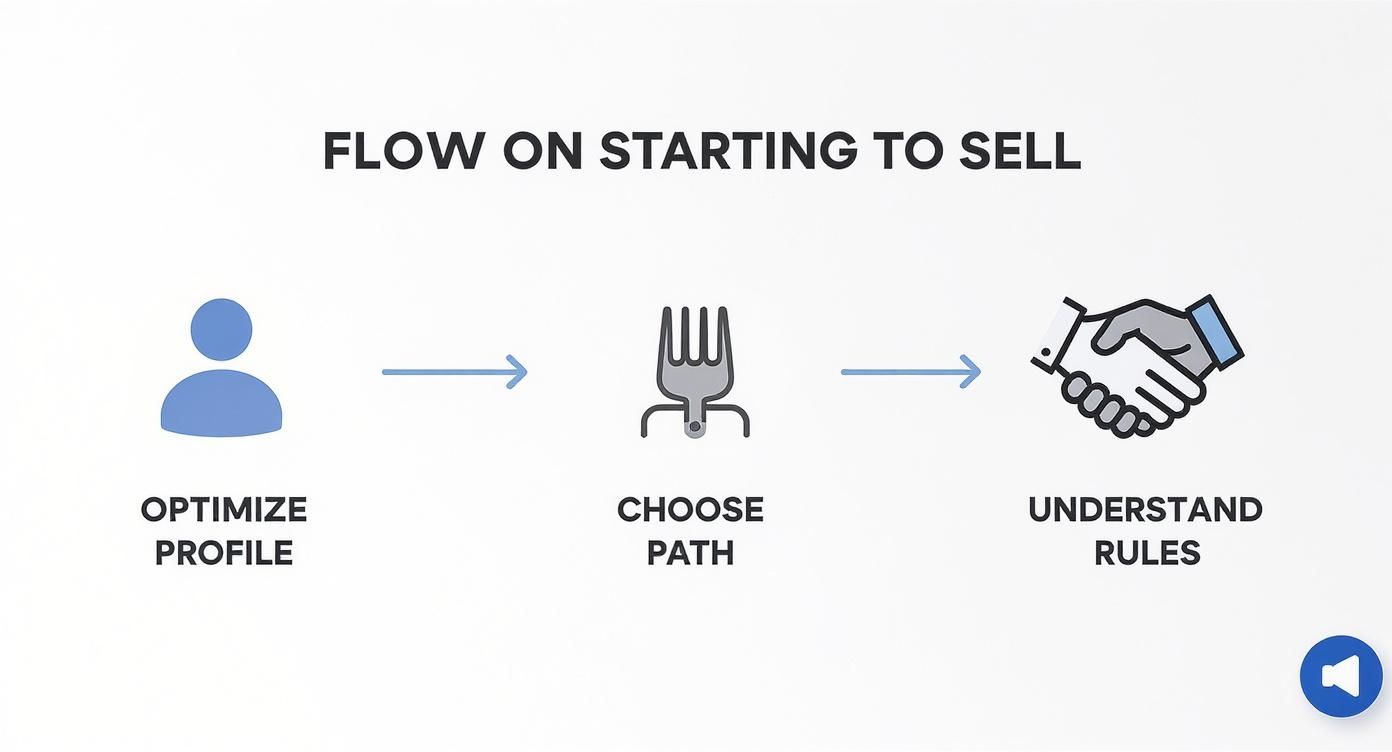
Each step builds on the last, giving you a solid foundation before you dive in.
And it's worth the effort. The platform has become an absolute giant, holding a staggering 51.19% market share of all social commerce. With 1.1 billion monthly active users as of 2024, the potential audience is just massive, making it an incredibly powerful sales channel.
To really get good at this, it helps to understand the core principles in a practical guide to flipping items for profit, which covers everything from finding things to sell to closing the deal. While local pickup is the bread and butter of Marketplace, offering shipping opens you up to a national audience. Getting that part right is essential, which is why knowing https://milliondollarsellers.com/blog/how-to-reduce-shipping-costs-for-small-business is a game-changer for your profit margins.
Once your profile is squared away, it’s time to get down to the real work: your listings. A great listing does more than just show what you're selling; it tells a story, answers questions before they're even asked, and creates a sense of urgency. Think of it as your digital sales pitch—every single element has to work hard to grab a buyer's attention in a sea of endless scrolling.
A lot of sellers think a quick, blurry photo and a one-line description will cut it. This is a huge mistake. Buyers make snap judgments in seconds. If your listing looks lazy, they'll assume the product is junk, and you'll be left wondering why your inbox is empty.
Before a buyer reads a single word, they see your photos. This is, without a doubt, the most important part of your listing. High-quality, clear, and honest photos build instant trust and make your item look far more valuable. You don't need a fancy camera; your smartphone is more than capable if you know what you're doing.
Focus on a few key principles for photos that actually sell:
By mastering a few simple techniques, you can make your products look professional and desirable. For those looking to really elevate their visuals without breaking the bank, understanding the basics of affordable product photography is a fantastic next step.
Your title is the hook. It’s what pulls buyers in from the search results, so it needs to be clear, descriptive, and packed with the keywords a potential buyer would actually use. Put yourself in their shoes. What words would they type into the search bar?
Ditch vague titles like "Nice Couch" or "Kids Bike." You have to be specific.
Vague TitleBetter TitleWood DresserSolid Oak 6-Drawer Dresser - Mid-Century Modern StyleGaming LaptopDell G15 Gaming Laptop - RTX 3060, 16GB RAM, 512GB SSDBaby StrollerUPPAbaby Vista V2 Double Stroller with Bassinet - Grey
See the difference? The better titles include the brand, key features, model name, and style. This not only attracts the right buyers but also helps your listing show up in way more searches.
After the photos and title grab their attention, the description is what closes the deal. This is your chance to answer questions, provide details, and convince the buyer that your item is the one they need. Keep your paragraphs short and easy to scan.
A solid description should always include these five things:
Pricing is both an art and a science. If you price too high, you'll hear crickets. Price too low, and you're leaving money on the table. The first step is always to do your homework.
Search for the exact same or very similar items right there on Marketplace. The trick is to filter by "Sold" items to see what people are actually paying, not just what other sellers are asking. This gives you the true market value.
Price your item competitively based on its condition compared to the sold listings. If yours is in better shape, you can price it slightly higher. If it has more wear and tear, price it a bit lower to move it fast. And don't forget to consider using the "OBO" (Or Best Offer) tag—it signals you're open to negotiation and can attract a lot more messages.

Most sellers treat Facebook Marketplace like a digital garage sale, but that's a huge mistake. They completely miss the powerful search engine running under the hood. Just like Google, Marketplace has an algorithm that decides which listings get seen. The secret to consistent views and faster sales is learning to work with that algorithm, not against it.
This isn’t about some complex technical wizardry. It’s about understanding what the platform wants and making a few strategic tweaks to your listings. By zeroing in on a few key areas, you can dramatically boost your visibility and get your items in front of buyers who are actually ready to pull the trigger.
The bedrock of good Marketplace SEO is choosing the right keywords. You've got to get inside your buyer's head. What words and phrases would they type into that search bar if they were hunting for your item? A little research here pays massive dividends.
A great place to start is by searching for similar items yourself. Look closely at the titles of the top-ranking listings and especially the ones already marked as "Sold." What language are they using? Instead of a generic "Couch," you'll probably see things like "Grey Sectional Couch," "Mid-Century Modern Sofa," or "Leather Recliner."
Picking the right category seems simple, but it’s a critical step. Sure, your "dining table" goes in "Furniture," but look for more specific subcategories. Choosing the most accurate one helps the algorithm understand exactly what you're selling and who to show it to.
Tags are your next best friend. Think of them as bonus keywords that give the algorithm even more context. You can use up to 20 tags, so make them count.
Pro Tip: Don't just tag the obvious. If you're selling a vintage armchair, you could use tags like armchair, vintage furniture, living room chair, mid-century, accent chair, and upholstered chair. This casts a much wider net and helps you get discovered.
The core principles of finding the right terms are pretty universal across e-commerce. Even though the interface is different, it’s worth understanding the detailed approach of optimizing keywords for marketplace search to really master that buyer-intent mindset.
The Marketplace algorithm is also watching how people interact with your listings. The more engagement you get, the more the platform thinks your item is a hot commodity and shows it to even more people.
The key signals to watch for are:
You can't directly force these actions, but a killer listing with great photos and a fair price will naturally encourage people to save it and send you a message.
Finally, don't let your listings get stale. After seven days, Facebook gives you a "Renew" button. Always click it. Renewing is a free and easy way to bump your item right back to the top of the search results for a fresh wave of visibility. For a deeper look at the technical side of visibility, exploring broader https://milliondollarsellers.com/blog/ecommerce-seo-best-practices can offer some valuable insights that apply far beyond just Marketplace.

Once your listing is live, the messages will start popping up. This is where your people skills become your best sales tool. The beauty of Marketplace is its speed—high-demand electronics can sometimes sell in under 24 hours. This rapid pace is fueled by roughly 3 billion monthly connections between buyers and sellers, which means you've got to be ready to act fast to close the deal.
Your goal in every single interaction? Be clear, quick, and confident. Slow replies or vague answers are the fastest way to lose a potential buyer to someone else who's on top of their game.
When a message hits your inbox, speed is everything. Try to reply within an hour, if not sooner. A lot of buyers are messaging multiple sellers for the same type of item, and the first person to give a solid, helpful answer usually wins.
I highly recommend creating a few saved replies for common questions. It’s a simple trick that saves a ton of time.
A prompt and helpful response does more than just answer a question; it signals that you are a serious, organized, and reliable seller. This initial interaction sets the tone for the entire transaction and is a crucial step in building the trust needed to close the deal.
Negotiating is just part of the Marketplace culture, so you need a game plan. You will get lowball offers—don't take it personally. The key is to respond politely but firmly, without shutting them down completely.
Instead of just ignoring a low offer, which feels rude, send back a counteroffer. If you have an item listed for $100 and someone offers $50, a good reply is: "Thanks for the offer! That's a bit lower than I'm looking for, but I could meet you at $85." This shows you're open to a discussion but still value your item.
Once you’ve settled on a price, it's time to coordinate the handover. Whether it’s local pickup or shipping, clear communication is non-negotiable to avoid any mix-ups.
For Local Pickup:
Your safety is the absolute top priority. Never, ever give out your home address.
By setting up a clear, safe, and professional communication process, you won't just close deals more efficiently. You'll also build a reputation that brings back repeat buyers and earns those all-important five-star ratings.

Making the jump from casually offloading old stuff to building a real, profitable business on Marketplace requires a total mindset shift. This isn't about decluttering your garage anymore; it's about building a repeatable system.
You have to start treating Marketplace as a legitimate sales channel. That means developing sourcing strategies, optimizing your workflows, and letting data—not just gut feelings—drive your decisions.
The first big change? You stop waiting for inventory to just appear. You have to go out and actively find it. This is the engine that powers any reselling business and it's what separates a hobby from a reliable income stream.
To really scale, you need a constant pipeline of products you can buy low and sell for a healthy margin. This skill, which sellers call "sourcing," is something you have to develop and perfect over time. Luckily, there are a few proven paths to finding great items.
Successful sourcing isn't just about finding cheap stuff—it’s about knowing what sells. In my experience, items like furniture, electronics, and power tools are always in demand. They're things people need, they're often pricey brand new, and they tend to hold their value well.
When you’re trying to list dozens of items every week, writing each description from scratch will absolutely kill your momentum. This is where listing templates become a lifesaver. A good template doesn’t just save you time; it helps build a consistent, professional brand for your little Marketplace empire.
Your template should standardize the information that rarely changes.
I keep a simple template in the notes app on my phone. I just copy, paste, and then plug in the unique details for each new item. This little system easily cuts my listing time in half and makes sure every single post looks polished and professional.
Real businesses run on data, not guesswork. While Facebook Marketplace analytics are basic, they offer some incredibly valuable insights if you know where to look.
Head over to your Marketplace profile and dig into your "Archived" or "Sold" listings. Start asking yourself some tough questions:
This simple review helps you spot trends you’d otherwise miss. Maybe you’ll notice that every mid-century modern dresser you list sells within 48 hours. That’s a massive signal to start actively hunting for more of them. By making this a weekly habit, you can fine-tune your sourcing and pricing, turning random sales into a predictable, scalable business.
Finding the right scaling strategy depends entirely on your goals, resources, and how much time you can commit. Here’s a quick breakdown to help you decide on the right path forward.
StrategyBest ForProsConsNiche DownSellers who have found a profitable product category and want to become the go-to expert.Higher margins, easier sourcing once connections are made, strong brand recognition.Risk of market shifts or trends dying out, smaller potential customer pool.Volume PlaySellers who can source low-cost items in bulk and are focused on quick turnover.Consistent cash flow, less reliance on any single "home run" item, simpler listings.Lower profit margins per item, requires significant storage space, can be a logistics grind.Expand to ShippingLocal sellers who want to tap into a national customer base for smaller, easy-to-ship items.Massively larger audience, potential for higher sale prices, not limited by local demand.Shipping logistics, packaging costs, higher risk of returns or "item not as described" claims.Hire HelpSellers whose operations have outgrown the time they can personally invest.Frees you up to focus on high-value tasks like sourcing and strategy, enables faster growth.Adds payroll costs, requires training and management, finding reliable help can be difficult.
Ultimately, there's no single "best" way to scale. Many successful sellers combine these strategies—for example, niching down on a specific furniture style while also hiring a part-time helper for pickups and deliveries. The key is to analyze your own performance, identify your biggest bottlenecks, and choose a strategy that directly addresses them.
Once you get started, you'll see the same questions and headaches pop up over and over. Figuring out how to handle these common situations ahead of time will save you a ton of frustration down the road. It's really all about creating a simple, repeatable game plan for the issues every seller runs into.
Knowing how to navigate these challenges is what separates the pros from the amateurs. It keeps your ratings high and the sales flowing. Think of this as your field guide for the trickiest parts of the process.
Before you list a single thing, you absolutely have to know what you can't sell. Facebook has a strict Commerce Policy designed to keep everyone safe, and ignoring it is the fastest way to get your account shut down.
There are entire categories of items that are completely off-limits. This isn't the full list, but some of the big ones include:
The rules can and do change. A quick five-minute scan of the official Commerce Policy before you jump into a new category is just smart business. It’s a simple check that can prevent a world of hurt.
It’s one of the most maddening parts of selling locally: you set up a meetup, and the buyer just ghosts you. I'm sorry to say it, but it's going to happen. The trick is to have a professional system so you don't waste your entire day waiting around.
First, send a single, polite message. Something like, "Hi, just checking in to see if you're still on your way or if we need to reschedule?" That's it. If you don't hear back in a reasonable amount of time, just move on to the next person in line.
To cut down on no-shows, I always confirm the meeting about an hour beforehand. I also state clearly in my listings that I operate on a "first to pick up" basis and can't hold items. This sets expectations, respects your time, and lights a fire under serious buyers.
This is a classic dilemma. Do you stay local, or do you open up your listing to the entire country? The right answer depends entirely on what you're selling.
Local pickup makes the most sense for:
Offering shipping is a game-changer for:
My best advice? Offer both whenever it’s practical. Giving buyers the choice between pickup and shipping widens your net and can get you a much faster sale.
If your listings aren’t getting views, they definitely aren’t going to sell. Beyond the basics of great photos and keyword-stuffed titles, a few simple tricks can give your items a serious boost.
One of the most powerful—and most overlooked—features is the Renew button. After seven days, Facebook lets you renew a listing, which bumps it right back to the top of the search results for free. Make it a weekly ritual for anything that hasn't sold.
Another killer tactic is to share your listing in relevant local buy-and-sell groups. This puts your item directly in front of a targeted audience that's already looking to buy. For higher-value items, don't sleep on Facebook’s "Boost Listing" feature. Yes, it's a paid ad, but a small investment can get your product in front of thousands of potential buyers in your area.
At Million Dollar Sellers, we know that mastering platforms like Marketplace is just one piece of building a massive e-commerce brand. Our exclusive community is where 7-, 8-, and 9-figure founders share the advanced strategies needed to win in a competitive market. If you’re ready to scale past the basics and learn from the best in the business, see if you qualify to join us.
Learn more and apply for membership at https://milliondollarsellers.com.
Join the Ecom Entrepreneur Community for Vetted 7-9 Figure Ecommerce Founders
Learn MoreYou may also like:
Learn more about our special events!
Check Events



.png)