Chilat Doina
May 24, 2026
If you already run a brand outside Amazon, you're probably looking at FBA from a different angle than most beginner content assumes. You're not trying to hack together a side hustle. You're asking whether Amazon can become a serious acquisition channel, a margin-positive revenue stream, and a durable brand asset without turning into a cash drain.
That's the right question.
Most advice on how to start FBA on Amazon is written for people trying to spend as little as possible. That approach creates weak launches. Established operators need a different playbook. The issue isn't whether you can get a product live. The issue is whether you can launch in a way that protects working capital, gives the listing a real chance to rank, and builds an asset you'd still want to own a few years from now.
A familiar scenario plays out once a brand starts scaling outside Amazon. Your direct site is converting, wholesale is working, and branded search volume is rising. Then you check Amazon and find unauthorized sellers on your listings, weak copy under your brand name, or a generic competitor taking the demand you created elsewhere. At that point, opening an FBA channel stops being a marketing experiment. It becomes a channel control decision.
For established operators, the primary question is not whether Amazon can add revenue. It usually can. The harder question is whether Amazon deserves inventory, cash, and management attention ahead of your other growth bets.

FBA gives you fast fulfillment, Prime eligibility, customer service coverage, and returns handling through Amazon's network. That matters because customer expectations on Amazon are already set. Shoppers compare your offer against listings that arrive fast, carry Prime, and remove purchase friction.
That does not mean FBA gives you an edge.
It means you can compete on the same field. The edge still comes from margin discipline, listing quality, review generation within Amazon's rules, inventory planning, and how well your product fits the category. Sellers who miss this point often overestimate the value of "getting on Amazon" and underestimate the cost of staying in stock, buying rank with ads, and protecting contribution margin after fees.
In practice, FBA works best when you want Amazon to handle the post-purchase operation so your team can stay focused on sourcing, conversion, replenishment, and brand control. That trade-off is usually attractive for founders who already know how expensive in-house fulfillment becomes once order volume starts swinging.
If you are still validating ecommerce more broadly across channels, spend some time on launching your online business in AU before treating Amazon as the center of the business.
Amazon tends to make sense when the business already has operating maturity. You do not need a huge catalog, but you do need a product line that can survive Amazon's fee structure and cash conversion cycle.
Good signs include:
That last point matters more in 2026 than many founders expect. Amazon can accelerate top-line growth while pressuring cash flow. Inventory has to be ordered earlier. Ads usually ramp before rankings stabilize. Storage and placement costs punish sloppy forecasting. A launch can look healthy in revenue terms and still strain the business if working capital is thin.
Amazon is a poor fit if the unit economics only work before ad spend, if the product is easy to copy, or if your team does not have the discipline to monitor inventory and price position weekly.
I have seen strong off-Amazon brands enter FBA too early, then get trapped between reorder deposits, rising PPC costs, and stockouts that reset momentum. The product was good. The timing and capital plan were not.
A realistic screen is simple. If Amazon would force you to underfund inventory, cut creative corners, or accept marginal contribution just to say you launched, wait. If you can support the first 90 to 180 days properly, Amazon becomes far more attractive.
If you are still weighing the trade-offs, this guide on whether selling on Amazon is worth it gives a useful strategic frame. The right answer depends on margin structure, category pressure, and how much platform concentration risk your business can absorb.
A clean launch usually gets decided before the first carton leaves your warehouse. Seller Central setup, entity details, brand control, and prep standards determine whether inventory checks in on time and whether your team can scale without constant support tickets.
Treat this stage like infrastructure, not admin.
Amazon gives you two plan types. The wrong choice will not kill the business, but it does create friction you do not need.
If you are launching a real brand line with planned ad spend, catalog expansion, and weekly inventory management, the Professional plan is usually the right fit. The Individual plan makes more sense for very low volume testing or opportunistic resale. Established operators rarely stay there long because the workflow is too limited for a serious FBA build.
| Plan | Best fit | Cost structure | What usually goes wrong |
|---|---|---|---|
| Individual | Low-volume testing, casual selling | Per-item fee | Costs rise fast once velocity improves |
| Professional | Brand launch, catalog build, consistent sales | Monthly subscription | Fixed overhead starts before the listing matures |
The issue is not the monthly fee. It is whether you are building an account structure that supports a brand asset. If the answer is yes, set it up that way from day one.
Seller verification problems are rarely complicated. They are usually caused by sloppy consistency across documents.
Use the exact same legal entity name, business address, and ownership details everywhere they appear. That includes formation documents, tax records, banking information, and the data entered in Seller Central. One mismatch can trigger a review cycle that burns launch time and ties up inventory planning.
Review these items yourself before anyone on your team submits them:
I do not delegate the final check on this step. A VA or agency can enter the data. The account owner should verify every field.
If you wait until after launch to address trademark and brand ownership, you make content control harder than it needs to be.
Start the trademark process early and move toward Amazon Brand Registry as soon as you qualify. That gives you better control over listing edits, stronger merchandising options, and more protection if another seller tries to alter your detail page or attach to the listing improperly.
This matters more for established businesses than beginner sellers admit. You are not just trying to get a SKU live. You are building an asset with defensibility, cleaner conversion paths, and a catalog structure you can expand later.
If your team is still tightening its supplier and ownership process, this guide to product sourcing for ecommerce brands is a useful companion because supplier decisions and brand control usually get tangled together early.
A messy backend creates expensive cleanup later. Parent-child relationships, variation themes, SKU naming, case pack logic, and barcode decisions should be mapped before inventory is in motion.
This is one of the quiet differences between a small test launch and a disciplined one. Operators with experience think about how the catalog will look six months from now, not just how to get one ASIN active this week.
A few examples:
Small backend errors have a habit of showing up as margin problems later.
Amazon only receives inventory smoothly when the product arrives exactly as required. Packaging, labeling, carton data, and shipment creation have to line up. If they do not, inventory gets delayed, rerouted, relabeled at extra cost, or stranded.
Established brands get caught here because their current retail or 3PL standards do not always match Amazon's requirements. A master carton that works fine for wholesale can still create receiving issues at FBA. A barcode decision that seemed minor can create commingling risk or relabeling charges.
Run a final pre-inbound check on:
Good launches look simple from the outside. Under the hood, they are controlled.
Product research on Amazon gets oversimplified. People make it sound like a scavenger hunt for low-competition keywords. That's not how strong brands launch. Product validation is a financial decision first and a merchandising decision second.
If you're learning how to start FBA on Amazon as an established operator, your core job is to avoid buying inventory for a product that can't carry its full cost structure. Demand matters. Differentiation matters. But margin discipline matters first.
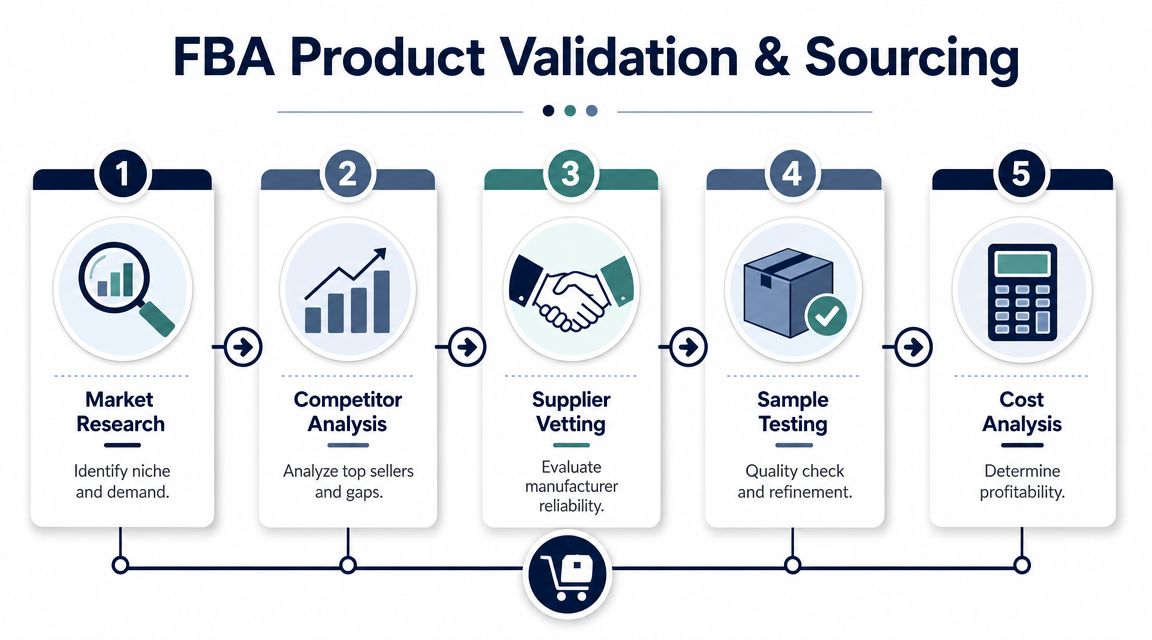
A simple benchmark from Helium 10 is that a main keyword should show at least 500 monthly searches before you treat the niche as viable, and the same source notes that while some sellers have launched with $500, a more realistic entry budget is $2,500 to $5,000 for inventory, shipping, and initial ad spend in many cases, based on Helium 10's FBA overview.
The search threshold matters because low-demand products don't give you enough room to absorb PPC, fulfillment, and launch mistakes. For established founders, I'd treat that threshold as a floor, not a green light.
Demand validation should answer five questions:
If you can't answer all five, don't source yet.
The distinction between experienced operators and beginners becomes evident. Beginners often price the product first, then estimate costs. Do the opposite. Build the cost stack before you get emotionally attached to the niche.
Your true landed cost should include at least:
You don't need perfect precision before sampling, but you do need an honest model. If the business only works under ideal assumptions, it doesn't work.
The biggest sourcing mistake isn't paying too much to the factory. It's buying a product whose economics only work on paper before ads, delays, and defects show up.
Don't just pull keyword data. Read the listings. Read the reviews. Read the complaints. The top opportunities usually hide in obvious places:
That's where the edge lives. Not in finding a magical category with no competition, but in spotting where buyers are already signaling dissatisfaction.
A practical workflow looks like this:
| Validation layer | What to review | What you're trying to find |
|---|---|---|
| Search results | Main keyword page | Who dominates shelf space and how polished they are |
| Listing quality | Titles, bullets, images, A+ Content | Whether incumbents are actually selling well or just present |
| Reviews | Positive and negative reviews | Repeated praise, repeated complaints, unmet expectations |
| Price architecture | Good-better-best spread | Whether there's room for premium positioning or bundles |
| Unit economics | Your model vs likely price band | Whether the niche can support paid launch activity |
If the listings are sloppy and the review complaints are consistent, that's promising. If the top page is full of advanced brand operators with clear differentiation and strong retail execution, you need a stronger reason to enter.
The worst supplier isn't always the expensive one. It's the one that communicates poorly, changes specs casually, or sends inconsistent product quality between sample and production.
When you vet manufacturers, push on the things that break businesses later:
This is also a good point to sharpen your sourcing lens with a more category-specific perspective on what product sourcing looks like in practice.
Founders often order samples hoping to be impressed. That's backwards. Order samples trying to kill bad ideas early.
Check the product like a customer and like an operator:
If the sample needs too many excuses, move on.
Inventory can be in transit, your supplier can hit the date, and your margins can still get squeezed if the listing is weak or the inbound plan is sloppy. On Amazon, merchandising and operations meet at the same point. The moment inventory becomes available, your page has to convert and your units have to check in without problems.
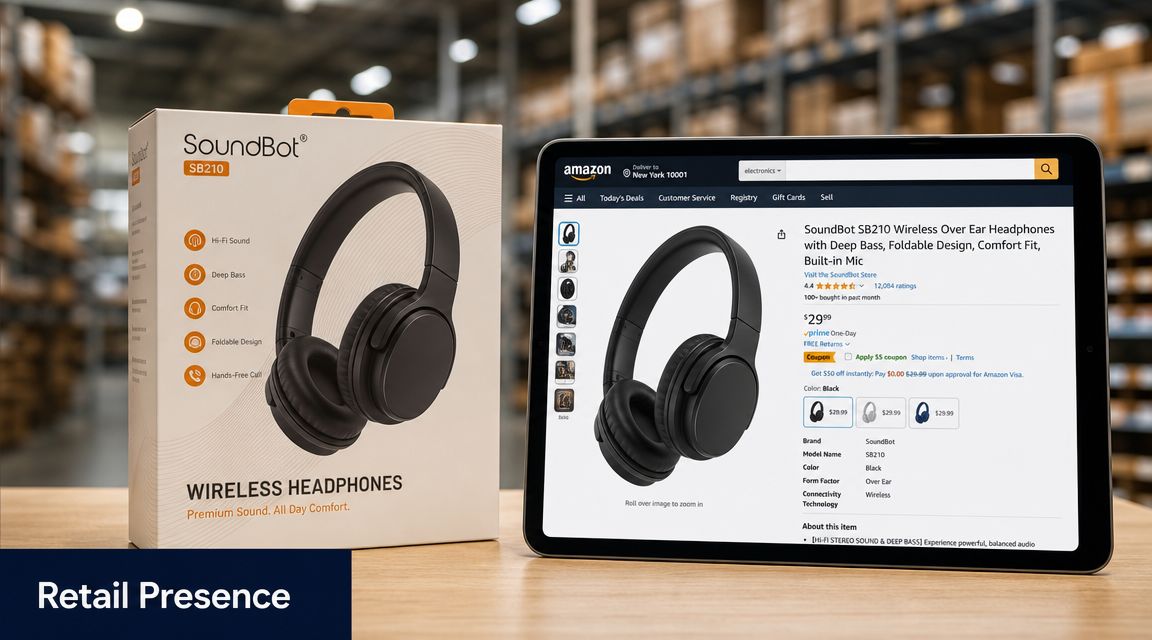
Established operators usually understand this fast. Amazon rewards listings that answer buying objections clearly, and it punishes vague merchandising with lower conversion, weaker rank retention, and more wasted ad spend.
The structure matters. The title handles relevance and clarity. Bullets turn features into purchase logic. Images remove hesitation. A+ Content gives the brand context and helps shoppers compare your offer to weaker alternatives.
Write for the buyer, not for your keyword tool.
A shopper needs three answers within seconds:
Your image stack usually carries more selling weight than founders expect. Use it to show the main product, packaging, dimensions, included components, material quality, and the use case that justifies the price. If fit, compatibility, refill requirements, or setup confusion could trigger returns, deal with that visually before the customer reaches the Q&A section.
For a stronger framework on retail-page execution, this guide on Amazon listing optimization is a useful companion.
Once Brand Registry is approved, treat the listing like a brand shelf, not a one-SKU product page. A+ Content should reduce uncertainty and move the shopper closer to purchase. Good modules explain why the product exists, what problem it solves better than generic competitors, and where it sits in your wider catalog.
Useful formats include:
Bad A+ usually looks polished but says nothing. Decorative banners, repeated bullet copy, and generic lifestyle images do not improve conversion. They just fill space.
Here's a practical walkthrough on the mechanics sellers need to understand inside Seller Central before inventory lands:
The operational side is where a lot of profitable launches lose time and cash. Amazon can handle fulfillment, customer service, and returns once inventory is received and sellable, but none of that helps if units get delayed, stranded, or checked in incorrectly.
Treat inbound like a controlled handoff, not an administrative task.
That last point matters more in 2026 than many guides admit. Cash gets trapped between manufacturing deposits, freight, prep, storage, and inventory that has technically shipped but still cannot generate revenue. Larger operators should plan around that lag, not assume Amazon will receive everything on the ideal timeline.
The launch starts when sellable units are live, not when the cartons leave the factory.
Keep your inventory records tight during this handoff. If your internal counts, Amazon receipts, and landed cost records do not match, margin analysis turns into guesswork fast. A practical effective inventory tracking guide can help tighten that discipline before your SKU count expands.
A live listing with sellable inventory is only the start. The actual launch begins when traffic hits the page and you find out whether the offer can convert at a cost the business can support.
Established operators usually make the same early mistake for different reasons than beginners. They already know how to buy traffic, so they push spend too fast before the listing, pricing, and review profile have earned the right to scale. On Amazon in 2026, that gets expensive quickly.
Treat the first few weeks as a data acquisition phase with tight financial guardrails. The goal is to identify profitable search intent, remove conversion friction, and avoid forcing volume into a weak detail page.
Launch PPC should answer specific questions. Which search terms convert. Which angles attract clicks but fail on the page. Which placements can produce rank movement without blowing out TACoS.
Keep the account structure simple enough to make decisions fast.
A practical launch setup usually includes:
The point is not to make every campaign efficient on day one. The point is to find the terms worth defending, the terms worth dropping, and the places where the listing is leaking conversion.
Single-metric management creates bad decisions. ACoS can look ugly while the launch is working. ACoS can also look healthy while the product is going nowhere organically.
The operators who scale well watch the relationship between advertising efficiency, conversion, and rank movement.
| Metric | What it tells you | Early interpretation |
|---|---|---|
| ACoS | Ad spend relative to attributed ad sales | Often high during testing, acceptable if it reveals winning terms |
| TACoS | Ad spend relative to total sales | Better indicator of whether ads are building the whole listing or just renting sales |
| Session-to-conversion rate | How well the page closes traffic | Weak conversion usually points to offer, creative, pricing, or review friction |
| Organic vs paid sales mix | Reliance on ad spend | Paid-heavy is normal early, but the mix should improve as rank builds |
| Keyword rank movement | Search position over time | Confirms whether spend is creating visibility that can compound |
If click-through is weak, fix the main image, title, or price architecture before increasing bids. If traffic is strong and conversion is soft, the problem usually sits in the offer. That can mean review count, image stack, A+ content, coupon strategy, or simple mismatch between the keyword and the product promise.
This is also where bigger brands can get trapped. They assume more budget solves everything. It does not. More budget poured into a listing with weak conversion just accelerates cash burn and distorts the read on product-market fit.
Every serious launch has friction. CPCs run high. Conversion starts uneven. A few keywords disappoint. None of that is unusual.
Danger shows up in a different pattern:
That last point matters more than many operators admit. A launch can look healthy inside Seller Central while the P&L says something else entirely. You may be paying for ads, carrying inventory, and preparing a reorder before Amazon fees, returns, and post-launch price pressure have fully shown up. Good expert cash flow tips help, but the discipline has to come from your weekly review process.
Strong launch teams review the listing and ad account together, not in separate silos. Search term reports, customer questions, early reviews, return reasons, and competitor moves should feed one decision cycle.
I look for a few practical signs before increasing spend with confidence:
Experienced peer feedback can speed this up. Established ecommerce founders often use groups like Million Dollar Sellers for blunt operator-level discussion, along with agency partners, in-house channel leads, and Amazon consultants who can audit a listing without sugarcoating it.
Good launch management is measured by speed of learning and control of downside, not by how busy the dashboard looks.
Once a core set of terms converts consistently, increase spend with intent. Raise bids on proven search terms. Isolate winning ASIN targets. Cut waste faster. Protect margin on anything that attracts clicks but does not build rank or repeat sales.
Review these questions every week:
If the third answer is shaky, hold back. A stockout after early rank gains is expensive. So is reordering into a launch that still has not proven durable demand. The better play is controlled acceleration, with spend tied to conversion strength, inventory coverage, and actual contribution margin.
A lot of established operators lose money in the first 90 days for a simple reason. They treat an Amazon launch like a marketing project when it is really a capital sequencing project.
The sequence matters. Commit to inventory before the unit economics are proven and cash gets trapped. Push traffic before the listing is ready and you pay to learn what should have been fixed earlier. Reorder too early, or too late, and Amazon turns a promising launch into a working capital problem.
For a mature business, the goal is not to get a product live as fast as possible. The goal is to get through day 90 with clean data, healthy inventory coverage, and enough cash left to make the second inventory decision from a position of strength.
Days 1 through 30 are about proving the business case. Finish the account and compliance work, pressure-test demand, build the landed cost model, review the competitive set, and get samples in hand. If the numbers only work with optimistic conversion assumptions or unrealistically low freight, the product is not ready.
Days 31 through 60 are where significant commitments start. Supplier selection, packaging revisions, production terms, inspection planning, creative development, and shipment prep all hit at once. This is usually the point where weak operators underbudget because each line item looks manageable on its own.
Days 61 through 90 are about controlled commercialization. Inventory checks in, the listing goes live, ads start gathering data, and the first wave of customer response exposes what the model missed. Good operators stay calm here. They adjust fast, but they do not confuse early movement with proof that the product deserves aggressive scale.
Cash timing matters more than founders expect, especially if the business is already funding other channels, payroll, or wholesale POs. Strong expert cash flow tips help, but the practical rule is simpler. Keep enough reserve to absorb slower sell-through, creative revisions, and a reorder window that arrives before the first tranche of Amazon payouts feels useful.
| Phase | Key Actions | Estimated Cost Range (for a standard private label product) |
|---|---|---|
| Days 1-30 | Open Seller Central account, choose plan, complete tax and identity verification, begin trademark and Brand Registry path, research demand, evaluate competitors, build landed-cost model, request samples | Lower inventory spend, but meaningful outlay for samples, compliance, early brand work, and validation |
| Days 31-60 | Select supplier, revise product specs, finalize packaging, place production order, prepare listing assets, organize photography, create shipment plan, confirm prep requirements | Capital outflow rises fast here because production deposits, packaging, freight planning, and creative costs stack together |
| Days 61-90 | Inventory ships and checks in, listing goes live, activate PPC, monitor indexing and conversion, refine images and copy, track early sales and reorder signals | Ad spend begins, operational costs continue, and the business needs enough liquidity to cover a reorder before the launch fully matures |
Budget ranges in FBA guides are usually too generic to be useful for established founders. As noted earlier, smaller launches can start with a modest test budget. In practice, brand-minded operators usually need enough capital to cover three things without compromise: inventory depth, conversion-ready creative, and paid discovery. If one of those gets cut, the launch may still go live, but the data you get back is less trustworthy.
That is the hidden trade-off. A cheap launch lowers upfront exposure, but it often creates noisier signals, thinner margins, and less room to correct early mistakes. A better-capitalized launch costs more upfront and gives you cleaner decision-making.
Use the 30-60-90 structure as a decision gate, not a calendar promise.
I have seen strong products get mishandled because the team felt pressure to stay on schedule. Amazon does not reward schedule discipline by itself. It rewards operators who release capital in the right order.
The biggest FBA mistakes usually don't look dramatic at first. They look manageable. A slightly thin margin model. A shipment that isn't prepped tightly enough. A launch plan that assumes ads will “figure it out.” Then the small errors stack.
That's why the dangerous part of Amazon in 2026 isn't complexity by itself. It's how easy it is to hide weak economics inside a launch that still appears active.
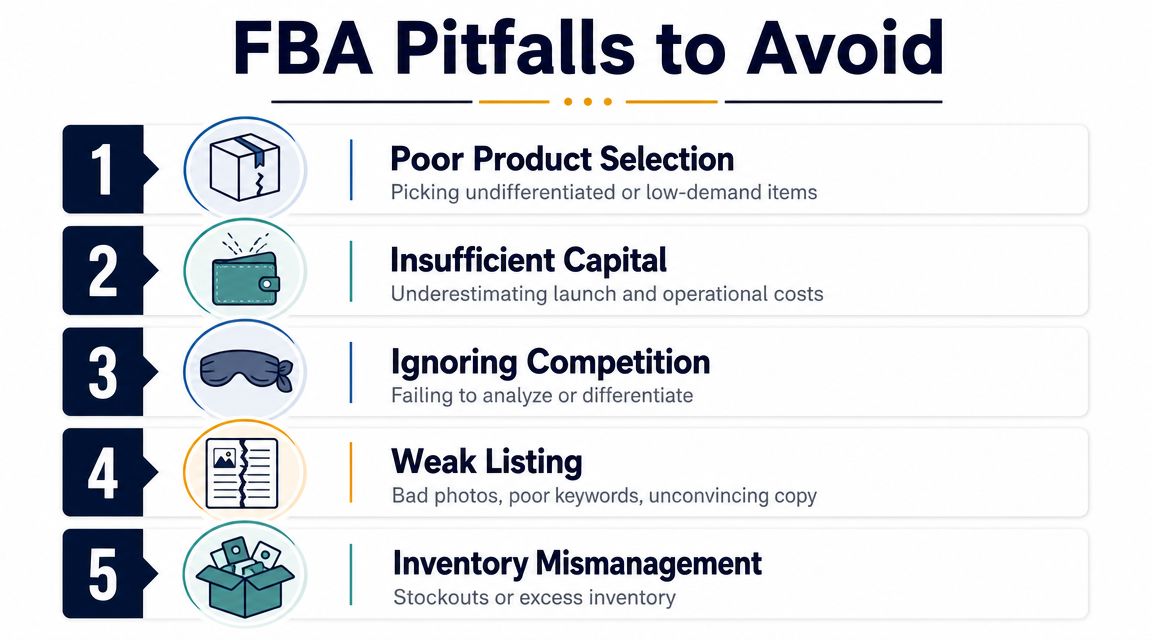
Amazon's fee environment is tighter than many launch guides admit. Beyond referral fees and standard FBA fulfillment charges, Amazon has also expanded fee types such as low-inventory-level and inbound placement-related charges, which can materially affect profitability on small test orders, as reflected in Amazon's fee and policy references for sellers.
That means undercapitalized launches aren't just slower. They're structurally fragile.
The common mistakes look like this:
A lot of new sellers become dependent on paid traffic before organic ranking stabilizes. That's not automatically a problem. It becomes a problem when the listing never earns its way into better organic performance.
If your product only moves when ad spend stays aggressive, you don't yet have a strong Amazon asset. You have a paid acquisition loop.
Build a listing that can convert paid traffic into organic momentum. If that handoff never starts, the launch economics stay brittle.
Stockouts are obvious. Over-ordering is less obvious, but it can be just as damaging. One starves momentum. The other traps cash, increases storage exposure, and limits your ability to reinvest into the SKUs that are working.
The best operators treat inventory planning as a profit lever, not an admin task. They watch sell-through patterns, lead times, prep realities, and ad pacing together. That's what keeps the business stable after the excitement of launch fades.
Serious founders usually don't need more generic Amazon advice. They need better operator-to-operator pattern recognition. If you want that kind of peer environment, Million Dollar Sellers is an invite-only community where established ecommerce entrepreneurs share how they're navigating Amazon, DTC, and omnichannel growth at scale.
Join the Ecom Entrepreneur Community for Vetted 7-9 Figure Ecommerce Founders
Learn MoreYou may also like:
Learn more about our special events!
Check Events