Chilat Doina
December 21, 2025
So, is selling on Amazon actually worth it?
The short answer is yes, but it comes with a massive asterisk. The platform gives you incredible access to a global audience that’s ready to buy, but success is far from guaranteed. It demands a smart, data-driven strategy.

Think of the Amazon marketplace as the world's biggest, busiest bazaar. By setting up your stall, you get instant access to millions of shoppers walking by every minute. That’s a level of foot traffic that would take years and a fortune in marketing to build on your own. This is the core appeal. It's the undeniable power of the platform.
But you're not the only one with a stall. You're surrounded by intense, often cutthroat, competition on all sides. Everyone is fighting for the same customer's attention, turning it into a constant battle for visibility, pricing, and positive reviews.
This is the central challenge every seller has to navigate: immense opportunity paired with equally fierce competition.
The numbers behind Amazon's marketplace are just staggering. You’re jumping into an ecosystem with 9.7 million sellers active across the globe, including over 1.9 million in the U.S. alone.
Third-party sellers like you and me now make up 62% of all Amazon sales, which shows how much the platform has shifted from being its own retailer to a seller-driven marketplace.
For small and medium-sized businesses, the potential is real. The average U.S. SMB seller pulls in about $290,000 in annual sales, with profit margins typically floating around 21%.
To help you figure out if this is the right move, we've put together a quick comparison of the good and the bad.
FactorPotential UpsidePotential DownsideAudience ReachInstant access to hundreds of millions of active, high-intent buyers.Massive competition makes it hard to stand out from the noise.LogisticsFulfillment by Amazon (FBA) handles storage, packing, shipping, and returns.FBA fees can be complex and eat into margins if not managed well.MarketingPowerful built-in advertising tools (PPC) to target ready-to-buy shoppers.Ad costs are rising, and a poor strategy can quickly burn through your budget.Brand ControlLimited control over branding, customer data, and the overall shopping experience.Building a direct relationship with customers is nearly impossible.Fees & CostsMultiple fees (referral, storage, fulfillment, ads) that add up quickly.Unexpected costs can erase profits if you're not careful.
This table just scratches the surface. This guide is designed to move you beyond a simple "yes or no" and give you a real decision-making framework.
We’ll break down:
By the end of this guide, you won't just have an answer to whether selling on Amazon is worth it—you'll have an answer that's right for your business, your goals, and your products.
This data-driven approach is critical for any brand. For another great perspective, check out this piece on Is Selling on Amazon Worth It for Your Omnichannel Brand.
Let's start by digging into the real economics of the marketplace.

Profitability on Amazon is a game of margins, pure and simple. It all starts with a clear-eyed, honest look at the true costs. Thinking your product cost is the only major expense is a fast track to burning through cash with nothing to show for it. It's like opening a retail store but only budgeting for inventory—you're completely ignoring the rent, utilities, and staff salaries that actually keep the lights on.
Amazon’s fee structure can feel like a tangled web, but once you start to unravel it, you see the real price of admission to its massive marketplace. You can't even begin to answer "is selling on Amazon worth it?" until you decode these expenses.
Your journey starts with a foundational choice: your seller plan. This dictates your basic operational fee before you even make a sale. Amazon gives you two main doors to walk through, each built for different sales volumes.
The math is simple: if you plan on selling more than 40 units a month, the Professional plan immediately starts saving you money.
For every sale, Amazon takes a piece of the pie. This is the referral fee, and it’s essentially their commission for giving you access to millions of ready-to-buy customers. It's calculated as a percentage of your item's total sales price—that includes the product price, shipping, and even any gift-wrapping charges.
This percentage isn't a flat rate; it swings pretty wildly depending on your product category, usually landing somewhere between 8% and 15%. For instance, consumer electronics might have an 8% fee, but apparel could be as high as 17%. You have to bake this into your pricing from day one, because it's one of the biggest and most consistent costs you'll have.
Key Takeaway: Referral fees are non-negotiable and hit your gross profit margin on every single unit sold. Always, always check the specific fee for your category before you finalize your price.
Okay, so you've listed your product. Now, how do you get it to the customer? This is a huge decision that splits into two main paths, each with its own set of costs.
Fulfillment by Amazon (FBA)
This is the path most sellers take. You ship your products in bulk to Amazon's massive warehouses, and they take it from there. They handle storage, picking, packing, shipping, customer service, and even returns. That convenience comes with a few price tags:
Fulfillment by Merchant (FBM)
With FBM, you're the master of your own fulfillment universe. You store your own inventory and ship every order yourself. While you dodge the specific FBA fees, you're now on the hook for your own warehousing, packing materials, shipping labels, and customer service headaches. A big trade-off here is that you also lose the automatic Prime eligibility that’s a massive sales driver for FBA sellers.
Keeping up with Amazon's constantly shifting fee structure is non-negotiable for staying profitable. For a deeper dive, you can learn more about how much Amazon costs to sell in our detailed guide. It's also critical to understand how to navigate Amazon's 2024 low inventory fee and other fee changes to avoid nasty surprises on your statement.
Finally, we have the costs that new sellers almost always underestimate. Just listing a product and hoping for the best is a recipe for disaster. It won't sell itself.
You absolutely need a budget for Amazon PPC (Pay-Per-Click) advertising to get eyeballs on your listings. On top of that, there are other potential expenses: professional product photography (non-negotiable), third-party software for inventory management or analytics, and the inevitable cost of customer returns. Think of these as the essential operational costs of doing business—they're required to compete effectively and must be part of any realistic budget.
To put it all together, here's a sample budget to give you a rough idea of the costs involved when launching on Amazon.
Cost CategoryEstimated Cost Range (Monthly)DescriptionProfessional Seller Plan$39.99Flat monthly fee for unlimited listings and access to advanced tools.Product Sourcing$150 - $1,500+Initial inventory order. This cost is highly variable based on your product.FBA FeesVariesIncludes fulfillment and storage fees. Dependent on product size, weight, and sales velocity.Amazon PPC Advertising$300 - $1,000+A starting budget to drive initial traffic and sales. Often 10-20% of revenue.Software & Tools$50 - $200For product research, keyword tracking, and inventory management.Professional Photos/Videos$300 - $1,000 (One-Time)Crucial for conversion. A one-time investment per product.UPC/Barcodes$30 (One-Time)Required for listing new products on the platform.
This table is just an estimate, but it highlights that your total investment goes far beyond just the cost of your products. A realistic view of these numbers is the first step toward building a profitable business on the platform.

After wading through the maze of fees and operational costs, we get to the big question: why do millions of sellers even bother? The answer is simple but incredibly powerful. Amazon hands you immediate access to a massive, built-in audience of high-intent shoppers—an audience that would otherwise take years and a small fortune in marketing to build from scratch.
Think about what it takes to launch a direct-to-consumer (DTC) brand. You start at ground zero. Zero customers, zero brand recognition, and zero traffic. You're essentially shouting into a void, burning cash on social media ads and content marketing just hoping someone will notice.
Amazon, on the other hand, is like opening a shop in the middle of Times Square. The people are already there, and they showed up with their wallets open.
It's hard to wrap your head around the sheer scale of Amazon's customer base. You're plugging your products directly into a marketplace with more than 310 million active users across the globe.
Even better, over 240 million of them are Prime members. These are the loyal, repeat customers who are hardwired to look for the Prime badge and love the convenience of one-click checkout.
This isn't just a giant audience; it's a high-quality one. These shoppers aren't just window shopping; they are actively searching for products to buy right now. They already trust the platform, their payment info is saved, and they're ready to pull the trigger. For many entrepreneurs, tapping into that existing trust and infrastructure is a massive shortcut that alone makes selling on Amazon worth it.
The numbers on seller success speak for themselves. While the competition is no joke, the rewards for those who figure it out are substantial. And the opportunity isn't just to survive—it's to thrive.
Take this for example: by 2025, it's projected that over 100,000 sellers globally will be pulling in $1 million or more in annual revenue. That’s a huge leap from the 60,000 who hit that milestone back in 2021. In the U.S. alone, a staggering 43% of marketplace sellers make $100,000 or more each year.
This kind of growth is a clear signal that even with all the competition, there are still massive slices of the pie up for grabs for smart sellers.
The Megaphone Effect: Building a brand from scratch is like whispering your message. Selling on Amazon is like being handed a high-powered megaphone connected to a global stadium, instantly amplifying your reach to customers who are already there and ready to listen.
This built-in audience doesn't just supercharge your domestic sales; it's also a launchpad for global expansion. With Amazon's international marketplaces, you can start reaching customers in places like the UK, Germany, Japan, and Australia with relative ease. The platform gives you the tools and logistics to handle cross-border commerce, knocking down many of the old barriers to entry.
For sellers looking to scale beyond their home turf, this is a total game-changer. Our guide on selling on Amazon internationally breaks down exactly how to tap into these lucrative overseas markets.
Ultimately, the decision to sell on Amazon comes down to a strategic calculation. The costs are real, and the competition is fierce. But the upside—getting access to a massive, trusted, global marketplace of ready-to-buy customers—is an advantage that very few platforms can ever hope to offer. It remains one of the most direct and potent engines for rapid business growth available today.
Let’s be honest: selling on Amazon is a partnership. And like any partnership, it’s all about tradeoffs. You get a golden ticket to a massive, built-in audience of buyers, but you’re also handing over the keys to a big part of your business.
It’s the classic dilemma: rent a gorgeous, fully-furnished apartment in the best part of town, or build your own house from the ground up? One gives you incredible convenience and a ready-made environment. The other offers total freedom and the pride of ownership.
This is where you need to have a frank conversation with yourself about your long-term vision. Are you laser-focused on maximizing sales volume right now? Or are you trying to build an enduring brand with a cult following? Your answer to that question will tell you almost everything you need to know.
When you sell on Amazon, you’re a guest in their house. You’re operating within Amazon’s brand, not your own. Your product pages have to fit into their rigid templates, which leaves very little room for the unique design and storytelling that makes a direct-to-consumer (DTC) brand stand out.
Think about it this way:
In this environment, creating a deep, emotional connection with customers—the very heart of a strong brand—is a massive uphill battle.
This might be the single biggest compromise you make: you don't have a direct relationship with the people buying your products. When a sale happens on Amazon, that person is Amazon's customer, not yours. This has huge consequences for your long-term growth.
You don't get customer email addresses—the lifeblood of nearly every successful DTC business. This means you can’t build an email list to announce new products, you can’t run targeted marketing campaigns, and you can’t nurture repeat purchases through your own channels. You are almost completely reliant on Amazon’s ecosystem to reach those people ever again.
This isn't an accident; it's by design. Amazon wants to own the customer relationship. They want shoppers to return to their platform for everything, no matter which third-party seller they bought from last time.
This creates a serious vulnerability. If something goes wrong with your Amazon account, your entire revenue stream could disappear overnight. And you'd have no way to contact the very people who already bought and loved your products.
Finally, when you operate on Amazon, you’re playing their game by their rules. And those rules can be strict, confusing, and can change without much warning. Most sellers live with a constant, low-level hum of anxiety about a potential account suspension.
A sudden policy change, a string of bogus negative reviews, or a simple misunderstanding with Seller Support can put your entire business in jeopardy. Getting a suspended account reinstated can be a bureaucratic nightmare, costing you thousands in lost sales and an unbelievable amount of stress.
This is where the "renting" analogy really hits home. Your landlord can change the rules, or even evict you, and you often have very little recourse. Understanding these compromises is absolutely essential before you decide to build your business on their platform.
Knowing the numbers behind Amazon is only half the battle. The other half is figuring out exactly how you’re going to show up and sell. This isn't a one-size-fits-all game. There are several different ways to operate on the platform, and each one comes with its own playbook, its own risks, and its own potential rewards.
Think of it like choosing the right vehicle for a road trip. A sleek sports car is a blast for a solo drive on the coast, but it’s completely useless for a cross-country family vacation. An RV gives you all the comforts of home, but it’s a pain to park and guzzles gas. Your choice comes down to where you’re going, what you’re willing to spend, and how much you want to be in the driver’s seat.
Private Label is the classic Amazon dream: you build your very own brand. You find a product with potential, partner with a manufacturer to put your own spin (and logo) on it, and then you’re the only one selling it. For entrepreneurs who want to create a real, sellable asset, this is usually the go-to model.
It’s where you’ll find the highest potential profit margins, and you have total control over your product, pricing, and brand story. The flip side? It demands the most cash upfront for inventory, branding, and a serious marketing push. You’re on the hook for everything—from sourcing and negotiating to launching and fighting your way up the rankings.
The Wholesale model is a different beast entirely. Here, you’re not creating anything new. Instead, you buy products in bulk directly from established brands or their distributors and then resell them on Amazon. You’re essentially piggybacking on products that already have built-in demand and brand recognition.
This approach dramatically lowers your marketing burden because customers are already looking for these items. The real work is in securing profitable wholesale accounts and mastering your inventory management. Startup costs are generally lower than private label, but your margins will be thinner, often in the 10-20% range, since you’ll likely be competing with other sellers on the exact same product listing.
Key Insight: Private Label is about building an asset from the ground up. Wholesale is about finding and capitalizing on existing assets. The first is a creative journey; the second is a numbers game. Nailing that distinction is crucial.
Arbitrage is the art of the hustle. It’s all about spotting and exploiting price gaps between what an item costs in one place and what you can sell it for on Amazon.
It breaks down into two main flavors:
Arbitrage has the lowest barrier to entry, period. You can get started with just a few hundred bucks, and you don’t have to worry about manufacturers or building a brand. But make no mistake, it’s a grind. It’s incredibly time-consuming, and it’s tough to scale. Your entire business depends on your ability to constantly find the next good deal.
Finally, we have the model for established brands that are already successful elsewhere, maybe with a strong direct-to-consumer (DTC) website or a presence in physical retail stores. For these businesses, Amazon isn’t the starting line—it’s a massive new sales channel to bolt onto their existing strategy.
The goal here is simple: tap into Amazon's colossal audience and grab sales you’d otherwise miss. The challenge is learning to play by Amazon's rules without hurting your existing business. It’s a balancing act of logistics, advertising, and brand protection to make sure your Amazon channel complements—not cannibalizes—your direct sales.
Each of these paths offers a different answer to the question, "Is selling on Amazon worth it?" To help you compare them directly, our detailed guide to different Amazon business models provides an even deeper analysis of the pros and cons for each strategy.
Alright, we’ve pulled apart the costs, looked at the huge potential upside, and wrestled with the tough trade-offs. Now it's time to shift from just thinking about it to actually making a call.
The real question isn't a simple "Is selling on Amazon worth it?" It’s more about holding a mirror up to your own business—your goals, your bank account, and how much risk you're willing to stomach. This framework is your final gut-check, a series of blunt questions to help you make a clear-eyed decision that's right for your specific situation.
Be brutally honest with yourself as you go through these. Your answers will light up the right path forward.
This chart breaks down the four main ways you can operate as a seller on the platform.
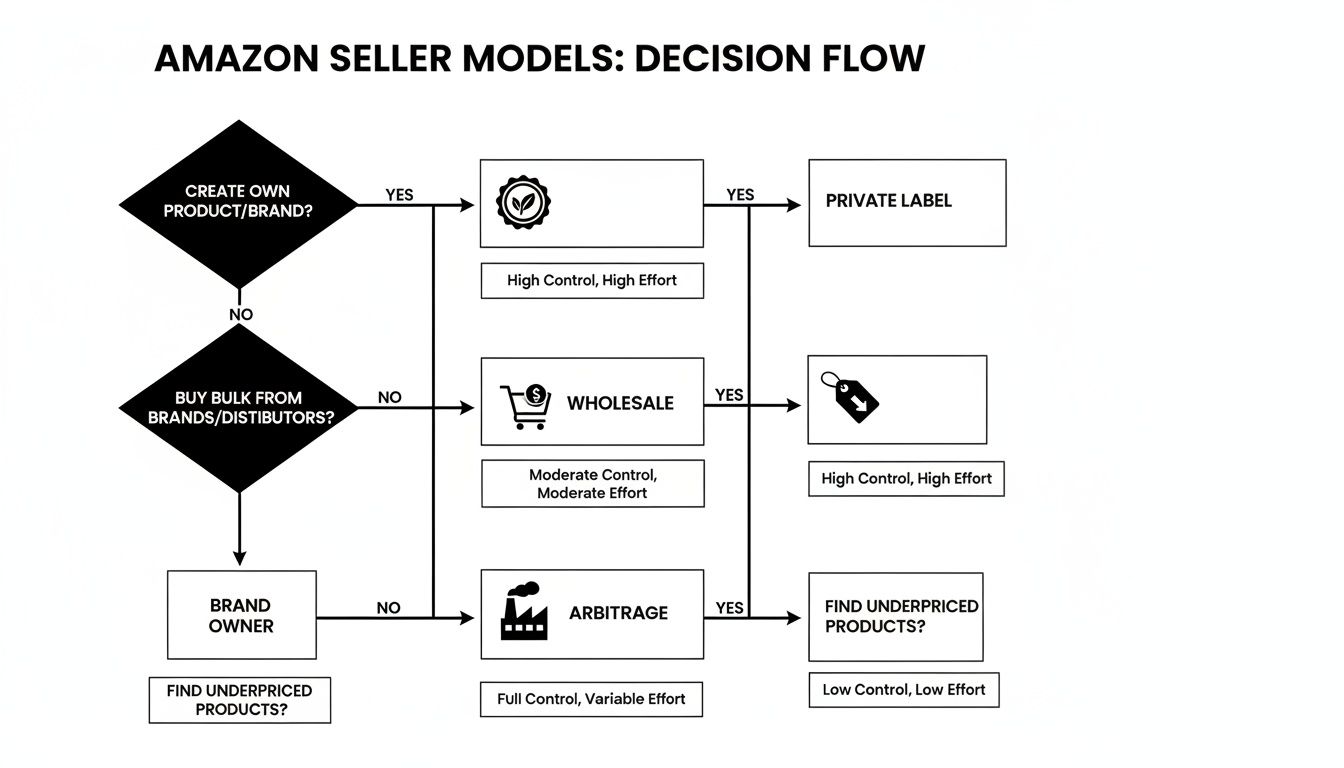
Each model strikes a different balance between how much money you need upfront, how much control you have, and how big you can scale—from the brand-building marathon of Private Label to the quick-flip hustle of Arbitrage.
The Final Verdict: Let's be clear: Amazon is not a get-rich-quick scheme. It’s a powerful, but incredibly demanding, engine for growth. If you are well-funded, have a product that actually stands out, and are committed to mastering the game, then the answer is a resounding yes—it is absolutely worth it. For the entrepreneur who comes prepared, it’s still one of the most direct paths to scaling a brand in commerce today.
Even after laying out the pros and cons, I know you probably have a few questions still rattling around. Let’s tackle some of the most common ones I hear from founders trying to figure out if Amazon is their next big move.
There's no single magic number here. The startup cost depends entirely on the game you want to play. If you're going the arbitrage route, you could technically get started with as little as $500, hunting for deals at local stores to flip online.
But if you're building a real private label brand? Be realistic. You should plan on a starting budget somewhere between $3,500 and $10,000. That's not just for inventory; it's for getting professional photos, investing in essential software, and—most importantly—fueling your launch ads.
My Two Cents: Don't just budget for the cost of your goods. I've seen so many brands flame out because they underfunded their marketing. Skimping on your ad budget is one of the fastest ways to fail on Amazon before you even get a chance to compete.
Patience is more than a virtue on Amazon; it's a requirement. While a lucky few might see some profit in the first couple of months, the typical timeline to hit consistent profitability is closer to six to twelve months. This is especially true for new private label brands.
Why so long? That initial period is a grind. You're fighting for sales velocity, trying to get those first crucial reviews, and constantly tweaking your ad campaigns to find what works. Think of it as a marathon, not a sprint. Every dollar you make early on should be pumped right back into growing your inventory and brand presence.
Nope, FBA isn't mandatory, but for most sellers, it’s a no-brainer. The alternative is Fulfillment by Merchant (FBM), which means you’re the one storing, packing, and shipping every single order, not to mention handling all the customer service.
Sure, FBM gives you more control and helps you dodge some fees, but it comes with some serious trade-offs:
For almost every new seller I talk to, the operational lift and customer preference for Prime shipping make FBA the obvious strategic choice. Honestly, whether selling on Amazon is worth it often boils down to how well you can leverage powerhouse programs like FBA.
Ready to scale your e-commerce business with a network of elite founders? Million Dollar Sellers is an exclusive, invite-only community where top entrepreneurs share proven strategies to grow faster. Apply for membership at Million Dollar Sellers and connect with the best in the business.
Join the Ecom Entrepreneur Community for Vetted 7-9 Figure Ecommerce Founders
Learn MoreYou may also like:
Learn more about our special events!
Check Events