Chilat Doina
February 12, 2026
Product sourcing is the entire game of finding, vetting, and buying the products you sell. It’s so much more than just clicking “buy” on some inventory. Think of it as a strategic system for locking in reliable suppliers, negotiating smart deals, and handling all the nitty-gritty logistics to get your products from the factory floor to your fulfillment center.
A lot of new entrepreneurs see sourcing as a simple transaction: find a product, pay for it, sell it. But for high-growth e-commerce brands, that’s a rookie mistake. Sourcing is the bedrock that your profitability, scalability, and even your brand's survival are built on.
It’s like an architect designing a skyscraper. They don’t just order a random pile of steel and concrete. They carefully select every single partner and material to make sure the whole structure is sound, safe, and built to last for decades.
Strategic product sourcing is the exact same idea. It’s a complete ecosystem you build to give your brand a competitive edge, moving way beyond simple transactions.
To scale a business into the 7- and 8-figure range, your sourcing can't be an afterthought—it has to be a well-oiled machine. This system relies on five core functions that work together to protect your brand and optimize your entire supply chain.
Let's break down what that system looks like.
.tbl-scroll{contain:inline-size;overflow-x:auto;-webkit-overflow-scrolling:touch}.tbl-scroll table{min-width:600px;width:100%;border-collapse:collapse;margin-bottom:20px}.tbl-scroll th{border:1px solid #ddd;padding:8px;text-align:left;background-color:#f2f2f2;white-space:nowrap}.tbl-scroll td{border:1px solid #ddd;padding:8px;text-align:left}FunctionObjective for 7- and 8-Figure BrandsSupplier Discovery & VettingIdentify and perform deep due diligence on partners to confirm their legitimacy, capacity, and quality standards before a single dollar is spent.Negotiation & ContractingSecure favorable terms on pricing, MOQs, and payment schedules (like 30/70 splits). Create ironclad Purchase Orders that act as binding agreements.Quality Control ManagementImplement a system of inspections and establish a "Golden Sample" to ensure every production run meets your non-negotiable brand standards.Logistics & FulfillmentMaster the flow of goods, from managing freight and customs to ensuring products arrive at your 3PL or warehouse exactly when you need them.Compliance & Risk MitigationProactively manage product safety, certifications, and geopolitical risks to protect your brand from costly delays, recalls, or legal trouble.
Each of these pillars is critical. A weakness in one area can bring the whole structure down, which is why a holistic, strategic approach is the only way to win in the long run.
For a scaling brand, mastering product sourcing means treating it as a dynamic system, not a one-off task. You're building a resilient supply network that can pivot with market shifts and fuel your growth targets.
In the high-stakes game of e-commerce, your supply chain decisions make or break you. A recent survey revealed that while 80% of US companies expect trade tensions to cause major disruptions, a surprising 66% still plan to work with Chinese suppliers. This highlights the complex balancing act between cost and risk that defines modern sourcing.
You can dig into more of those insights in the 2025 global sourcing survey. The takeaway is clear: a sophisticated, strategic approach isn't just a "nice-to-have"—it's non-negotiable for success.
Deciding on your product sourcing model is one of the most critical calls you'll make for your business. This isn't just some logistical checkbox; it’s a strategic move that dictates your cash flow, profit margins, brand control, and ultimately, your ability to scale.
Think of it like choosing a vehicle for a cross-country race. You could pick a dragster—incredibly fast off the line but totally impractical for the long haul (that's dropshipping). Or you could go with a massive freight truck that can carry a huge load but requires a massive investment and a specialized license to operate (that's manufacturing). The key is to match your vehicle to the terrain and your ultimate goal.
Let's break down the four main models so you can figure out which path makes the most sense for your brand's ambitions.
Going straight to the source and working with a manufacturer is the ultimate power move. This approach, often called OEM (Original Equipment Manufacturer) or ODM (Original Design Manufacturer), gives you the highest possible control and the fattest potential profit margins. You’re literally creating a product from scratch that is 100% yours.
This is the path for brands serious about building a defensible moat around their business. When you own the design and the entire production process, you create something competitors simply can't copy. But that power comes at a price. It demands serious upfront capital for things like tooling and meeting minimum order quantities (MOQs), not to mention a deep commitment to quality control. It’s the high-risk, high-reward option for founders playing the long game.
The wholesale model is straightforward: you buy branded products in bulk from a manufacturer or distributor and then resell them. It's an incredibly popular and effective way to get to market fast with products that already have a built-in audience and proven demand.
The biggest win here is speed. You don't have to invent anything new; you just have to get good at finding profitable products from existing brands. This dramatically lowers the barrier to entry compared to creating a custom product from the ground up.
The trade-offs, however, are very real. Your profit margins will be significantly thinner, and since you’re selling the exact same items as a dozen other retailers, you’ll face brutal price competition. It becomes a race to the bottom, where your success hinges on operational efficiency rather than a unique brand. You can dive deeper into this model by exploring how to find reliable wholesale suppliers for Amazon.
Dropshipping is the classic inventory-free model. You partner with a supplier who handles all the storage and shipping, sending products directly to your customers whenever you make a sale. You're essentially the marketing and sales front, collecting the customer's money and then paying your supplier to fulfill the order.
Dropshipping is the ultimate low-capital entry point into e-commerce. It completely removes the financial risk of holding inventory, making it an attractive option for new entrepreneurs or for testing new product ideas without a major investment.
The catch? You give up almost all control. You have no say over the packaging, the shipping times, or the final quality of the product that lands on your customer's doorstep, which can do serious damage to your brand's reputation. Margins are often razor-thin, and your entire operation is at the mercy of your supplier’s stock levels and performance.
This model is all about creating products yourself or with a small, specialized team. It's the lifeblood of platforms like Etsy, where businesses offer unique, one-of-a-kind items that carry a powerful brand story and can command premium prices.
The main benefit here is unparalleled product uniqueness and brand authenticity. You control every single detail, from the raw materials to the final narrative. The challenge, however, is that this model is notoriously difficult to scale. Production is capped by your own time and resources, which creates a hard ceiling on your revenue potential. It’s a fantastic fit for niche lifestyle brands but a tough road for founders with aggressive growth targets.
Choosing the right sourcing model is less about finding the "best" one and more about finding the best fit for your brand's current stage and future ambitions. Each path offers a unique blend of risk, reward, control, and investment.
This table breaks down the core trade-offs to help you make a more strategic decision.
.tbl-scroll{contain:inline-size;overflow-x:auto;-webkit-overflow-scrolling:touch}.tbl-scroll table{min-width:600px;width:100%;border-collapse:collapse;margin-bottom:20px}.tbl-scroll th{border:1px solid #ddd;padding:8px;text-align:left;background-color:#f2f2f2;white-space:nowrap}.tbl-scroll td{border:1px solid #ddd;padding:8px;text-align:left}Sourcing ModelMargin PotentialBrand ControlCapital InvestmentBest ForManufacturingHighMaximumHighBrands building a unique, defensible product with long-term vision.WholesalingLow-MediumLowMediumSellers wanting to enter the market quickly with established products.DropshippingLowMinimalVery LowNew entrepreneurs, testing product ideas, and budget-conscious launches.HandcraftedHighCompleteLow-MediumNiche lifestyle brands focused on authenticity and unique craftsmanship.
Ultimately, the model you start with doesn't have to be the one you stick with forever. Many successful brands begin with a lower-risk model like dropshipping or wholesaling to validate their market before graduating to custom manufacturing as they scale. The important thing is to be honest about your capital, your appetite for risk, and how much control you need to build the brand you envision.
Finding a potential supplier on a B2B marketplace is just the first step. The real work—the part that protects your brand, your investment, and your customers' trust—happens during the vetting process.
Think of it like hiring a key team member. You wouldn't just glance at a resume and hand them a contract, right? You’d interview them, check their references, and make sure their claims hold up. You need to apply that exact same level of scrutiny when you're choosing a sourcing partner. A great supplier becomes a true extension of your team. A bad one? They can trigger production delays, quality control nightmares, and inventory disasters that can sink a growing brand.
The goal here is simple: get past the sales pitch and see what their operation is really like. This isn't a single action but a multi-stage process, starting with a quick digital check and moving all the way to a deep operational review before you even think about placing a big order.
First impressions happen online, and a supplier's digital footprint can tell you a lot about their professionalism before you even send the first email. Start by digging into their website, their profile on whatever B2B marketplace you found them on, and any social media they might have.
You're looking for consistency. Do they have clear product photos? Is their company information detailed and easy to find? A professional, well-maintained online presence is a good sign. On the flip side, a bare-bones profile with generic stock photos and bad grammar should be an immediate red flag.
When you do make contact, pay close attention to how they communicate.
This first phase is all about filtering out the obvious duds before you waste any more of your time.
Once a supplier has passed that initial sniff test, it’s time to get serious and verify their credentials. This is when you start asking for the paperwork to prove they are who they say they are.
Don't be shy about asking for these documents. Any reputable manufacturer will have this stuff ready to go and will fully expect you to ask for it. It's just part of doing business.
This stage is about moving from claims to cold, hard proof. For a more detailed breakdown of what to ask, you can run through our supplier vetting checklist.
Due diligence isn't just about what happens inside the factory anymore. Today’s supply chains are a tangled web, and smart sourcing means looking at the bigger picture.
It’s no secret that brands are diversifying away from single-country dependency. Hotspots like Vietnam, India, and Mexico are seeing a huge influx of business, with 50% of companies increasing their regional sourcing just last year to spread their risk. For an e-commerce brand, this means your due diligence has to include looking at geopolitical risks, regional trade policies, and logistical hurdles. Ignoring these factors can lead to crippling delays that impact up to 30% of less agile supply chains.
This decision tree gives you a quick visual guide to help match your business goals with the right sourcing model.
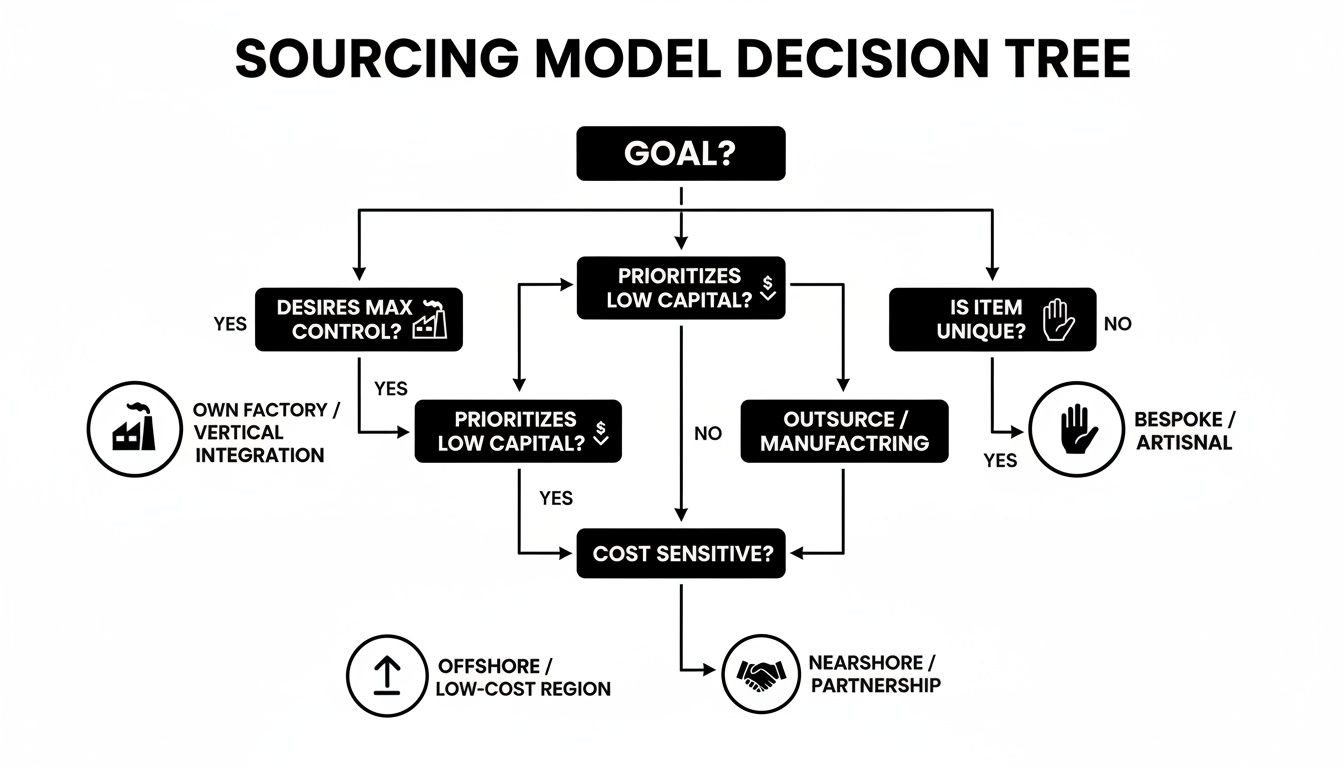
As you can see, the path becomes much clearer when you know whether you're optimizing for control, capital, or product uniqueness.
Key Takeaway: The final, most important step in vetting a supplier is validating the actual product. No amount of paperwork can replace getting a physical sample in your hands.
This is your chance to assess everything—the material quality, the construction, the packaging, and their ability to follow your exact specs. For example, the process for finding the best wholesale jewelry suppliers involves scrutinizing the finish and clasp quality on a sample, not just looking at photos.
Always order samples from your top two or three candidates. Pit them against each other. This final check is the best insurance policy you can have against a disastrous first production run.
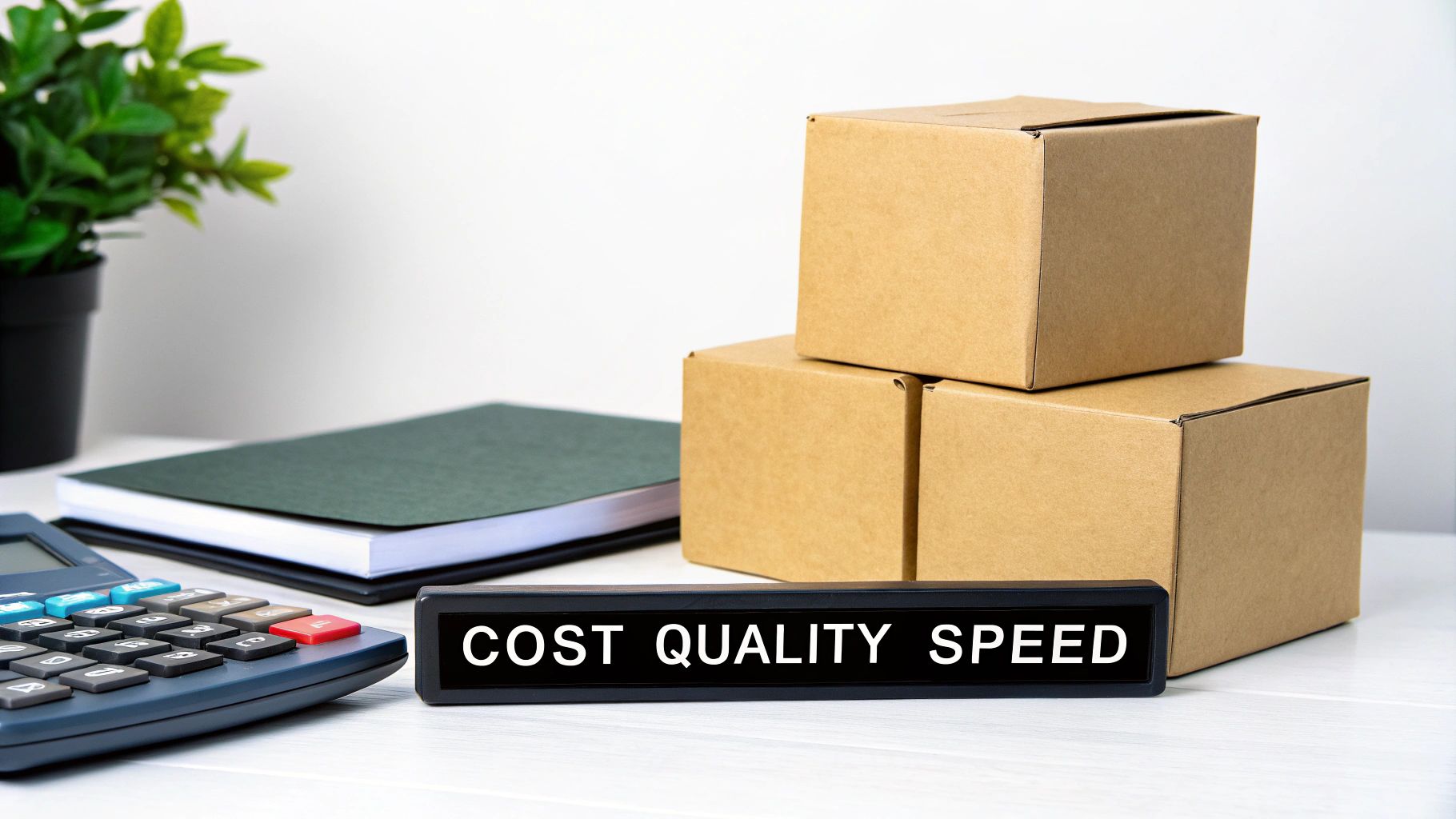
Smart product sourcing isn't a race to the bottom on price or a mad dash for the fastest shipping. It's a delicate balancing act between three forces that are constantly pulling in opposite directions: cost, quality, and lead times. Think of it as the "iron triangle" of e-commerce—a core challenge every single operator has to solve.
Picture a three-legged stool. If you hack one leg down—say, you slash costs to the bone—the whole thing wobbles and falls over. Your job is to find that sweet spot, the equilibrium where all three elements work in harmony to build a profitable, reputable brand.
Getting this right is what separates the pros from the amateurs. It demands a strategic look at each piece of the puzzle, starting with what your products actually cost you.
That unit price a supplier quotes you? It's just the tip of the iceberg. And relying on that number alone is one of the quickest ways to torpedo your profit margins. To make genuinely smart sourcing decisions, you have to calculate your Total Landed Cost.
This number is the all-in cost to get one single unit from the factory floor to your warehouse doorstep. It’s the only number that gives you a true picture of your expenses.
Your Total Landed Cost calculation must include:
Add all those up, divide by the number of units, and you've got your real-world cost basis. Now you can set prices with confidence and dodge any nasty financial surprises down the road.
Let's get one thing straight: quality isn't an expense. It's a direct investment in your brand's reputation and your customers' loyalty. One bad batch of products can unleash a firestorm of negative reviews, expensive returns, and irreversible damage to the trust you've worked so hard to build. A proactive Quality Control (QC) plan is non-negotiable.
The bedrock of any solid QC plan is a painfully clear definition of what "quality" means for your product. You can't leave this open to interpretation.
The "Golden Sample" is your ultimate source of truth. This is a physical, approved sample that represents the absolute standard for all future production runs. Your manufacturer must sign off on it, and it becomes the benchmark against which every unit is measured.
Your entire QC process should be built around this sample, with scheduled checkpoints along the way. The most crucial one is the pre-shipment inspection (PSI). This is where you—or a third-party inspector—physically check a portion of the finished goods before you wire that final payment and before the container leaves the factory. Finding defects at this stage is a thousand times easier and cheaper than discovering them in your own warehouse.
Lead time is the total clock-time from the moment you place a purchase order to the second that inventory is checked into your warehouse, ready to sell. Miscalculating this timeline is an incredibly common mistake that leads directly to stockouts, lost sales, and panicked, wallet-busting air freight bills to fix the mess.
A complete lead time map has several distinct stages:
Always, always add buffer days to your timeline. Delays are not a possibility; they are an inevitability. Most importantly, you have to be acutely aware of major production holidays, especially Chinese New Year. Factories in China shut down for weeks, creating a massive production and shipping backlog that can snarl supply chains for more than a month. Smart planners get their orders in well in advance to navigate this predictable annual bottleneck.
Let's be honest: your profit margins are often won or lost at the negotiating table. After you've done the hard work of vetting suppliers, the next make-or-break phase is mastering the art of negotiation. This isn't just about haggling over the price per unit; it’s a strategic dance to build a partnership that's both profitable and resilient.
For any scaling brand, a solid negotiation sets the foundation for a healthy, long-term supplier relationship. It’s where you lock in terms that protect your cash flow, your intellectual property, and your brand's future. The goal isn’t to squeeze every last penny out of your supplier—that's a recipe for disaster. The real win is creating a fair, sustainable agreement where both sides come out ahead.
This means you have to start thinking beyond the cost per unit. While price is obviously important, focusing on other key terms can often deliver far greater value to your business down the road.
Truly effective negotiation is about shaping the entire deal. A lower price is a great win, of course, but things like better payment terms or securing market advantages can have a much bigger impact on your bottom line and operational stability.
Here are a few key areas you should be focusing on in your discussions:
By broadening the scope of your negotiation, you can secure a much stronger, more defensible position. Our full guide on negotiating with suppliers dives into more advanced tactics to help you secure these kinds of favorable terms.
A Purchase Order (PO) should never be a casual email or a simple one-page form. For serious e-commerce operators, the PO is your single most important contractual tool. It’s a legally binding agreement that translates all your hard-fought negotiations and product specs into a clear, actionable set of instructions. A weak PO leaves everything open to interpretation, which is just an invitation for costly mistakes.
A detailed Purchase Order is your primary line of defense against production errors, quality failures, and shipping disasters. It removes ambiguity and holds your supplier accountable for meeting your exact standards.
Your PO needs to be exhaustive. Think of it as the ultimate blueprint for your production run. It has to include precise, undeniable details on every single aspect of the order.
Your PO must clearly define:
This level of detail ensures nothing gets lost in translation. With one-third of global firms bracing for supply disruptions worse than in previous years, mastering the art of the purchase order is more critical than ever. A well-defined PO acts as a crucial risk mitigation tool, giving you a contractual basis for recourse when things inevitably go wrong. An ironclad PO protects your brand from misunderstandings and expensive production failures.
Relying on a single supplier—or even a single country—is one of the biggest liabilities a growing e-commerce brand can have. What works for a six-figure business can quickly become a catastrophic point of failure for an eight-figure operation.
Real, long-term growth demands a resilient, future-proof supply chain that can handle unexpected shocks. It means moving beyond a simple transactional relationship with one factory. As you scale, your focus has to shift toward diversification, solid performance metrics, and turning your key suppliers into genuine partners who are actually invested in your success.
The old "all your eggs in one basket" approach is a recipe for disaster. A single lockdown, port strike, or policy shift can bring your entire operation to a screeching halt. This is precisely why savvy operators are adopting a "China Plus One" strategy—a core concept in modern product sourcing.
The idea is simple: maintain a primary manufacturing base in China to tap into its incredible efficiency and scale, while also developing a secondary supplier in another region like Vietnam, Mexico, or India. This builds in redundancy and buffers you from geopolitical and logistical risks.
For top e-commerce sellers, mastering this dynamic is non-negotiable. While nearshoring to places like Mexico is gaining steam, the unmatched scale and speed of Chinese suppliers in certain sectors mean most big brands use a dual-supplier model. They leverage China for volume while piloting alternatives to de-risk their supply chain. You can dig into more data on this trend by exploring global sourcing survey insights.
You can't improve what you don't measure. As your order volume grows, you have to track supplier performance with cold, hard data—not just gut feelings. Key Performance Indicators (KPIs) give you a clear scorecard to hold partners accountable and spot trouble before it spirals.
Start by tracking these essential metrics:
A supplier relationship should evolve from transactional to strategic. This shift happens when you move from simply placing orders to actively collaborating on growth, sharing data, and solving problems together.
The endgame of a scaled sourcing strategy is to build true partnerships. This means treating your top suppliers like an extension of your own team, with open communication and mutual trust at the core. A real partner will prioritize your orders during peak season and will work with you on product development, not just for you.
To get there, start sharing your sales forecasts to help them plan their capacity. Bring them into your product development process early on; their manufacturing expertise can save you from designing something that’s a nightmare to produce.
When suppliers feel invested in your brand's journey, they become a powerful asset, helping you innovate faster and navigate challenges more effectively. This collaborative spirit is the hallmark of a truly mature and resilient sourcing operation.
Even with a solid game plan, you're going to hit some specific snags when you're in the trenches of product sourcing. Let's tackle some of the most common questions and challenges that pop up for e-commerce founders building out their supply chains.
Look, Alibaba is a fantastic starting point, but it's just that—a start. To find the real gems and higher-quality partners, you need to diversify your search and get more hands-on.
Here are a few methods that actually work:
Newcomers almost always make the same predictable—and costly—errors. If you can sidestep these common pitfalls, you’ll protect your capital and your brand's reputation right from day one. The worst mistakes usually happen when you rush the process or fixate on the wrong things.
The single biggest mistake is choosing a supplier based only on the lowest price. This almost always leads to quality compromises, communication issues, and long-term headaches that cost far more than the initial savings.
Here are three other critical mistakes to steer clear of:
When you're starting out with a new supplier, a 30% upfront payment to cover materials and 70% upon completion (right before shipping) is a pretty standard deal. Whatever you do, almost never agree to pay 100% upfront. It kills all your leverage if something goes wrong.
As you build a solid track record and trust with your supplier, you can start negotiating for better terms. A great next step is pushing for that final payment to happen after the goods have passed a third-party inspection.
For really big orders, using secure methods like Alibaba Trade Assurance or a Letter of Credit adds an essential layer of financial protection for both you and the factory. This kind of structured approach to payments protects your cash flow and keeps everyone accountable.
At Million Dollar Sellers, our members share real-world insights on negotiating with suppliers, finding hidden-gem factories, and building resilient supply chains. If you're ready to scale your operations with strategies from the world's top e-commerce founders, find out if you qualify for our exclusive community. Learn more about Million Dollar Sellers.
Join the Ecom Entrepreneur Community for Vetted 7-9 Figure Ecommerce Founders
Learn MoreYou may also like:
Learn more about our special events!
Check Events