Chilat Doina
May 29, 2026
Most advice on Amazon FBA is stuck in a beginner loop. It treats FBA like a convenience feature, not a capital allocation decision. That framing is too shallow for any seller who already understands listings, replenishment, and ad spend.
The primary concern isn't whether Amazon will store and ship your products efficiently. It will. The key question is whether your margin structure can survive Amazon's fee stack, your own forecasting errors, and the rising cost of staying visible. If the answer is yes, FBA is still one of the most powerful logistics systems available to a brand. If the answer is no, the Prime badge becomes an expensive illusion.
By 2025, Amazon FBA was still the default choice for many sellers. Seller Assistant cited an independent survey showing 82% of sellers use FBA, with 57% reporting profit margins above 10% and 28% at 20% or more in its analysis of whether Amazon selling is still worth it. That tells you two things at once. FBA still works. And it doesn't work evenly.
The old lazy advice said FBA is worth it because Prime wins conversions, Buy Box share gets easier, and Amazon handles the operational headache. That advice leaves out the part that matters most. A fulfillment method is only worth it if it improves contribution margin after all channel costs are counted.
That is why experienced operators should pay attention to what happened in the acquisition market. Empire Flippers reported that the average monthly profit of Amazon FBA businesses sold on its marketplace increased by 31% from 2023 to 2024, rising from about $10,500 to roughly $13,700 to $13,800, while the average listing multiple fell from 37.3x to 32.3x in its review of Amazon FBA exits in 2025. Sellers were producing more cash on average, but buyers got pickier about what that cash flow deserved in valuation.
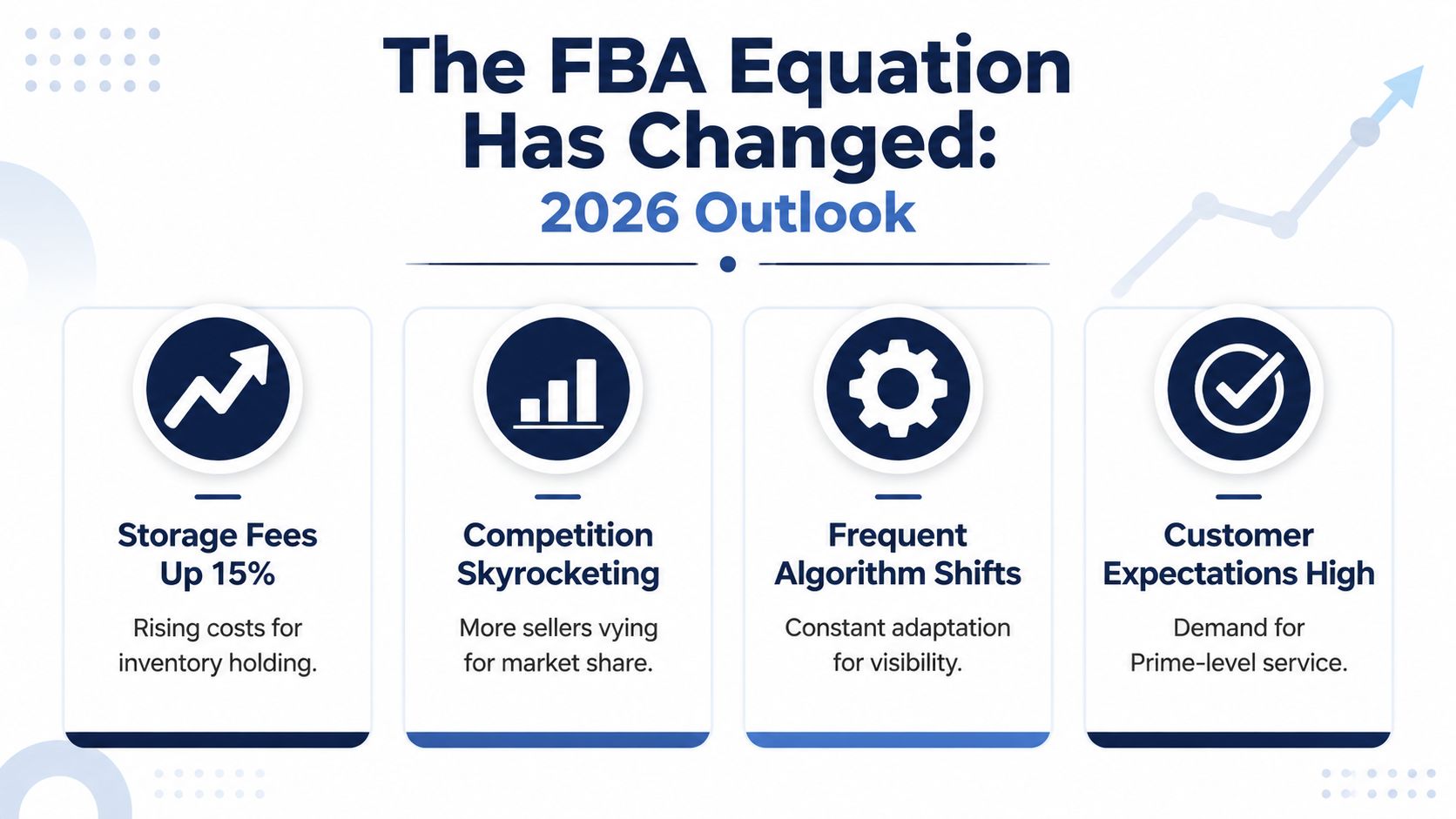
If profits are up but multiples are down, the market is sending a clear message. FBA businesses can still throw off meaningful cash, but buyers no longer pay a premium just because the business runs on Amazon's logistics rails. They pay for quality. They pay for margin durability. They pay for inventory discipline.
That's why the better framing for is Amazon FBA worth it isn't "does FBA help me sell more?" It is "does FBA make each sale more profitable than my alternatives after accounting for the full system?"
Practical rule: Prime eligibility is a lever, not a moat. If your product only works because Amazon subsidizes customer trust and delivery speed, your margin can disappear faster than your sales rank improves.
Seven-figure sellers don't ask whether FBA is good or bad in the abstract. They ask narrower questions:
The biggest mental shift in 2026 is this. FBA is no longer the strategy. It's infrastructure. Strategy lives above it, in product quality, sourcing, brand positioning, and channel mix.
Most margin analysis fails because sellers stop at the obvious line items. They count landed cost, Amazon referral fees, and the basic fulfillment fee. Then they wonder why the P&L feels tighter than the spreadsheet.
That gap usually comes from cost layering. Amazon FBA's economics are highly sensitive to unit-level fees. Sellers pay fulfillment and storage fees, and inventory held over 181 days can trigger aged-inventory surcharges, as explained in Power Digital's breakdown of Amazon FBA pros and cons. The important point isn't just that fees exist. It's that they compound when your inventory forecast is wrong.
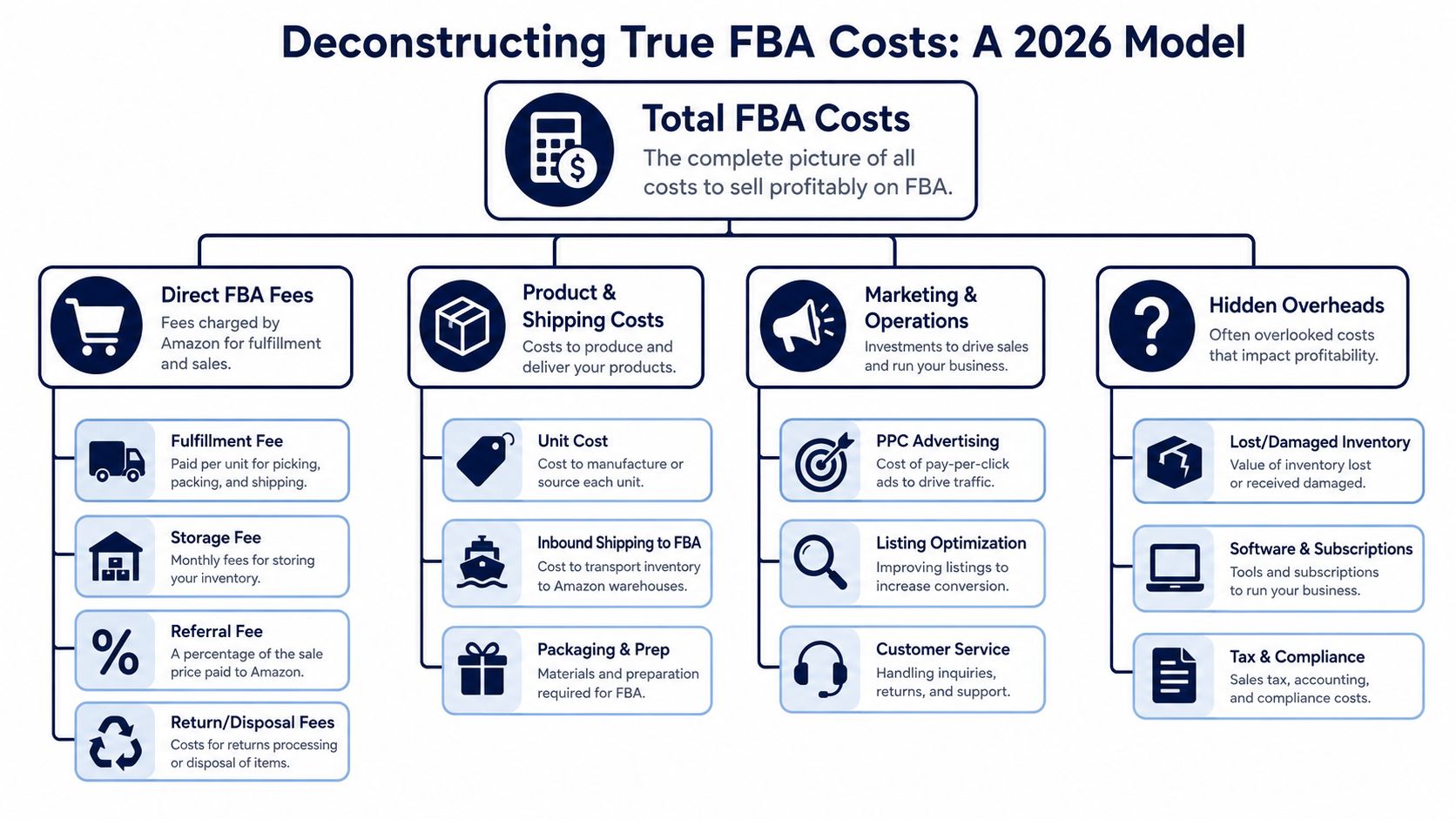
A practical FBA model has to include more than Amazon's visible invoice lines.
Here's a simple way to think about it.
| Cost layer | What sellers usually count | What experienced sellers also include |
|---|---|---|
| Amazon fees | Referral fee, fulfillment fee | Storage drag, returns, removal, disposal, aged inventory exposure |
| Supply chain | Unit cost | Prep, packaging, inbound freight, shipment corrections |
| Marketing | PPC spend | Ranking maintenance, launch inefficiency, creative refresh costs |
| Ops | Seller Central basics | Inventory planning tools, reporting, reconciliation, compliance |
Here, otherwise solid brands lose money without noticing it fast enough:
For teams that sell across channels, cleaner inventory data matters more than most founders admit. If you're trying to connect to Amazon SP API for inventory, the point isn't technical elegance. It's avoiding stock decisions that inflate storage costs on one side and trigger stockouts on the other.
A fee model also needs to be alive, not static. If your team isn't reviewing changing fee exposure regularly, it helps to keep a current reference for Amazon FBA fees inside your operating playbook.
A quick visual walkthrough helps if you're mapping this with your finance or ops lead:
The SKU with the highest revenue is often not the SKU with the best economics. The best SKU is the one that sells predictably, replenishes cleanly, and keeps margin after the full fee stack hits.
Most sellers use the wrong benchmark. They ask whether a product is profitable at today's selling price. The better question is what price and sell-through rate this SKU needs to maintain before it becomes dead weight.
That shift matters because a critical gap in most FBA analysis is the margin that remains after all costs are modeled. The consensus highlighted by Aura's review of whether Amazon FBA is worth it is that profitability depends on disciplined product selection and inventory turnover. Wrong product choices and sloppy turnover can kill the model fast.

Use this base equation for every SKU:
Landing cost + Amazon referral fee + FBA fulfillment fees + estimated storage + PPC ad spend = minimum sale price for break-even
Then add two more filters that most spreadsheets skip:
If the SKU only works under ideal conditions, it doesn't work.
You don't need a fancy model to get the first answer. You need a disciplined one.
A lot of sellers stop after they find a positive number. Experienced sellers push further and ask:
Margin test: If your spreadsheet needs perfect demand, low returns, and cheap clicks to produce a healthy profit, the product isn't profitable. It's fragile.
Revenue hides bad operational judgment. Contribution margin exposes it.
That is why a lot of teams rely on a dedicated Amazon FBA profit calculator before they place a PO, not after inventory lands. The right workflow is simple. Model the SKU, pressure-test the assumptions, then decide whether FBA deserves the inventory.
The strongest Amazon sellers I know don't treat break-even as a finance exercise. They treat it as a catalog filter. It tells them which products deserve cash, ad spend, warehouse space, and management attention.
FBA is a tool. FBM and 3PL are tools too. The expensive mistake is turning one of them into ideology.
When sellers default to FBA for every SKU, they usually give away control on products that should never have gone into Amazon's warehouse network. When they overcorrect into FBM, they often recreate a fragile mini-fulfillment operation in-house. And when they jump to a 3PL too early, they buy complexity before they buy enough repeatability.
The practical way to compare fulfillment methods is by business fit, not by abstract pros and cons.
| Criteria | Fulfillment by Amazon FBA | Fulfillment by Merchant FBM | Third-Party Logistics 3PL |
|---|---|---|---|
| Cost structure | Strong for many standard, fast-moving SKUs. Can get ugly when fees pile up or items move slowly | More direct control over fulfillment costs, but labor and shipping management sit with you | Can improve economics for brands with enough volume and stable operations |
| Brand control | Limited packaging and post-purchase control | Highest direct control over packaging and customer handling | More control than FBA, less operational burden than pure FBM |
| Scalability | Very high operational scalability inside Amazon's system | Harder to scale unless your internal fulfillment is already mature | Scales well when the 3PL is a fit and processes are tight |
| Customer experience | Strong Prime-linked expectations and Amazon-handled service | Depends on your own systems and carrier execution | Depends on partner quality and SLA discipline |
| Operational complexity | Lower day-to-day shipping burden, higher platform dependency | Highest internal complexity | Shared complexity. Less warehouse burden, more partner management |
FBA tends to win when the item is standard-sized, replenishes predictably, and sells fast enough to justify Amazon's convenience and reach.
FBM tends to win when the product is bulky, customized, fragile in a way that needs special handling, or sold in a pattern that doesn't fit FBA storage economics.
3PL tends to win when you're building a brand across Amazon, Shopify, retail, and other channels and need one fulfillment layer that doesn't force your whole business into Amazon's rules.
If your team is thinking beyond a simple warehouse lease, it helps to study how operators approach designing e-commerce fulfillment solutions before committing to internal infrastructure or a 3PL footprint.
Instead of asking which model is cheapest in theory, ask:
For sellers comparing marketplace logic directly, a focused breakdown of Amazon FBA vs FBM is useful because the right answer is often SKU-specific, not account-wide.
Don't choose a fulfillment model for your business. Choose the right fulfillment model for each product family.
FBA should be judged at the SKU level, but experienced operators already know that. The harder question is whether FBA improves contribution dollars per unit of working capital, or just inflates top-line revenue while hiding weaker economics.
A good FBA SKU usually has three traits at the same time. It turns fast, ships cheaply, and does not need much post-purchase handling. If one of those breaks, FBA often stops being a growth tool and starts acting like an expensive convenience layer.
Christ Turton's 2026 guidance on whether Amazon FBA is still worth it points to the same underlying reality. Prime eligibility and Buy Box lift can help. They only matter if the extra conversion survives fees, returns, storage exposure, and TACoS pressure.
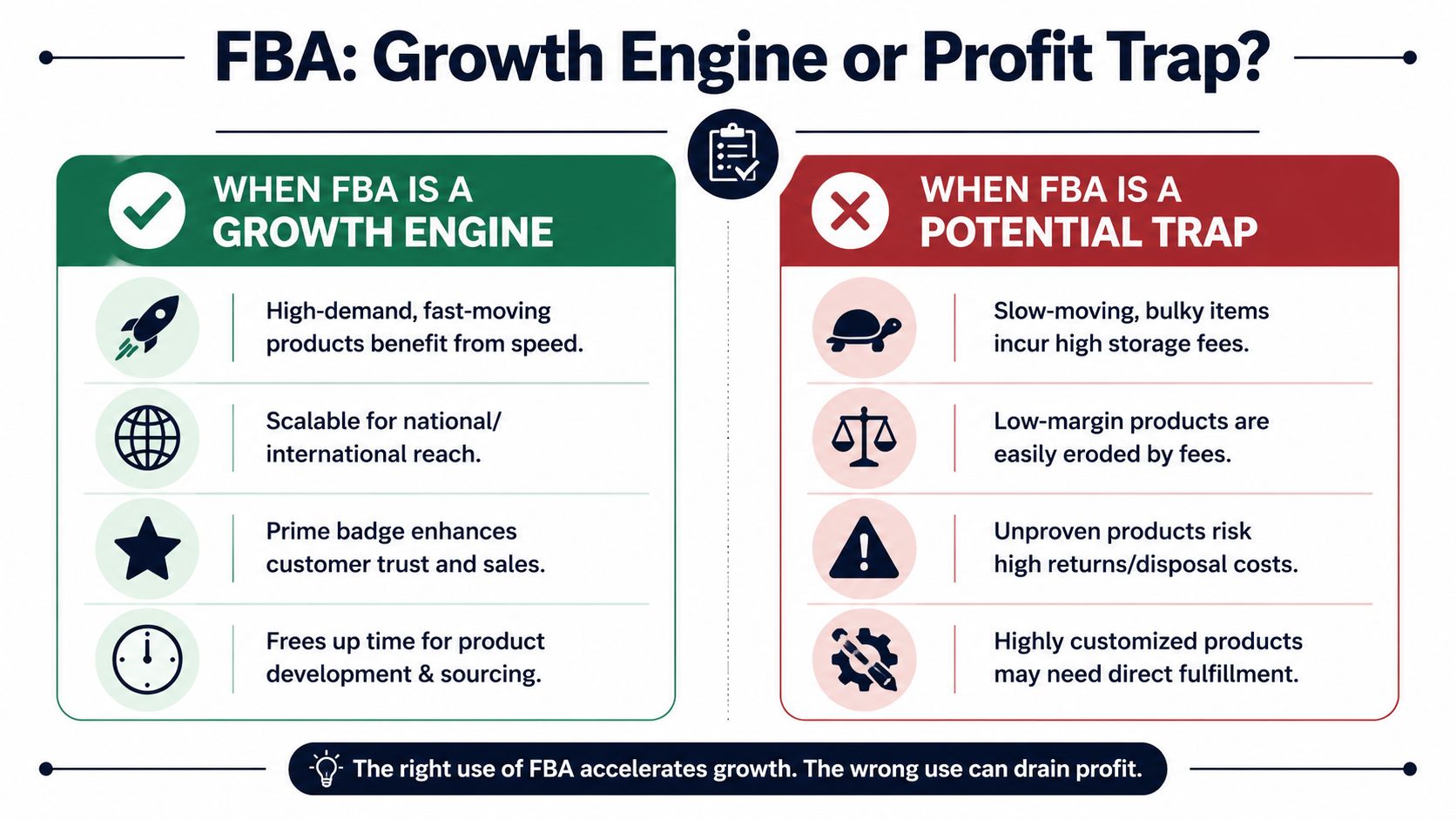
FBA tends to perform well for products with tight operational predictability and enough margin to absorb Amazon's tollbooth.
These are the SKUs that can scale cleanly. The fulfillment layer stays simple, inventory replenishment is easier to model, and the team can spend time on ranking, conversion, sourcing, and cash flow instead of fixing warehouse exceptions.
The trap shows up when sellers use FBA because it is easy to launch, not because the math is strong.
These SKUs usually struggle:
I see this mistake often in catalogs doing decent revenue but weak free cash flow. A product can look healthy in Seller Central and still be a bad business asset once you account for aging inventory, return leakage, and the capital sitting in Amazon's network.
Strong operators rarely force the entire catalog into one fulfillment model. They assign fulfillment based on unit economics and operational risk.
Put high-velocity, margin-safe winners into FBA. Keep awkward bundles, slower movers, seasonal items, and products that need packaging control in FBM or a 3PL. That structure protects Prime where it matters and preserves margin where Amazon's fee stack is too expensive.
That is the difference between chasing convenience and building a durable fulfillment system. Advanced seller communities talk about this constantly because the 2026 decision is no longer "Should I use FBA?" The question is "Which SKUs deserve FBA, and which ones make more money somewhere else?"
There isn't a universal yes or no answer. There is only a disciplined answer for your catalog, your margins, and your growth model.
Use three filters.
Ask whether the SKU keeps healthy contribution margin after landed cost, referral fees, fulfillment, storage, and advertising. If the product only works when every assumption goes right, it doesn't belong in FBA.
Then stress test the ugly scenarios. Slower sell-through. Higher CPC. A reorder that lands late. Returns that come in above plan. Products that survive those scenarios deserve more inventory.
Look at the physical product and the cadence of demand. Fast-moving, compact, standardized items tend to fit FBA well. Slow-moving, bulky, seasonal, or customized products often need a different path.
Also be honest about your operating system. If your forecasting is loose and your inventory visibility is weak, FBA punishes that. The logistics are outsourced. The consequences are not.
The strongest 2026 model may be a hybrid one, using FBA for logistics while building demand and brand through off-Amazon channels like TikTok Shop, as discussed in this 2026 Amazon and channel-mix commentary. That's the important strategic shift. Defensibility now comes less from fulfillment alone and more from brand and channel mix.
So the final decision looks like this:
If you want the shortest honest answer to is Amazon FBA worth it, it's this. Yes, for the right products under the right operating discipline. No, if you're using it to cover weak margins, bad forecasting, or a lack of brand strategy.
If you're an established ecommerce operator and want to compare FBA economics, hybrid fulfillment structures, and what other serious sellers are doing behind the scenes, Million Dollar Sellers is where vetted founders share real operating playbooks across Amazon, DTC, and omnichannel growth.
Join the Ecom Entrepreneur Community for Vetted 7-9 Figure Ecommerce Founders
Learn MoreYou may also like:
Learn more about our special events!
Check Events