Chilat Doina
February 20, 2026
If you're selling on Amazon, FBA fees aren't just a line item on a spreadsheet—they are the single biggest factor that will make or break your profitability. Get them wrong, and a surefire bestseller can quickly turn into a money pit.
For anyone serious about building a business on Amazon, getting a handle on the tangled web of FBA fees is non-negotiable. It’s not just about accounting; it’s about survival. This guide is here to cut through the noise and show you exactly what each fee is, why it exists, and how it directly impacts your bottom line.
Think of Amazon FBA fees as the price of admission to the world's most powerful e-commerce machine. You're paying for access to their state-of-the-art warehouses, their incredible shipping network, and their massive base of loyal customers. Just like a brick-and-mortar store has overhead, your FBA business has its own costs. Ignoring them is the fastest way to fail. Mastering them? That's how you scale.
To give you a bird's-eye view of what we'll be covering, here’s a quick breakdown of the core fees you'll encounter on your FBA journey.
.tbl-scroll{contain:inline-size;overflow-x:auto;-webkit-overflow-scrolling:touch}.tbl-scroll table{min-width:600px;width:100%;border-collapse:collapse;margin-bottom:20px}.tbl-scroll th{border:1px solid #ddd;padding:8px;text-align:left;background-color:#f2f2f2;white-space:nowrap}.tbl-scroll td{border:1px solid #ddd;padding:8px;text-align:left}Fee CategoryWhat It CoversWhen It Is ChargedReferral FeesThe "commission" Amazon takes for listing your product on their marketplace.On every sale.Fulfillment FeesThe cost for Amazon to pick, pack, and ship your product to the customer.On every unit shipped.Storage FeesThe "rent" for the physical space your inventory occupies in an Amazon warehouse.Monthly and long-term.Removal & Disposal FeesThe cost to have Amazon return or get rid of your unsold inventory.When you request a removal.Refund & Returns FeesCharges associated with processing customer returns.When a customer returns an item.
This table is just the starting point. We'll be digging deep into each of these, so you know exactly what to expect and how to keep these costs under control.
This guide is your playbook. It's designed to turn fees from a confusing, unpredictable expense into a manageable part of your business strategy. You'll see how the pros:
Keep in mind, Amazon’s fee structure is a moving target—it changes almost every year. For instance, recent updates brought in new fulfillment fees that hit lower-priced items hard while giving a break to sellers of bulky products. The old Small and Light program was also replaced by the new Low-Price FBA program, which automatically enrolls items under $10 but can lead to steep fee hikes for products just outside that range. You can dig into a full breakdown of recent Amazon FBA fee changes to stay on top of the latest updates.
Ultimately, the goal here is simple: to make sure every single sale you make is as profitable as it can possibly be.

If you want to build a profitable Amazon business, you have to get a handle on the two foundational Amazon FBA fees that hit every single sale. Think of these as the non-negotiable costs of admission to the world's biggest marketplace. Getting these down is your first step to actually knowing your numbers.
The first, and most straightforward, is the Referral Fee. This is just a fancy name for Amazon's sales commission. You're paying them for bringing you a customer. Just like a brick-and-mortar store takes a cut for putting your product on their shelf, Amazon takes a piece of your revenue for putting you in front of their millions of buyers.
This fee is a percentage of your item's total sales price—and that includes the item price, any shipping charges, and even gift-wrapping fees. The percentage itself swings quite a bit depending on your product category, usually landing somewhere between 8% and 15%. For instance, "Electronics Accessories" will set you back 15%, while something in "Appliances" might only be 8%.
Key Takeaway: The Referral Fee is your cost of access. It's what you pay for a spot on the digital shelf, and Amazon takes it right off the top the second you make a sale.
This means your product's category has a massive impact on its profitability. We break down all the current rates in our deep dive on the Amazon Referral Fee, which is a must-read before you even think about sourcing a new product.
Next up are the Fulfillment Fees. This is what you pay for the magic of FBA—Amazon handling all the messy logistics so you don't have to. It's the price for not having to run your own warehouse, and it covers the entire journey from shelf to doorstep.
When a customer hits that "Buy Now" button, this fee kicks in to cover:
Now, here's the key difference: unlike the Referral Fee, this one has nothing to do with your product's price. The Fulfillment Fee is all about your item’s physical footprint—its size and weight. Amazon has very specific size tiers, and the bigger and heavier your product is, the more you'll pay to get it out the door.
It's crucial to know that these fees are always moving. Back when FBA first launched in 2006, the rates were dirt cheap to get sellers on board. Fulfilling a small, standard-size product then was only $2.42. As of 2024, that same item now costs $3.43 to fulfill—that’s a 42% hike.
The jump for bigger items is even more eye-watering. A 2-pound oversized item has shot up a whopping 73% in that same time. These steady increases are a reminder that what was profitable last year might not be this year.
Mastering the interplay between the Referral Fee (based on price) and the Fulfillment Fee (based on size and weight) is the entire game. A high-ticket, tiny item could easily be more profitable than a cheap but bulky product once you factor in all the Amazon FBA fees. Nail these two core costs, and you've built the foundation you need to price your products for real, sustainable profit.
While fulfillment and referral fees pop up every time you make a sale, inventory storage costs are the silent margin killers that chip away at your profits every single day. Think of Amazon's warehouses as a premium storage unit for your products—you're paying rent for the physical space your inventory occupies.
The key to mastering these Amazon FBA fees is to stop seeing inventory as just an asset. If you manage it poorly, it quickly becomes a liability. Your products are either making you money or costing you money, and it's these storage fees that often tip the scales. It's a tricky balancing act. Hold too much, and you pay. Hold too little, and you pay for that too.
The most fundamental storage cost is the Monthly Inventory Storage Fee. Amazon calculates this based on the daily average volume (in cubic feet) your products take up in their fulfillment centers. It's simple, really: the bigger your item, the more you pay for its shelf space.
But the rates aren't set in stone. They shift based on two main things:
This Q4 price hike is no joke. It can jump by as much as 300% per cubic foot. Any seller who doesn't get their inventory levels right before October 1st is in for a nasty surprise when their storage bill arrives.
On top of the monthly rent, Amazon penalizes sellers for letting products collect dust. This is where the Aged Inventory Surcharge (what we used to call the Long-Term Storage Fee) kicks in. It’s an extra charge tacked on to any unit that's been sitting in a warehouse for too long, usually starting after 181 days.
This fee is Amazon's way of discouraging you from using their fulfillment centers as a long-term garage. Their entire business model relies on fast inventory turnover. Your slow-moving products are taking up precious real estate that could be used for items that fly off the shelves. The longer your stuff sits, the higher the fee gets, escalating at different time markers.
Storing inventory in a fulfillment center is not a passive activity; it requires constant monitoring. The Aged Inventory Surcharge is Amazon's way of telling you to either sell your products faster or get them out.
Keeping a close eye on your inventory age is non-negotiable. You can get a better handle on these expenses by digging into the details of your inventory carrying cost and how it eats into your bottom line.
For years, the game was all about avoiding overstocking. Now, Amazon has flipped the script and introduced a fee that penalizes the opposite problem: running out of inventory. The Low-Inventory-Level Fee is a newer charge that hits you when your stock levels for a product are consistently too low compared to how fast it's selling.
This fee was created to solve a major headache for Amazon. When you stock out of a popular item, it makes for a bad customer experience and messes with their logistics, which costs them money. The fee is based on your "days of supply." If that number drops below a certain point (historically 28 days), you'll start getting dinged on every unit you sell until you restock.
This puts sellers in a very tight spot. You're now forced to walk a fine line:
The financial pressure to keep your stock levels just right has never been more intense. The fee structures have become much more aggressive over the years. For example, basic monthly storage fees went from $0.48 per cubic foot to $0.78 by 2024. During that same time, removal fees to get rid of that dusty, slow-moving stock shot up from $0.50 to $2.80—a whopping 460% increase. Strategic inventory management is no longer optional; it's a critical survival skill.
Beyond the everyday costs of selling and storing your products, there's another layer of Amazon FBA fees that can pop up. These are the situational and operational fees—charges that only hit your account when specific things happen.
Think of them as the “fine print” of your FBA partnership. If you’re not paying attention, they can feel like a surprise punch to your profit margin. But once you understand what triggers them, you can build processes to dodge them almost entirely, turning a potential cost center into a competitive advantage. These fees are your reward for running a tight ship.
When a customer sends something back, you don't just lose the revenue from that sale. In some cases, you get hit with an extra fee on top of it. This is the Returns Processing Fee, and it applies to products in categories where Amazon gives buyers free return shipping—think Apparel, Shoes, Handbags, and Jewelry.
Because Amazon is footing the bill for that return shipping label, they pass a piece of that cost back to you. The fee is simple: it’s the exact same amount as the original fulfillment fee for that item. If it cost $3.50 to ship that t-shirt out, it’ll cost you another $3.50 in a Returns Processing Fee when it comes back. This makes keeping your return rates low an absolute top priority in these categories.
Sooner or later, you'll need to pull inventory out of Amazon's warehouses. Maybe a product just isn't selling, it's nearing its expiration date, or you've found a better sales channel for it. You have two ways to do this, and neither is free.
Deciding which to choose is just a matter of doing the math. For a low-cost item, the removal fee could easily be more than the product's value. In that case, disposal is the smarter, albeit more painful, choice.
Pro Tip: Don't let slow-moving inventory just sit there. The moment you see it start to gather dust, make a decision. Proactively removing or disposing of it is almost always cheaper than letting it get slapped with long-term storage fees month after month.
Amazon’s fulfillment network is an incredibly efficient machine, but that efficiency depends on one thing: sellers sending in their inventory exactly the way Amazon wants it. When you don't follow their strict prep and shipping rules, you get hit with Unplanned Service Fees.
These are basically penalties for making the warehouse team do extra work they weren't expecting. Common mistakes that trigger these fees include:
These fees are charged per item and can bleed a shipment dry in a hurry. The good news? They are 100% preventable. All you have to do is follow Amazon's inbound requirements to the letter, every single time. It's that simple.
Knowing the individual fees is one thing, but seeing how they all stack up to eat into your profit margin is where the rubber meets the road. This is the single most important calculation you'll do, both when researching a new product and when checking the financial health of your existing ones. It’s how you find out if a product idea is actually viable before you sink a dollar into inventory.
Let's walk through how to put all the pieces together. The basic formula isn't complicated, but the devil is in the details. You absolutely have to account for every little cost tied to selling a single unit.
At its heart, figuring out your net profit is just a simple subtraction game. You start with your sale price and then deduct every single cost that comes out of it.
The fundamental formula looks like this:
Selling Price - Cost of Goods - Referral Fee - Fulfillment Fee - Estimated Storage Fee = Net Profit
This quick calculation gives you a snapshot of your margin on one sale. It's also worth remembering that these fees are business expenses. For sellers in the UK, understanding how these fit into your accounting as sole trader tax deductions is key for accurate financial planning.
Before we jump into a real example, we need to cover a concept that trips up new sellers all the time: dimensional weight. Amazon doesn't just care how heavy your product is in pounds or ounces; they care just as much about how much space it hogs on a shelf or in a truck.
Dimensional weight (or "dim weight") is a logistics industry standard for pricing shipments. It’s based on a package's density. Think about shipping a giant, lightweight teddy bear. The shipping cost will be based on the bulky box it requires, not the fact that it only weighs a couple of pounds.
Critical Insight: Amazon will calculate both the actual weight and the dimensional weight of your package and then charge you based on whichever value is greater. This is exactly why smart sellers obsess over their packaging, trying to make it as compact and dense as possible. It's a massive lever for cutting costs.
Let's put this into practice with two different products. You’ll see just how dramatically the Amazon FBA fees can shift based on an item's size and price.
This table breaks down the costs for a small, standard-sized product versus a much larger, oversize one.
.tbl-scroll{contain:inline-size;overflow-x:auto;-webkit-overflow-scrolling:touch}.tbl-scroll table{min-width:600px;width:100%;border-collapse:collapse;margin-bottom:20px}.tbl-scroll th{border:1px solid #ddd;padding:8px;text-align:left;background-color:#f2f2f2;white-space:nowrap}.tbl-scroll td{border:1px solid #ddd;padding:8px;text-align:left}Fee ComponentExample 1 Standard Size Item ($25)Example 2 Oversize Item ($75)Selling Price$25.00$75.00Cost of Goods-$5.00-$20.00Referral Fee (15%)-$3.75-$11.25Fulfillment Fee-$4.00-$12.50Estimated Monthly Storage-$0.10-$0.75Estimated Net Profit$12.15$30.50Profit Margin48.6%40.7%
Look at that difference. Even though the oversize item sells for 3x the price, its profit margin is actually lower because of those beefy fulfillment and storage fees. This is why you can't just guess.
Running these numbers yourself is essential. You can simplify the process by using a good Amazon FBA profit calculator to model different scenarios and truly understand a product’s potential.
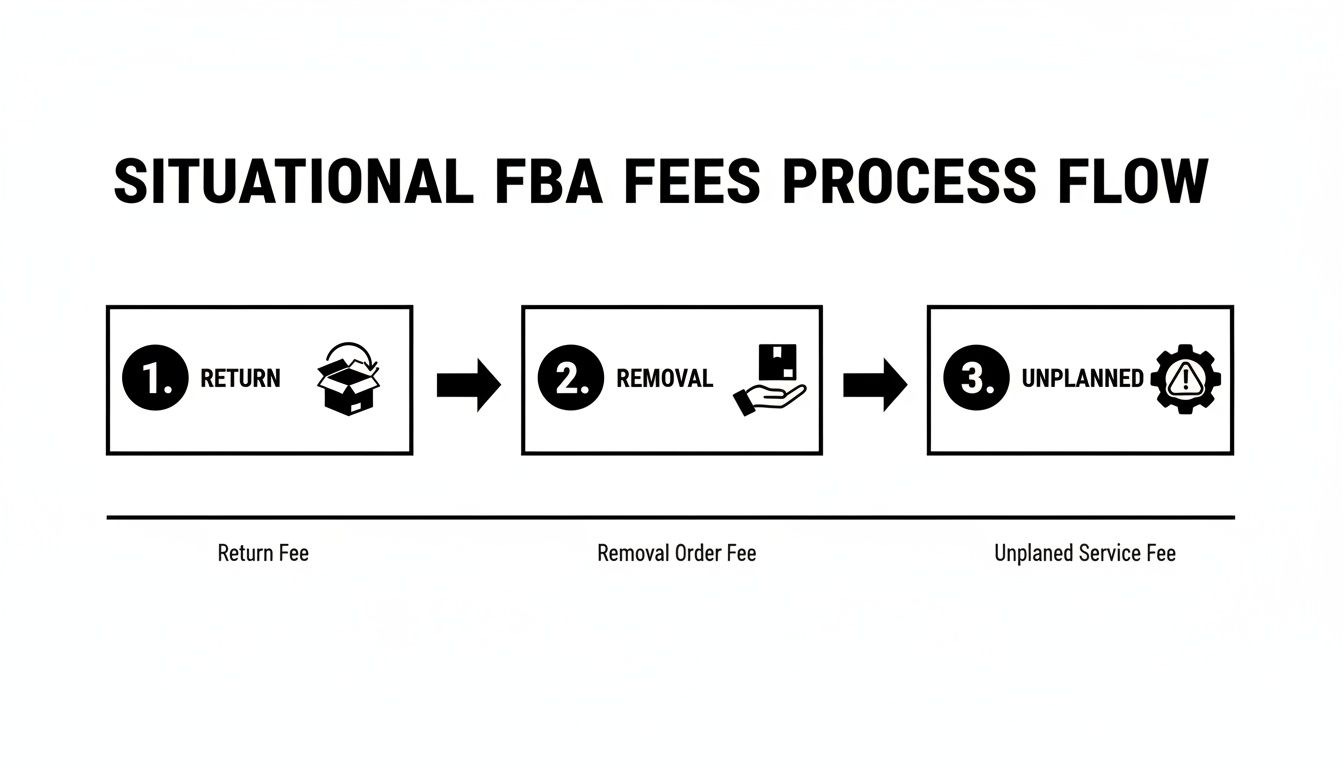
Beyond the standard fees, don't forget about these situational costs. They pop up when things don't go perfectly—like with returns or shipping errors—and can quietly drain your profits if you don't have solid operational processes in place.
Knowing what all the different Amazon FBA fees are is one thing. Actively chipping away at them is how you actually protect your margins and build a business that can scale. The top sellers I know don't just accept fees as a fixed cost—they treat fee optimization as a core part of their operations.
This isn't about finding some secret loophole. It's about making smarter, more strategic decisions across three key areas: your product's packaging, how you manage your inventory, and your own financial diligence. A tiny adjustment in one of these areas can send positive ripples straight to your bottom line.
The single biggest lever you can pull to lower your fulfillment fee is your product's packaging. Amazon’s fees are ruthlessly tied to size and weight, so even a quarter of an inch can be the difference between a standard-size product and a much more expensive oversize one.
Your goal here is simple: make your packaging as compact and dense as you can without putting the product at risk. You should be working with your supplier to get rid of any and all empty space inside the box. For anyone selling in high volumes, just look at the history of fee increases—it’s a constant reminder of why you need to be modeling these costs relentlessly. What started as a seller-friendly perk can now easily eat 30-50% of your revenue if you're not on top of it.
Here are a few things you can do right away:
Your second line of defense is just plain good inventory management. Every single day your product sits on an Amazon shelf, it’s costing you money in storage fees. Let it sit there for too long, and you’ll get hit with aged inventory surcharges that can completely wipe out your profits on that stock.
The goal is to achieve a "just-in-time" inventory flow, where new stock arrives just as the old stock is selling out. This minimizes storage costs and prevents penalties.
To pull this off, you need to get really good at forecasting your sales. Use your historical sales data to predict future demand, especially for your peak seasons. The biggest mistake sellers make is sending in six months of inventory at once. Instead, you should be planning smaller, more frequent shipments to keep your "days of supply" in a healthy range.
Finally, you have to watch your payment statements like a hawk. Amazon’s fulfillment network is a massive, complex machine, and mistakes absolutely happen. They lose inventory, damage items in the warehouse, and sometimes just plain overcharge you on fees. It’s on you to find these errors and get your money back.
Make these audits a regular part of your routine:
These might seem like small wins, but they add up fast. Finding and reclaiming even a few hundred dollars a month can significantly boost your annual bottom line, turning a hidden cost back into pure profit.
Alright, we've torn apart the individual fees, but you probably still have a few questions rattling around about how this all works in the real world. Let's tackle the most common ones I hear from sellers.
Hands down, the best tool for this is Amazon's own FBA Revenue Calculator. It's free and it's essential. You can just plug in a product's dimensions, weight, category, and your target sale price, and it spits out a pretty accurate breakdown of the referral and fulfillment fees you’ll be looking at.
Seriously, make this a non-negotiable step in your product research. It lets you model your profitability with actual numbers before you ever drop a dime on inventory. This simple check can save you from disastrous sourcing mistakes down the line.
The main difference is simply who does the work. With FBA (Fulfillment by Amazon), you're paying Amazon a bundle of fees to handle storage, picking, packing, shipping, and customer service for you. When you go FBM (Fulfillment by Merchant), you only pay Amazon's referral fee, but then all the logistics—from storing boxes in your garage to post office runs—are on you.
While FBA fees are obviously higher, they buy you access to the all-powerful Prime badge. That little checkmark is a massive driver of customer trust and can easily boost your sales volume enough to make the extra cost well worth it.
For 99.9% of sellers, that's a hard no. Amazon FBA fees are standardized and laid out on a public rate card. They're calculated strictly based on your product’s category, size, and weight. There’s no backroom to negotiate a better deal.
Your path to lower costs isn't through negotiation—it's through optimization. The smartest sellers I know focus on what they can actually control. They shrink their packaging, obsess over inventory turnover to dodge storage penalties, and meticulously audit their statements for errors.
Your command center for this is right inside Seller Central. The Payments Transaction View is your best friend—it gives you a line-by-line report of every single dollar in and out for every order. It's total transparency if you know where to look.
Beyond that, you need to keep a close eye on two other reports. First, the FBA Inventory report is crucial for tracking inventory age so you can stay one step ahead of those nasty aged inventory surcharges. Second, check your Reimbursements report regularly. This shows you every time Amazon credited you for inventory they lost or damaged. You've got to be diligent to make sure you get back every penny you're owed. Protecting your margins is an active job, not a passive one.
Success on Amazon is about more than just finding winning products; it's about scaling intelligently with a network of peers who have already overcome the challenges you're facing. At Million Dollar Sellers, you'll connect with elite e-commerce founders to share strategies, solve complex problems, and accelerate your growth. Find out if you qualify to join the most powerful community in e-commerce at https://milliondollarsellers.com.
Join the Ecom Entrepreneur Community for Vetted 7-9 Figure Ecommerce Founders
Learn MoreYou may also like:
Learn more about our special events!
Check Events