Chilat Doina
May 27, 2026
You're probably staring at a product idea that looks promising on paper but still feels dangerous once real money gets involved. Tooling quotes are coming in. Inventory math is starting to harden. You can already see the next fork in the road. Commit and hope, or slow down and validate before the PO gets signed.
Most expensive product mistakes don't happen because founders lack ambition. They happen because founders confuse surface demand with durable demand. A category looks hot, reviews look active, search volume looks decent, and the team fills in the blanks with optimism.
For Amazon and DTC brands, market research for products should be less about reports and more about forced clarity. The job is simple. Find out whether the customer has a painful enough problem, whether the market has room for a better offer, and whether paid traffic can acquire buyers at economics that don't break the business.
A failed launch usually follows the same pattern. The founder sees momentum in a niche, samples a product, improves a few features, orders inventory, launches ads, and then learns the truth too late. Customers click but don't buy. Buyers purchase once but never reorder. Reviews expose a problem nobody on the internal team caught.
That's why experienced operators stop treating research like a pre-launch formality. They build it into the operating system. The point isn't to remove risk entirely. The point is to avoid dumb risk.
Statista's market research overview reports that worldwide market research industry revenue reached almost $54 billion in 2023, up by more than $20 billion since 2008. It also notes that online and/or mobile quantitative research was the biggest revenue contributor. That matters because the best brands now use scalable digital inputs to pressure-test product ideas before those ideas become inventory liabilities.
Top Amazon and DTC operators don't ask, “Do I like this product?”
They ask sharper questions:
Those questions change behavior. You stop chasing novelty and start looking for proof.
Practical rule: If the only argument for launching is “the category is growing,” you don't have a product thesis. You have exposure to a crowded market.
Founders often think research is slow. Bad research is. Good research speeds up decisions because it tells you what to test next, what to ignore, and where your margin of error is narrowest.
In practice, strong market research for products does three things before launch:
| Decision area | Weak approach | Strong approach |
|---|---|---|
| Product concept | Copy what's selling | Identify where buyers complain, hesitate, or switch |
| Customer targeting | Broad demographic guess | Specific buyer context and use case |
| Launch plan | Buy inventory first | Validate with traffic, message tests, and purchase intent |
The brands that keep winning don't trust instinct alone. They turn instinct into a hypothesis, then force the market to answer.
Most founders want to jump straight into polls, creative tests, or supplier calls. Start earlier. A solid workflow begins with secondary research, then moves to primary validation. CleverX's guide to product market research makes that sequence explicit and warns that a common failure mode is relying on convenient but unrepresentative respondents.
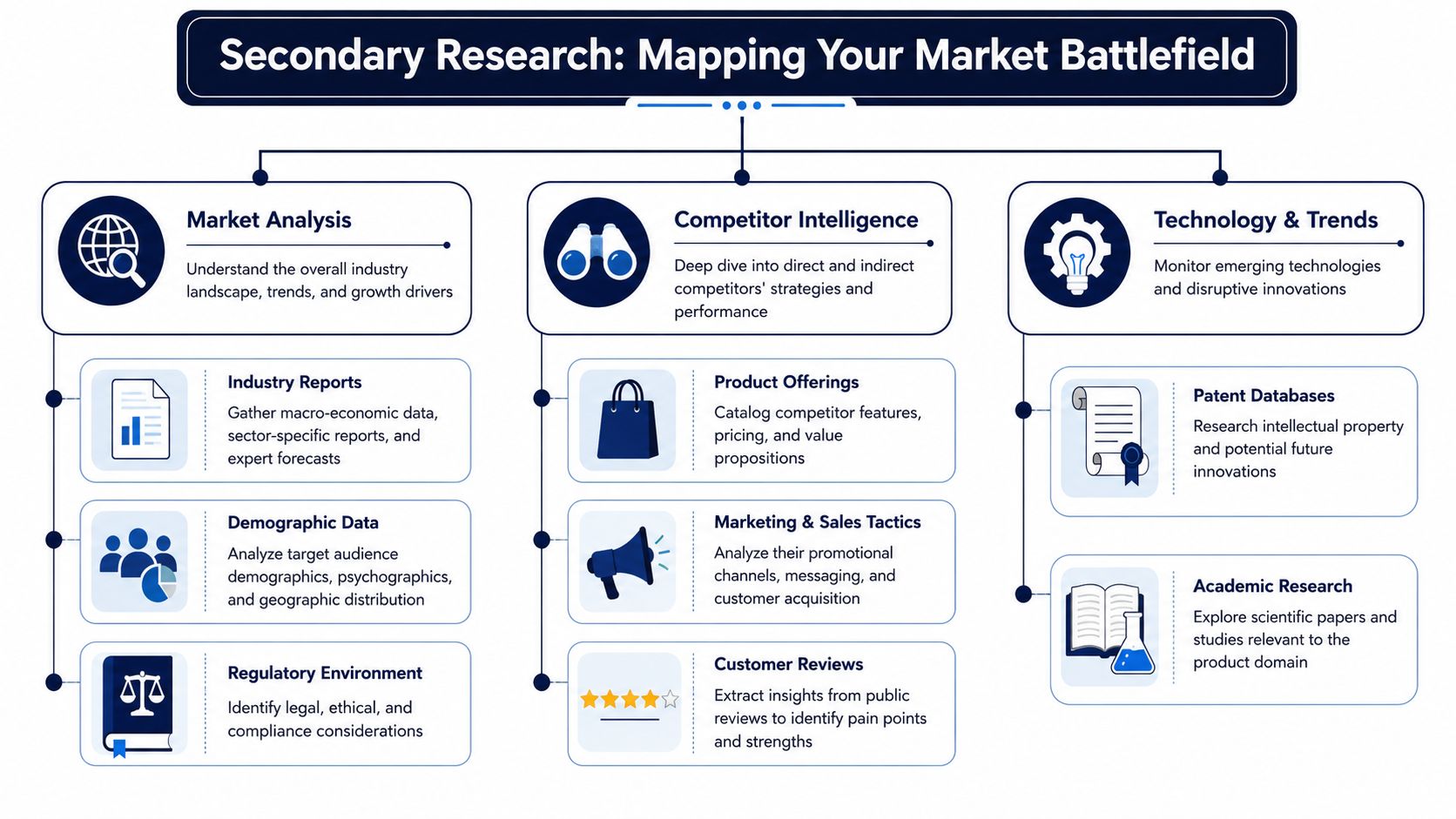
Before you ask customers anything, get clear on the field you're entering. For Amazon-heavy brands, that usually means opening Helium 10, Jungle Scout, Amazon search results, and review pages. For DTC-led brands, add Similarweb, Meta Ad Library, Google search results, retailer listings, and brand sites.
You're not hunting for a perfect estimate. You're looking for directional answers:
A healthy category can still be a terrible entry point if all visible winners are locked into commodity pricing and review count dominance.
Most competitor reviews are better than a paid research report if you know how to read them. Don't just skim star ratings. Pull recurring complaint patterns from low reviews, compare them against high reviews, and separate fixable issues from structural ones.
Focus on these buckets:
Product failure
Breakage, fit issues, leakage, poor durability, weak materials, inconsistent sizing.
Expectation failure
Listing images oversell results, copy hides limitations, packaging confuses usage.
Economics failure
Customers like the item but hate the refill cost, replacement cycle, or bundle logic.
Brand execution failure
Slow shipping, stockouts, weak inserts, generic branding, poor support response.
A category gets interesting when you see buyers wanting the solution but disliking the current execution.
The best opportunities rarely look empty. They look active, flawed, and annoying.
If you want a tighter structure for this work, this competitive analysis framework is a useful way to organize findings into what competitors do well, where they're weak, and what that means for positioning.
Founders often skip this step and waste interviews. Don't go in blind. Write down your initial belief about who buys, why they buy, what alternatives they compare, and what trade-off they currently tolerate.
Keep it short:
| Hypothesis area | Example prompt |
|---|---|
| Buyer | Who is most likely to feel this pain often enough to pay? |
| Trigger | What event pushes them to search now? |
| Alternative | What are they using today if they don't buy this product? |
| Friction | What makes switching feel risky or annoying? |
That hypothesis gives your qualitative work something to challenge. Without it, you collect opinions. With it, you collect useful contradiction.
Demographics help with ad targeting. They're weak on their own for product creation. A buyer's age, income band, or gender might describe the market, but those traits rarely explain why someone leaves one solution, tolerates another, or finally decides to buy now.
Harvard Business School's discussion of jobs to be done pushes the better lens. Compare your product against all the ways buyers currently solve the same need. That's where you uncover the actual competition, the key friction, and the gaps demographics miss.

“What features do you want?” is one of the fastest ways to get low-value research.
People are much better at describing their last frustrating experience than designing your next product. You want the story around the purchase, not a wishlist. Ask about the moment the problem became expensive, embarrassing, inconvenient, or impossible to ignore.
Good interviews focus on:
The most misleading interviews usually come from convenience samples. Friends, followers, and general audience respondents give clean quotes and weak insight. You need people who are in-market or recently solved the problem.
Better recruiting pools include:
This matters even more if you're trying to understand behavior. The strongest interviews come from people who bought, rejected, returned, substituted, or delayed.
For teams building a repeatable feedback habit, this practical resource on how to get customer feedback is worth keeping around because it pushes beyond passive post-purchase collection and into ongoing site-level feedback loops.
Use open questions that force context. Avoid yes/no prompts and avoid pitching inside the question.
A solid interview guide looks more like this:
Buyers don't switch because a feature sounds interesting. They switch when the current option creates enough friction to justify the hassle of change.
If you're trying to sharpen the analysis after interviews, this article on consumer behavior analysis is a strong companion because it helps you connect what people say to what they do before purchase.
Don't end interviews with a pile of transcripts. Turn them into a decision memo.
Sort findings into four columns:
| Theme | What to capture |
|---|---|
| Pain | What outcome is failing today |
| Language | Exact phrases buyers use to describe the issue |
| Trade-off | What compromise they currently accept |
| Purchase barrier | What delayed or blocked the decision |
That's the raw material for your landing page headline, your hero image angle, your first Amazon bullets, your ad hooks, and your packaging promise. Good qualitative work doesn't sit in Notion. It shows up in conversion.
At this stage, most product ideas either harden into a real business case or fall apart fast. You've mapped the category. You've interviewed buyers. Now you need behavior, not opinions.
Use more than one signal. Ovation Market Research guidance is clear that sample definition matters and that broad conclusions from fragmented evidence are a common pitfall. That's exactly why the best validation stacks methods instead of trusting one test in isolation.
A quick visual helps frame the progression:
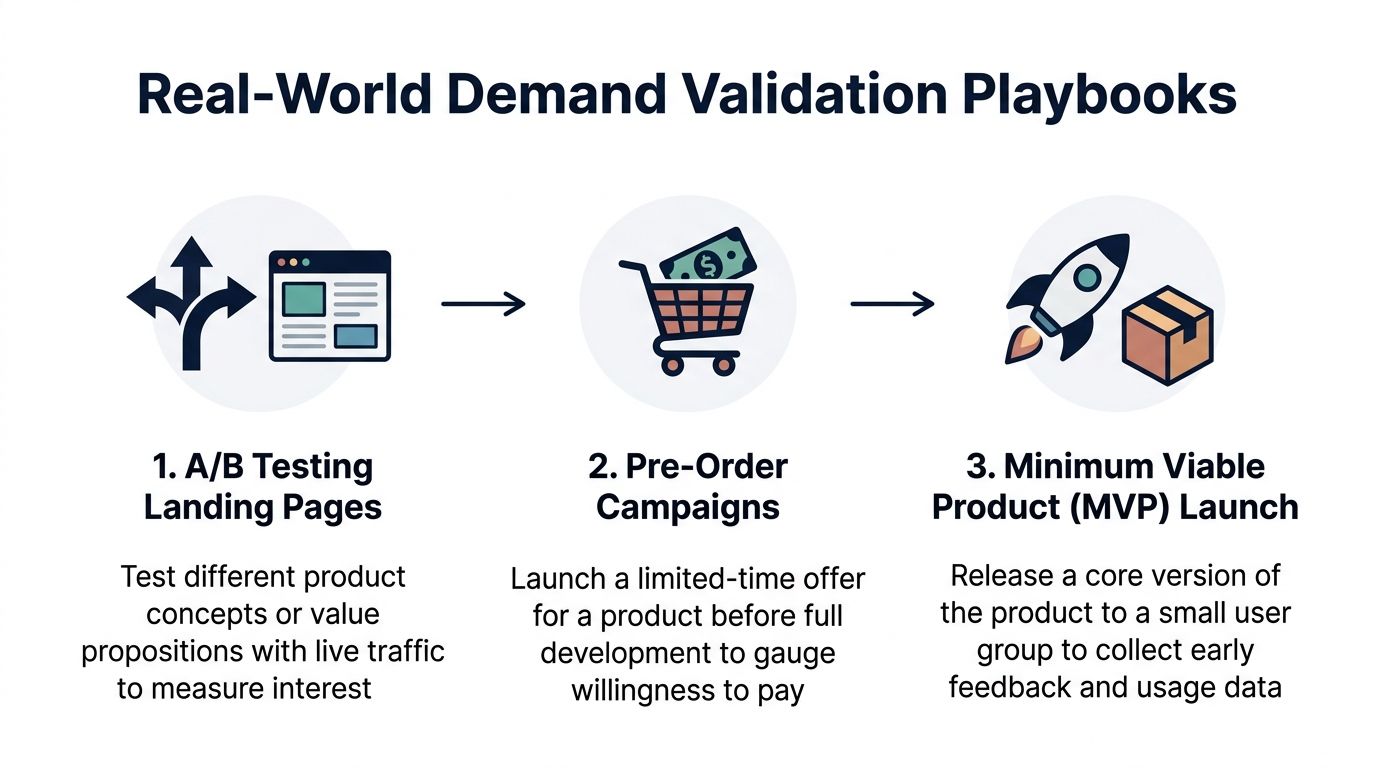
A lean paid traffic test is one of the fastest ways to see whether your value proposition earns attention from cold traffic. This works on Meta, Google, or both. The platform matters less than the discipline.
Build a simple landing page with one product concept, one primary promise, one hero image or mockup, and one clear CTA. Don't hide behind a long homepage. You want a page that says, “This is the problem, this is the solution, this is why it's different.”
Watch these signals together:
A bad PPC test usually fails for one of three reasons. The audience is wrong. The promise is weak. The offer positioning is off. Don't assume all three are broken at once.
Field note: If an ad gets attention but the page can't hold it, the product angle probably isn't clear enough. If the page works on warm traffic but paid traffic collapses, your message is overfit to insiders.
The smoke test is harsher and better. Instead of asking for interest, ask for commitment. Put the product up for sale or near-sale before a full inventory commitment. You can do this with a pre-order flow, a reservation deposit, or a transparent “ships soon” purchase path.
The point isn't to trick buyers. The point is to test whether the demand survives real purchase friction.
For a clean smoke test:
This method surfaces what surveys usually miss. Buyers may say they like a concept and still refuse to pay for it once delivery timing, trust, and price enter the equation.
A smoke test is especially useful when the founder is deciding between multiple concepts. The winner is rarely the one with the best internal excitement. It's the one buyers move toward with the least resistance.
Here's a useful walkthrough before you build your own testing stack:
Platforms like PickFu are useful for fast comparisons. They're not a replacement for actual market behavior, but they can speed up decisions on positioning before you buy traffic.
Use them for:
The mistake is asking broad taste questions. Ask comparative questions tied to action. Which option looks more trustworthy? Which product appears easier to use? Which headline makes the value proposition clearer?
Don't rely on a single metric threshold. Judge patterns.
A product moves forward when you see:
Kill or rework the concept when:
The goal isn't to prove the product is perfect. It's to prove the demand is real enough to deserve the next level of investment.
Research is only useful if it changes the spreadsheet. Founders get in trouble when validation lives in slides while the P&L tells a different story. The point of market research for products isn't just to find demand. It's to estimate whether that demand can survive acquisition costs, margin pressure, and retention reality.
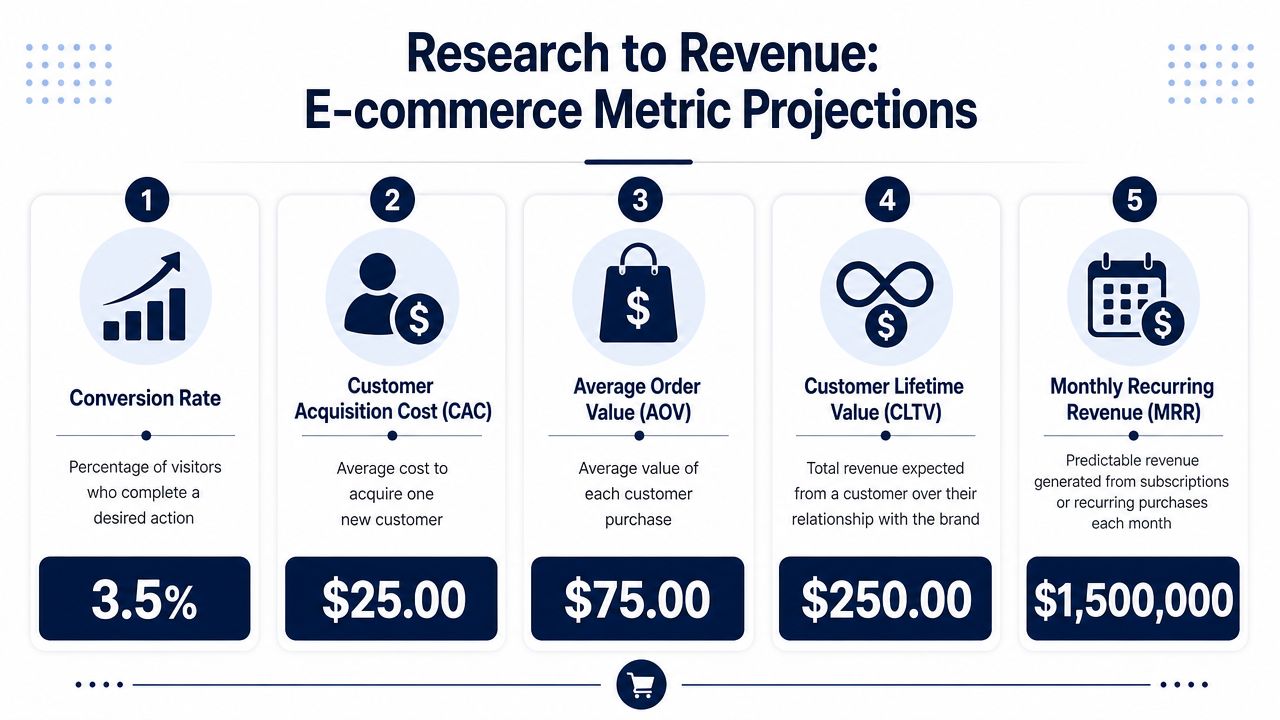
You don't need a giant forecast model at this stage. You need a simple one tied to observed behavior.
Use your validation data to build assumptions around:
| Input | What you learn from testing |
|---|---|
| Ad response | Whether the message earns efficient attention |
| Landing page behavior | Whether the value proposition is clear enough to move buyers |
| Checkout or pre-order behavior | Whether intent survives price and trust friction |
| Post-purchase or follow-up feedback | Whether repeat potential is plausible or weak |
From there, pressure-test the unit economics. If paid clicks are expensive and conversion intent is soft, your future CAC probably won't improve just because you ordered more inventory. If buyers only respond to a bundle or premium angle, your probable AOV may need to be modeled higher than the base SKU. If the product solves a recurring problem or opens natural replenishment, you may have a real LTV story. If not, don't invent one.
A smart operator doesn't ask whether CAC, AOV, and LTV look good in isolation. They ask whether the relationship between them leaves room for error.
That means checking:
If you need help tightening the conversion side of that model, this guide for ecommerce sales boosting is useful because it connects page-level conversion work to the levers that matter before scale.
Good research reduces fantasy in the forecast. It doesn't make the numbers look prettier. It makes them harder to fake.
For teams standardizing this analysis across channels, a practical reference for key performance indicators for ecommerce can help align test outcomes with the metrics that deserve executive attention.
Use this three-part screen before you greenlight a product:
Acquisition
Can you get qualified attention at a cost the product can support?
Conversion
Does the buyer understand the offer fast enough to act?
Retention or expansion
Is there a believable path to repeat purchase, bundling, or line extension?
If one of those is weak, the launch might still work. If two are weak, you don't have a scaling candidate yet. You have a research project.
Fast product validation isn't about speed for its own sake. It's about sequencing. The best brands move quickly because they know which question to answer first and which test deserves the next dollar.
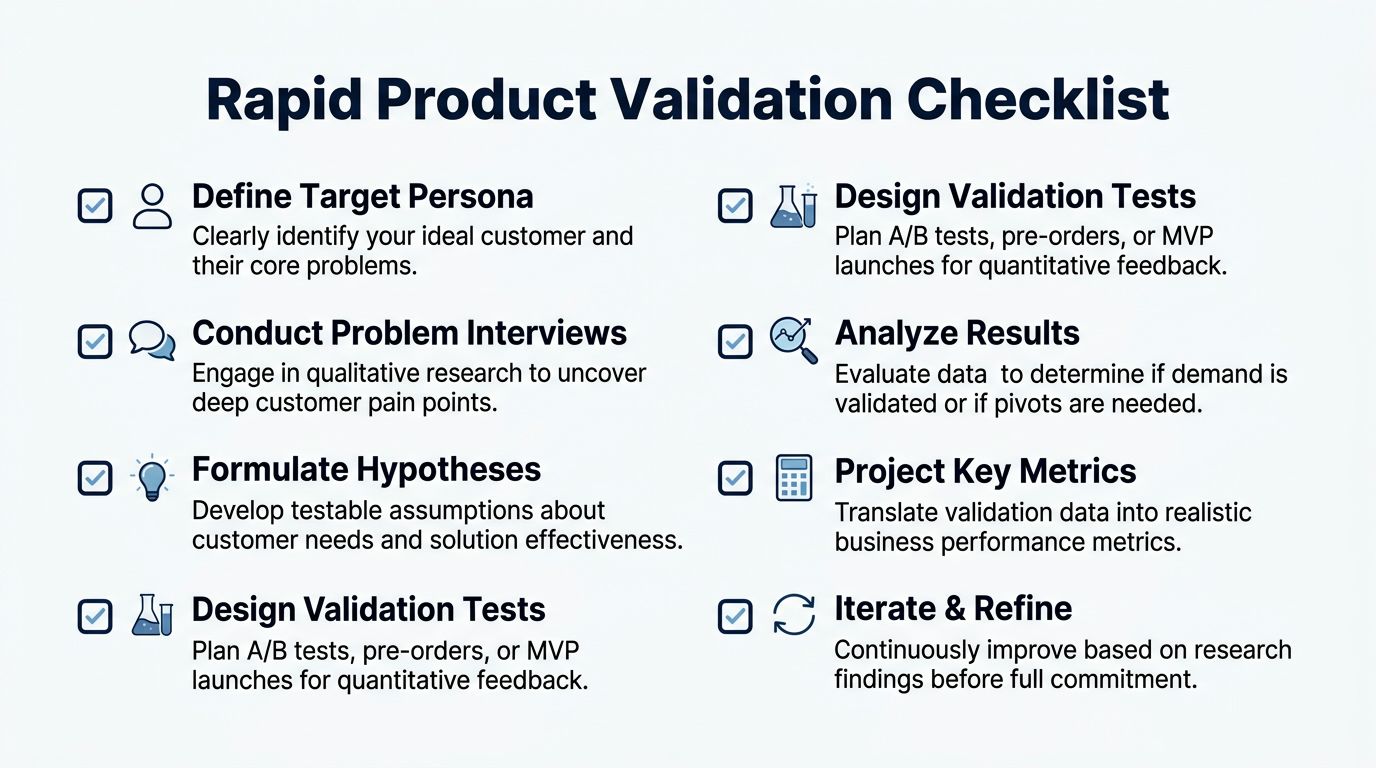
Define the buyer clearly
Start with a use case, trigger, and problem context. “Women 25 to 44” is not a product insight.
Map the category before building
Review Amazon listings, DTC competitors, review complaints, bundle patterns, imagery quality, and positioning gaps.
Interview for pain, not preferences
Ask what happened the last time the buyer faced the problem, what they tried, and what frustrated them enough to search.
Write the product hypothesis down
Clarify who it's for, why they'll switch, what alternative they replace, and what objection will most likely block the sale.
Run live traffic tests
Use paid traffic and a simple page to see whether the promise gets attention and whether that attention survives contact with the offer.
Use a smoke test for real commitment
If buyers won't reserve, pre-order, or start checkout, don't overvalue verbal enthusiasm.
Model the economics early
Translate your test behavior into a working CAC, AOV, and LTV assumption set before you commit to serious inventory.
AI can accelerate research work. It can summarize reviews, cluster interview themes, generate angle variants, and speed up creative testing workflows. In visual categories like apparel or design-led consumer goods, some teams also use specialized tools to speed concept iteration. If that's relevant to your category, this roundup of top AI tools for fashion in 2025 is a useful starting point for the workflow side.
AI should speed judgment, not replace it. It can help you process evidence faster. It can't decide whether the signal is strong enough to bet inventory on.
The founders who keep launching winners aren't guessing better than everyone else. They're invalidating weak ideas earlier, tightening good ones faster, and only scaling once the market gives them enough evidence to deserve confidence.
If you're building at a serious level and want sharper peer insight on product validation, launch strategy, and scaling decisions across Amazon and DTC, Million Dollar Sellers is where high-level operators compare real playbooks with other founders who are already in the trenches.
Join the Ecom Entrepreneur Community for Vetted 7-9 Figure Ecommerce Founders
Learn MoreYou may also like:
Learn more about our special events!
Check Events