
Chilat Doina
May 26, 2026
You're probably looking at the same dashboard you looked at last quarter. Traffic is there. Ad spend is up. Email is going out. Amazon sessions haven't fallen off a cliff. Yet revenue feels harder to predict, and every growth lever that used to work cleanly now feels noisy.
That's the point where most brands push harder on acquisition. More creative tests. More campaigns. More discounts. More top-of-funnel volume. Sometimes that works for a minute. Usually it just hides the underlying problem.
The core problem is that you know what happened, but not why it happened.
A founder can live with that at low scale. At serious scale, that gap gets expensive. You can't fix a PDP that attracts clicks but repels buyers. You can't improve retention if all loyal customers look identical in your reports. You can't grow profitably across Amazon, DTC, and retail if each channel tells a different partial story and nobody connects them.
Consumer behavior analysis is what closes that gap. Not the watered-down version that stops at dashboards and reports. The useful version. The one that turns browsing patterns, hesitation points, repurchase signals, returns, review language, and channel switching into testable growth hypotheses.
That's the difference between analytics as reporting and analytics as an operating advantage.
When this discipline is done well, you stop asking vague questions like “How do we improve conversion?” and start asking questions you can test:
Those questions lead to action. Better merchandising. Smarter remarketing. Cleaner PDPs. Better creative angles. Sharper retention flows. More useful channel strategy.
Most growth walls don't show up as dramatic collapses. They show up as drift.
CAC creeps. Conversion becomes inconsistent. One campaign works on Meta but dies on Amazon. Your branded search holds up, but your new customer mix gets weaker. Email revenue looks fine in aggregate, but repeat purchase behavior softens underneath it. You still have movement, but less certainty.
That's when surface-level metrics start misleading you.
A dashboard can tell you that paid traffic bounced more this month. It can't tell you whether shoppers came in with the wrong expectation, got confused by the bundle structure, or didn't trust the value proposition. Your Shopify backend can show that a product underperformed. It can't tell you whether the issue sat in the first image, the reviews, the pricing architecture, or the post-click audience quality.
A lot of brands respond by adding more reports. That usually creates wider visibility and weaker decision-making at the same time.
You end up with channel teams defending their own metrics:
Everyone has data. Nobody has a clear model of buyer behavior.
Practical rule: If your team can describe the metric but can't describe the customer action behind it, you don't have insight yet.
Consumer behavior analysis gives you that model. It looks at the sequence, not just the outcome. It asks how customers browse, where they stall, what they compare, how they react after purchase, and what patterns separate first-time buyers from repeat buyers. That's the level where profitable decisions get made.
When you start from behavior, your growth questions get sharper.
Instead of “How do we increase sales?” you ask where the buying journey leaks confidence. Instead of “Why is retention lower?” you ask what changed in post-purchase engagement, replenishment timing, or customer recognition. Instead of “Which channel is best?” you ask what role each channel plays in discovery, evaluation, and repeat purchase.
That's a different operating posture. You stop treating growth like a traffic problem and start treating it like a decision-making problem inside the customer journey.
For founders running Amazon, DTC, and omnichannel brands, that shift matters. Mature brands usually don't stall because demand disappears. They stall because behavior changed first, and nobody noticed until revenue lagged.
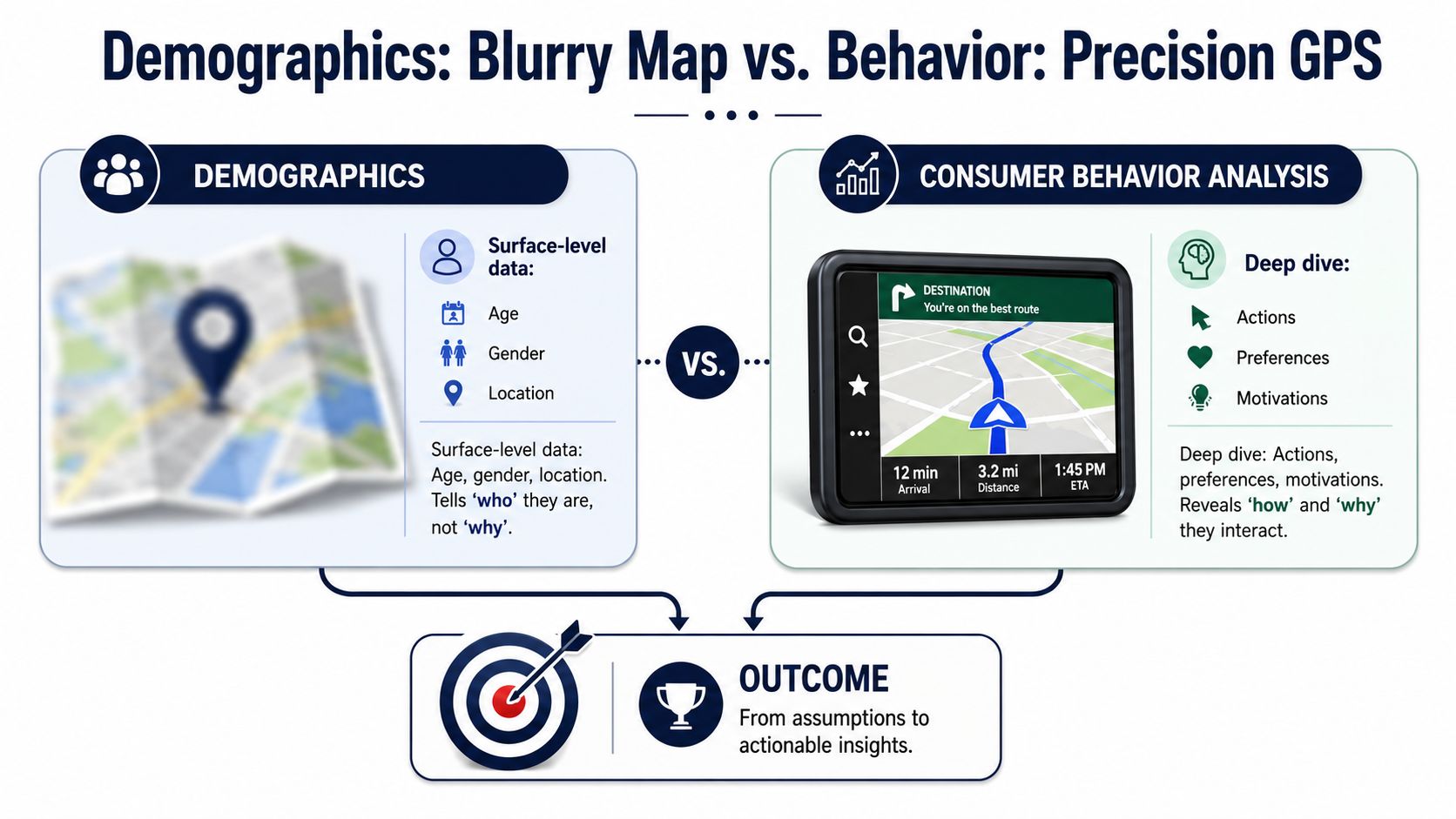
Demographics are a blurry map. They tell you roughly who might be in the area.
Consumer behavior analysis is the GPS feed. It shows where the customer went, where they slowed down, where they turned around, and where they dropped off.
That shift matters because broad demographic targeting only gets you so far. A foundational change in this field was the move from demographic targeting to behavioral segmentation, which became widely operational as brands began tracking browsing, click paths, cart abandonment, and repeat purchases. That approach ties behavior directly to conversion and retention instead of relying on assumptions about age or geography, as described in this consumer behavior analysis guide from Qualtrics.
In plain terms, consumer behavior analysis means combining what customers do with the business context around those actions.
That usually includes two layers:
If you want a clean framing of the category, these ecommerce behavioral analytics definitions are a useful reference because they anchor the idea in actions rather than vanity metrics.
For a DTC brand, this might mean seeing that shoppers hit the PDP, read the reviews, open the FAQ, then abandon once shipping details appear. For an Amazon seller, it might mean noticing that one ASIN gets traffic but weaker repeat purchase behavior than adjacent products. For an omnichannel brand, it can mean realizing the same customer buys one mission in-store and another online.
The point isn't to collect more data for its own sake. The point is to understand intent.
That means looking at signals like:
Demographics tell you who someone might be. Behavior tells you what they're trying to get done.
Organizations often still stop too early. They segment by age, gender, geography, or persona and call that customer insight. That's useful for media planning, but weak for optimization.
Behavior gives you the advantage demographics can't. It lets you see whether a customer is close to buying, at risk of churning, or more likely to respond to a specific intervention. That's what makes it operational. You're not building a prettier report. You're building a decision system around customer intent.
Once you start seeing the journey this way, generic dashboard reviews stop being enough. You need hypotheses tied to behavior, because behavior is what moves revenue.
A lot of teams still treat behavior analysis like a support function for marketing. That's too small.
If you run a serious ecommerce business, this is a profitability system. It helps you acquire customers more efficiently, convert them with less waste, and keep them longer because you understand how they buy.
One data point makes the retention side hard to ignore. 49% of customers expect to be recognized for being loyal customers, according to a guide published by the University of Massachusetts Global that cites Accenture in its discussion of customer behavior analysis and personalization here. That's why behavior analysis isn't just about finding new buyers. It's about recognizing relationship signals early enough to act on them.
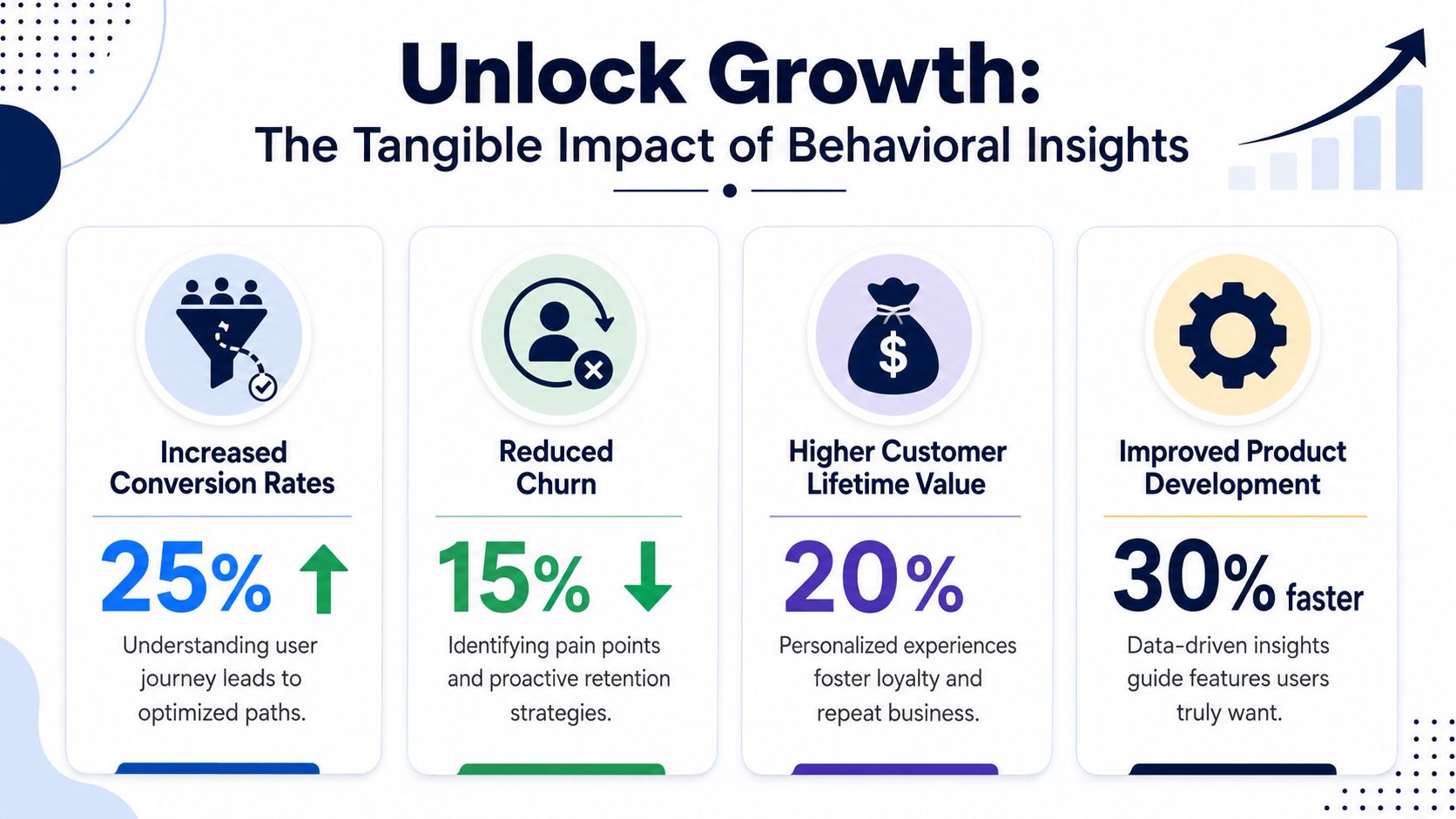
Behavior becomes a growth engine when you use it to make channel-specific decisions.
For Amazon, that often means diagnosing whether traffic is high but purchase intent is weak, or whether your listing attracts the wrong use case. The fix might be title hierarchy, image sequencing, review mining, coupon framing, or a tighter product family strategy.
For DTC, the power usually sits in funnel friction and lifecycle timing. Buyers don't just abandon carts. They hesitate for reasons. They compare products, question delivery promises, stall on subscription language, or fail to see the right benefit fast enough.
For omnichannel brands, the big win is alignment. You need to know whether channels are complementing each other or cannibalizing each other. Behavioral insight is often the only way to tell whether a lift in one channel reflects net new demand or customer migration.
Strong operators don't ask for more data. They ask for better decisions from the data.
That usually means turning behavior into hypotheses such as:
If your team is trying to build that discipline more deliberately, this guide on data-driven decision-making is a useful companion because it forces the conversation away from opinions and toward evidence-backed action.
The brands that keep growing aren't always the ones with more traffic. They're the ones that understand buyer behavior faster than their competitors.
What doesn't work is using behavior analysis as an after-the-fact explanation layer.
If your process is “launch, wait, review the dashboard, debate, move on,” you're still operating reactively. You'll catch obvious failures, but you'll miss the subtle patterns that show up before revenue moves. You'll also keep optimizing channel metrics in isolation, which is how teams protect spend while margins gradually erode.
Significant power comes when behavior analysis becomes part of weekly operating rhythm. Not an analyst's side project. Not a quarterly deck. A living input into ads, creative, merchandising, retention, and inventory decisions.
Founders usually don't need more tools. They need a cleaner way to separate methods that tell you what happened from methods that tell you why it happened.
That's the easiest way to organize consumer behavior analysis in ecommerce. Quantitative methods show patterns at scale. Qualitative methods explain the human logic behind those patterns. You need both, because one without the other creates blind spots.
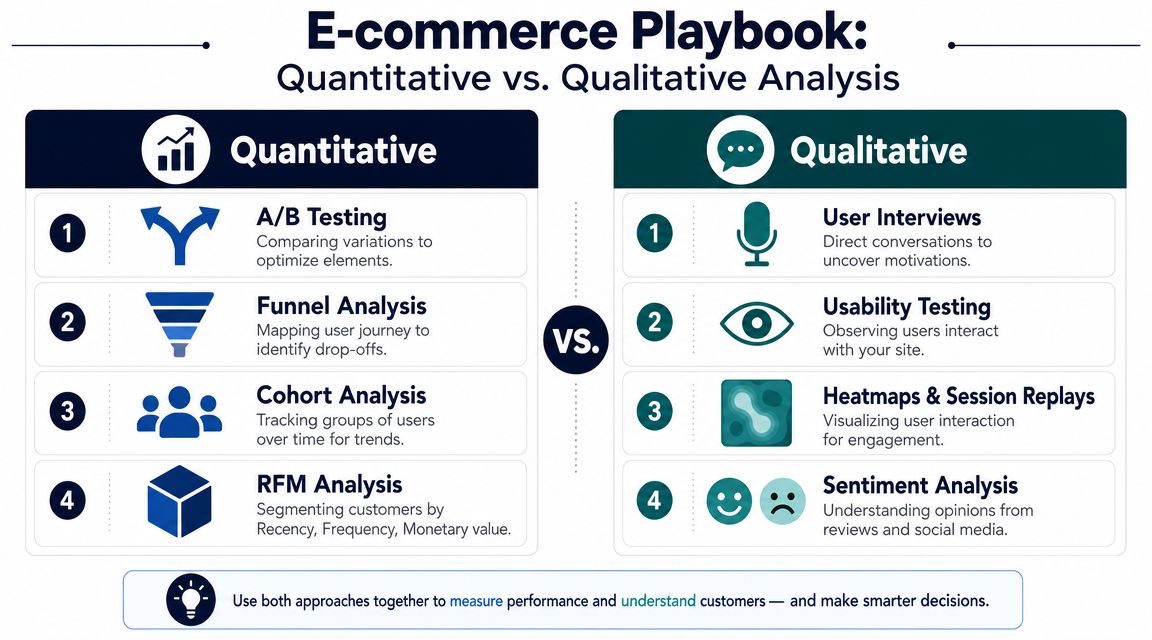
Start with the methods that reveal movement through the journey.
A lot of teams need a stronger experimentation standard here. If your CRO process is too loose, this playbook for e-commerce success is useful because it pushes testing toward commercial questions instead of cosmetic ones.
One more blind spot matters for brands with multiple channels. Circana points out that brands should study total basket data, cross-purchase habits, and store-level nuances, because the same shopper may buy different missions in different formats. That means channel behavior can't be reduced to one fixed persona. Their write-up on underserved consumer markets is worth reading for that reason.
Numbers show the leak. Qualitative work tells you why the leak exists.
Here are the methods that tend to pay off fastest:
Operator note: If a customer can explain the friction in one sentence, but your team needs six dashboards to find it, trust the customer first and validate with data second.
This is also where channel context matters. An Amazon review might expose a sizing expectation problem. A DTC exit survey might reveal price anchoring issues. A retail sell-through anomaly might point to packaging or shelf communication. Same customer category, different behavior environment.
Here's a quick comparison for how to use each method:
| Method | Best for | Weakness |
|---|---|---|
| Funnel analysis | Finding drop-off points | Doesn't explain motivation |
| A/B testing | Validating a focused hypothesis | Wasteful without a clear hypothesis |
| Cohort analysis | Understanding retention by group | Can hide product-level nuance |
| User interviews | Uncovering decision logic | Small sample, needs interpretation |
| Review mining | Capturing raw customer language | Biased toward strong opinions |
| Usability testing | Spotting hidden friction | Requires disciplined observation |
For teams training operators across functions, examples help more than theory. This customer-focused video breaks down the mindset well:
The underused method is cross-channel behavior interpretation.
Too many teams build separate truths for Amazon, DTC, and retail. Smarter brands ask whether each channel is serving a different mission. Discovery, convenience, replenishment, gifting, trial, bulk purchase, and urgency can all sit inside the same customer base. If you don't analyze those patterns, your segmentation stays shallow.
That's why customer segmentation frameworks need to evolve beyond static personas. This breakdown of customer segmentation examples is useful when you want to sharpen segments around actual behavior rather than broad profiles.
Most brands already have enough data to improve decisions. The issue is that it sits in separate systems, measured by separate teams, with no shared view of behavior.
A workable toolkit doesn't need to be fancy. It needs to connect traffic source, on-site behavior, order data, post-purchase activity, and customer feedback. If one of those layers is missing, your read on buyer behavior gets distorted.
For most ecommerce brands, the stack starts with a few obvious systems.
The goal is not to stare at all of these daily. The goal is to use each one for the question it answers best.
Founders get into trouble when dashboards overweight visibility and underweight intent.
Sessions, impressions, and gross sales can all move while buyer quality gets worse. Behavioral KPIs are stronger because they expose what customers are signaling inside the journey. If you want a broader framework for building a cleaner scorecard, these key performance indicators for ecommerce are a useful starting point.
Here's a practical table for the metrics that tend to matter most.
| KPI | What It Measures | Business Insight |
|---|---|---|
| Cart abandonment rate | How often shoppers begin purchase intent but fail to complete checkout | Reveals friction, trust issues, offer mismatch, or checkout complexity |
| Repeat purchase rate | How often customers come back and buy again | Shows whether the product and post-purchase experience create ongoing demand |
| Customer lifetime value | The long-term value created by a customer relationship | Helps you judge acquisition efficiency and retention quality |
| Time to first purchase | How long it takes a new visitor or lead to convert | Indicates how much education, trust, or remarketing the sale requires |
| Average session value by traffic source | Revenue efficiency by channel session | Exposes whether some channels drive attention while others drive buying intent |
| Product return rate | How often buyers send products back | Flags expectation gaps, quality issues, or poor merchandising clarity |
| Email or SMS engagement by lifecycle segment | How different customer groups respond after purchase or before churn | Helps personalize retention instead of sending one generic message to everyone |
| Support contact rate by product or order stage | Where customers need help most often | Identifies hidden friction that standard conversion reporting misses |
Different channels deserve different emphasis.
For Amazon, focus on product-level behavior, review language, and repeat purchase tendencies across ASINs. For DTC, prioritize session behavior, cart and checkout friction, and post-purchase retention signals. For omnichannel, watch how demand appears in one channel and resolves in another.
The best KPI dashboard answers one question fast: what behavior changed, and where should we investigate first?
That's the standard. Not more metrics. Better triage.
A final note on tooling. Some operators also use peer communities as part of their decision toolkit. Million Dollar Sellers is one example. It's an invite-only ecommerce community where founders compare operating patterns across Amazon, DTC, TikTok Shop, and multichannel brands. That kind of peer input can help teams sanity-check what they're seeing in the numbers.
Many organizations don't fail at collecting data. They fail in the handoff between insight and action.
The pattern is familiar. Someone notices a drop. A dashboard gets shared. Opinions pile up. Teams debate channel quality, pricing, creative, and seasonality. Then the organization either overreacts or does nothing.
Useful consumer behavior analysis works differently. It runs as a loop.
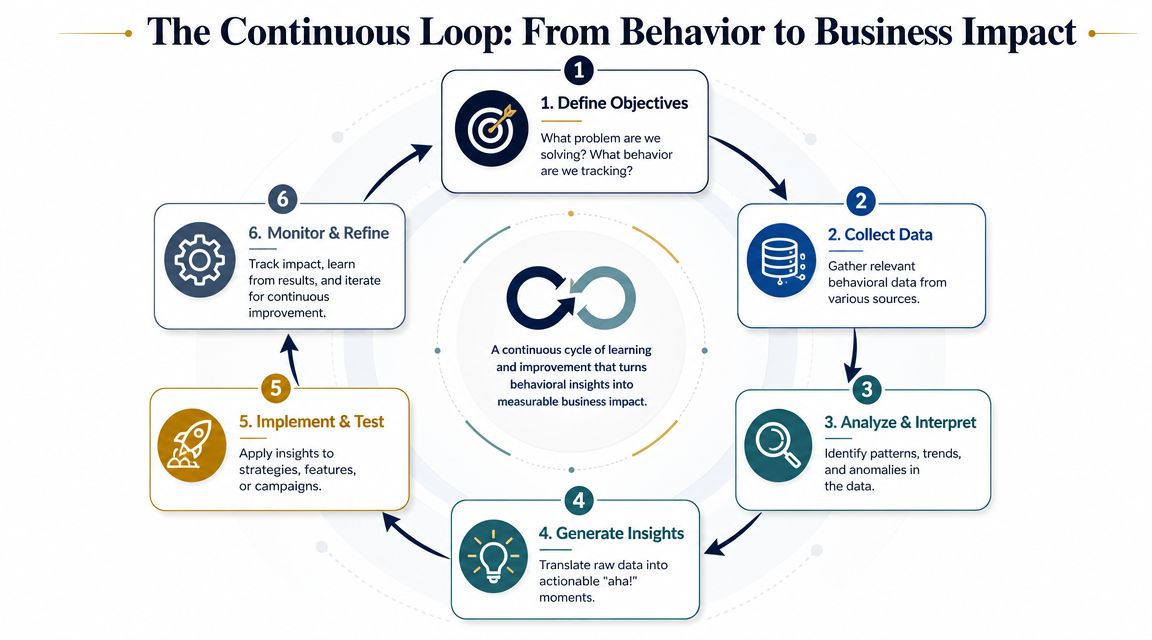
The best work begins with a question that matters to the P&L.
Good examples:
Those questions are specific enough to investigate and broad enough to matter.
One source almost always lies by omission.
If conversion drops, don't just open GA4. Pair site behavior with order data, support tickets, reviews, survey responses, and channel context. If retention weakens, don't just look at repeat purchase counts. Check customer recognition, reorder timing, post-purchase messaging, and product complaints.
Advanced workflows help. Session-level diagnostics and struggle-score frameworks look for repeated errors, rapid navigation, and long idle times, which helps teams spot micro-friction before it turns into lost revenue, as explained in this session-level customer behavior analysis overview from Glassbox.
This is the discipline most brands skip.
Don't stop at “conversion is down on mobile.” Write the actual hypothesis. For example:
A weak observation creates random tests. A sharp hypothesis creates focused experiments.
Stop asking which metric moved. Ask what customer decision became harder.
This doesn't need to become a giant optimization program.
You can test:
The important part is isolating the reason behind the change. If you change five things at once, you learn very little.
Good teams build a memory around behavior. They log the question, the evidence, the hypothesis, the test, and the result. Over time, that becomes one of the most valuable assets in the business because it compounds learning across channels.
This is also where speed matters. The advantage doesn't come from owning the most tools. It comes from shortening the cycle between noticing behavior, forming a hypothesis, and shipping a response.
Founders who do this consistently stop relying on gut feel alone. They still use instinct, but instinct gets sharpened by repeated contact with real customer behavior. That's what makes the system durable. It improves ad efficiency, merchandising quality, retention strategy, and channel coordination at the same time.
If you want to compare notes with operators who are doing this across Amazon, DTC, and omnichannel brands every day, Million Dollar Sellers is the room for that. It's an invite-only community built for founders and executives who value execution, pattern recognition, and honest strategy sharing at scale.
Join the Ecom Entrepreneur Community for Vetted 7-9 Figure Ecommerce Founders
Learn MoreYou may also like:
Learn more about our special events!
Check Events