Chilat Doina
September 11, 2026
Most ecommerce advice still starts with the same four levers: traffic, conversion, average order value, and repeat purchase. That framework is incomplete. It tells you where revenue comes from, but not whether the next dollar of revenue creates cash or consumes it.
That distinction matters more now because founders are dealing with higher acquisition pressure, more expensive fulfillment, and customers who expect discounts. U.S. consumers remain price-sensitive, with 76% worried about inflation, while 63% of Amazon shoppers say price and discounts are the most influential purchase factor, according to Shopify's analysis of revenue-generating strategies. A top-line plan built around discounting can produce impressive sales reports and a weaker business.
The better question is simple: which revenue growth strategy increases incremental contribution profit, and which one merely makes the P&L busier? Protect margin first, improve the existing engine second, and scale acquisition only when the economics can support it.
The classic four-lever model isn't wrong. It's just too shallow for an established brand. More traffic can create more orders, a better product page can raise conversion, a bundle can lift AOV, and lifecycle marketing can drive another purchase. But each lever can also hide a margin leak.
Paid traffic may convert while contribution profit declines. AOV can rise because customers receive a deeper bundle discount. Repeat purchase can look healthy while returns, shipping subsidies, and customer support costs consume the gain. Revenue growth without unit economics discipline turns marketing into a form of self-arbitrage. You pay to create sales, then spend more to make those sales appear profitable.
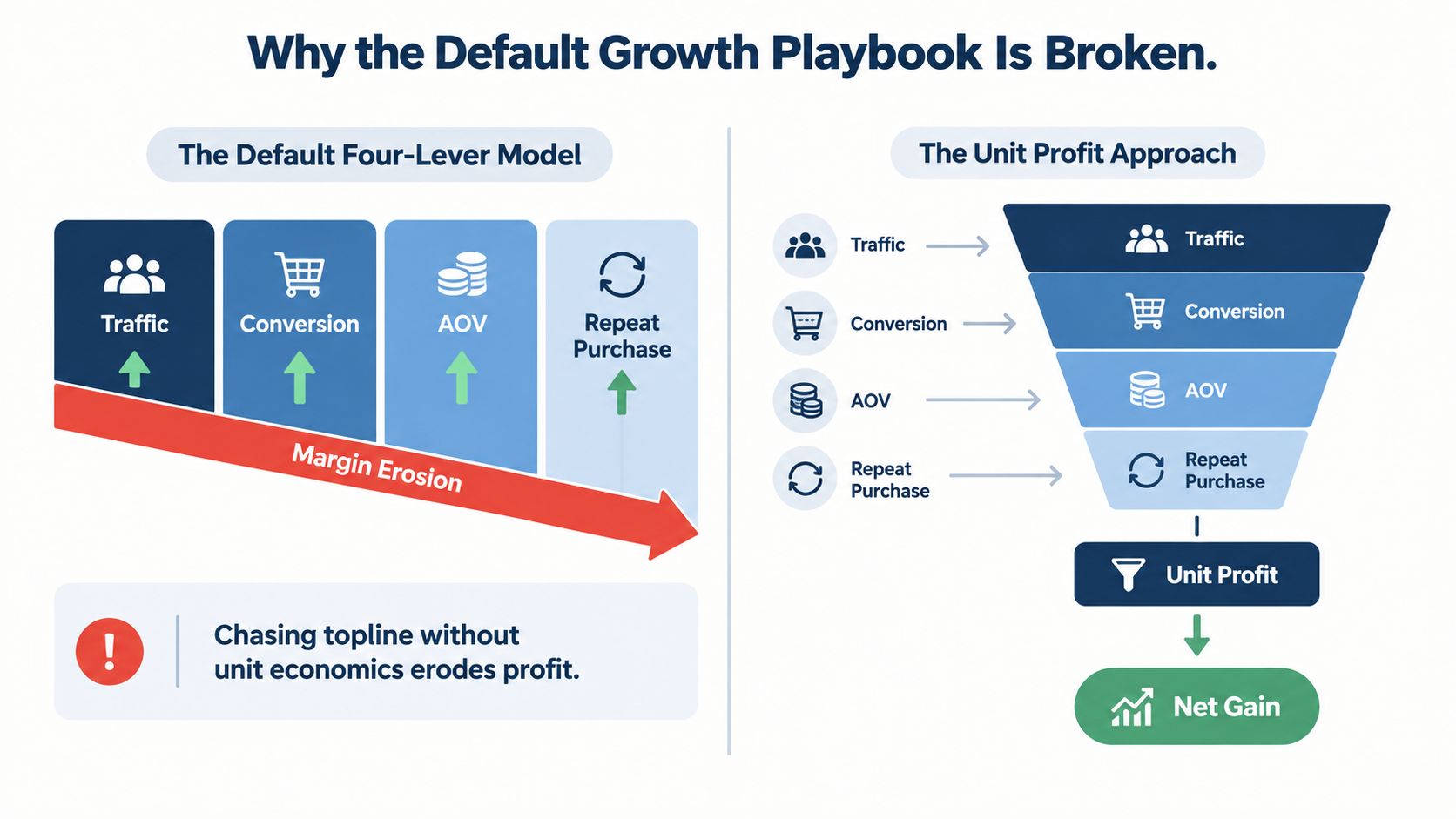
Founders often review channel revenue before contribution margin because revenue is immediate and easy to report. That habit creates bad decisions. A campaign can look like a winner in Shopify or Amazon while its actual economics deteriorate after product cost, marketplace fees, fulfillment, returns, discounts, and advertising.
The organizing principle should be incremental contribution, not incremental revenue. Before approving a growth initiative, calculate what remains after every variable cost that changes with the order. If the answer is negative, more volume doesn't solve the problem. It magnifies it.
Practical rule: Never scale a lever because it increases revenue. Scale it because the next unit creates attractive contribution profit.
Pricing makes this problem especially visible. Research summarized by Johnny Grow's price optimization analysis found that only about one-quarter of companies combine a formal pricing strategy with active price optimization, and companies that do are 40% more likely to achieve year-over-year revenue growth. The same research attributes 2% to 8% annual revenue growth to active pricing programs, with B2B firms at 3% to 8% and B2C firms at 2% to 4%.
Those figures don't mean every brand should raise prices tomorrow. They do expose the flaw in treating pricing as a finance exercise while treating acquisition as the growth engine. Your price, offer structure, and discount rules influence every order before you buy another impression.
A useful growth plan should eliminate initiatives. If your quarterly roadmap contains ten “high-priority” projects, you haven't prioritized anything. Rank each possible move by leverage-to-effort and capital intensity, then force the business to work from the top of the list downward.
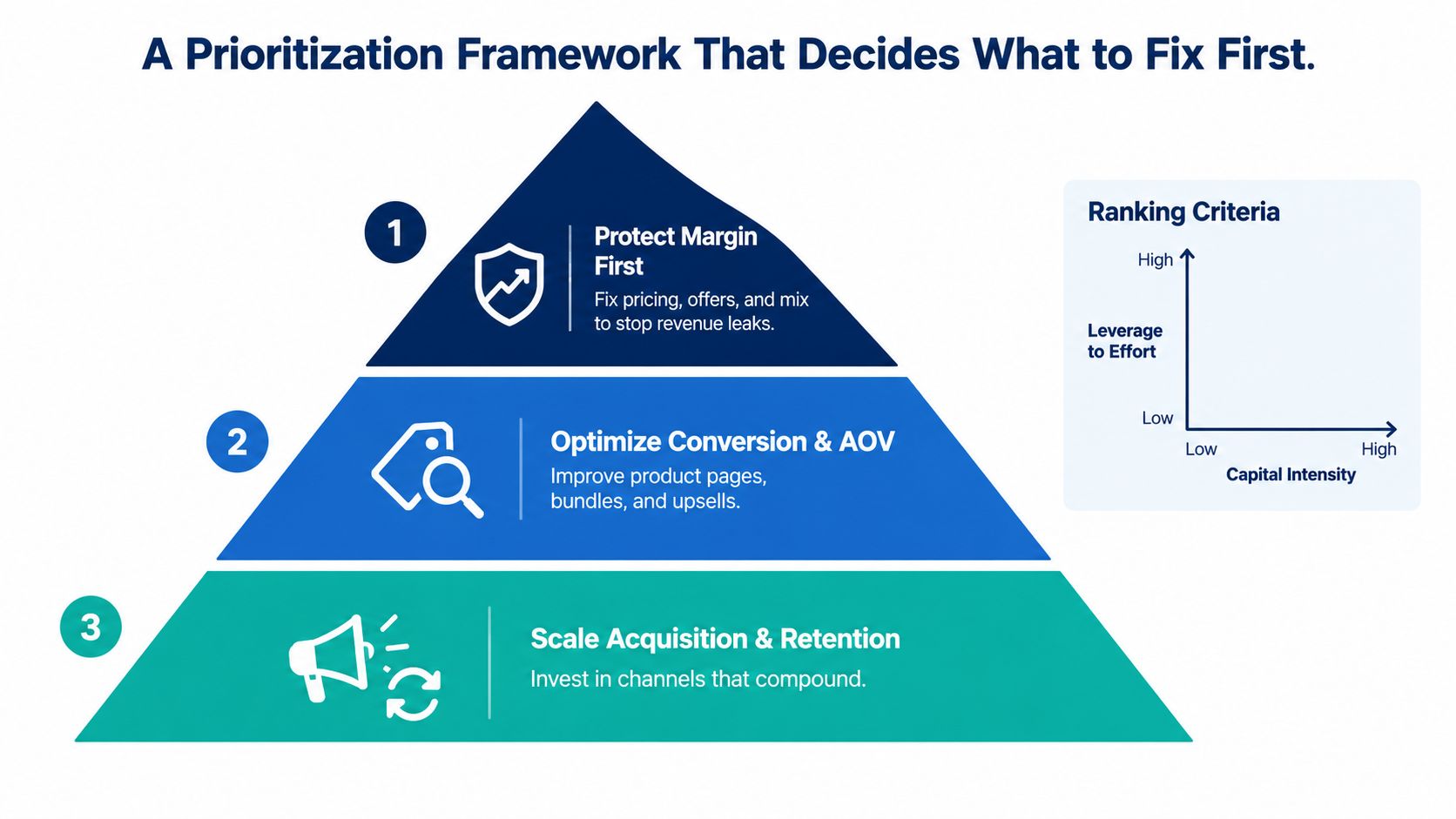
Start with pricing, discounting, returns, product mix, and fulfillment costs. Ask:
Don't move to aggressive acquisition while these answers are unclear. Fixing an offer or removing an unprofitable promotion usually requires less capital than buying more traffic.
Once the margin floor is protected, improve retention, expansion, assortment, checkout, and merchandising. Review cohort reorder curves by acquisition source, time to second purchase, and the share of customers who move into larger bundles, subscriptions, or complementary products.
For recurring or replenishment businesses, monitor net revenue retention. Saas Capital's benchmark analysis found that moving NRR from the 100% to 110% range into the 110% to 120% range improves growth rate by 9 percentage points, because the retained base expands through upsells, cross-sells, and price increases. The decision-making frameworks guide can help your team turn these diagnostics into explicit operating choices rather than informal opinions.
Paid acquisition belongs last because it consumes working capital immediately. Set a payback ceiling before launching a channel, decide how much cash the business can safely put at risk, and define the kill rule in advance. If the channel misses that rule, stop funding it. Don't keep spending because the creative is “promising.”
Use the framework to choose one or two experiments, not to justify a longer list. A smaller plan with clear thresholds beats a crowded roadmap that keeps every department busy.
Pricing is the closest thing ecommerce founders have to a universal revenue lever. A paid campaign affects the customers it reaches. A price architecture change affects every eligible order, often without requiring more traffic, headcount, or warehouse capacity.
Research on active pricing programs found that they were associated with 2% to 8% annual revenue growth, and that companies combining formal pricing strategy with active optimization were 40% more likely to achieve year-over-year revenue growth. The relevant insight isn't that pricing always works. It's that most brands test creative and channels more aggressively than they test the amount customers pay.
List price resets should start with products that have strong customer satisfaction, low return friction, and clear differentiation. Test the price in the channel where contribution is strongest, then watch conversion, refund behavior, customer service contacts, and contribution profit. A higher price that lowers order volume can still win if each remaining order contributes more.
Bundle architecture changes the comparison customers make. A single product competes on price. A thoughtfully designed bundle competes on convenience, completeness, or outcome. Pair a hero SKU with a complementary item, but don't hide an unwanted product inside a “deal.” Customers notice forced bundles, and poor bundle fit increases returns.
Promotional cadence determines whether your list price has credibility. Always-on coupons teach customers that the displayed price isn't real. Replace blanket offers with targeted incentives tied to first purchase, replenishment timing, inventory needs, or high-margin bundles.
For a deeper treatment of customer willingness to pay and perceived value, review how to master value based pricing. The principle is practical: price against the value and alternatives customers perceive, not merely your internal cost-plus calculation.
| Pricing Lever | Typical Contribution Margin Lift | Time to Impact | Channel Fit |
|---|---|---|---|
| List price reset | Depends on elasticity and product economics | Fast | DTC, Amazon, retail |
| Bundle architecture | Depends on product mix and discount depth | Fast to moderate | DTC, Amazon |
| Promotional cadence | Protects realized price and margin | Moderate | DTC, marketplace |
| Segmented offers | Directs incentives toward specific customer groups | Moderate | DTC, lifecycle |
Amazon adds constraints. Buy Box dynamics, competitor pricing, and marketplace rules can limit how freely you change price, while DTC gives you more control over merchandising and customer communication. Don't force one pricing playbook across every channel. Use the ecommerce pricing strategies guide to map channel-specific tests, then prioritize the channel where a pricing decision creates the most contribution.
Acquisition gives you a customer once. Retention lets the original acquisition cost work across future orders. That makes repeat purchase one of the most durable revenue growth strategies, especially when paid traffic becomes less predictable.
Landmark Bain research, summarized by Shopify's ecommerce revenue growth analysis, is widely cited for finding that a 5% increase in customer retention can increase profits by 25% to 95%. The same summary reports that existing customers are 50% more likely to try new products and spend 31% more than new customers. Industry summaries also report that 75% to 80% of recurring business revenue comes from existing customers.
Those figures support a sequencing decision, not a license to send more generic email. Retention deserves investment because the customer already knows your brand, but the program still needs instrumentation and disciplined offers.
Build reorder curves by first-order traffic source. A customer acquired through branded search may reorder differently from one acquired through a creator, marketplace placement, or paid social campaign. A blended repeat-purchase rate hides those differences and can cause you to overfund a channel whose second-order economics are weak.
Track three events:
The operational sequence matters. Send useful post-purchase education first, introduce replenishment when the product should be running low, present a bundle upgrade at reorder, and reserve win-back incentives for customers with a real lapse signal. Customer lifetime value calculations should include gross margin, returns, fulfillment, support, and future order behavior. Use this customer lifetime value calculation guide to keep the metric connected to cash economics.
| Retention Tactic | Effort | Time to Impact | Expected Repeat Purchase Lift |
|---|---|---|---|
| Post-purchase education | Low to moderate | Fast | Depends on product usage |
| Replenishment reminders | Moderate | Fast to moderate | Depends on reorder timing |
| Subscribe-and-save migration | Moderate | Moderate | Depends on customer fit |
| Reorder bundles | Moderate | Moderate | Depends on assortment relevance |
| Predicted-lapse win-back | Moderate to high | Moderate | Depends on signal quality |
Retention isn't limited to ecommerce email. In subscription businesses, NRR captures whether the existing base is shrinking, holding, or expanding. Upsells and cross-sells can reduce the amount of new revenue required to replace churn, making growth less dependent on paid media.
Every channel has a different economic job. Amazon can provide purchase intent and conversion velocity, DTC gives you customer ownership and first-party behavior, retail can broaden reach, and wholesale can create volume with less direct marketing execution. None of those advantages matter if the channel's contribution profit can't support its working-capital demands.
| Channel | Gross Margin Profile | Brand Control | Capital Intensity | Scale Ceiling |
|---|---|---|---|---|
| Amazon | Compressed by marketplace and fulfillment costs | Limited to moderate | Moderate | High, but category-dependent |
| DTC | Potentially stronger, with paid media burden | High | High | High, if acquisition remains efficient |
| Retail | Depends on wholesale terms and trade spend | Moderate | High | High, with operational complexity |
| Wholesale | Often lower per-unit contribution | Lower | Moderate to high | Depends on accounts and terms |
Allocate budget by contribution margin after channel-specific costs, not by gross sales. On Amazon, rising TACoS can indicate that organic demand isn't carrying enough of the catalog. In DTC, blended MER drift can show that total marketing spend is rising faster than total revenue. Both are warning signals, not standalone verdicts.
Meta and Google make sense when creative and landing pages can produce a repeatable payback. Shift more attention toward creators, lifecycle programs, SEO, and partnerships when paid acquisition becomes dependent on constant discounting or increasingly broad targeting. Use a fixed payback ceiling by business stage, and never let an agency define success using a metric that excludes returns and contribution costs.
Creative production is often the bottleneck before media buying becomes the bottleneck. Tools such as ShortGenius AI ad generator can help teams produce and test more ad concepts, but faster production doesn't make weak economics acceptable. Set the contribution threshold first, then use creative volume to search for winners within that boundary.
Founders often treat assortment and operations as back-office concerns. Customers experience them as conversion factors. A product that's unavailable, difficult to compare, slow to ship, or painful to return weakens the economics of every acquisition channel.
A large catalog can create choice overload, inventory fragmentation, and weak merchandising. Start with hero SKU discipline. Identify the products that attract demand, retain customers, and create healthy contribution, then make those products easier to find and easier to buy.
Variant rationalization can remove low-demand options that complicate forecasting without adding meaningful customer value. Bundle architecture can raise basket value through relevance rather than a deeper discount. Search and navigation should lead customers toward the right product quickly, especially when several variants solve similar needs.
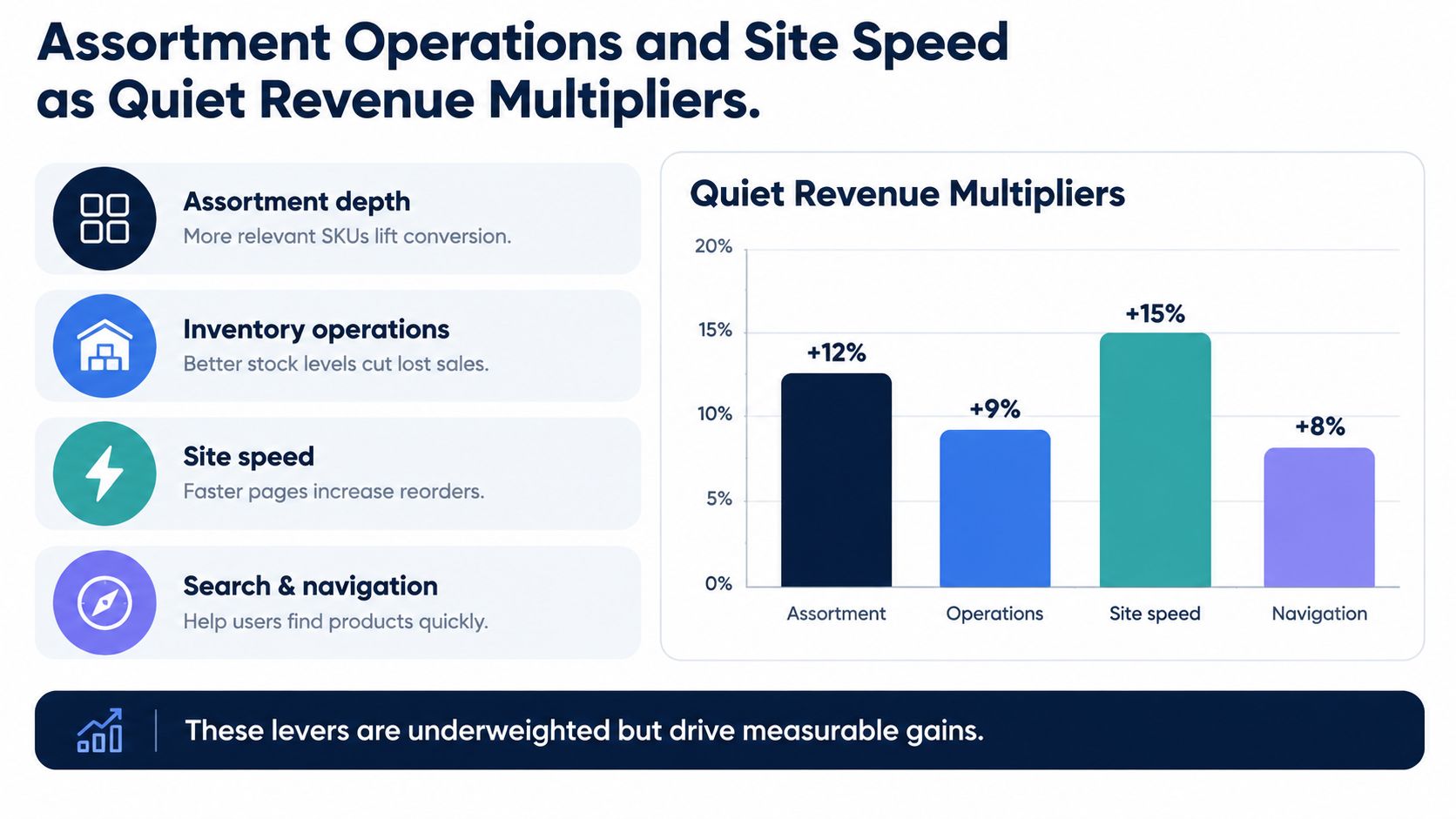
A stockout wastes the acquisition cost attached to the demand you created. Slow shipping can increase support contacts and cancellation risk. Unclear return policies can suppress conversion before the customer ever reaches checkout. These problems don't always appear in an ad dashboard, but they still reduce the value of every click.
Audit inventory availability, promised delivery dates, return reasons, and fulfillment costs by SKU. If a paid campaign drives demand toward a product with unreliable stock or expensive returns, pause the campaign before changing the creative.
Site speed deserves the same financial treatment. A faster mobile storefront reduces friction across product discovery, checkout, and repeat visits. Prioritize the pages carrying paid traffic, compress heavy assets, remove unnecessary scripts, and measure the result using conversion and contribution, not a technical score alone.
Operator's rule: Don't buy more traffic to a store that makes customers wait, search, or second-guess the purchase.
These are quiet multipliers because they improve several stages at once. Pricing can create an immediate gain, but assortment clarity, reliable fulfillment, and a faster storefront can strengthen conversion and reorder behavior without training customers to expect a lower price.
You don't need a large data team to run disciplined revenue growth strategies. You need a short list of metrics, consistent definitions, and a calendar that forces decisions. The minimum stack should show whether revenue is becoming more profitable and whether the existing customer base is getting stronger.
A Shopify and marketplace export can provide a workable starting point. A spreadsheet is acceptable if definitions stay consistent. The goal isn't perfect attribution. The goal is reliable enough information to stop funding obvious leaks.
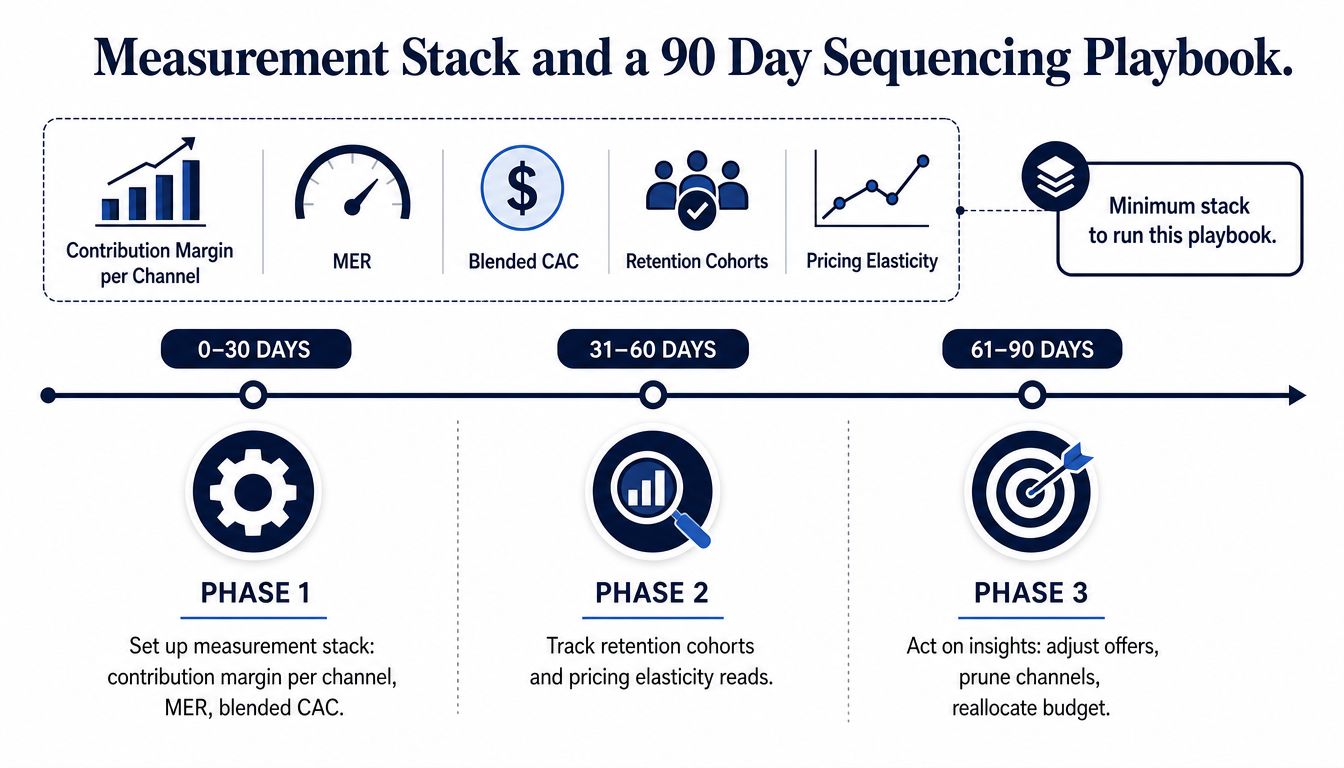
Days 1 to 30, establish the baseline. Reconcile channel revenue with contribution margin. Separate new and returning customers. Identify the largest leak, whether it's pricing, discounting, returns, stock availability, or checkout friction.
Days 31 to 60, fix one constraint. Run the highest-test, usually an offer, price, product-page, or checkout change. Set the success metric and kill criteria before launch. Don't add a second major initiative until the first has enough evidence to support a decision.
Days 61 to 90, add one compounding loop. Choose one retention improvement and one carefully bounded channel test. Measure contribution, payback, reorder behavior, and operational impact. At the end of the period, prune losing tests, document the winner, and move the next constraint into the queue.
This sequence turns strategy into resource allocation. A bad bet should cost a defined test window, not an entire planning cycle.
Founders often mistake activity for progress. A sitewide discount can hit a sales target while damaging price perception. A performance agency can increase spend before the business understands retention. A new marketplace or retail channel can add revenue while consuming inventory, cash, and management attention.
Discount-led growth is especially dangerous because it changes customer expectations. Once buyers anchor to the lower price, the brand has fewer options than it had before. The business must then pursue more volume to replace the contribution it gave away.
The same problem appears when a brand chases another channel while its existing storefront still has weak product discovery, slow checkout, poor stock availability, or unprofitable returns. More reach won't repair a broken economic engine.
Technology can help when it removes a specific constraint. For example, custom ecommerce app development may make sense when a standard storefront cannot support a validated workflow, integration, or merchandising requirement. It shouldn't be the first move when the issue is unclear pricing or undisciplined offers.
Revenue without margin isn't growth. It's a slower path to insolvency. Protect contribution margin first, strengthen the existing customer engine second, and scale topline only after the numbers prove that the next dollar is worth buying.
Million Dollar Sellers gives serious ecommerce operators a peer environment for comparing pricing, retention, channel, and operational decisions with founders running Amazon, DTC, and omnichannel businesses. Visit Million Dollar Sellers to see how the community can help you pressure-test your next quarter's growth plan and cut the initiatives that don't deserve more capital.
Join the Ecom Entrepreneur Community for Vetted 7-9 Figure Ecommerce Founders
Learn MoreYou may also like:
Learn more about our special events!
Check Events