Chilat Doina
March 27, 2026
If you're an Amazon seller, you've definitely seen the sales rank on Amazon. It's that little number tucked away on the product page, officially called the Amazon Best Sellers Rank (BSR). But what does it actually mean?
Think of it as a live scoreboard for every product on Amazon. A lower number means a higher rank, which tells you that product is selling better than others in its category right now. A product with a BSR of #1 is the current best-seller in that category, plain and simple.
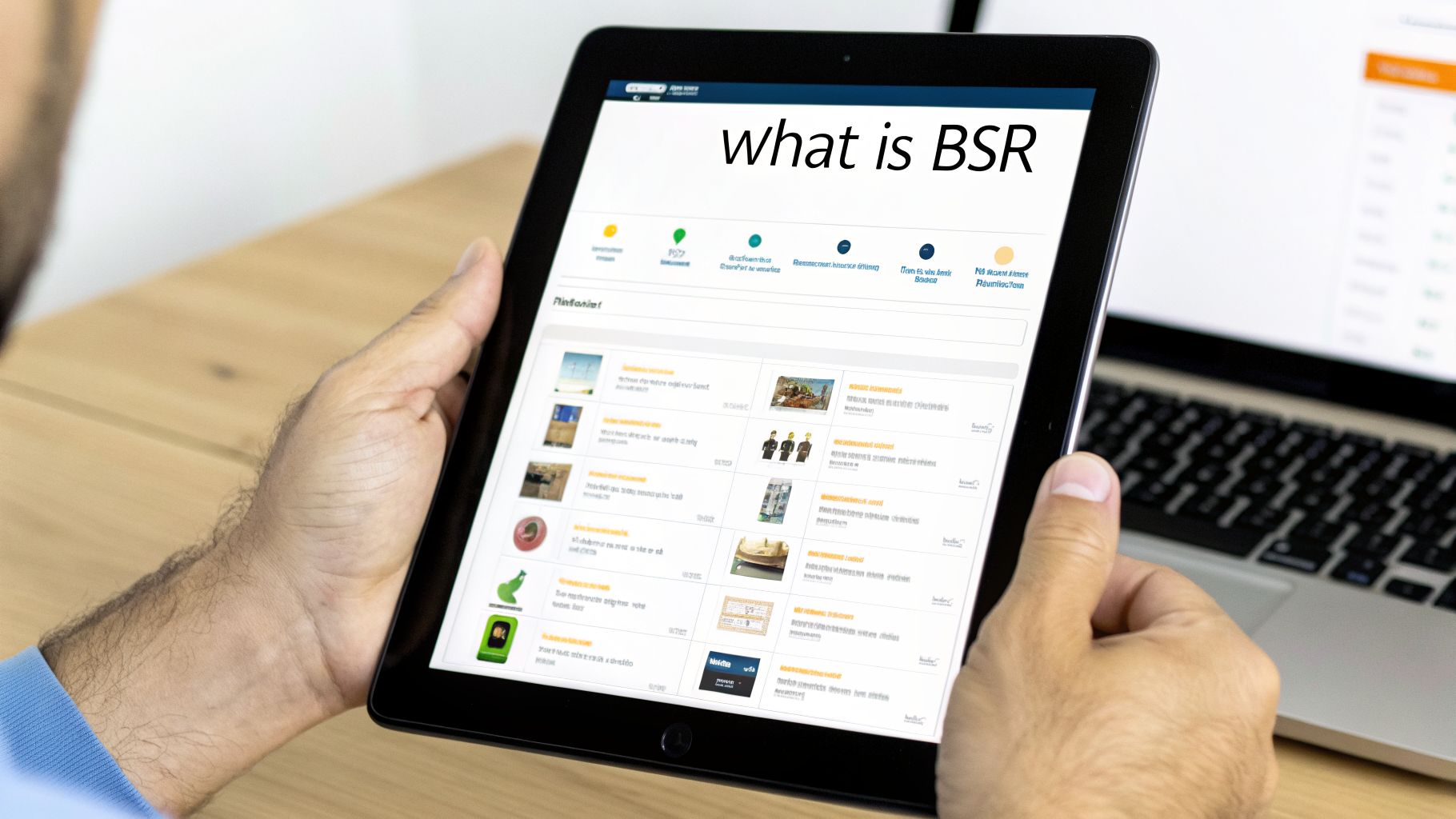
The BSR is probably one of the most-watched, yet most misunderstood, numbers on Amazon. It isn't a badge for lifetime sales or a reflection of your 5-star reviews. It’s all about a product’s current sales momentum, updated almost hourly.
Here’s an analogy: imagine two marathon runners. One has a great history and has won plenty of races over the years (that’s like total lifetime sales). The other might be a newer runner, but they’re currently leading today's race (that’s recent sales velocity). BSR only cares about who’s running fastest today. This is why your rank can jump around so much in a single day.
A "good" BSR is completely relative. Its real meaning comes from the category it's in. A rank of #10,000 in a huge category like 'Electronics' could mean you’re selling thousands of units. But that same #10,000 rank in a tiny niche like 'Fly Fishing Tippet Materials' might only be a few sales a day.
You'll find the BSR on the product detail page, usually by scrolling down to the "Product information" or "Product details" section. It's right there in plain sight.
Amazon will always show the rank in the product's main category. If a product is also ranked in one or more subcategories, you'll often see those listed, too.
The algorithm behind the BSR is focused on two things: recency and sales volume. While Amazon keeps the exact formula under wraps, we know it's heavily weighted towards the most recent sales.
A sale made an hour ago has a much bigger impact on your rank than a sale from yesterday. This is why a sudden spike in sales from a lightning deal or a viral social media post can send your BSR soaring, at least for a little while.
However, historical sales data still plays a role, acting as a stabilizer. A product with a consistent sales history won't see its rank plummet from one slow hour. Think of it as a predictive algorithm—it's not just looking at past sales but trying to forecast future sales as well.
Let's break down the core ideas into a simple table.
This table sums up the key things to remember about the Amazon Best Sellers Rank.
| Concept | What It Means for Sellers |
|---|---|
| Hourly Updates | Your rank can change quickly. Don't panic over short-term fluctuations; look for trends. |
| Category-Specific | A "good" BSR in one category can be a "bad" one in another. Context is everything. |
| Sales Velocity | It's all about how fast you're selling now, not how much you've sold in total. |
| Relative Ranking | Your rank is a comparison to other products in the same category. It's a competition. |
Ultimately, BSR is a direct reflection of customer demand in near real-time.
Sure, seeing your product crack the top 100 feels great, but the BSR is way more than just a vanity metric. For serious sellers, it’s a vital sign for the health of your business.
The sales rank on Amazon is your compass. It doesn't just tell you where you are; it helps you navigate where you need to go. Monitoring its trends is crucial for inventory forecasting, marketing attribution, and competitive analysis.
Top sellers treat BSR as a core key performance indicator (KPI). They don't just watch their own rank; they track their competitors', too.
By understanding BSR, you can stop just reacting to your sales numbers and start making proactive decisions that actually drive growth.
Alright, let's break down how Amazon's Best Sellers Rank algorithm actually works. While Amazon keeps the exact formula under lock and key, the core principle isn't some complex mystery. It’s all about one thing: sales velocity.
And not just any sales velocity. The algorithm is obsessed with what's happening right now.
Think of it this way: a sale you made an hour ago is a superstar. A sale from yesterday? It’s already a fading memory. This is the single most important detail most sellers get wrong. Your product’s amazing sales history from last Christmas or even last month means very little to your rank today.
This obsession with recency is why your sales rank on Amazon can swing wildly, sometimes in the span of a single hour. A shout-out from an influencer can send your rank soaring, but just a few slow hours can cause it to dip. The system is built to mirror what’s hot at this very moment, not what was popular in the past.
So, what does this mean for your strategy? Because the algorithm rewards recent sales so heavily, you can essentially "buy" a better rank for a little while. Run a massive discount or a super aggressive ad campaign, and the sudden flood of orders will rocket your BSR into the top of your category.
But here’s the catch: as soon as you turn off the promotion and your sales rate goes back to normal, your rank will drop just as fast as it climbed.
This reality gives you two main ways to chase a strong rank:
If you’re trying to build a sustainable brand, your focus has to be on consistent sales. Spikes are just a tool in your belt; a solid foundation of organic orders is what truly keeps you at the top.
While Amazon doesn’t publish its formula, the BSR is a dynamic metric updated hourly to reflect sales velocity. The consensus among top sellers is that recent performance is the dominant factor, with current sales volume estimated to be 70-80% of the ranking equation. Discover more insights into how BSR charts work by exploring the data from Clear the Shelf.
Here’s another way to think about it: the BSR algorithm isn't just describing what has sold; it's trying to predict what will sell. By giving so much weight to recent orders, Amazon is constantly trying to forecast which products are trending and are most likely to be bought in the immediate future.
From Amazon’s perspective, a product that sold 100 units in the last hour is a much hotter, more relevant item than one that sold 100 units over the last week.
Getting this logic is crucial. It means you shouldn’t have a meltdown over a sudden rank drop if you know your overall sales are holding steady. It might just be a competitor running a lightning deal. On the flip side, it shows just how powerful a well-timed promotion can be, giving you a temporary but valuable leg up to climb the sales rank on Amazon and grab that precious organic visibility.
New sellers always ask, "What's a good BSR?" The truth is, that number on its own doesn't mean much. To really understand sales rank on Amazon, you have to look past the single number and see the whole picture.
Let's put it this way: a BSR of #50,000 in a massive category like 'Home & Kitchen' could be crushing it in daily sales. Meanwhile, a rank of #5,000 in a tiny, niche subcategory like 'Bonsai Tools' might barely move any units.
The size of the pond is what really matters. A big fish in a small pond might look impressive, but it’s often the medium-sized fish in the ocean that’s moving serious volume. This is why seasoned sellers don't get hung up on the raw BSR number. It’s just a way to measure your speed against the other swimmers in your specific lane.
So, how do you build a powerful sales rank? It’s not by trying to be #1 in a huge parent category from day one. The smartest play, and a strategy used by countless successful brands, is to pick a fight you can win. Dominate a specific, relevant subcategory first.
This "beachhead" approach gives you a focused point of attack. By becoming a top seller in a smaller pond, you hit several key targets:
It’s like winning your local election before running for president. You build the momentum you need to compete on a much bigger stage.
A "good" BSR is one that consistently beats your direct competitors in your most important subcategory. Don't chase a low number in a huge category—that's a fool's errand. Instead, own your niche. That’s how you build sustainable sales velocity.
To truly read BSR like a pro, you have to connect it to what really matters: estimated daily sales. These are just estimates, of course, and they will fluctuate. But they give you a vital framework for sizing up the competition and setting real goals.
The algorithm is all about sales velocity, and it has a very short memory. A sale you made today has a much bigger impact than one from last week.
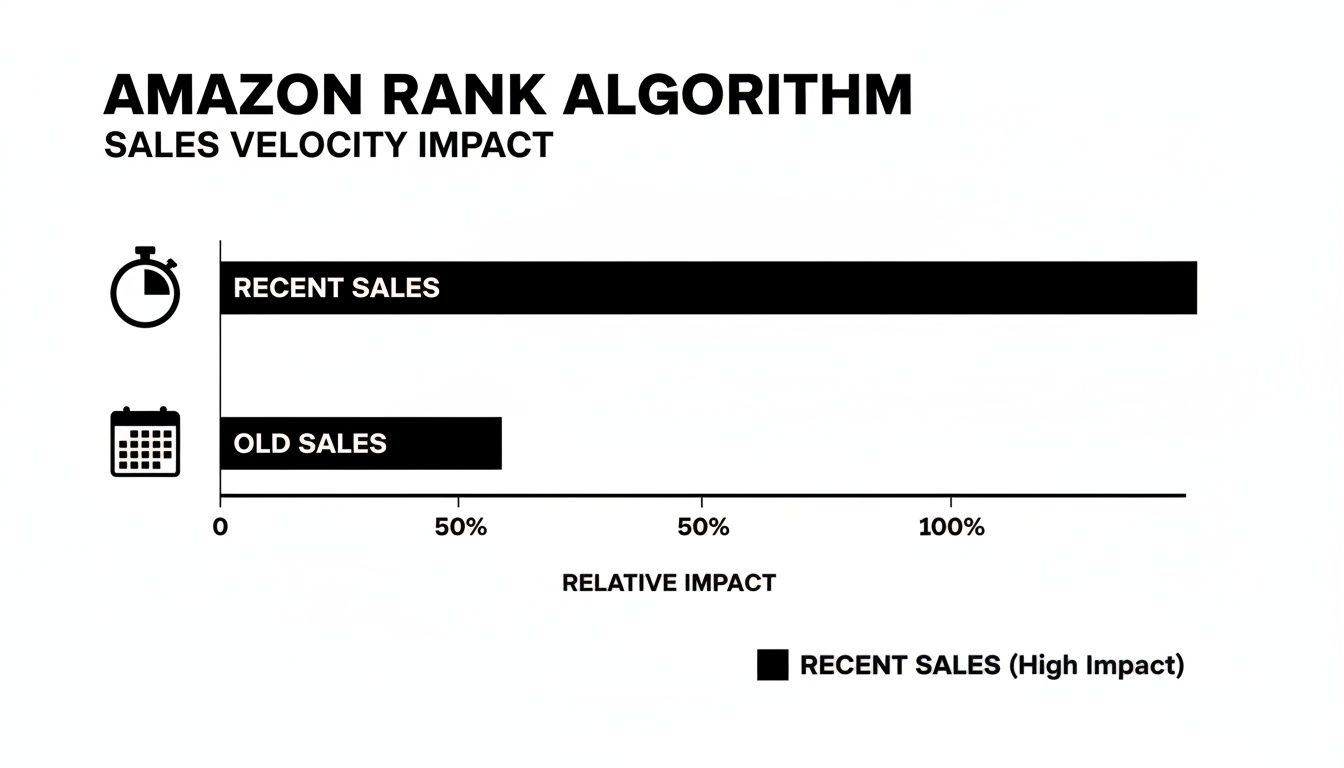
This is why consistent, daily performance is everything for maintaining a strong sales rank on Amazon.
But how BSR translates into sales depends entirely on the category. To give you a better idea of how much this varies, we've put together a table showing what it takes to be in the top 1% across different product worlds on Amazon US.
BSR vs Estimated Daily Sales By Amazon Category
| Category | Total Products | Top 1% BSR | Estimated Daily Sales (for Top 1%) |
|---|---|---|---|
| Books | ~60 Million | < 1,000 | 100 - 500+ |
| Home & Kitchen | ~65 Million | < 2,000 | 50 - 200+ |
| Health & Household | ~12 Million | < 1,500 | 60 - 250+ |
| Toys & Games | ~4 Million | < 500 | 80 - 300+ |
As you can see, the sales needed to hit a top BSR are all over the place. A top 1% rank in Toys & Games might mean selling 80 units a day, while in Home & Kitchen it could be just 50.
Getting a feel for this relativity is the first step. It helps you turn BSR from a simple vanity metric into a real strategic tool for your business.

Knowing how the sales rank on Amazon works is one thing. Actually improving it is a whole different ballgame—it’s where the pros really stand out. Since BSR is all about sales velocity, every move you make has to circle back to one simple goal: getting more people to hit that "Add to Cart" button.
This isn't about some secret trick or a magic bullet. It's about methodically pulling the right levers to kickstart a powerful feedback loop. More sales means a better BSR. A better BSR means more organic visibility. And more visibility drives even more sales. That's the flywheel you want to get spinning.
Before you even think about spending a dime on ads, your product page has to be a finely-tuned conversion machine. Driving traffic to a listing that doesn't convince shoppers to buy is just throwing money away. A solid conversion rate is the absolute foundation of a healthy, stable sales rank.
Zero in on these key areas:
Nailing these elements is how you turn casual window shoppers into paying customers. If you want to dig deeper into how all these pieces fit together, check out our guide on powerful listing optimization on Amazon.
Once your listing is ready to convert, it's time to add some fuel to the fire with Amazon Pay-Per-Click (PPC). For a new product launch, PPC isn't a "nice-to-have"—it's a must-have. It’s how you get the initial sales moving and even get on the BSR scoreboard in the first place.
A smart PPC campaign does a lot more than just bring in a few sales. It’s a signal to Amazon’s algorithm that your product is relevant and that people want it. This can give a nice lift to both your BSR and your organic keyword rankings over time. Think of it as a direct investment in your product's long-term visibility.
For a new launch, your initial PPC goal isn't about profit—it's about velocity. Running an aggressive campaign out of the gate can create a quick burst of sales, locking in a strong starting BSR and telling the algorithm to show your product to more organic shoppers.
The BSR algorithm absolutely loves a good sales spike. You can manufacture these spikes yourself using Amazon's own promotional tools. It's a fantastic way to climb the rankings fast, especially if you're trying to leapfrog a competitor.
Here are a couple of tactics to create that controlled burst of sales:
These aren't tools you want to run 24/7. They're tactical weapons. You deploy them strategically to give your sales rank on Amazon a targeted jolt when you need it most. By combining a fully optimized listing with smart advertising and well-timed promotions, you build an unstoppable engine for climbing the BSR ladder.
There’s a ton of bad advice floating around about the sales rank on Amazon. Getting caught up in the myths can lead even smart sellers to make some costly mistakes. The Best Sellers Rank (BSR) is a huge indicator of performance, but it’s so often misunderstood.
Let's clear the air and tackle the most common myths head-on.
Getting these ideas straight is key to building a solid strategy. Too many sellers fall into analysis paralysis or chase the wrong numbers, all because they’re misreading what the data is actually telling them.
This is probably the biggest and most damaging myth out there. It's absolutely critical to understand that your BSR and your keyword rank are two completely different things. They don't even measure the same thing.
They’re related, sure, but they don't move in perfect sync. A product can have a killer BSR because a TikTok video went viral, driving tons of direct traffic, but it might not even be on the first ten pages for its main keywords. On the flip side, you could be ranked #1 for a super niche, low-traffic keyword and still have a terrible BSR.
Your BSR reflects sales volume, while keyword rank reflects search relevance. A good sales rank on Amazon can positively influence your keyword positions over time, as sales velocity is a key factor in Amazon's organic ranking algorithm, but they are not the same thing.
Seeing your product crack the top #100 in its category feels amazing, and it is a win! But that shiny BSR badge says absolutely nothing about how much money you're actually making. It’s surprisingly easy to have a best-selling product that loses you money on every single sale.
How is that even possible? A brand might rocket up the BSR charts by:
These can be legitimate tactics for a product launch just to get the ball rolling. The mistake is confusing a great BSR with a healthy business. You have to look at your Total ACoS (TACoS) and net profit to get the real story.
It’s easy to assume that a best-selling product must be a great, high-quality item with thousands of glowing reviews. And while good products often sell well, the BSR metric itself doesn't care one bit about your star rating or what customers are saying.
A product with 2,000 five-star reviews will get outranked in a heartbeat by a brand-new product with zero reviews if that new product simply sells more units today. BSR is a cold, hard calculation based purely on sales velocity.
Speaking of reviews, building a strong base of them is essential for long-term sales and conversion. If you need help with that, you might be interested in our guide on getting more Amazon reviews.
Understanding these differences helps you treat BSR for what it is—a near real-time snapshot of market demand—without falling for the myths that trip up so many other sellers.
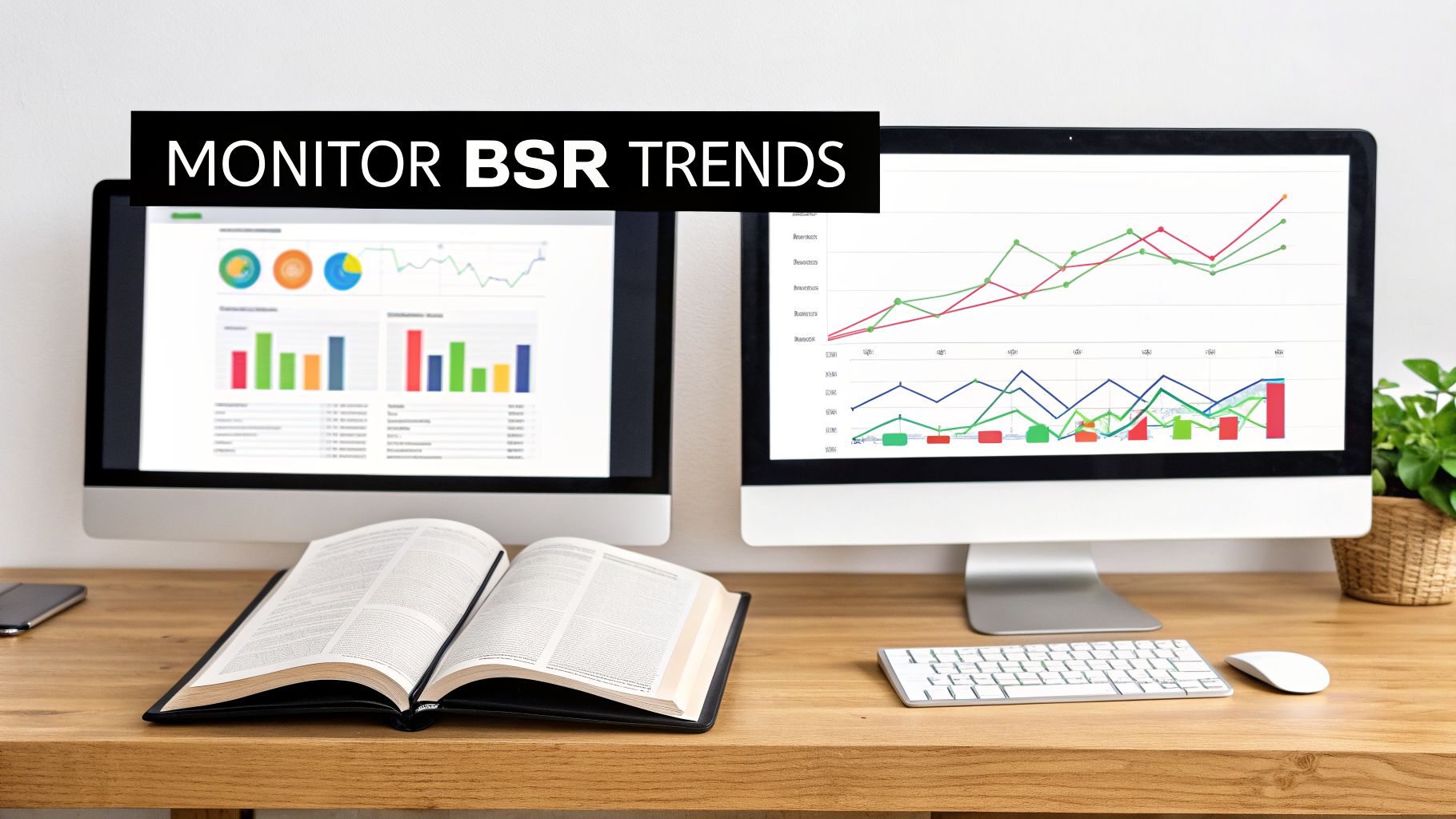
The best sellers on Amazon aren't the ones who panic over a minor dip in their sales rank. Instead, they treat BSR as a strategic tool, analyzing its history to find powerful insights that build their brand for the long haul. This is how you turn a simple number into a roadmap for growth.
When you start looking at your sales rank on Amazon over weeks and months, you can finally see past the daily noise. It helps you spot the bigger picture, find hidden issues, and truly measure what’s working. A single day's rank is just a snapshot; the trend tells the whole story.
By tracking your BSR over time, you can connect the dots between your efforts and how the market responds. Did your rank get consistently better after you launched that new A+ Content? That’s a clear win. Did it suddenly tank for no good reason? Maybe a new competitor just showed up.
A BSR that keeps getting worse is one of the earliest red flags you’ll get. Think of it as your canary in the coal mine, warning you about trouble before it really hits your bottom line.
A sudden, sharp drop in rank usually points to an urgent problem you need to fix, fast:
On the flip side, keeping an eye on your competitors’ BSR can uncover some golden opportunities. If a top rival’s rank suddenly plummets, they might be out of stock. That’s your signal to turn up the heat on your advertising and grab their sales while they’re down.
So, how do you really know if that new PPC campaign or influencer shout-out actually paid off? The shift in your BSR trend gives you a clear, data-driven answer. By lining up your marketing activities with your rank history, you can see the real effect on your sales velocity, going way beyond basic ad metrics.
Top sellers use BSR trends as a core KPI for marketing. They map out campaign start and end dates against their rank history to see the lift. This is how they prove what’s working and justify where the ad budget should go next.
For example, if you run a week-long coupon, you should see your BSR get lower (which is better!) during that exact time. If nothing changes, that promotion probably didn't move the needle. This kind of analysis gives you the hard data you need to make your next marketing push even better.
One of the smartest ways to use historical BSR data is for better inventory forecasting. A consistently improving sales rank is a direct sign that demand for your product is heating up.
By tracking your rank over time, you can:
Tools like Helium 10 or Jungle Scout are essential for this kind of deep dive. They automatically track and graph your BSR history, making it easy to compare it against competitor data, promotions, and other key events. For a closer look, check out our guide to the top Amazon product research tools that can help you do this.
Ultimately, mastering the sales rank on Amazon is all about shifting from reacting to thinking strategically. Use the data to learn, adapt, and build a brand that doesn’t just survive on Amazon—it thrives.
Let's be honest, even seasoned sellers get tripped up by the finer points of Amazon's sales rank. It looks straightforward enough, but dive a little deeper, and you'll find plenty of nuances.
We're going to clear up a few of the most common questions we hear. Nailing these details is what separates good analysis from bad, and it’s key to making sharp, data-driven decisions for your brand.
This is a big one, and it’s easy to confuse the two. Think of it like this: your sales rank (BSR) is a measure of pure sales power. It answers the question, "How many units am I moving compared to everyone else in my category?"
Keyword rank, on the other hand, is all about search visibility. It answers, "Where does my product show up when a customer searches for 'leather wallet'?"
Now, the two are definitely connected. Strong sales velocity (a great BSR) is a major factor in Amazon's algorithm, so it can absolutely boost your keyword rankings over time. But they aren't the same thing. You could have a product with an amazing BSR thanks to a huge influencer push but still rank poorly for your main keywords, or vice-versa.
Nope. A customer return won’t directly tank your BSR. The algorithm is built to track sales orders, not your net sales after you account for returns.
That initial sale gives your BSR a bump, and the return that comes later doesn't claw it back. You don’t have to stress about returns immediately wiping out the sales momentum you just built.
This is a huge relief, especially if you're selling in a category known for higher return rates. The takeaway? Keep your focus on driving those initial sales—that's what the BSR system is paying attention to.
You'll see changes happen pretty fast, often within just a few hours. How fast depends on how well your product is already selling.
If you're running something big like a Lightning Deal or a major coupon event, keep a close eye on your rank. You'll get near-instant feedback on how much sales velocity you're generating.
At Million Dollar Sellers, we move past the basics and into the high-level strategies that build 8- and 9-figure brands. If you're an established entrepreneur ready to scale with a network of proven peers, see if you qualify for our exclusive community. Learn more at https://milliondollarsellers.com.
Join the Ecom Entrepreneur Community for Vetted 7-9 Figure Ecommerce Founders
Learn MoreYou may also like:
Learn more about our special events!
Check Events