Chilat Doina
March 4, 2026
Think of Amazon product research tools as your personal guide to the sprawling, often chaotic, Amazon marketplace. These software platforms dig through mountains of data to help you spot profitable products, size up the competition, and get a real sense of what you can expect to sell. For any serious seller, they’re the difference between launching a product based on a gut feeling and making a calculated move backed by hard numbers.

Ever tried to navigate a ship in a storm without radar? That's what selling on Amazon without data feels like—a whole lot of guesswork and hoping for the best. For 7- and 8-figure sellers, Amazon product research tools aren't just a nice-to-have; they're a core part of how they manage risk.
These platforms give you a clear, unobstructed view of the competitive landscape. They help you answer the make-or-break questions before you sink a single dollar into inventory. Is there actually a market for this? How much are the top dogs making? And most importantly, can I source this thing at a price that leaves me a healthy profit after Amazon takes its cut?
Without these tools, every product launch is a gamble. With them, it becomes a strategic business decision. This is how successful sellers build predictable, scalable operations—they put their money where the data tells them they have the best shot at a solid return.
The real magic is how these tools pull together millions of data points, revealing patterns you'd never spot on your own. This lets you:
In the crowded world of Amazon, where over 2.5 million active sellers are all vying for attention, these tools have become a non-negotiable. It's not just small sellers, either. One report found that 42% of users were e-commerce professionals at major brands, proving that even the biggest players rely on this data to stay competitive.
For elite sellers, data isn’t just information; it’s a competitive moat. It allows them to systematically de-risk inventory purchases and marketing campaigns, ensuring that their capital is always working to produce the best possible outcome.
Ultimately, top sellers use these insights to constantly tweak their strategy and find new ways to increase Amazon sales. They know that in a marketplace as fast-moving as Amazon, the brand with the best data almost always wins.
Opening up an Amazon product research tool for the first time can feel like staring at an airplane cockpit. You’ve got dozens of charts, graphs, and flashing numbers all competing for your attention, and it’s easy to feel overwhelmed. But here's the thing: experienced sellers know that only a handful of these metrics truly matter when you're making six- and seven-figure inventory decisions.
The trick is to stop seeing them as just numbers. Instead, learn to read them as a story that reveals a product’s real potential—and its hidden risks. Think of it like learning a new language. Once you know the vocabulary, the entire picture comes into focus.
The very first question you have to answer is simple: "Does anyone actually want to buy this?" Getting a handle on demand is the bedrock of good product research, and a few key metrics will give you a clear map of customer desire.
Estimated Monthly Sales: This is your most direct signal of a product's current performance. If a tool shows a product is pulling in $30,000 in monthly revenue, you immediately know a substantial market exists.
Monthly Search Volume: This metric tells you how many shoppers are typing a specific keyword into Amazon's search bar each month. A keyword like "bamboo cutting board" with 25,000+ searches/month confirms strong, active interest and validates the entire niche.
Best Seller Rank (BSR): BSR is a snapshot of how well a product sells compared to others in its category. A lower number is always better. A product sitting at #500 in Home & Kitchen is flying off the shelves compared to one ranked at #50,000. Watching its 90-day average BSR helps you separate consistent winners from one-hit wonders.
When you look at these metrics together, they tell you whether there's enough demand to even consider building a business around a product. High sales, strong search volume, and a steady, low BSR are green lights signaling a healthy market.
Once you've confirmed that people want the product, you need to figure out who you'll be up against. How crowded is the field, and how established are the current players? This is where you size up the difficulty of breaking into the market.
Review Count and Velocity: A listing with 4,000 reviews is obviously a tough competitor. But what's even more telling is its review velocity—the pace at which it's gathering new reviews. A competitor gaining 150+ new reviews every month has a powerful sales engine running, likely fueled by heavy ad spend and promotions.
Seller Count: This number shows how many other sellers are competing on the same listing. If you see just one seller, it's almost certainly a private label brand you can't touch. For wholesale or arbitrage models, a sweet spot is usually between 3 and 15 sellers. Any more than that, and you're probably walking straight into a price war that will crush your margins.
Think of these metrics as a weather report for a product niche. High demand is a sunny day, but a high number of entrenched competitors with rapid review velocity is a sign of an approaching storm. Successful sellers learn to find the sunny days with just a few clouds.
After all that, it boils down to one final question: can you actually make money? This is where you have to connect the market data back to your own finances. A product might have incredible demand, but if you can't source it profitably, it's a non-starter.
These are the core metrics that tell you what really matters in Amazon product research. Each one answers a critical question that guides your decision-making.
By focusing on these core numbers, you can turn a confusing dashboard into a clear and actionable framework for making smarter decisions.
To make sure your numbers add up, focus on these profitability indicators:
Focusing on these core metrics lets you cut through the noise and zero in on products with the highest chance of success. For a closer look at how these financial calculations work, our guide on understanding unit economics breaks it all down.
You ever wonder how 8-figure sellers seem to pull winning products out of thin air? It’s not luck. They aren’t just aimlessly clicking around until something sticks. They’re running a playbook—a systematic, repeatable workflow that turns raw ideas into validated opportunities.
This isn’t about guesswork. It’s a structured process for qualifying or disqualifying ideas with speed and confidence. Think of it as moving from a wide-angle lens on the market down to a microscope on a single product. Following this path helps you dodge expensive mistakes and put your capital where it has the best shot at success. It’s how the top players consistently find and launch profitable items.
So, where do you start? The journey kicks off with broad discovery. You’re casting a wide net, not to find the perfect product right away, but to identify promising niches where customer demand is high and the competition looks a little lazy. This is exactly where a solid Amazon product research tool becomes your best friend.
Tools like Helium 10's Black Box or Jungle Scout's Product Database are basically your market scanner. You can dial in specific filters to comb through millions of products and hunt for ones that fit your ideal criteria.
This first pass will probably spit out dozens, maybe even hundreds, of potential products. Now the real work begins: narrowing the field.
Alright, you've got a list of interesting candidates. The next move is to put the top competitors under the microscope. It’s not enough to know what they’re selling; you have to understand how they’re selling it. This is where you’ll spot their strengths and, more importantly, their weaknesses.
Take a hard look at the top 5-10 listings for each of your promising ideas. Check for sales consistency—don't get fooled by a single good month. A product with wild sales swings might be seasonal or leaning on some unsustainable promo. Also, get picky about their listing quality. Are the images sharp and professional? Does the copy actually sell the product? Are they using A+ Content effectively?
This is where you find your opening. A niche packed with competitors who have blurry photos, sloppy copy, and a bunch of negative reviews all complaining about the same product flaw? That’s a golden opportunity.
A great product idea is totally worthless if nobody is actually searching for it. Before you get too attached to an idea, you have to validate that customer search interest is both big enough and stable enough to build a business on. This step makes sure you’re tapping into a market with real, organic demand, not just a passing fad.
Using a keyword research tool, dig into the main search terms for the product. You’re hunting for a few key signs:
Validating keywords confirms that you can actually get in front of customers through Amazon's search bar, which is the lifeblood of any FBA business. You can learn more about this in our full guide on how to find winning products.
This is the make-or-break step. The final, most critical piece of the puzzle is calculating profitability. Can this product actually make you money? So many sellers get starry-eyed over revenue numbers, but the pros model their full profitability with ruthless precision.
This means you need to account for every single cost that will eat into your margin:
The infographic below breaks down how to think about the key metrics you’re decoding for a successful launch.
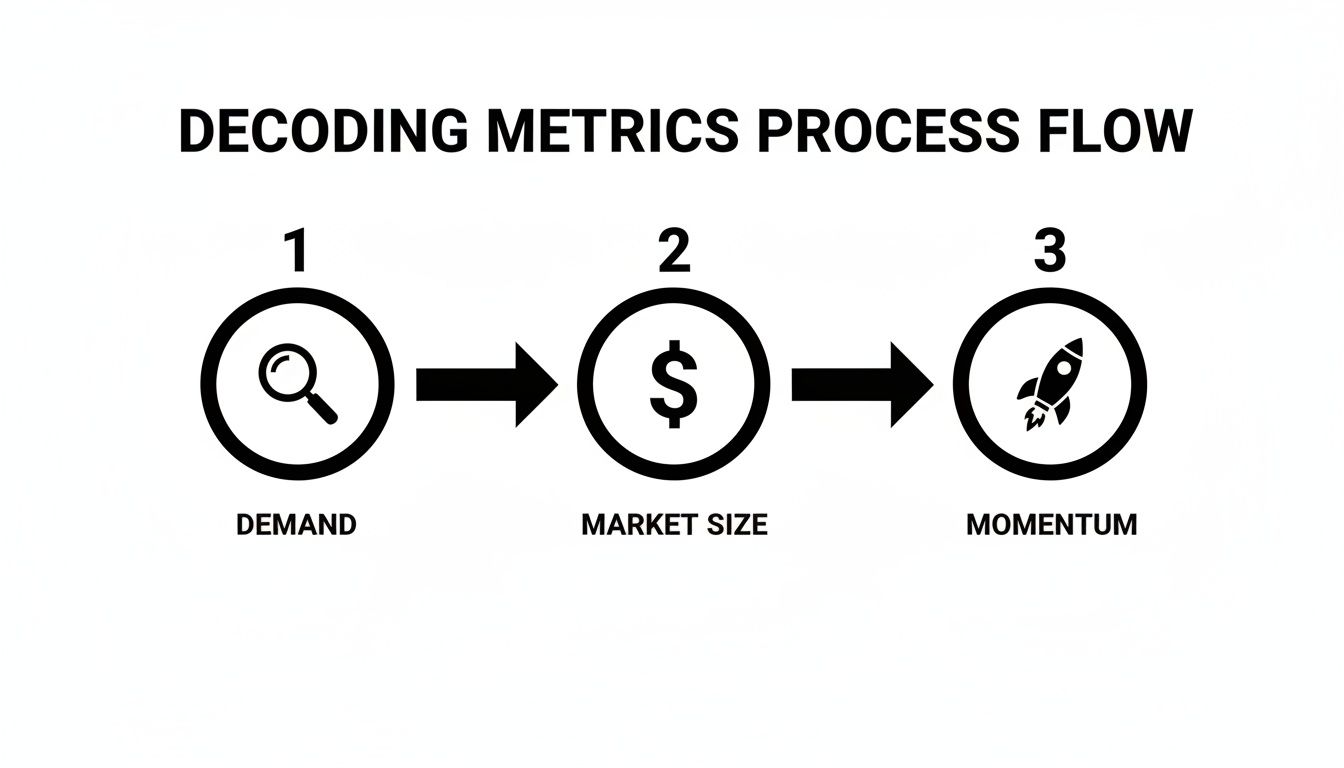
This workflow ensures you size up the demand, validate the market, and gauge the competitive heat before you spend a single dollar on inventory. A product only gets the green light for sourcing when it passes this final test—and for us, that means showing a net margin of 20% or more.
This process is a testament to the power of using the right tools. I know a seller who used Helium 10's Black Box and Cerebro to find a product pulling in $460,000 a month. That’s a find that’s pretty much impossible with manual research. While free tools can give you quick estimates, serious sellers know that paid suites cut research time from days down to hours, letting you vet way more product ideas and find the real winners.
The world of Amazon product research tools is crowded. Dozens of options are all promising to help you find your next big winner, but where do you even start? Your first big decision comes down to a simple fork in the road: stick with Amazon's free tools or invest in a paid, third-party suite.
Getting this choice right is fundamental to building a solid research process.
Think of Amazon's built-in tools, like Opportunity Explorer, as the free map the rental car company gives you. It's useful, for sure. It’ll show you the major highways and point you toward the popular neighborhoods, giving you a general sense of the landscape at no cost. It’s a great starting point.
But for anyone serious about scaling a business on Amazon, that's where the free map's usefulness ends. To really know the terrain—to see the hidden side streets with less traffic, understand historical sales patterns, and accurately calculate the real cost of getting there—you need a much more powerful system. This is where paid tools become an absolute must-have.
Let's break down the practical differences. While Amazon's free tools are getting better, they're designed to give you just enough information to get started. Paid suites, on the other hand, are built from the ground up to give you a serious competitive advantage.
Ultimately, Amazon's tools give you a glimpse into what's happening right now. Paid suites give you the full story—past, present, and a much clearer picture of the future. For growing brands, that context is everything.
Premium suites from companies like Helium 10 or Jungle Scout are the professional-grade command centers for your Amazon business. While Amazon's tools offer a single photo, paid platforms give you the entire movie, complete with historical archives.
They unlock critical data points that Amazon simply doesn’t share with the public. With a paid tool, you get:
This level of detail is what separates educated guessing from data-backed decision-making. For 7- and 8-figure sellers, this isn't a "nice-to-have"—it's the core of their entire risk management strategy.
Just as we've gotten used to the free vs. paid debate, Artificial Intelligence has arrived and is completely reshaping the board. AI isn't just a marketing buzzword anymore; it's a real, functional engine inside modern Amazon product research tools that automates complex analysis and uncovers insights that used to take weeks to find manually.
This is happening on two fronts. First, Amazon's own AI, like the conversational shopping assistant Rufus, is changing how customers find products. Discovery is becoming more personalized. Sellers who get this can position their products to be recommended by these new AI-powered engines.
Second, AI is being baked directly into the research tools themselves. By 2026, AI-infused tools are expected to be standard for the 2.5M sellers chasing over $700B on the platform. The influence of Amazon's Rufus alone is projected to be massive, accounting for 13.7% of searches and helping drive an estimated $12B in extra sales in 2025. You can explore more on these findings on Amazon product research at AutoDS.com.
AI doesn't just find data; it interprets it. Instead of just showing you competitor sales, AI can now analyze their listing quality, identify thematic weaknesses in their reviews, and even draft optimized listing copy for you to counter them.
This creates a fascinating new dynamic. Amazon's free native tools are getting smarter, but the paid suites are using AI to pull even further ahead. They automate deep competitor analysis, suggest niche opportunities based on emerging cultural trends, and help you craft superior listings faster than any human could. For any seller looking to stay competitive, embracing these AI features is no longer optional—it's essential for survival and growth.

If you're only looking at your business through an Amazon lens, you're driving blind. It’s like trying to navigate a busy highway by only looking out the passenger-side window. You see a slice of the action, but you’re missing the full picture. Relying only on even the best Amazon product research tools will give you a dangerously incomplete view of your brand's actual health.
Any serious seller knows Amazon is just one piece of a much larger puzzle. Your Shopify store, your retail partners, and any other sales channels are all part of the same brand ecosystem. To make the big, strategic decisions that fuel growth, you have to get out of the Amazon data silo and create one central source of truth for your entire business.
This is where omnichannel analytics platforms change the game. These tools are built to pull data from all your different revenue streams—Amazon, Shopify, retail, you name it—and stitch it all together into a single, unified dashboard. It’s about getting a complete, 360-degree view of your performance, graduating from channel-specific stats to true brand intelligence.
So, why is this so critical? Because looking at data in isolation will lead you straight to the wrong conclusions. Imagine you run a social media ad campaign that drives sales to both your website and your Amazon listings. Without an integrated view, you can’t see its total impact or calculate the real ROI. You might end up killing a campaign that was secretly a massive success.
An omnichannel approach means that every piece of data, from every sales channel, informs your strategy. It’s the difference between managing individual sales outlets and building a cohesive, resilient brand.
Pulling this off requires some pretty sophisticated data integration, a concept that mirrors the unified approach of top-tier omichannel customer service strategies.
Once you can finally see the whole board, you can start tracking the metrics that actually define long-term success. These are the numbers that 8- and 9-figure founders live and die by.
True Net Profit: This isn't your Amazon profit. It’s a full accounting of your business's total profitability after you factor in every single cost—from software fees to warehouse salaries—across all your channels.
Blended Customer Acquisition Cost (CAC): This metric gives you the average cost to land a new customer across all your marketing, whether it’s Google, Meta, or Amazon PPC. It reveals your true, combined cost of growth.
Cross-Channel Lifetime Value (LTV): This is the holy grail. It measures the total value a customer brings to your brand over their entire relationship with you, no matter if they first bought on Amazon and later from your DTC site.
Getting a handle on these blended metrics is absolutely essential. For example, Amazon's own tools like Product Performance Spotlight can offer great real-time competitive data. However, they can't calculate your true omnichannel profitability, which is why specialized platforms have popped up to fill this massive gap. For more context, check out these insightful Amazon statistics from SalesDuo.com.
At the end of the day, integrating your data is what allows you to make strategic calls on inventory, marketing spend, and brand expansion with real confidence. It’s a crucial part of building a comprehensive omnichannel retail strategy. You stop being a collection of separate storefronts and become a single, powerful, and data-driven brand.
Finding a winning product on Amazon isn’t about striking gold with a lucky guess. The top sellers I know don't gamble—they operate like scientists. They stick to a disciplined, repeatable system that puts every potential product under a microscope, making sure they only bet on opportunities with a real shot at success.
This checklist is your final pre-launch inspection. It’s built on one core idea: winning on Amazon means you have to kill your risks and stack the odds in your favor before you spend a dime on inventory.
Think of these as the hard-and-fast rules of the road. If a product idea can't clear these first hurdles, it's an immediate pass. This kind of discipline is what keeps you from getting bogged down in low-margin products or trying to fight battles you can't win.
Prove the Demand Exists: Never, ever source a product based on a gut feeling. Get into your research tools and confirm that the top competitors are pulling in at least $10,000+ in monthly revenue. You also want to see a primary keyword with 5,000+ monthly searches. This is your proof that a real market is there waiting.
Find Your Competitors’ Weak Spots: Your way into a market is through your competitor’s blind spot. Hunt for niches where the top sellers have terrible photos, lazy product descriptions, or a clear pattern of negative reviews all hitting on the same product flaw. That’s your opening to do it better and steal their customers.
Look at Profit, Not Just Revenue: Big revenue numbers look great, but they don't mean a thing if you aren't making any money. Pop everything into a profitability calculator to see your real net profit after all the costs are factored in—that means landed cost of goods, FBA fees, storage, and a realistic 10-15% for ad spend. If you can't hit a 20% net margin or higher, be very careful.
Once an idea makes it past the foundational checks, it's time to start thinking about long-term survival. These next steps are all about dodging the common, expensive mistakes that trip up even seasoned sellers.
The goal isn't just to find products that can make money. It's to find products that can make money predictably and sustainably, without putting your whole business on the line.
Here’s how you check for long-term health:
Even the most seasoned sellers have questions when they're digging into the data from Amazon product research tools. Let's cut through the noise and get you some straight answers to the most common head-scratchers, so you can trust the numbers that are actually driving your business.
You’ve probably noticed this: you check the same product on two different tools and get two different sales estimates. It’s totally normal. Every platform has its own secret sauce—a unique algorithm for estimating sales, since Amazon doesn't just hand over that data. Think of it like two different weather apps. One might say there's a 70% chance of rain, the other 80%.
Don't get hung up on the exact number from a single tool. Instead, look for the trend. If Jungle Scout shows a product is doing $20,000 a month and Helium 10 says it's $24,000, your big takeaway is the same: this is a healthy market in the $20k-$25k range. Use the numbers to gauge the size of the prize, not as an absolute, down-to-the-dollar fact.
Let's be real—finding a truly untapped niche is like finding a unicorn. But finding an underserved niche? That’s a repeatable game plan. The goal isn’t to find something nobody is selling. It’s to find a market where the current sellers are just phoning it in. That’s where you can swoop in and dominate.
Fire up your research tools and start filtering for products with these tell-tale signs:
Knowing when to trust the data and when to put on your detective hat is a skill that separates the pros from the amateurs. It’s all about balancing what the tools tell you with your own gut and business sense.
Always trust the trend, but verify the specifics. If a tool shows a market is growing, that’s a powerful signal. But you must still calculate your own profitability with your exact sourcing costs and fees.
Go all-in on the data when:
Pump the brakes and dig deeper when:
At the end of the day, these tools give you the map, but you're the one who still has to drive the car.
At Million Dollar Sellers, we believe in using data to build smarter, more defensible brands. Our community is where top e-commerce founders share the exact strategies they use to turn data into profit. Find out if you qualify to join the conversation at Million Dollar Sellers.
Join the Ecom Entrepreneur Community for Vetted 7-9 Figure Ecommerce Founders
Learn MoreYou may also like:
Learn more about our special events!
Check Events