Chilat Doina
May 23, 2026
You've already done the obvious work. Sponsored Products are built out. Search term reports are clean. Top-of-search bids are dialed in. TACoS is stable enough that nobody on the team is panicking.
And yet growth feels heavier than it should.
That's usually the point where smart brands make the wrong call on Amazon display advertising. They either dismiss it as expensive retargeting, or they launch a few Sponsored Display campaigns, judge them like bottom-funnel PPC, and shut them off before the strategy has a chance to work. Both reactions leave money on the table.
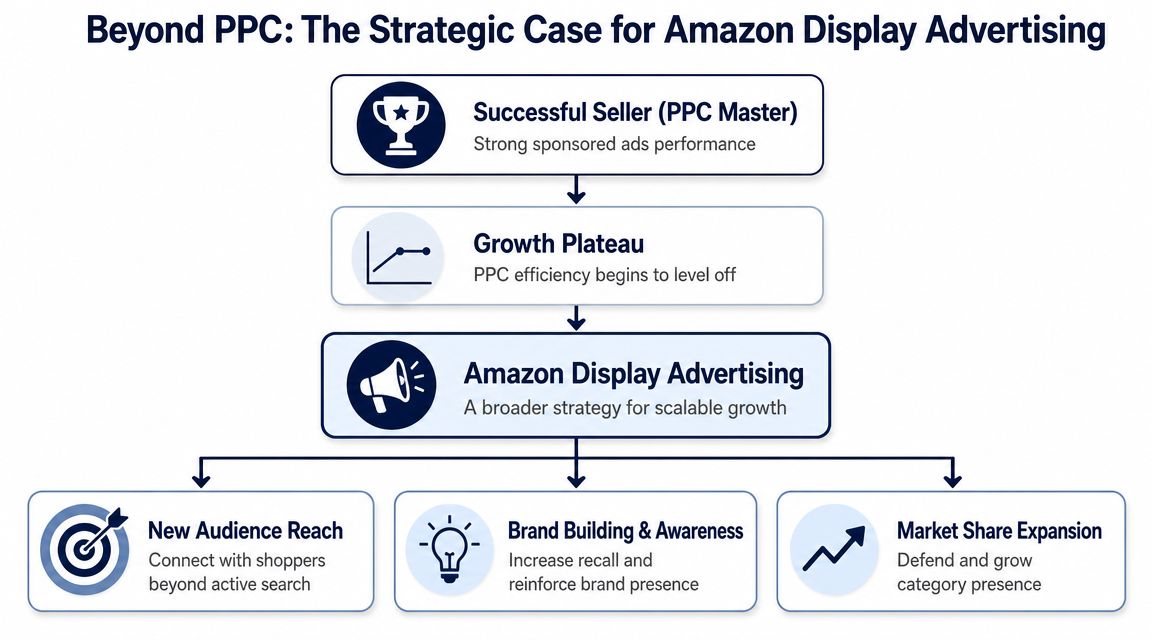
The operators who keep gaining share don't treat display as a side channel. They use it to defend branded demand, pressure competitor consideration, expand audience reach beyond search, and influence revenue that doesn't always show up neatly inside one last-click dashboard. That's the difference between running ads and building an advertising system.
A seller can get very far on search alone. Then the ceiling shows up.
Search captures demand that already exists. Display advertising on Amazon helps create, shape, and recapture demand before and after the search. That matters if your catalog has matured, your branded search is getting attacked, or your category is crowded enough that winning only at the keyword level stops being enough.
Amazon's ad machine is too large to treat display as optional. Statista estimates Amazon's worldwide advertising revenue reached about $56.21 billion in 2024 and is projected to hit $65.64 billion in 2025, with 2024 revenue rising by more than 20% year over year. That tells you something important. Display isn't a niche feature bolted onto the platform. It sits inside one of the world's most important ad ecosystems.
The practical implication is simple. If your competitors are strategic, they're not only bidding on keywords. They're showing up around your detail pages, around related shopping behavior, and across off-Amazon inventory where future customers are still forming preferences.
Practical rule: Search wins the click in front of you. Display helps decide which click exists tomorrow.
This is also where a lot of Amazon-native brands underestimate what they're buying. Amazon's own ad ecosystem spans Amazon-owned properties and third-party placements. That changes the role display should play in your media mix. It's not just there to chase cart abandoners.
Lumping everything together under “display” often leads to inconsistent results. The format matters, but the strategic role matters more.
A clean way to understand this is:
| Channel | Best strategic use | Where it tends to help |
|---|---|---|
| Sponsored Display | Brand defense, competitor conquesting, retargeting, PDP pressure | On-Amazon influence with some off-Amazon reach |
| Amazon DSP | Market expansion, audience development, scaled prospecting, omnichannel influence | Broader reach across Amazon-owned and external inventory |
Sponsored Display is usually the faster lever for sellers who want to protect branded traffic, stay visible near competitor products, and re-engage shoppers who already showed intent.
DSP is the larger strategic weapon. If you want to build audiences outside direct search behavior, carry brand messaging beyond Amazon, or scale a full-funnel plan, DSP is where that gets more interesting. If you need a deeper breakdown of how operators use it in practice, this guide on Amazon DSP advertising is worth reading alongside your media planning.
The mistake is judging display by the same standard you use for mature Sponsored Products campaigns.
Display rarely looks best when your only question is, “Did this campaign produce efficient last-click Amazon sales immediately?” The better question is, “Did this campaign improve the quality, volume, and defensibility of demand around the brand?”
That's why strong operators use display for three jobs that PPC alone can't fully handle:
This isn't unique to Amazon. If you want a simple outside-Amazon example of how adaptable display creative can be by market and objective, Silva Marketing's breakdown of responsive display ads for local Prescott businesses is a useful reminder that display works best when the message fits the audience and context.
The brands that win don't ask whether display can replace PPC. It can't. They ask a better question. Where is search no longer enough?
If you target everyone, you usually waste money on almost everyone.
The fix isn't more complexity. It's building a simple audience matrix that ties each campaign to a job. Display advertising on Amazon performs best when the audience definition comes before the bid and before the creative.
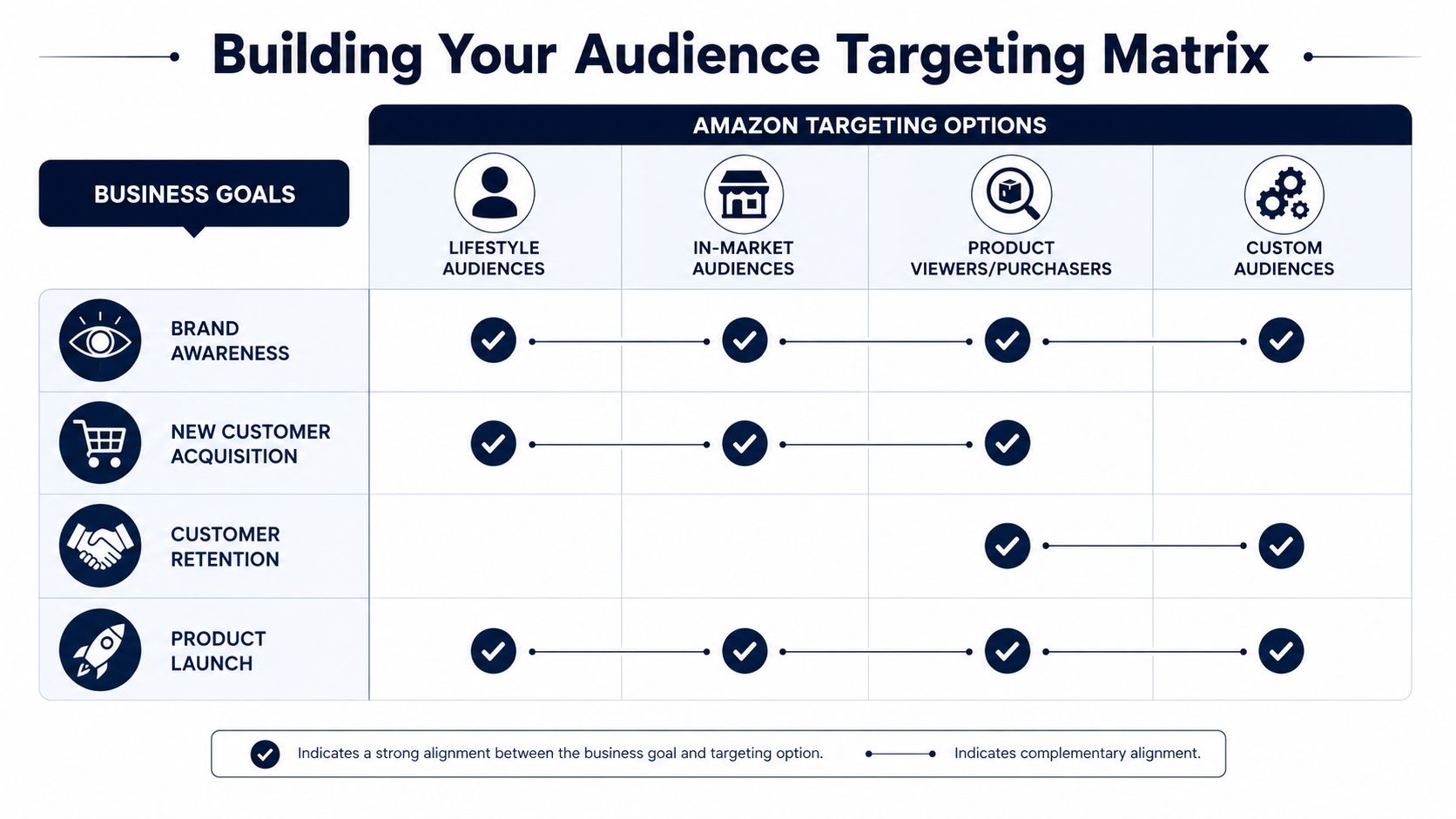
Teams often open Sponsored Display or DSP and begin with whatever targeting option looks easiest. That's backwards.
Build the matrix around four common business goals:
Then assign the audience type that best fits that job.
This is your highest-intent pressure layer inside Amazon.
You're targeting products, categories, and buying contexts where the shopper is already in-market. Such targeting involves competitor ASIN targeting, category adjacency, and detail-page presence. It's less about broad discovery and more about intercepting consideration.
Use this layer when you need to:
A lot of sellers over-expand here. They target massive sets of ASINs with weak relevance and then call contextual targeting inefficient. Tight product logic usually wins over broad product dumps.
Don't target competitor pages just because they exist. Target the ones where your offer creates a believable switching case.
Under these circumstances, Sponsored Display usually gets much more compelling.
Warm audiences outperform cold ones because the shopper already knows the product, brand, or category. That's why industry data cited by Improvado says remarketing display ads typically achieve 2 to 3 times higher conversion rates than prospecting campaigns. That gap is exactly why mature accounts treat retargeting as a core profit layer, not an afterthought.
Use these audiences differently based on behavior:
| Audience | Best use | Common mistake |
|---|---|---|
| Product viewers who didn't buy | Recover lost consideration | Using generic creative instead of product-specific ads |
| Cart abandoners | Push urgency and return intent | Sending them broad brand messaging |
| Past purchasers | Repurchase, refill, cross-sell | Showing the same hero SKU they already bought |
| Brand-engaged shoppers | Mid-funnel reinforcement | Bidding like they're cold traffic |
Remarketing works because it matches message to familiarity. A shopper who viewed one product needs a tighter follow-up than a shopper who vaguely fits your category.
DSP is where your matrix gets broader and smarter.
This layer is for shoppers who may not know your brand but fit patterns that matter. That includes in-market audiences, lifestyle audiences, and custom audience groupings built around signals that align with your category. This is the right layer when search volume is tapped out, when launches need more discovery, or when you're trying to extend influence beyond Amazon storefront interactions.
The mistake here is jumping into broad prospecting before the business has clear proof of who converts well. The stronger sequence is usually:
If the brand objective is retention, start with past purchasers and high-intent viewers. If the goal is launch velocity, lead with contextual product targeting and reinforce with retargeting pools as traffic builds. If the objective is category expansion, move into DSP audiences that mirror the customer profile without relying only on branded search.
In this aspect, founders often overcomplicate the stack. You don't need every audience type live at once. You need audience tiers with clear roles.
The audience matrix should tell your team what each campaign is allowed to do. If a campaign has no clear job, it usually ends up with no clear result.
That one discipline cleans up most display accounts fast.
A good audience with weak creative is just a more efficient way to waste impressions.
That's why strong Amazon display execution starts with message control. Different people need different reasons to care. The shopper who has never heard of your brand shouldn't get the same ad you'd show someone who viewed your hero ASIN yesterday.

Most underperforming display campaigns have a targeting problem, a creative problem, or both. The creative issue is often easier to spot.
For awareness, run brand-level messaging. Focus on the category problem you solve, the product benefit, and visual identity. Here, lifestyle imagery often earns its place because the ad needs to create relevance before it asks for action.
For consideration, narrow the message. Product-specific imagery, clearer benefit framing, and stronger offer communication usually matter more. Shoppers at this stage need a reason to compare you favorably.
For re-engagement, get direct. If someone already engaged with the product, broad branding is usually too soft. You want creative that reminds them what they looked at and why they should come back now.
A simple way to understand:
Amazon's own guidance supports testing the elements that change response. Pacvue's summary of Amazon guidance notes A/B testing for headlines, product versus lifestyle images, and CTA variations. That's the right way to treat display. Not as static inventory, but as a controlled environment for learning what angle resonates.
The biggest missed opportunity is that teams often test too many variables inside one campaign and then learn nothing useful.
Test one message angle at a time:
What works in Sponsored Display often gives you signal you can reuse in Sponsored Brands, listing creative, storefront modules, and even external paid social.
Here's a useful walkthrough before you build more variants:
A messy campaign structure kills creative testing because the results get mixed together.
Keep prospecting and retargeting separate. Keep product families separate when the use case or buyer motivation differs. Keep branded defense separated from competitor conquesting. That sounds obvious, but a surprising number of accounts still blend all three and then wonder why creative insights are muddy.
A clean baseline structure looks like this:
| Campaign bucket | Purpose | Creative style |
|---|---|---|
| Brand defense | Protect owned demand and PDP traffic | Familiar, trust-building, product-forward |
| Competitor conquesting | Disrupt comparison shopping | Differentiation-focused, clear value prop |
| Retargeting | Recover shoppers who already showed intent | Specific, direct, action-oriented |
| Prospecting | Reach new relevant audiences | Problem-solution and brand introduction |
Strong creative doesn't just improve click-through. It tells you which promise the market believes.
That's why elite teams don't outsource all judgment to automation. They use the ad platform for delivery, but they keep the strategic creative decisions in human hands.
Most Amazon sellers still make the same mistake with display. They judge it too narrowly and too early.
If your only scoreboard is immediate ROAS, you'll underinvest in campaigns that build future demand, protect branded traffic, and influence purchases that happen outside the exact click path you can see. That doesn't mean discipline goes away. It means the measurement model has to match the job.
Amazon's display inventory can be bought on either a CPC basis or a vCPM basis, and Amazon also notes that display ads can appear in placements such as the homepage, product detail pages, shopping results pages, and external apps and websites in its display ads guide. That matters because bid logic should follow campaign intent.
A useful working rule:
If you use awareness inventory but judge it with only bottom-funnel click economics, you'll kill it too soon. If you use retargeting audiences but optimize only for cheap impressions, you'll buy visibility without enough action.
Don't split budget evenly between Sponsored Display and DSP just because both live under “display.” Budget should follow strategic role.
One practical framework:
| Budget bucket | What it supports | What you watch closely |
|---|---|---|
| Defense | Branded demand, owned PDP presence | Share of visibility, branded conversion quality |
| Recovery | Viewers, abandoners, engaged traffic | Return rate, acquisition efficiency, repurchase patterns |
| Expansion | New audiences and category growth | New-to-brand quality, assisted demand, view-through influence |
This is also where a broader advertising strategy matters. If your team still evaluates everything through a narrow PPC lens, this overview of Amazon advertising services helps frame display inside a more complete media system.
This is the metric almost everyone under-discusses.
Marketing Dive reported on a study finding that 70% to 90% of the sales impact from Amazon display ads occurs in channels other than Amazon. If you only evaluate Sponsored Display or DSP by what closed directly on Amazon PDPs, you can end up turning off campaigns that are driving demand into DTC, retail, and other channels.
That doesn't mean every display campaign deserves credit for everything. It means the attribution frame has to be more honest. Strong brands ask questions like:
Display should be measured like influence media with performance edges, not like search with banners attached.
The right KPI stack depends on the campaign's job. But the minimum standard should go beyond CTR and immediate ad-attributed sales.
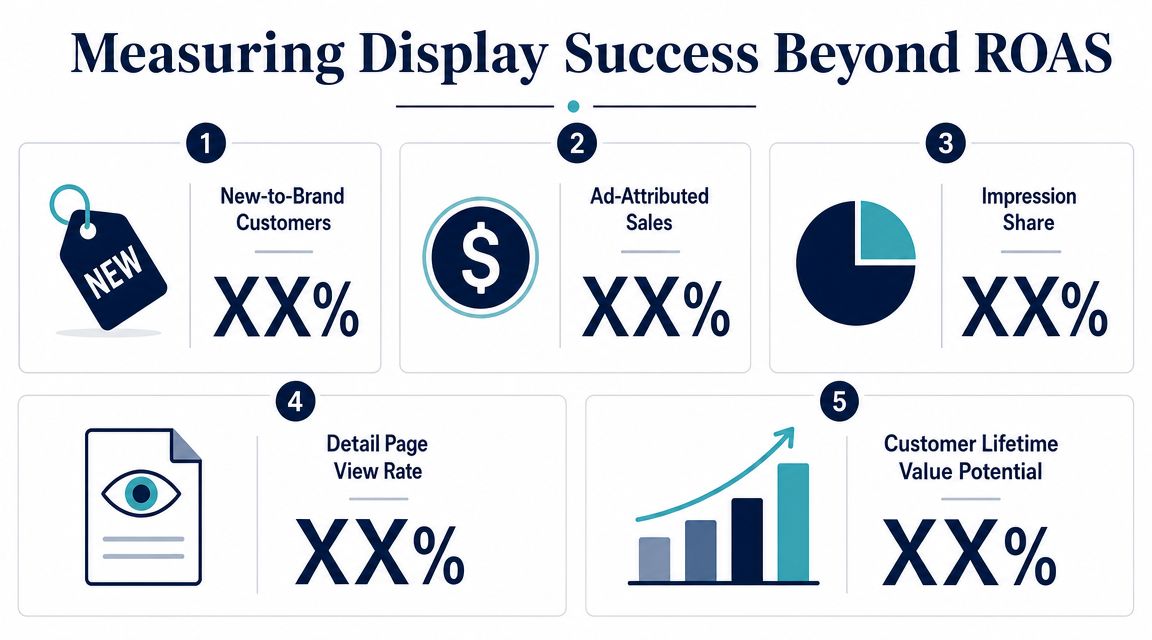
Track a mix of direct and directional metrics:
The hidden trap is overvaluing CTR. A campaign can attract clicks with the wrong message and still be weak at the business level. High CTR with low-quality downstream behavior usually means the creative promised the wrong thing or the audience was too loose.
Good display operators don't ask one metric to do five jobs. They match the KPI to the objective, then judge the campaign accordingly.
Most display campaigns don't fail because the channel is broken. They fail because the account team has no operating rhythm after launch.
The fix is a simple loop. Analyze. Hypothesize. Test. Measure. Then repeat without changing five things at once.
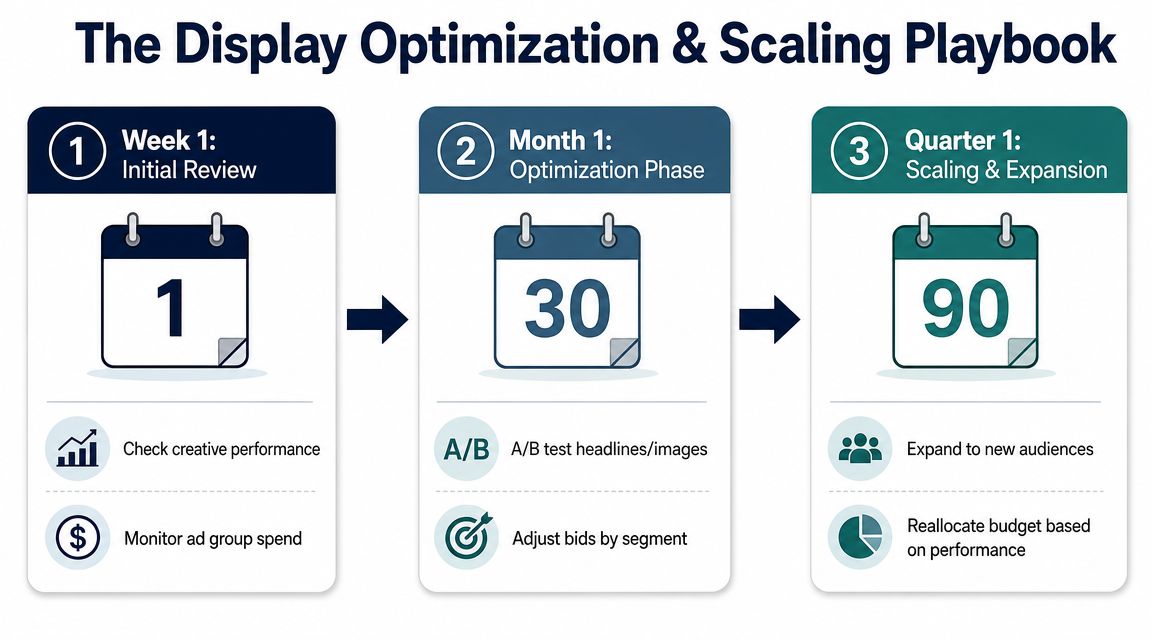
This phase is not for making dramatic conclusions. It's for checking whether the machine is behaving the way you intended.
Look for directional issues:
Don't start over because a fresh campaign didn't look perfect in the first few days. Early review is diagnostic, not emotional.
By this point, patterns start becoming useful. At this stage, real optimization begins.
Amazon's own guidance says that when performance is weak, the first variables to test are creative, audiences, or bids, one at a time, so you can isolate what changed outcomes in Amazon's display advertising guidance. That single rule eliminates a huge amount of bad optimization.
A practical decision tree works well here:
| Problem | Likely cause | First test |
|---|---|---|
| Low impressions | Bid too low, audience too narrow, limited eligible inventory | Raise bids or broaden one audience segment |
| Good impressions, weak CTR | Creative mismatch or fatigue | Refresh imagery or headline |
| Good CTR, weak sales quality | Poor audience fit or weak landing product match | Tighten audience or split product sets |
| High spend, poor efficiency | Mixed intent in the campaign | Break out retargeting, conquesting, and prospecting |
If you need a stronger process for that review cycle, this playbook on Amazon advertising optimization fits well with display management.
Change one lever, wait long enough to read the signal, then decide. Most teams lose the lesson because they change the audience, creative, and bid at the same time.
At the quarterly mark, the question changes from “Can this campaign work?” to “What deserves scale?”
In better accounts, winners are separated by role.
A retargeting campaign that efficiently recovers product viewers may deserve more budget but not broader targeting. A conquesting campaign with strong engagement may deserve more ASIN coverage. A DSP audience that consistently drives quality new customer flow may deserve creative variants and broader deployment across placements.
Three common scale moves make sense here:
Graduate proven audiences upward
If Sponsored Display reveals a high-quality audience pocket, that insight can justify a larger DSP rollout built around the same buyer logic.
Expand only after message fit is proven
Don't take mediocre creative to a larger audience. Scale the angle that already works, then broaden distribution.
Use display around launch windows intentionally
New products often need more than keyword harvesting. Display can create parallel pressure through contextual visibility, re-engagement pools, and broader awareness support while traffic history is still thin.
Display accounts usually break in recognizable ways.
This often comes down to one of three issues. The audience is too narrow. The bid isn't competitive enough. Or the campaign is constrained by a creative or placement mismatch. Fix one variable first, not all of them.
That usually means the ad got attention without creating the right expectation. The audience may be too broad, but often the message is the bigger problem. A benefit-heavy awareness ad can attract curiosity that doesn't convert if the product page has a different story.
That's common. Warm traffic is easier. The answer isn't to force prospecting to perform like retargeting. The answer is to judge it by prospecting objectives, tighten audience logic, and improve top-funnel creative.
Creative fatigue is real in display. If the same imagery and message keep circulating, response softens. Refreshing visual angle, CTA framing, or product emphasis often matters more than endlessly tweaking bids.
They don't optimize by mood. They run a repeatable loop.
That discipline is what turns display from “something the ads team is trying” into an actual growth engine.
The big shift is this. Amazon display isn't just another ad type sitting next to Sponsored Products. It's the layer that helps strong brands protect demand, shape consideration, and reach buyers before search alone can do the job.
That's why advanced operators use Sponsored Display and DSP differently. One is often the sharper tool for defense, re-engagement, and on-platform pressure. The other gives you more room to expand reach, build audiences, and influence demand across channels. Both become more valuable when you stop judging every campaign like a last-click keyword buy.
The brands that get the most from display usually do three things well. They assign each campaign a clear strategic job. They match audience and creative tightly. And they measure impact with enough maturity to see beyond immediate dashboard ROAS.
If your Amazon growth has flattened while your search campaigns are already well managed, this is usually the next lever worth taking seriously. Not because it's trendy. Because it gives you more control over who sees your brand, where they see it, and what they do next.
The founders who scale fastest usually aren't looking for more surface-level tactics. They want vetted strategies, honest operator feedback, and access to people solving the same problems at a higher level. If that's the room you want to be in, Million Dollar Sellers is built for exactly that.
Join the Ecom Entrepreneur Community for Vetted 7-9 Figure Ecommerce Founders
Learn MoreYou may also like:
Learn more about our special events!
Check Events