Chilat Doina
January 24, 2026
For serious Amazon sellers, figuring out how to ship from China to Amazon FBA isn't just another box to check—it's the absolute backbone of your business. How well you handle this supply chain directly impacts your cash flow, your profits, and your ability to simply stay in stock.
Getting this right is a massive competitive advantage. It's not optional if you want to play in the big leagues.
Sourcing from China gives sellers a huge leg up. You get competitive pricing and access to a manufacturing powerhouse—it's no surprise that over 70% of products on Amazon come from Chinese suppliers.
But the journey from a factory in Shenzhen to an Amazon warehouse in Dallas is riddled with potential tripwires. Nailing this process is what separates the seven-figure sellers from everyone else. A smooth shipping operation means your inventory timelines are predictable, which leads to consistent sales and a healthier Best Sellers Rank (BSR).
On the flip side, just one mistake—an incorrect customs form or a pallet that Amazon rejects—can trigger a cascade of costly delays, surprise fees, and the dreaded stockout that completely kills your sales momentum.
Mastering your logistics does more than just let you sleep at night. It unlocks some serious business advantages:
A well-managed supply chain acts as a force multiplier for your entire business. It lets you focus on marketing and growth instead of constantly putting out inventory fires.
Think of this guide as your playbook for turning a logistical nightmare into a well-oiled machine. We’re going to walk through every critical step, from choosing between air and sea freight to navigating customs and making sure your products are FBA-ready the moment they land.
For a deeper dive into the end-to-end process, check out a practical guide to shipping from China to Amazon FBA for even more insights. Let's get started building a supply chain that actually fuels your growth.
Deciding how to get your inventory from China to an Amazon FBA warehouse isn't just a simple shipping choice. It's a core business decision that directly hits your cash flow, profit margins, and—most importantly—your ability to stay in stock.
The whole air versus sea freight debate isn't about which one is "better." It's about knowing which tool to use for the job at that specific moment.
I've seen seven-figure sellers who don't just pick one method and stick with it. They're constantly, dynamically switching between air and sea based on their inventory levels, sales velocity, and even the time of year. Each shipment is a calculated move.
Let's be clear: air freight is your ace in the hole for speed. It's way more expensive—often 5 to 10 times the cost of sea freight per kilogram—but its real value is in strategic agility. Sometimes, you just can't afford to wait.
Think about these real-world situations where paying for air freight is a no-brainer:
Think of air freight as an insurance policy against lost momentum. The extra cost is often a bargain compared to the revenue you'd lose by being out of stock for a month.
This isn't just about moving boxes; it's about building a well-oiled machine. A solid shipping strategy is the engine that drives your business, from generating initial profits to scaling up and leading your market.
Mastering this flow is how you turn logistics into a competitive advantage.
Sea freight is the workhorse of your supply chain. It's how you build real, sustainable profitability through economies of scale. Yes, the transit time is a lot longer—figure on 30 to 60 days from your factory to the FBA warehouse—but the cost savings are massive, especially for anything bulky or heavy.
This is your go-to for routine, planned inventory replenishment. But even with sea freight, you have a critical choice: Full Container Load (FCL) or Less than Container Load (LCL)?
A huge part of planning your sea strategy is knowing exactly how to max out your container space. Understanding how many pallets can fit in a 40ft container is key to squeezing every last drop of value out of an FCL shipment.
Ultimately, choosing correctly comes down to forecasting. A well-planned sea shipment that arrives just as you need it is the secret to maximizing your margins on every single unit you sell.
To make the choice clearer, here’s a quick breakdown of how these options stack up for the typical Amazon seller. Think of this as your cheat sheet for deciding which mode fits your immediate needs.
Freight ModeCost per KGTransit TimeBest ForKey ConsiderationExpress Air$9 - $143-7 daysUrgent restocks, small test orders, lightweight items.Highest cost, but door-to-door service is incredibly simple.Standard Air$6 - $108-15 daysProduct launches, preventing stockouts, high-value goods.A balance of speed and cost; requires more coordination than express.Sea Freight$2 - $430-60 daysRoutine replenishment, bulky/heavy items, maximizing profit.Lowest cost, but requires precise forecasting and inventory planning.
Each mode has its place in a smart FBA logistics plan. The goal isn't to always pick the cheapest option, but the one that makes the most financial sense for your business at that exact moment.
Getting your inventory from China to an Amazon FBA warehouse has a lot of moving parts. But customs? That's where a profitable shipment can turn into a financial nightmare, fast.
This isn't just a box-ticking exercise; it's a complex checkpoint that demands absolute precision. One wrong move here can trigger costly delays, inspections that add weeks to your timeline, or even the seizure of your entire container.
Getting this right isn’t just a good idea—it's essential for survival.
Think of your customs paperwork as a passport for your products. If anything is missing, looks fishy, or is just plain wrong, your shipment grinds to a halt. Every single import relies on these three core documents.
Let me be clear: there is zero room for error here. A simple typo on the declared value or a mismatch between the packing list and the actual contents is a massive red flag for customs agents.
Every single product that crosses a border gets assigned a Harmonized System (HS) code. This is a universal language for customs, telling them exactly what you’re importing and, crucially, determining the tariff rate that applies.
Getting this code wrong is one of the most common—and expensive—mistakes new sellers make.
Trying to use a code with a lower duty rate to save a few bucks? That’s called customs fraud, and if you get caught in an audit, the penalties are severe. On the flip side, using an incorrect code with a higher duty rate means you’re just throwing money away on every single shipment, killing your profit margins.
Always, always verify your HS codes. Get it from your supplier, then have your freight forwarder or customs broker confirm it.
Your freight forwarder or a dedicated customs broker is your best ally here. They live and breathe this stuff. Never just trust the code your supplier gives you without verifying it independently.
Tariffs are not set in stone. They shift with trade policies, political winds, and economic pressures. For anyone importing from China, staying on top of these changes is non-negotiable.
A perfect example is the US-China tariff truce extension through November 15, 2025. This was a lifeline for countless Amazon sellers. Without it, duties on many popular products would have shot back up to nearly 80%. An item costing you $100 would suddenly cost $180 to land.
The extension kept duties capped closer to 30%, saving sellers around $50 per unit in some cases. That’s a massive swing that can make or break your profitability.
These tariffs are a direct component of your landed cost—the true, all-in cost to get a product from the factory floor to Amazon’s warehouse door. It includes the product cost, shipping, insurance, customs fees, and, of course, duties. If you miscalculate this number, a product that looks profitable on paper can quickly become a money pit.
To get this right, check out our guide on how to calculate landed cost accurately.
Ultimately, you have to be proactive. Work with a reliable customs broker, build potential tariff hikes into your financial models, and never assume that today's duty rate will be the same six months from now. This is the kind of diligence that separates the sellers who thrive from those who get blindsided by unexpected costs.
Picking a freight forwarder is easily one of the most critical decisions you'll make when you ship from China to Amazon FBA. This isn't just about hunting for the lowest quote; it's about finding a true logistics partner who becomes an extension of your own team. A great forwarder spots and solves problems before you even know they exist. A bad one creates them.
Think of your forwarder as the quarterback of your supply chain. They coordinate every single handoff, from picking up goods at a factory in Shenzhen all the way to the final-mile delivery to a specific FBA fulfillment center in Texas. They're your eyes and ears on the ground, and their expertise is the grease that keeps your business moving.
Before you can even start comparing quotes, you absolutely have to get your head around Incoterms. These are the universal rules of the road for international shipping, clearly defining who is responsible for the goods (and the risk) at every stage of the journey.
For most Amazon sellers, it really boils down to three key terms.
Here's the deal: not all freight forwarders get Amazon. FBA has incredibly strict rules for receiving inventory, and a forwarder who doesn't live and breathe these requirements will cause you a world of pain—rejected shipments, surprise fees, the works.
When you're talking to potential partners, you need to ask targeted questions that go beyond the surface.
A top-tier forwarder doesn't just move your boxes. They're a strategic advisor. They’ll guide you on the smartest shipping routes and help you navigate the insane volatility of freight rates to protect your margins.
For instance, ocean freight rates can swing wildly. In late 2025, we saw month-over-month rates for West Coast routes plummet by 15-20%. A 40-foot container from Shanghai to the LAX9 fulfillment center was running about $3,800 all-in DDP. The sharpest sellers took advantage of this by working with forwarders who suggested diversifying to other ports—like Shenzhen to ONT8—to slash their cost per cubic meter while certain tariff extensions were still active.
The cheapest quote is almost never the best deal. A lowball offer is often a bait-and-switch, hiding destination fees, customs brokerage charges, and other surprise costs that magically appear on the final bill. A trustworthy partner provides a detailed, all-in quote that itemizes every single fee. No surprises.
Communication is just as crucial. You need a forwarder who gives you a dedicated point of contact—a real person who sends proactive updates. When your container is stuck at the port, you need answers now, not two days from now.
Finding the right logistics partner is a foundational step for any serious e-commerce brand. For a deeper look at our top recommendations, you might be interested in our guide on selecting the best Amazon FBA freight forwarders. Treat this search like you're hiring a key employee, because their performance directly impacts your cash flow and your sanity.
So, your shipment has cleared customs. Great news! But don't pop the champagne just yet. Now comes the final, critical leg of the journey: getting your inventory into an Amazon FBA warehouse.
This "final mile" is where a shocking number of sellers get tripped up. Why? Because Amazon's receiving requirements are notoriously strict. They're not suggestions; they're hard-and-fast rules. Getting this stage perfect is absolutely crucial if you want to avoid costly penalties, refused shipments, and sales-killing delays.
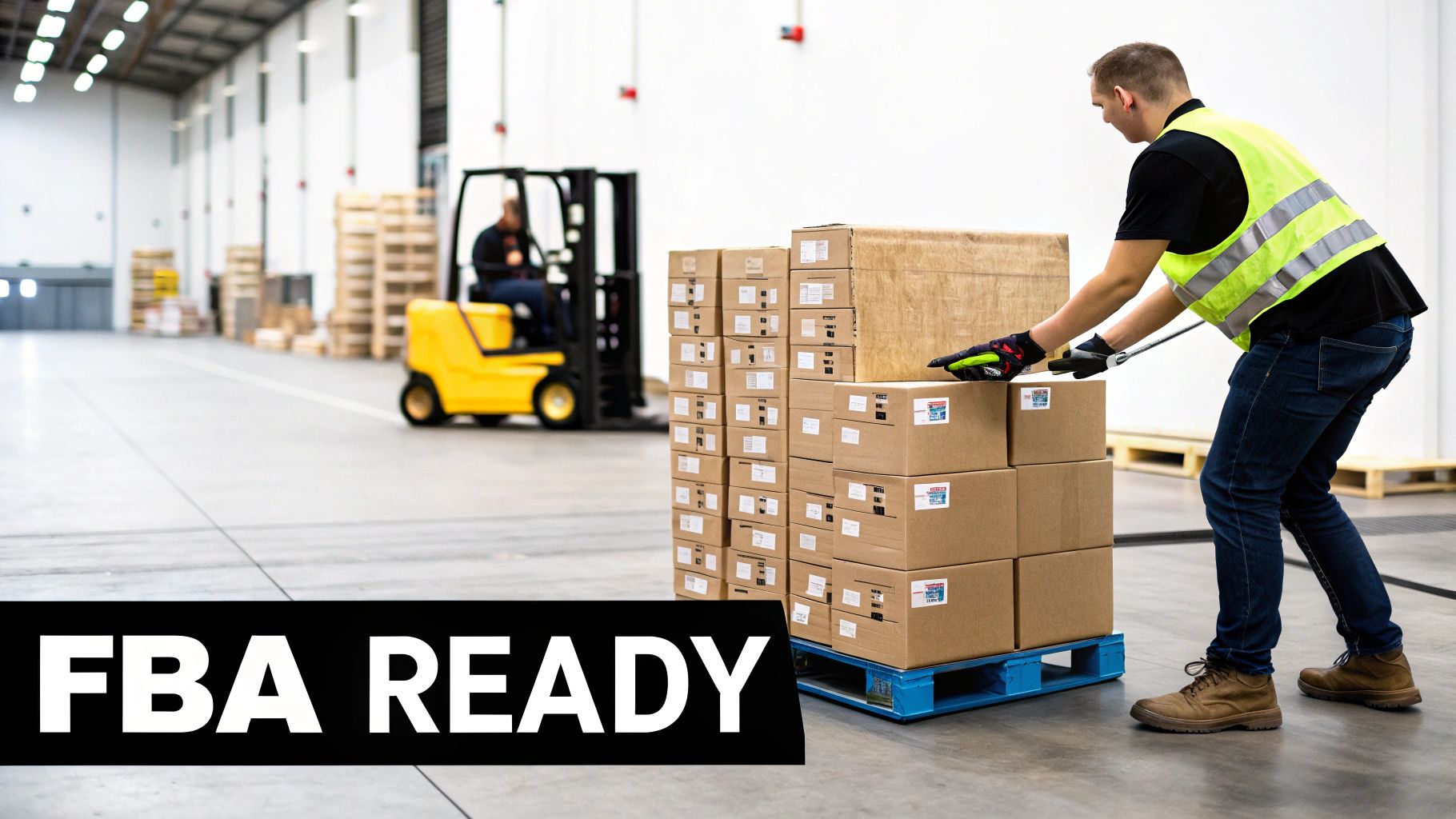
Even the domestic trucking part of the process has its own quirks. The time it takes for your goods to get off the ship or plane, clear customs, and load onto a truck can vary wildly. A sea freight LCL shipment, for instance, might sit for 5-10 business days just for clearance and port handling. Air freight, on the other hand, often clears in just 1-3 days—assuming your paperwork is flawless.
One of the first big decisions you'll face is who should handle the nitty-gritty FBA prep work. You've basically got two choices, and each comes with its own set of pros and cons.
1. Letting Your Supplier Handle FBA Prep
On the surface, this looks like the easiest and cheapest option. Your factory in China slaps on the FNSKU labels, packs the master cartons to Amazon's specs, and palletizes everything before it even leaves their facility.
2. Using a Third-Party Prep Center (3PL)
The alternative is to have your goods shipped from China to a specialized prep center near your destination port. These companies are experts in one thing: getting products ready for Amazon FBA.
For new sellers or anyone dealing with high-value goods, using a third-party prep center is almost always the smarter, safer play. Think of the extra cost as an insurance policy—it's a small price for the peace of mind that your shipment will be accepted by Amazon without a hitch.
You can dive deeper into the benefits of using Amazon prep centers in our detailed guide.
Amazon's receiving process is a high-speed, automated machine. It has zero tolerance for shipments that don't meet its exact specifications. If you don't comply, you're looking at refused shipments, unplanned service fees, and receiving delays that can drag on for weeks.
Here are the non-negotiables you absolutely must get right:
Breaking these rules simply isn't an option. Perfecting this final step is a mandatory part of any successful strategy to ship from China to Amazon FBA and is the key to getting your inventory checked in and available for sale as fast as possible.
Learning from experience is a powerful teacher, but when you’re shipping from China to Amazon FBA, that tuition is brutally expensive. The smartest sellers I know built their logistics strategy not just on their own wins, but on the costly, hard-won lessons of others.
Let's walk through the big ones. Sidestepping these common pitfalls is the fastest way to build a supply chain that actually works and makes you money from day one.
This is probably the most frequent blunder I see. A new seller gets a quote from a supplier, plugs it into a spreadsheet, calculates their margin, and thinks they’ve struck gold. They completely forget to account for the dozen other fees that stack up along the way.
We're talking about port charges, customs brokerage, final-mile trucking, drayage, and palletizing fees. They all add up.
What looks like a juicy 40% margin on paper can quickly shrink to a razor-thin 15% (or worse) once the final bill from the freight forwarder arrives. Always get a detailed, all-in quote and bake in a buffer for unexpected costs.
Another massive, unforced error is skipping proper cargo insurance. It's so tempting to save a few bucks here, but it's a huge gamble.
Many sellers assume their freight forwarder’s liability coverage is enough. It isn't. That coverage is typically minimal, often just pennies on the dollar. You might be "covered" for a few hundred dollars on a $30,000 shipment.
Imagine your container is lost at sea or your pallets are crushed during a rough transit. Without your own insurance policy, you’re out the entire cost of your goods and the shipping fees. It's a catastrophic, business-ending mistake that is entirely avoidable.
Always purchase comprehensive cargo insurance. It’s a small price to pay—usually a fraction of a percent of your cargo's value—for the peace of mind that a single disaster won’t wipe out your business.
The third critical mistake is failing to build enough buffer time into your shipping calendar. Logistics rarely run perfectly on schedule. It’s just the nature of the beast. Containers get flagged for random customs inspections, ships get delayed by weather, and FBA warehouses get backed up.
This problem gets exponentially worse around major Chinese holidays. You absolutely have to plan for these.
Experienced sellers plan their production and shipping schedules months in advance to navigate these periods. They know that trying to rush a shipment right before a holiday is a recipe for inflated costs and missed deadlines.
Building an extra 3-4 weeks of buffer into your timeline isn't being pessimistic; it's smart, defensive planning. It protects your inventory levels, your sales velocity, and your sanity. Talk to your supplier and forwarder constantly to navigate these predictable disruptions without derailing your entire operation.
Even sellers who’ve been in the game for years still have questions about shipping from China. The rules are constantly shifting, and the stakes are high. Let's tackle some of the most common curveballs we see thrown at high-volume sellers.
This is a big one, and getting it wrong can be a nightmare. You’ve really only got two sane options here.
A quick word of advice: never, ever try to handle customs paperwork yourself unless you are a licensed expert. The risk of making a small mistake that gets your entire shipment flagged, fined, or stuck in limbo is just way too high.
A good customs broker is worth their weight in gold. Think of them as your first line of defense against inspections, penalties, and the soul-crushing headache of a shipment getting stuck at the port.
Yes. Full stop. This is completely non-negotiable.
So many sellers make the mistake of thinking the carrier's or forwarder's liability insurance has them covered. It doesn't. Not even close. Their liability is legally capped at a laughably low amount that will only cover a tiny fraction of your inventory's actual value.
Without your own cargo insurance policy, you're taking a massive, unnecessary gamble. If a container full of your products goes for a swim in the Pacific or a forklift operator has a bad day—and trust me, this stuff happens more than you'd think—you could be out your entire investment. Insurance is a small, essential cost of doing business that protects you from a potentially catastrophic loss.
Think of a third-party logistics (3PL) prep center as your secret weapon. It's a critical checkpoint after your goods land in the country but before they get sent into the Amazon vortex.
You should seriously consider using one if:
Yes, it adds a small cost and a few extra days to your lead time. But using a prep center can save you from the pain of rejected shipments, FBA penalties, and the flood of 1-star reviews that come from customers receiving damaged or defective products. It’s a smart investment in getting things done right the first time.
At Million Dollar Sellers, we connect top e-commerce entrepreneurs who have mastered these complex logistics. Our members share high-level strategies to build more resilient and profitable supply chains. Learn more about how the MDS community can help you scale smarter.
Join the Ecom Entrepreneur Community for Vetted 7-9 Figure Ecommerce Founders
Learn MoreYou may also like:
Learn more about our special events!
Check Events