Chilat Doina
June 23, 2026
A lot of brands in the TikTok seller community are in the same spot right now. Sales are up, affiliates are piling in, creators are clipping your videos into their own edits, and a product that finally found velocity is suddenly showing up in storefronts you didn't approve. The team calls it traction. Operations feels something else. Exposure.
That shift matters. On TikTok Shop, growth and brand risk arrive together. The same mechanics that help a product break out also make it easier for copycats, gray-market resellers, brand impersonators, and sloppy affiliates to attach themselves to your momentum.
If you're running an 8-figure or larger brand, brand protection can't sit with whoever has spare time in customer service. It has to live inside operations, legal, creator management, and marketplace ownership. It needs rules, thresholds, escalation paths, and reporting. The brands that keep scaling on TikTok Shop aren't just better at demand generation. They're better at control.
A product goes viral on Friday. By Saturday, creators you didn't brief are posting it. By Sunday, your support queue starts filling with messages about damaged packaging, wrong colors, and delayed shipping on orders your team never fulfilled. Monday morning, your Amazon reviews dip, your DTC team is asking why conversion softened, and someone sends over a TikTok Shop listing using your product photos under a seller name you've never seen.
That's the version of success most operators don't prepare for.
TikTok Shop is large enough now that brand protection isn't a niche concern. By the end of 2024, TikTok Shop had generated about $33 billion in global GMV, with the United States contributing roughly $10.4 billion. Globally, about 58% of TikTok's users, roughly 870 million active shoppers, have made purchases via TikTok Shop according to market and sales analysis on TikTok Shop by region. That scale changes the risk profile overnight.
The problem isn't only counterfeit product. It's velocity without governance. TikTok compresses discovery, persuasion, and checkout into one feed-native experience. If your brand wins attention, other sellers can draft behind it fast. Some will be obvious bad actors. Others will look legitimate enough to confuse customers, creators, and even internal teams.
Most established e-commerce teams built their controls around Amazon, DTC, and wholesale. TikTok Shop behaves differently. Content spreads first. Attribution gets messy. Seller proliferation happens faster. The enforcement mindset has to catch up.
One useful lens is the difference between audience access and audience ownership. That's part of why pieces like Comparing FindClout to Meta and TikTok are worth reading. Once you understand how platform dependence shifts control, brand protection stops looking like legal housekeeping and starts looking like margin defense.
Viral growth without brand controls is borrowed revenue.
In the TikTok seller community, the brands that hold gains are usually the ones that assume success will attract misuse. They don't wait for proof. They build the playbook before the first major breakout.
Teams often define brand protection too narrowly. They treat it as reporting fake listings after the damage is already visible. That's not enough.
Brand protection on TikTok Shop is a fortress, not a flyswatter. You don't just chase intruders. You harden the perimeter, monitor the weak points, and decide in advance how your team responds when someone gets through.

The stakes are obvious when transaction volume gets this high. In 2024, TikTok Shop's U.S. daily GMV regularly surpassed $25 million on ordinary days and could spike to $75–$100 million or more during major shopping events. The U.S. TikTok Shop marketplace surpassed 500,000 active sellers by late 2024, based on tracked TikTok Shop marketplace data. In a marketplace that crowded, bad inventory and bad actors don't stay isolated for long.
Counterfeits are the obvious one. Someone manufactures or resells fake goods under your name, usually with your imagery, your claims, or a close enough variation to create customer confusion.
Gray market selling is harder. The product may be real, but the channel isn't authorized. That means broken pricing, stale inventory, missing inserts, warranty confusion, and support headaches that still land on your team.
Brand impersonation shows up in storefront naming, logos, copied PDP language, and creator-facing outreach. These sellers don't need to fool everyone. They only need to fool enough buyers and enough affiliates.
Content misuse is where many larger brands find themselves losing control. Product videos, UGC, before-and-after hooks, creator testimonials, and live clips get reused outside your approval framework. Even when it drives sales, it can expose you to policy, claim, and reputational risk.
A mature brand protection function covers five areas:
Teams working on trust and safety outside e-commerce already understand the core principle. Platform integrity isn't about one report. It's about repeatable controls that reduce both abuse and uncertainty.
If your TikTok Shop protection process starts after a customer complaint, you're already late.
That's what brand protection really means in the TikTok seller community. It's a revenue system with legal components, not a legal system with revenue side effects.
Most brand teams get stuck because they mix every problem together. A fake seller, a rogue affiliate, a clipped creator asset, and a MAP violation don't belong in one generic queue. They require different actions, owners, and timing.
Use a four-pillar model instead: Prevention, Detection, Enforcement, and Recovery.
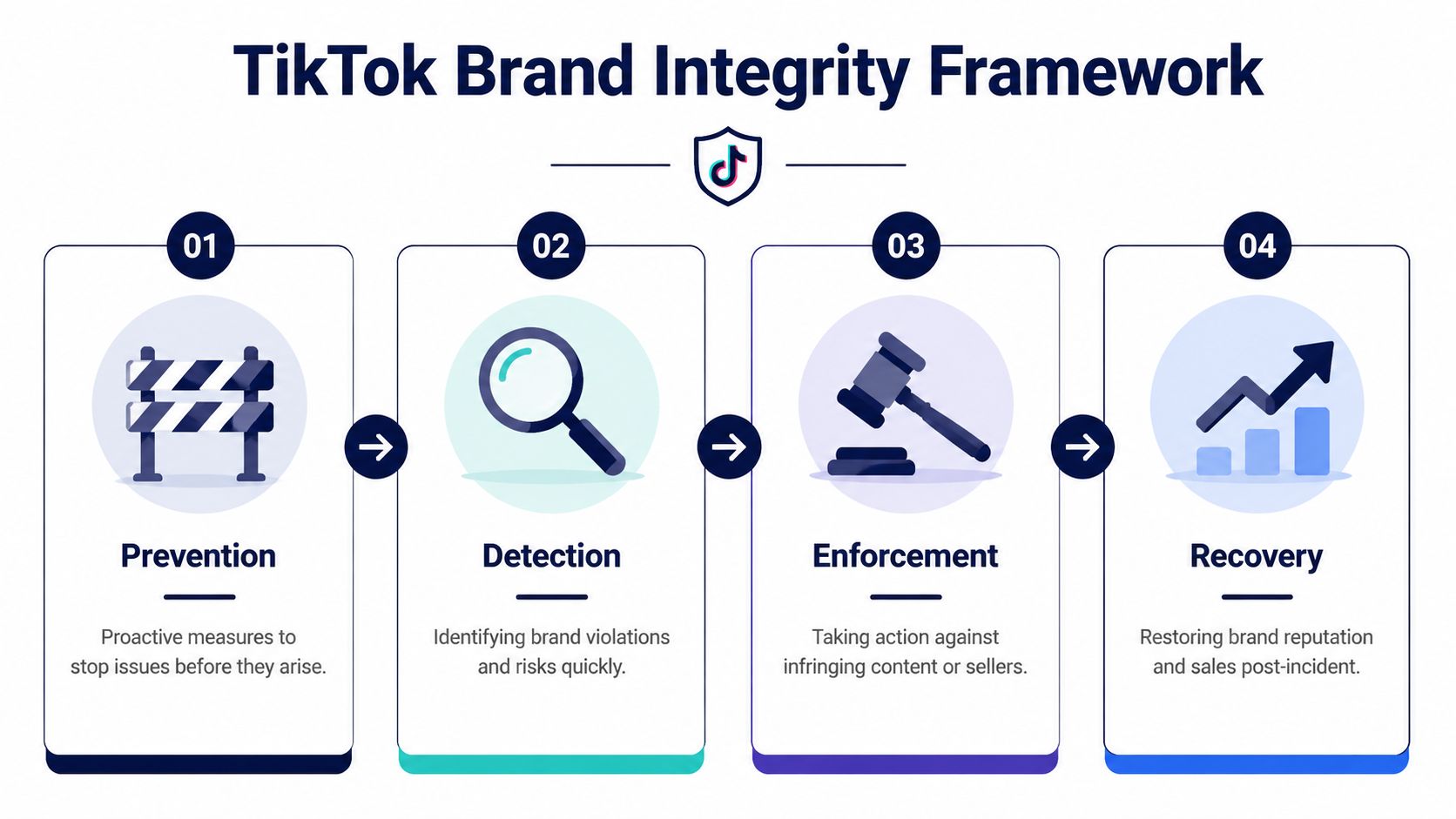
Prevention is where serious operators win margin. This is the work that lowers incident volume before listings go live or creators publish.
It includes trademark readiness, content usage rules, seller authorization policies, creator contracts, and product-packaging decisions that make imitation easier to trace. Good prevention feels slow when sales are hot. That's why many teams underinvest in it. Then they pay for that decision later through enforcement cost, customer confusion, and review contamination.
Operating principle: Build controls when the brand is calm, not when it is under attack.
Detection is your early warning system. The TikTok seller community often underperforms here, as monitoring frequently overlooks content not directly tagging the brand account.
That misses too much. Detection has to cover storefront names, unauthorized offers, creator posts making claims you didn't approve, reused assets, and refund patterns that point to inventory or representation issues. Good detection isn't passive browsing. It's scheduled, assigned, and documented.
Enforcement is where teams either stay disciplined or get emotional. The goal isn't to punish every offender equally. The goal is to remove risk efficiently.
Some violations belong inside platform workflows. Others need a direct seller contact, a formal notice, or legal escalation. Enforcement should follow severity, not outrage. The minute your team improvises case by case, consistency disappears.
Enforcement works best when severity tiers decide the response before the incident happens.
Recovery is the pillar most brands ignore. They remove a listing and think the job is done. It isn't.
Customers may still have bad product in hand. Creators may still have old content live. Search results may still surface confusion. Internal teams may still be making decisions off dirty marketplace signals. Recovery means restoring trust, correcting the narrative, and tightening the system so the same issue doesn't keep resurfacing.
This framework matters because it changes the operating question. Instead of asking, "How do we report this seller?" your team asks, "Which pillar failed, what is the business cost, and what control needs to be added?" That's how brand integrity becomes scalable.
The first part of the playbook is boring on purpose. That's a feature, not a flaw. If your prevention layer is weak, the TikTok seller community will eventually expose every shortcut you took.
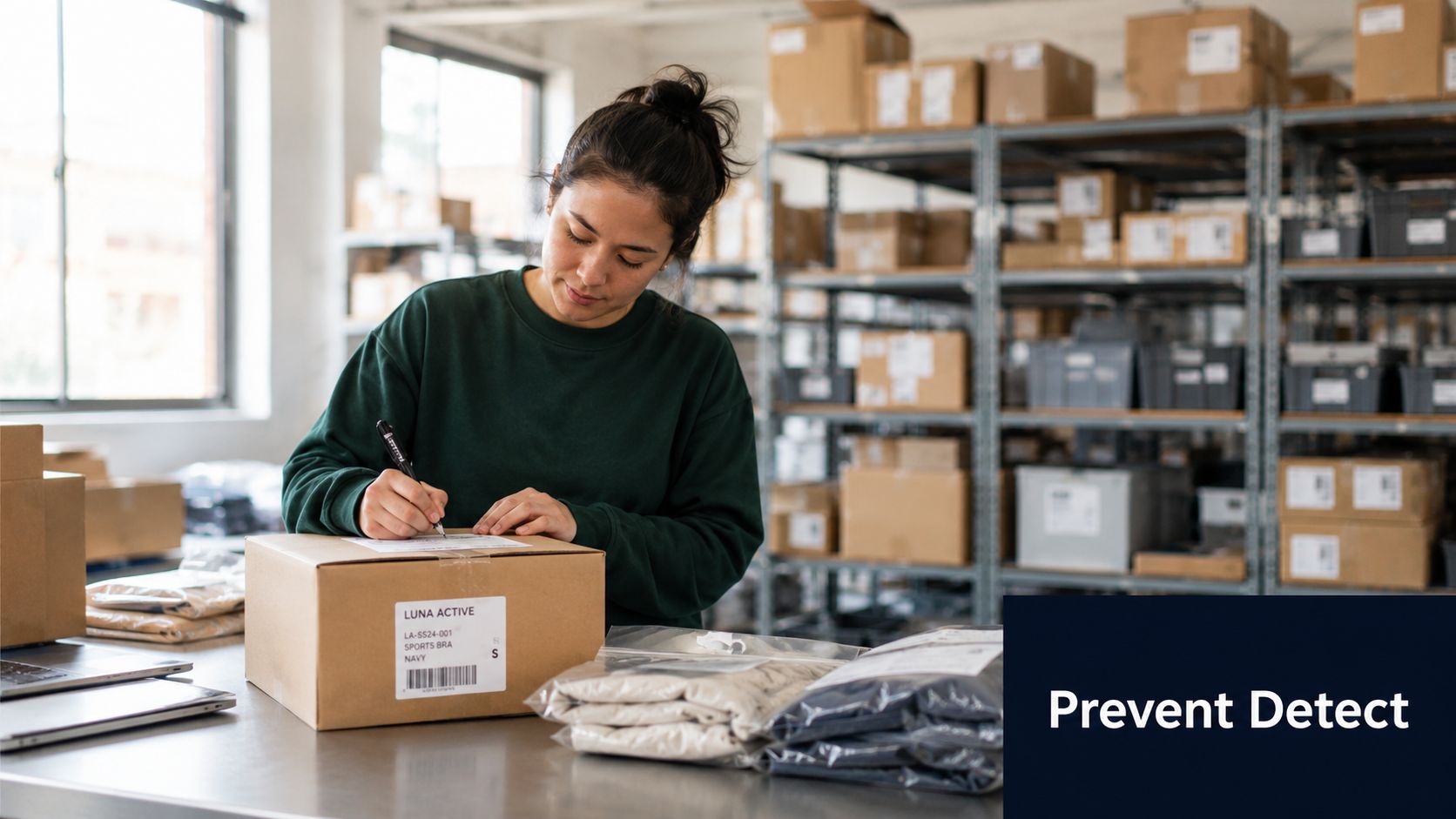
Before you think about reporting anyone, make sure your own house is organized. Your team should be able to pull trademark records, product photography ownership, packaging files, authorized seller lists, and creator agreements without asking five people in Slack.
A practical starting point is to centralize your trademark and ownership materials alongside a clear enforcement checklist. If your team needs a refresher on the fundamentals, this guide on how to protect intellectual property is a useful operational reference.
The second layer is channel policy. Decide, in writing, who may sell on TikTok Shop, under what storefront identity, using which claims, and with what pricing boundaries. If you don't document channel rules, your own sales team, agencies, and distributors will create conflicting versions of the truth.
Many fast-growing brands often get lazy. They focus on output and ignore rights, usage, and downside control.
Over 60% of creator-brand deals do not transparently disclose performance thresholds or clawback clauses in community discussions, which creates a blind spot for growth-stage sellers according to creator-brand deal benchmark commentary referenced here. That gap shows up later when a creator underdelivers, republishes restricted content, or makes claims your legal team would never approve.
Your creator agreement should answer:
Brands don't lose control in the courtroom first. They lose it in the briefing doc and the contract.
A lot of prevention is simple discipline. Keep approved claim libraries. Maintain a current do-not-use asset folder. Require final approval on affiliate-facing media kits. Audit outbound sample seeding so inventory isn't inadvertently feeding unauthorized resale.
Many teams say they monitor the platform. Very few run detection like an ops function.
Break it into recurring workflows:
Use this walkthrough as a training asset for junior team members who need to understand the seller environment at a practical level:
Detection also needs routing logic. A copied video isn't handled the same way as a counterfeit listing. A gray-market reseller isn't handled the same way as a creator making prohibited claims. If everything enters one generic inbox, your team will stall on triage.
Once you've identified a violation, speed matters. So does restraint. The wrong escalation can waste legal time, antagonize a salvageable partner, or create unnecessary noise inside the platform.
Start with evidence capture. Archive the listing, storefront, content, timestamps, claims, comments, order details if available, and any customer complaints tied to the issue. Don't rely on live links alone. Sellers edit and remove things fast.
Then sort the case into one of three lanes.
Platform lane. Use this for obvious infringing listings, copied imagery, impersonation, and clear policy violations. Your goal is fast removal with clean documentation.
Commercial lane. Use this when the seller may be handling real inventory but isn't authorized to operate on the channel or is violating your marketplace policy. This usually calls for direct outreach, account mapping, and internal investigation into where inventory leaked.
Legal lane. Use this when the violation is repeated, organized, tied to manufacturing, or severe enough to harm customer safety or brand equity. Formal notices and outside counsel come into play.
Not every bad listing deserves the same energy. Here's a simple decision framework:
Aggressive but inconsistent enforcement creates its own cost. Teams burn time on small issues while larger systemic threats keep running.
The best enforcement teams don't just close tickets. They reduce recurrence.
If you're dealing with unauthorized resellers at scale, don't stop at storefront takedowns. Trace inventory pathways. Check whether a distributor, liquidation partner, 3PL leakage point, sample seeding program, or affiliate bundle created the opening. Resellers are often the symptom. The source is operational.
Once the listing is down, you still have work to do.
First, align customer support. If shoppers received bad product or purchased through confusion, CX needs approved language for refunds, authenticity questions, and guidance on where to buy safely. Silence makes the platform rumor mill worse.
Second, refresh owned content. Push current creator assets, current product visuals, and current storefront messaging so the market sees your version of the brand more often than the bad version. Recovery isn't only defensive. It's narrative replacement.
Third, inspect downstream channels. A TikTok Shop incident can spill into Amazon reviews, DTC support, paid social comments, and creator relationships. Have one incident owner assign checks across those surfaces.
A simple post-incident review should answer:
That final point is the one that compounds. If recovery doesn't produce a new safeguard, the same problem usually returns in a slightly different format.
Brand protection gets better when it's measured like operations, not discussed like a vague reputational concern. Founders shouldn't be reviewing every bad listing personally. They should be reviewing whether the system catches, routes, and resolves issues fast enough.
Use a compact scorecard. Keep it visible to marketplace ops, legal, and leadership.
| KPI | Definition | Goal for Scaled Brands |
|---|---|---|
| Time to Detection | Time between a violation going live and your team logging it | Shorten consistently through better monitoring cadence |
| Time to First Action | Time between detection and first platform, seller, or legal action | Keep response fast and role-based |
| Takedown Success Rate | Share of submitted platform cases that result in removal | Improve through cleaner evidence and better case packaging |
| Repeat Offender Rate | Frequency of the same seller, creator, or source reappearing | Drive down through root-cause correction |
| Enforcement Cost per Takedown | Internal and external cost required to resolve one case | Reduce with templates and better triage |
| Customer Harm Rate | Number of incidents linked to refunds, complaints, or authenticity confusion | Keep low through early detection and clear CX scripts |
| Policy Breach by Partner Type | Which creators, affiliates, agencies, or resellers create the most risk | Use for partner pruning and contract updates |
The point isn't to make this elaborate. The point is to make it governable.
A founder-led enforcement process doesn't scale. A documented system does.
A good SOP stack usually includes incident intake, evidence capture, case categorization, escalation criteria, seller outreach templates, creator violation handling, legal handoff rules, and post-incident review. If your team needs a framework, this practical guide on how to create standard operating procedures is a solid place to model from.
At minimum, each procedure should define:
Once this exists, a founder can review dashboards instead of spending the week inside screenshots and takedown forms.
At scale, brand protection stops being a reactive support function and becomes a data advantage.
The stronger operators in the TikTok seller community don't just track which creators drive sales. They track which ones create controllable sales. Top-performing sellers track orders, revenue, and refunds by traffic source and by host creator. Benchmark data indicates top-tier hosts frequently exceed $40–$60 per 1,000 engaged viewers on LIVE. MDS-caliber operators use this to enforce creator-tier thresholds and de-risk their partnerships, according to this analysis of TikTok Shop data workflows.
That matters because creator performance and brand risk are often tied together. A host who sells aggressively but drives poor-fit orders, refund-heavy traffic, or claim drift isn't an asset. They're an expensive compliance problem.
They tier creators by risk, not just output. Refund behavior, content compliance, and asset handling should influence whether a creator gets more inventory, more rights, or more budget.
They build traceability into the supply chain. Packaging variations, fulfillment markers, and controlled sample distribution help identify where unauthorized inventory originated.
They compare partner quality before expanding a program. Tools and market context help. For teams evaluating how creators think about partnerships and deal flow, SponsorRadar for TikTok deals gives useful context on the commercial side of creator relationships.
Some brands also bring in outside marketplace specialists when internal bandwidth gets thin. A TikTok Shop management agency can help execute workflows, but the core policy, approval rights, and escalation logic still need to come from the brand.
The difference at the top end is simple. Mid-market teams ask how to stop one bad seller. Elite teams build systems that make bad actors less likely to matter.
If you're operating at scale and want to compare notes with founders solving the same marketplace, creator, and brand-control problems, Million Dollar Sellers is an invite-only community of high-revenue e-commerce operators sharing practical systems across Amazon, DTC, and TikTok Shop.
Join the Ecom Entrepreneur Community for Vetted 7-9 Figure Ecommerce Founders
Learn MoreYou may also like:
Learn more about our special events!
Check Events