Chilat Doina
May 13, 2026
You're probably already seeing the pattern. A few products catch on through creator content. An affiliate video unexpectedly converts. Someone on your team starts juggling Seller Center, creator DMs, inventory questions, ad account troubleshooting, and late-night Slack threads about a live that underperformed. Revenue is there, but the operating model is fragile.
That's the moment a tiktok shop management agency becomes a serious discussion instead of a nice-to-have. For a 7, 8, or 9 figure brand, TikTok Shop isn't just another acquisition channel. It's a retail environment with its own merchandising logic, creator economy, fulfillment pressure, and compliance risk. If you run it with a part-time operator and a freelance editor, you'll usually get part-time results.
The founder question isn't whether TikTok Shop matters. It's whether the agency in front of you can run the channel like a profit center, protect your brand, and integrate with the rest of your stack.
A lot of brands get their first traction on TikTok Shop in a way that creates false confidence. One good SKU. A few creators who overperform. A paid campaign that works well enough to justify more spend. Then complexity shows up all at once.
The workload stops looking like social media and starts looking like channel operations. Catalog issues suppress conversion. Creator outreach becomes a volume game. Live shopping requires planning, inventory alignment, scripting, moderation, and post-live analysis. Paid media needs someone who understands TikTok-native buying behavior, not just Meta habits transplanted into a new dashboard.
The scale of the channel is why this changed so fast. TikTok Shop grew from 4,450 U.S. shops in mid-2023 to more than 475,000 by mid-2025, a 5,000% increase, and the platform drove $33.2 billion in global GMV in 2024 according to Red Stag Fulfillment's TikTok Shop seller analysis. The same analysis notes that agencies are delivering 8-12% conversion rates for high-revenue brands, compared with the 2-4% range common in traditional e-commerce.
That gap matters. On a mature brand P&L, small execution differences turn into very large downstream effects.
Most in-house teams don't fail because they're weak. They fail because TikTok Shop compresses too many specialties into one channel:
Practical rule: If your team is debating who owns creator ops, live production, and Seller Center analytics, nobody owns the channel tightly enough.
A specialist agency can be the right answer when the internal bottleneck is coordination, not effort. Founders who've already learned what to delegate first across growth functions often see the same pattern on social commerce. The work that looks tactical is often the work that constrains scale, which is why 7-figure operators delegate channel execution before it becomes founder-dependent.
The upside isn't just labor. It's decision speed, pattern recognition, and operating discipline. A strong agency has already seen which offers die in live format, which creators drive low-quality traffic, and which merchandising errors stifle conversion.
That's why elite founders outsource now. Not because they can't run TikTok Shop. Because they know a channel this volatile punishes slow learning loops.
The fastest way to overspend on a tiktok shop management agency is to buy a full-service package before you've defined what stage you're in. Most brands don't need everything at once. They need the right layer of support at the right time.
I separate agency work into foundational services and accelerator services. Foundational work gives the channel a usable operating base. Accelerator work compounds what's already functioning.
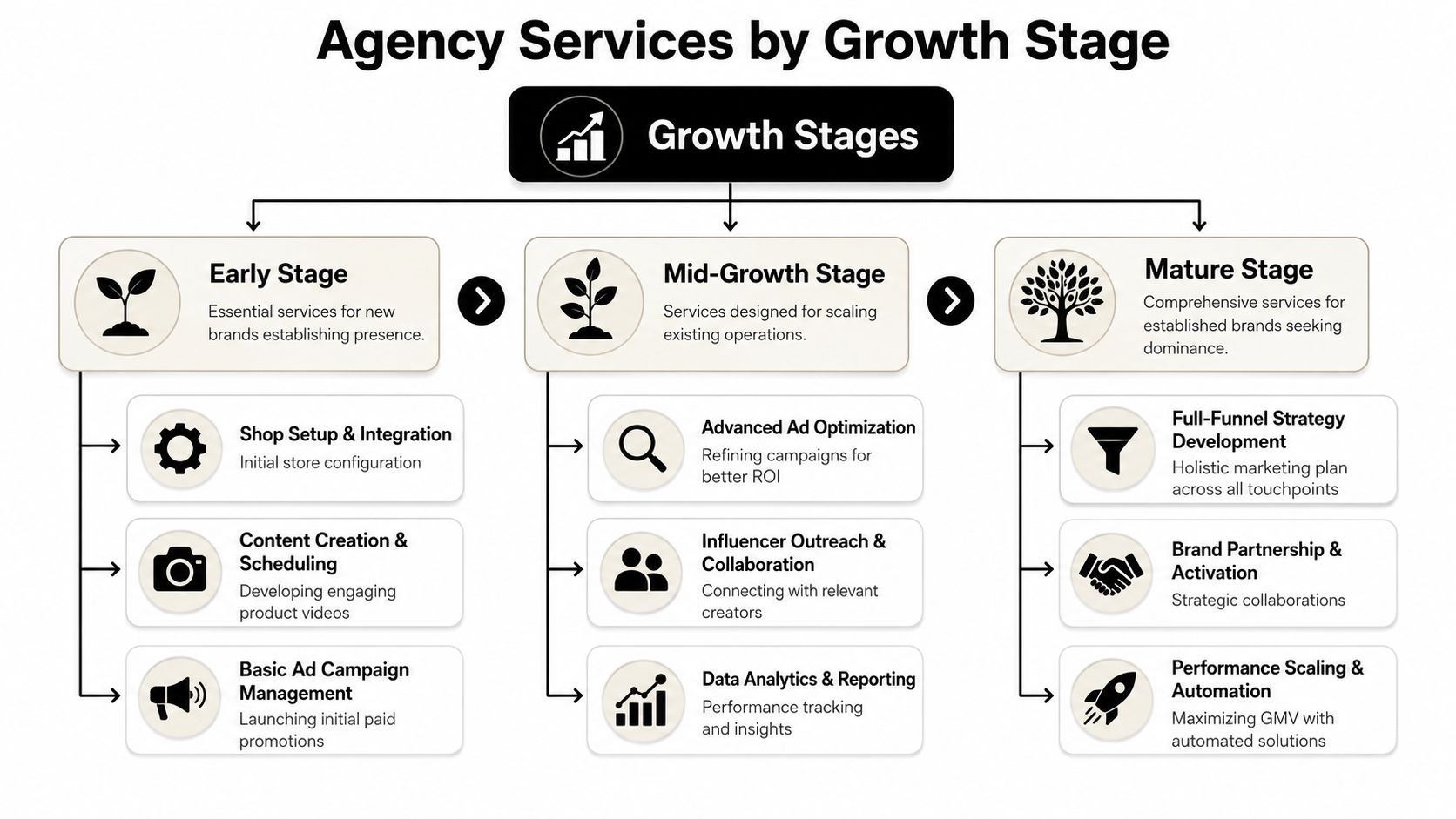
These are the services I'd expect to see first in any serious scope of work.
Catalog and PDP management sits at the bottom of everything. If your product detail pages are weak, no amount of creator seeding fixes the economics. A capable agency should improve product titles, image stacks, product videos, FAQs, and merchandising logic inside the shop. They should also know how your category behaves on-platform, not just in your DTC store.
That matters even more in categories with obvious product-market fit on TikTok Shop. Beauty & Personal Care generated $2.49 billion in U.S. GMV, representing a 22.5% share, and TikTok Shop's global GMV was projected to hit $26 billion in the first half of 2025 alone, according to Influencer Marketing Hub's TikTok Shop statistics roundup. If you're in beauty, personal care, or adjacent wellness products, your agency should already understand the content, merchandising, and creator patterns in that lane.
Affiliate program setup and creator ops come next. Good agencies don't just blast outbound messages. They build a recruitment system, handle product seeding, organize follow-up, track creator quality, and separate “content creators” from “commerce creators.” Those are not the same thing.
Basic shop tab merchandising is underrated. If a shopper lands in your store after seeing creator content, they need a clean path to the next purchase. Product grouping, featured items, and offer structure all affect whether traffic turns into GMV.
For founders comparing partners, this breakdown of TikTok Shop agency models is useful because it frames the agency role as an operating layer, not just a media vendor.
Once the foundation works, you pay for scale.
Live is where many agencies claim capability and very few possess established processes. For a scaled brand, “we can do live” isn't enough. You want run-of-show planning, host sourcing, offer sequencing, inventory coordination, moderation, clipping, and post-live analysis.
A weak agency treats live as content. A strong one treats it as programmed commerce.
Creative testing and shopping behavior converge. A strong agency should know when to push native product-tagged content, when to scale proven creative into Video Shopping Ads, and when to pull back because the economics no longer justify the spend.
If they only talk about top-line revenue, they're not ready for an upper-tier account.
This is usually the dividing line between mid-market agencies and operators who can support larger brands. A serious partner should understand how TikTok Shop affects Amazon, DTC, and fulfillment flows. That includes pricing conflict, inventory allocation, review velocity, and how promotion calendars collide across channels.
The right agency for a $2 million TikTok Shop run rate may be the wrong agency for a brand that also has to protect Amazon rank, DTC margins, and wholesale inventory.
Use a simple lens:
| Stage | What you need most | What to avoid |
|---|---|---|
| Early on-platform traction | Shop setup, catalog cleanup, creator affiliate ops | Expensive “full funnel” strategy decks |
| Revenue is proving out | Better creator systems, ad amplification, reporting discipline | Overbuilt retainers with vague deliverables |
| Mature scaling phase | Live programming, omnichannel coordination, executive reporting | Agencies that can't speak to margin protection |
Founders usually make one of two mistakes. They either underbuy and force one internal operator to carry the channel, or they overbuy and pay for strategy theater before the basics are stable.
The best fit is usually narrower than the proposal deck suggests.
Most agencies are easy to like in a discovery call. That's the problem.
They know the language. They mention creators, Shop ads, live commerce, and “native content.” They show polished decks. Some even have competent paid media teams. None of that tells you whether they can run your business inside TikTok Shop without creating new operational risk.
I'd treat agency selection like channel due diligence. Shortlist a few firms, run a tight RFP, ask for live access to their thinking, and score them on execution detail rather than personality.
Start with verbal pressure-testing before you invite a formal scope. The goal is to expose whether their process is real.
Ask questions like:
The more specific your questions get, the more generic agencies fall apart.
Use a scorecard. If you don't, charisma wins.
| Category | Question | Look for (Green Flag) | Watch out for (Red Flag) |
|---|---|---|---|
| Team structure | Who is actually on the account? | Named operators with clear responsibilities across Shop ops, paid, creator management, and reporting | “You'll have access to our full team” |
| Vertical fit | What brands in our category have you supported? | Specific examples of category familiarity and channel constraints | Broad claims about serving “all DTC brands” |
| Creator engine | How do you source and manage affiliates? | A repeatable outreach, seeding, and follow-up process | Heavy reliance on inbound creator interest |
| Live commerce | What happens before, during, and after a live? | A run-of-show, host plan, offer plan, and post-live review process | “We test lives and see what resonates” |
| Paid media | How do you scale winning content? | Clear logic for amplification and budget pacing | Generic paid social language copied from Meta |
| Reporting | What do founders see weekly? | A concise business view tied to revenue and channel health | Screenshots, vanity metrics, or no live dashboard access |
| Operations | How do you coordinate inventory and fulfillment issues? | Defined escalation path with your ops team | “That usually sits with the client” |
| Compliance | How do you handle affiliate disclosures and account health? | Explicit process and named owner | Hand-waving about “staying current” |
| Contracting | What happens if performance is weak? | Review windows, clear exit mechanics, and documented deliverables | Long lock-in periods with loose scope |
Most case studies are marketing assets, not operating evidence. You want to know what happened, what was changed, and whether the result is relevant to your business.
What I look for:
If they only show percentages with no context, skip them. If they refuse to discuss where performance came from, skip them faster.
Don't ask references whether they liked the agency. Ask what broke.
Useful questions:
That last question tells you more than a testimonial ever will.
Founder filter: If a reference answers every question smoothly and with no trade-offs, you probably got a curated cheerleader instead of a useful reference.
Before signing a large retainer, ask the finalists to walk through your store or account and identify the top issues they'd attack first. Not a free audit deck. A working session.
The strongest agencies usually spot the same things quickly: weak offer framing, poor PDP structure, inconsistent creator mix, unclear paid escalation rules, or reporting that hides profit reality.
This is also where adjacent channel experience helps. If you've already hired extensively in Amazon, you know how much execution quality matters after the sale. A lot of the same procurement discipline applies here, especially for full-service partners, which is why the evaluation standards in a strong Amazon agency selection process are worth borrowing.
Pick the agency that makes the business simpler to run, not the one that sounds the smartest on Zoom.
Most founders don't lose money on agencies because the fee is too high. They lose money because the economics were vague at the start.
A tiktok shop management agency can be profitable even with a meaningful retainer, but only if the scope, attribution logic, and performance checkpoints are explicit. Otherwise you end up paying for activity, not output.

Top-tier agencies often charge $10K to $50K per month in retainers plus a 5% to 15% commission on attributed sales, and only 25% to 35% of brands achieve positive ROI within the first six months, according to Trendio's review of TikTok Shop agency pricing and outcomes.
That's the number founders should anchor on. Not the retainer. The fact is that many brands don't get to positive ROI quickly.
This is usually the cleanest model if the deliverables are specific. It works well when the agency is taking on broad channel management, not just media buying.
Good fit when:
Bad fit when the statement of work is vague. A flat fee with fuzzy deliverables is how brands end up funding agency margin.
This aligns incentives better on paper than it often does in practice. The problem is attribution disputes. If a creator drove demand, paid retargeting closed it, and your existing brand traffic converted later, who gets credit?
This model can work, but only if “attributed sales” is defined in writing with examples.
This is what I usually prefer for scaled brands. A base retainer covers the team. A variable component rewards actual growth. The trick is keeping the variable tied to metrics that can't be manipulated by loose attribution or excessive discounting.
At a minimum, build a simple operating model that includes:
Your question isn't “Can this agency grow GMV?” Most decent agencies can create some growth. The question is whether that growth survives all-in channel costs.
Don't accept a proposal that shows upside without showing who absorbs the downside if attribution is messy, creators underperform, or margin gets compressed.
A practical way to pressure-test an agency is to ask them to walk through three scenarios: conservative, base case, and aggressive. Have them state what assumptions change in each case. The better operators are careful here. The weaker ones jump straight to top-line optimism.
Here's a useful primer before those conversations:
The obvious fees rarely kill the deal. These do:
Push for these terms early:
| Deal term | What to ask for |
|---|---|
| Ramp period | A short initial term with a formal review point |
| Deliverables | Named outputs, owners, and cadence |
| Attribution | Written definitions with examples |
| Fee structure | Fixed base plus variable upside tied to agreed metrics |
| Reporting | Live account visibility and raw data access |
If an agency resists transparent economics, that resistance is the signal. Serious operators don't mind being measured. They mind being measured unfairly, which is exactly why smart contracts define the scoreboard upfront.
A weak contract creates the same problem as a weak operator. Nobody knows who owns what once things get messy.
For a scaled brand, the agency agreement should function like a control document. It should define scope, data access, review cadence, asset ownership, and exactly how you unwind the relationship if the partnership stops making sense. Too many founders sign service agreements that read like pitch decks translated into legal language.
The bigger issue now is compliance. Recent 2025 and 2026 TikTok policy shifts increased scrutiny around affiliate disclosures and data privacy, and 15% of shops faced suspensions in Q1 2026, according to Valasys' summary of TikTok Shop agency and compliance risks. If your agency treats compliance as an afterthought, your contract is already missing something material.
The first clause to tighten is the scope of work. It should state who owns catalog work, creator communication, live execution, ad buying, reporting, compliance checks, and escalation with TikTok. “End-to-end management” is not a scope.
You also want data and asset ownership spelled out. That includes ad accounts, Seller Center access, creator lists developed during the engagement, reporting dashboards, raw creative, edited creative, and any operating SOPs produced specifically for your account.
Use a contract that clearly addresses:
Affiliate disclosure language should not sit in a generic legal boilerplate section. It needs operational specificity. If creators fail to disclose correctly, your brand absorbs the risk, even if the agency sourced them.
The contract should assign responsibility for:
If the agency says compliance is “shared,” translate that into task ownership line by line.
A founder-friendly contract doesn't assume the agency will do the right thing. It makes it expensive and obvious when they don't.
Many agencies outsource parts of execution. That isn't automatically bad. It is bad when you don't know it's happening.
Add a clause requiring disclosure of subcontractors or white-label partners involved in creative, creator management, or paid media. If someone outside the named agency team touches your account, you should know who they are and what they can access.
Good contracts aren't adversarial. They're specific. The best agency relationships usually start with both sides agreeing on what happens when the plan works, when it underperforms, and when TikTok changes a policy midstream.
If an agency pushes back on clarity around data ownership, compliance accountability, or exit rights, they're telling you how they handle friction after signature. Believe them the first time.
A signed contract does not protect GMV. Operating cadence does.
I have seen expensive agencies lose momentum in the first six weeks because the brand took four days to approve creators, finance held promo budgets too long, or nobody reconciled TikTok Shop sales against actual contribution margin. At this level, the failure is rarely strategy. It is slow decisions, weak controls, and reporting that flatters activity instead of profit.

A good agency should make the channel easier to run and easier to audit. You should know what was launched, what changed, what it cost, what it returned, and what broke.
The first month should tighten operations fast. Founders do not need a flashy kickoff. They need a channel with clear owners, clean data, and fewer surprises.
The agency should leave week one with access to Seller Center, Ads Manager, reporting tools, creative assets, and the people who can approve offers, budgets, and inventory allocation. If any of that drags, performance drags with it.
By the end of the first month, expect these five outputs:
If an agency spends the first month talking about virality without cleaning up catalog, offer, and approval workflows, they are avoiding the hard part.
This is the filtering phase. By now the agency should know which SKUs can carry paid traffic, which creators convert, and which offers create fake volume through margin destruction.
Run a weekly cadence with separate working sessions. Combining everything into one broad status call usually produces vague updates and no decisions.
| Meeting | Purpose | Attendees |
|---|---|---|
| Weekly performance review | GMV, spend, margin, creator output, key blockers | Agency lead, internal channel owner, finance or growth lead |
| Creative review | Winning hooks, failed angles, content gaps, approval speed | Agency creative lead, brand approver |
| Ops sync | Inventory risk, fulfillment issues, returns, CX signals, policy concerns | Agency operator, internal ops lead |
Communities and peer networks can also help with pattern recognition. Founders often compare reporting quality, operator turnover, and how agencies behave once early results flatten.
A 7 to 9 figure brand does not need more metrics. It needs the right hierarchy.
Start with the numbers that answer one question: is TikTok Shop producing profitable, repeatable revenue, or are you renting GMV through discounts and creator fees?
The founder view should stay tight:
If Tier 1 is weak, the agency does not get to hide behind reach, content volume, or top-line growth.
These metrics explain why the business result moved:
This level tells you whether the issue sits in offer design, PDP quality, traffic quality, or post-purchase experience.
These matter, but only as operating inputs:
If the weekly call spends twenty minutes on creator volume and three minutes on contribution margin, the agency is managing optics.
Do not stay at the summary layer. Ask for the cuts that expose channel quality:
This is usually where bad economics show up. A product can look strong on GMV and still fail once you account for coupon depth, affiliate payouts, and higher return rates from low-intent traffic.
I also want one list every week: what the agency is stopping. Teams that never cut anything are usually too loose on standards.
A proper QBR should read like an investment memo, not a recap deck.
The agency should come in with four things. What created incremental profit. What consistently underperformed and should be cut. What operational constraints are limiting scale. What needs to change in budget, assortment, creator mix, or offer structure next quarter.
The trade-offs matter. Sometimes the right move is pushing fewer SKUs with tighter inventory support. Sometimes it is reducing creator volume and paying more for a smaller group that converts. Sometimes the answer is slowing paid amplification until fulfillment and customer service can absorb demand without hurting account health.
If the same issues appear in back-to-back quarters, you do not have a learning curve problem. You have an execution problem.
It depends on whether your bottleneck is knowledge, speed, or management bandwidth.
If you already have a senior operator who understands creator commerce, merchandising, paid media, and TikTok Shop ops, building in-house can work. Most brands don't have that person. They have fragments of those skills spread across growth, content, and ops. In that case, an agency usually buys you a faster learning curve and tighter execution.
The better path for many brands is hybrid. Use the agency to build the operating system, then decide later which functions deserve internal ownership.
For TikTok Shop specifically, specialists usually win on channel execution. Omnichannel agencies often help at the strategy layer, but TikTok Shop punishes generic social playbooks.
That said, a specialist can still be the wrong choice if they don't understand how your Amazon, DTC, and fulfillment decisions interact. The ideal partner has depth in TikTok Shop and enough omnichannel maturity to avoid creating downstream damage elsewhere.
Expect cleanup, tighter reporting, and a lot of decisions about what not to scale.
You should see stronger visibility into catalog issues, creator quality, offer performance, and operational blockers. You may also see that some early wins were less repeatable than they looked. That's normal. The first quarter should create clarity and a workable cadence, not just surface-level growth.
A few patterns show up repeatedly:
Not always. Performance-based sounds aligned, but it can create gaming around attribution and promotions. A clean hybrid model is often safer for scaled brands because it funds competent execution while preserving incentive alignment.
More than most agencies imply.
You still need someone internally who can approve quickly, resolve cross-functional issues, and judge whether TikTok Shop growth is helping the broader business. The agency can run the channel. It can't replace leadership.
If you want sharper operator-to-operator input on agency selection, channel economics, and what's working inside TikTok Shop right now, Million Dollar Sellers is where serious e-commerce founders compare notes behind the scenes.
Join the Ecom Entrepreneur Community for Vetted 7-9 Figure Ecommerce Founders
Learn MoreYou may also like:
Learn more about our special events!
Check Events