Chilat Doina
February 11, 2026
When a seller uses your registered brand name, logo, or slogan without permission on Amazon, that’s trademark infringement. It’s a move designed to create confusion, and it can range from blatant counterfeits to sneaky listing hijacks.
Either way, it directly harms your sales and brand reputation. Letting these violations slide isn't an option—it’s a fast track to a crisis for your account's health.

For any serious e-commerce founder, trademark infringement is more than just an annoyance. It’s a direct assault on the brand equity you've poured your blood, sweat, and tears into building. Each unauthorized use of your brand chips away at the trust you’ve earned with your customers.
The financial hit can be immediate and severe. Lost sales are the most obvious gut punch as counterfeiters and hijackers steal revenue that should be yours. In the most extreme situations, brand owners can seek a Temporary Restraining Order (TRO), which gives Amazon the power to freeze an infringer’s funds. It’s a powerful legal tool, though not a simple one to deploy.
If you want to see just how bad it can get, check out this case study where a seller lost $50,000 in just three days after their bestseller was taken down.
Not all trademark violations are created equal. You need to know exactly what you’re up against to fight back effectively, because bad actors have a whole playbook of tactics.
This table breaks down the most common infringement scenarios you'll encounter. Think of it as your field guide to identifying the enemy.
.tbl-scroll{contain:inline-size;overflow-x:auto;-webkit-overflow-scrolling:touch}.tbl-scroll table{min-width:600px;width:100%;border-collapse:collapse;margin-bottom:20px}.tbl-scroll th{border:1px solid #ddd;padding:8px;text-align:left;background-color:#f2f2f2;white-space:nowrap}.tbl-scroll td{border:1px solid #ddd;padding:8px;text-align:left}Infringement TypeDescriptionExample ScenarioCounterfeitersSellers who create and sell fake versions of your product, often using your exact branding and listing details to trick shoppers.A seller lists a cheap knock-off of your popular leather wallet, using your brand name, photos, and even copying your A+ content.Listing HijackersA bad actor takes over your official product listing (ASIN) and starts selling a completely different—and usually inferior—product.Someone starts selling a low-quality plastic toy on your ASIN for a premium wooden puzzle, banking on your 5-star reviews to make quick sales.Unauthorized ResellersA seller resells your genuine product but misrepresents its condition (e.g., selling "New" when it's used) or implies they are an official dealer.A liquidator sells your products—which you never authorized them to sell—and claims to offer your brand’s official warranty, which they can't honor.Brand Name MisuseA competitor uses your trademarked brand name in their product title, backend keywords, or bullet points to siphon traffic away from you.Your competitor adds "Compatible with [Your Brand Name]" to their product title, trying to appear in search results when customers are looking for you.
Once you've identified the specific type of infringement, you can tailor your response for maximum impact. A counterfeiter requires a different approach than someone simply misusing your brand name in their keywords.
Ignoring what seems like a small violation today can explode into a massive threat to your Amazon account’s health tomorrow. Amazon takes intellectual property (IP) complaints very seriously, and if they start piling up, your entire business is on the line.
The fight against infringement is getting more intense. Account bans due to intellectual property violations have skyrocketed by 37% year-over-year, signaling that Amazon is cracking down harder than ever.
What's really telling is that trademark, patent, and copyright issues are the main culprits here, making up over 80% of all IP-related account suspensions. The data is clear: waiting for a problem to happen is a losing strategy.
A proactive IP protection plan isn't just about legal box-checking; it's a critical business function for any founder looking to build a lasting brand on the world's biggest marketplace. By actively monitoring for bad actors and using Amazon's tools the right way, you protect your revenue, your customer relationships, and the future of your brand.
Think of Amazon Brand Registry as more than just a certificate on the wall—it's your active enforcement system. Getting your trademark enrolled is step one, but the real power comes from using its suite of tools to shut down infringers before they can seriously hurt your sales and reputation. This is your command center for fighting trademark infringement on Amazon.
Of course, you have to be enrolled first. If you haven't done that yet, our detailed guide on Amazon Brand Registry requirements will walk you through it. Once you're in, you get access to the tools that shift you from being a victim to being an enforcer. Your most direct weapon is the "Report a Violation" tool, but using it well requires some precision.
Submitting a vague or sloppy claim is the fastest way to get your report denied. Amazon’s review teams see thousands of these every single day, so they need clear, accurate information to act on your behalf. This is exactly where a lot of brand owners get stuck—they don't properly distinguish between the different types of trademark infringement, which just delays the takedown.
You have to understand the difference between two very common situations:
Getting this right is everything. A report for a counterfeit usually requires different proof (like a test buy) than a report for trademark misuse on a listing. If you choose the wrong option, your claim will probably get kicked back, and you'll have to start all over while the infringer keeps making money off your name.
While the "Report a Violation" tool is great for infringements you spot yourself, the best defense is always a proactive one. This is where Amazon's more advanced, automated systems really shine, working around the clock to protect your brand so you don't have to. These features are genuine game-changers, shifting the burden from you to Amazon's tech.
Amazon has poured a ton of resources into machine learning to fight infringement at scale. This isn't just marketing fluff; it's a functional reality that has completely changed brand protection on the platform.
Amazon’s machine-learning capabilities now scan the marketplace in near real-time, proactively identifying and removing infringing listings before brand owners even know they exist. A dedicated 300-person global team operates 24/7, resolving trademark and copyright claims within hours—a significant improvement from the days-long process of the past. You can discover more insights about Amazon's evolving trademark enforcement on dickinson-wright.com.
This proactive shield gets smarter based on the information you provide. The more data you feed Brand Registry about your brand—logos, unique product features, even your past infringement reports—the more effective its automated protections become.
For brands that can get in, Project Zero offers the highest level of control you can get. The program mixes Amazon's powerful automated protections with the unprecedented ability for brands to directly remove counterfeit listings themselves. No more filing a report and waiting for Amazon to act.
Project Zero is built on three pillars:
By embracing these tools, you transform Brand Registry from a simple registration into a dynamic, 24/7 enforcement engine that actively defends your intellectual property and secures your revenue on the world's biggest marketplace.
A successful Amazon takedown isn't built on assumptions; it's built on a mountain of cold, hard proof. Before you even think about firing off a report through Brand Registry or drafting a cease-and-desist letter, you have to meticulously gather evidence that leaves zero room for doubt.
I've seen it time and again—brands rush this step and wonder why their legitimate claims get denied.
Your goal is to build an evidence file so clear and compelling that an Amazon investigator, who is likely reviewing hundreds of cases a day, can grasp the violation in under 30 seconds. This file isn't just for Amazon's internal teams, either. It becomes the foundation for any legal action you might need to take if the infringer decides to play hardball.
Think of yourself as a detective. Every detail matters.
First things first: you need to capture the infringement exactly as it exists on the platform right now. Digital evidence can vanish in a heartbeat, so you have to be fast and thorough. Start by taking high-resolution, full-page screenshots of everything.
Here’s your checklist for what to grab:
A quick tip: make sure your screenshots are timestamped or that the date and time are visible in the corner of your screen. Save everything with a clear naming system, like ASIN_SellerID_InfringementType_Date.png. Trust me, this organization will be a lifesaver later on.
Pro Tip: Don't just save images. Go a step further and save the complete web pages as HTML files. This preserves all the underlying code and metadata, which can be critical if a dispute escalates and the bad actor tries to claim you doctored the evidence.
When you're dealing with counterfeit products or hijackers selling a totally different item under your listing, the test buy is the single most powerful piece of evidence you can have.
It elevates your claim from "I think this is a fake" to "I have proven this is a fake." By ordering the product yourself, you get to physically inspect it and document every single discrepancy. The evidence you pull from this one purchase will become the core of your report to Amazon.
This decision tree shows the path forward: once you've confirmed infringement, a documented, evidence-backed report is the only logical next move.
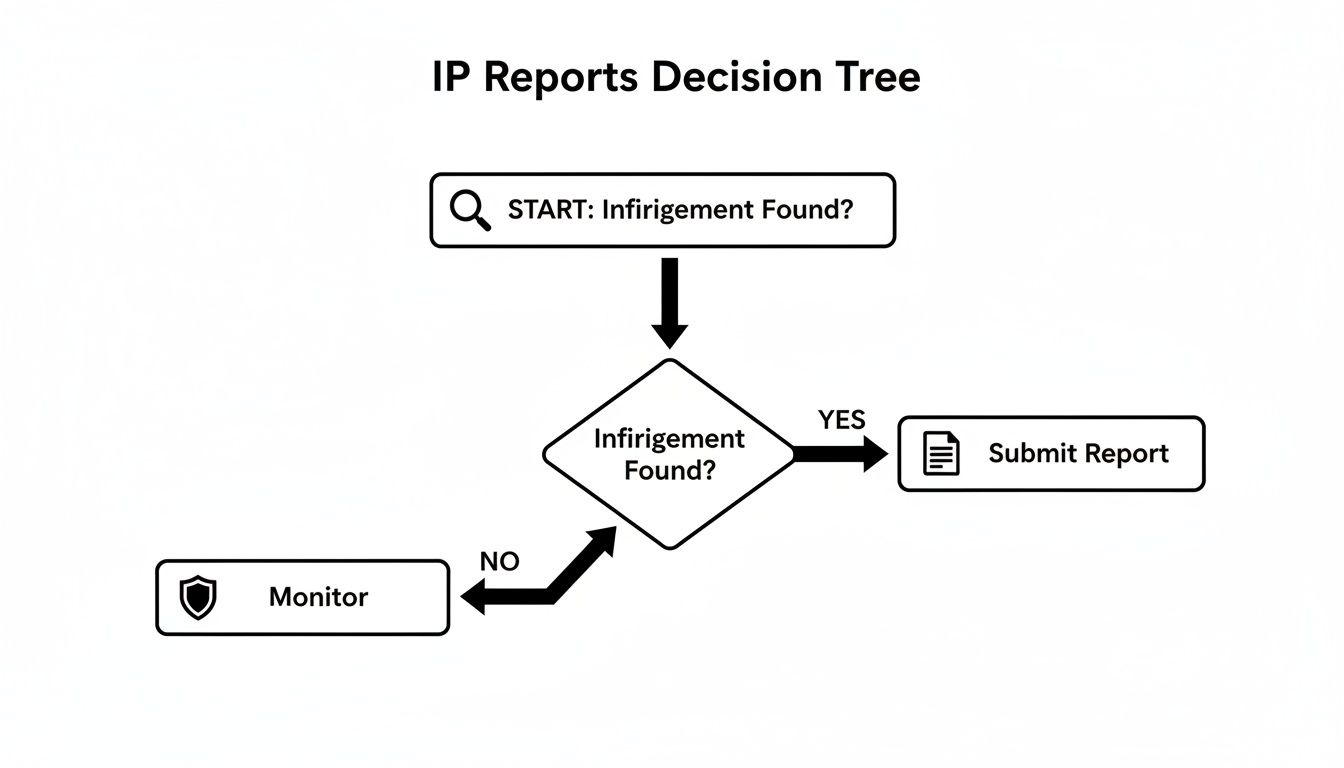
The visual makes it clear: while monitoring is a constant loop, a confirmed infringement demands a swift and decisive response.
Once that test buy package hits your doorstep, it’s showtime. Document everything.
This comprehensive evidence package proves you've done your homework. It makes it incredibly easy for Amazon to see what's going on, verify your claim, and take swift action to protect your brand.

Alright, you’ve gathered your evidence and have everything lined up. It’s time to take action. This is where you move from defense to offense, and your goal is to shut down the infringement as quickly and efficiently as possible.
You've got two main tools in your belt here: a takedown notice filed directly with Amazon and a formal cease and desist letter sent to the bad actor. Each has its place, and knowing when to use which is a key part of a smart brand protection strategy.
Filing a takedown notice through Amazon Brand Registry is almost always your first and best move. It's the most direct route to getting an infringing listing yanked. But here's the catch: Amazon's internal teams are swamped. They aren't going to spend time deciphering a sloppy, incomplete report.
If your notice is vague, it's going straight to the "denied" pile. You have to make it airtight.
Here’s exactly what you need to include to get your report approved on the first try:
Think of your takedown notice as a mini-legal brief. Your job is to present an open-and-shut case that requires minimal interpretation. The easier you make it for Amazon to say "yes," the faster the infringing listing will disappear.
Once you hit submit, you'll get a case ID. Hold onto that number. A well-crafted, evidence-backed report can often get a listing removed in less than 24 hours.
While an Amazon takedown solves the immediate problem on the platform, a cease and desist letter takes it a step further. It's a formal legal notice sent directly to the infringer, and it sends a powerful message: we see you, we're serious, and we're prepared to escalate this.
You don't need to fire one off for every single violation, but it's a vital tool for more serious situations. Knowing when to escalate from an internal Amazon report to a direct legal threat is a judgment call you'll have to make.
Here's a simple framework to help you decide when to stick with Amazon's tools and when it's time to bring in the legal big guns.
.tbl-scroll{contain:inline-size;overflow-x:auto;-webkit-overflow-scrolling:touch}.tbl-scroll table{min-width:600px;width:100%;border-collapse:collapse;margin-bottom:20px}.tbl-scroll th{border:1px solid #ddd;padding:8px;text-align:left;background-color:#f2f2f2;white-space:nowrap}.tbl-scroll td{border:1px solid #ddd;padding:8px;text-align:left}SituationRecommended ActionKey ConsiderationsFirst-time, small-scale infringerAmazon Takedown NoticeThis is fast, efficient, and usually all that's needed. A C&D might be overkill, and good luck even finding the seller's real contact info.Repeat offender or sophisticated hijackerTakedown Notice + Cease and DesistThe takedown gets the listing off Amazon. The C&D letter establishes a formal legal record and warns them against popping up again.Large-scale counterfeiting operationCease and Desist (from a lawyer)This shows you're gearing up for a fight. Organized counterfeiters often only respond to the threat of real legal action.
This table isn't a hard-and-fast rule, but it's a solid starting point based on hundreds of cases I've seen. The key is to match your response to the level of the threat.
If you do decide to send a cease and desist, it needs to be firm, professional, and straight to the point. No emotion, just the facts.
Your letter needs three essential components:
I always recommend sending this letter via a tracked method like certified mail. An email can get "lost," but a signed delivery receipt is hard to argue with. This formal communication puts the infringer on legal notice, which is invaluable if you end up having to take them to court later on.
You've filed the takedown notices. You sent a firm cease and desist letter. Maybe you even got a few of those bogus listings removed.
But sometimes, that’s just not enough.
When you’re dealing with a truly persistent or sophisticated infringer, you'll quickly hit the limits of what Amazon's internal tools can do. This is the critical moment where you need to seriously consider bringing in a trademark attorney.
Escalating isn’t a sign of failure; it’s a strategic move. It means the problem has grown from a simple annoyance into a legitimate threat to your brand’s revenue and reputation. Ignoring the red flags at this stage can be a very expensive mistake.
So, how do you know when you’ve hit that tipping point? The signs are usually pretty clear. If any of these scenarios feel familiar, it's time to stop the DIY approach and get professional legal help on the line.
These situations go way beyond simple trademark issues on Amazon. They are calculated attacks on your business.
When the fight moves from the marketplace to the legal arena, you're no longer just protecting a listing; you're defending your entire brand's intellectual property. A lawyer doesn't just send a scarier letter—they open up a whole new playbook of enforcement actions that infringers simply can't ignore.
Once you bring an attorney into the picture, the process gets a lot more formal and carries a ton more weight.
Your lawyer will likely kick things off by sending a powerful, official demand letter on law firm letterhead. This document is far more intimidating than any C&D you could draft yourself and often signals the end of the road for all but the most defiant infringers.
If that letter gets ignored, the next steps involve the court system. Your attorney can file a lawsuit for trademark infringement, and a crucial early move is often seeking a Temporary Restraining Order (TRO).
A TRO is a game-changer. It’s a court order that can immediately freeze the infringer’s assets—including the money in their Amazon seller account—effectively cutting off the cash flow from their illegal sales. This is often the single most effective way to bring a large-scale counterfeiting operation to a screeching halt. As legal battles become more complex, it's interesting to see how new technologies like AI for lawyers are being used to support these efforts.
The legal road is, without a doubt, more expensive and time-consuming. But the potential outcomes—court-ordered injunctions, seizure of counterfeit goods, and significant monetary damages—can provide the permanent solution that internal reporting never could. For a deeper dive into the foundational principles, our guide on how to protect intellectual property provides valuable context for these advanced strategies.
Calling in legal counsel is a big step, but when you're in the right fight, it's an investment in your brand's long-term survival.
It’s incredibly easy to mix these two up, but using the wrong report type inside Amazon's system is a surefire way to get your claim denied. That wastes valuable time while a hijacker keeps siphoning off your sales.
Think of it like this:
Getting this right is the first and most critical step. Choosing the right category in your "Report a Violation" submission makes all the difference in getting a fast, successful takedown.
Yes, you absolutely can—and you should.
This shady tactic, known as keyword stuffing, is a direct violation of Amazon's policies and a clear form of trademark infringement. The seller’s entire goal is to misleadingly pull your customers over to their product page when they are specifically searching for your brand.
Proving it can be tricky since backend keywords aren't public. But you should still report it through the Brand Registry "Report a Violation" tool. In your report, be very specific: state that the infringer is misusing your registered trademark in their search terms to manipulate Amazon's search results. Amazon’s internal teams have the tools to see these hidden attributes and can take action.
Getting that denial email is frustrating, but don't take it as the final word. Before you do anything else, take a breath and calmly review the original report you submitted. More often than not, a denial comes down to a simple error or not providing enough clear evidence.
Look for these common slip-ups:
If you spot a mistake, fix it and resubmit the claim. If everything looks right, try resubmitting with an even more detailed explanation or stronger evidence. Sometimes a second look from a different Amazon agent is all it takes.
But if a legitimate, well-documented claim is repeatedly denied, that's a strong signal you've hit a wall with Amazon's internal process. At this point, it’s time to escalate. Your next move is to get legal counsel involved, who can communicate directly with Amazon's legal department on your behalf. For a deeper dive into the legal principles that power these protections, you can explore our Trademark practice area.
Waiting on the USPTO can feel like an eternity, but you are not defenseless. While a pending trademark doesn't unlock all of Brand Registry's powerful tools, you still have moves to make.
You can take action based on "common law" trademark rights, which you establish simply by using your brand name in commerce. This gives you the standing to send formal cease-and-desist letters to infringers, putting them on legal notice.
Amazon also has a public-facing infringement report form that you can use to report obvious counterfeit products, even without being in Brand Registry.
For a serious advantage, look into the Amazon IP Accelerator program. This service connects you with vetted IP law firms and can grant you early access to Brand Registry’s protection features while your trademark registration is still making its way through the official process.
Join the Ecom Entrepreneur Community for Vetted 7-9 Figure Ecommerce Founders
Learn MoreYou may also like:
Learn more about our special events!
Check Events