
Chilat Doina
October 12, 2026
A seven-figure ecommerce brand can have healthy demand, good reviews, and a product people like, then lose margin through warranty claims nobody can explain. Support agents approve similar failures differently, finance sees replacements only after cash has left the business, and product teams receive vague complaints instead of usable defect data. By the time leadership notices a return spike or a marketplace escalation, the warranty process has already become an untracked operating cost.
That's the wrong mental model. Warranty management is a cross-border legal-entitlement and margin-control system, with customer service as one part of it. The brands that scale well connect policy language, product records, claim decisions, repair or replacement fulfillment, reserves, and supplier accountability in one auditable workflow.
A brand can manage warranty claims informally while volume remains modest. An agent reads an email, checks the order, requests a photo, and sends a replacement. The process appears efficient because its hidden costs are still small enough to overlook.
Growth exposes the control gaps. One agent classifies cosmetic damage as a defect, another calls it misuse, and a third approves it to prevent escalation. The help center, marketplace listing, and support script may describe different coverage. The warehouse may lack a consistent disposition code for returned goods. Customers receive different decisions for the same failure, while finance records each replacement as an isolated post-sale expense.
Policy ambiguity produces inconsistent approvals. Terms such as “manufacturing defect,” “normal wear,” and “improper use” need operational definitions alongside their legal wording. Agents must be able to map a customer's description to a fixed failure category and remedy rule. Otherwise, every claim becomes a negotiation.
Missing product data conceals defect clusters. A record that says “not working” cannot guide a supplier correction or reserve decision. Each claim should capture the SKU, serial or lot, sale date, failure date, channel, geography, failure mode, remedy, and cost. Without those fields, a recurring production issue looks like ordinary support noise.
Late financial recognition turns warranty into a margin leak. Claims administration records realized costs, while accruals and reserves anticipate future obligations. The warranty expense and claims data reported for U.S. car and cycle manufacturers shows why those views need to remain connected, even though automotive economics do not map directly to consumer goods.
Practical rule: If finance cannot explain warranty cost by product cohort and failure mode, the brand does not control warranty. It has a replacement habit.
A mature program replaces informal handling with three operating assets:
That operating discipline matters because each approved remedy affects gross margin. Warranty management belongs alongside inventory accuracy, advertising efficiency, and purchase-order controls, not below them as a customer-service detail.
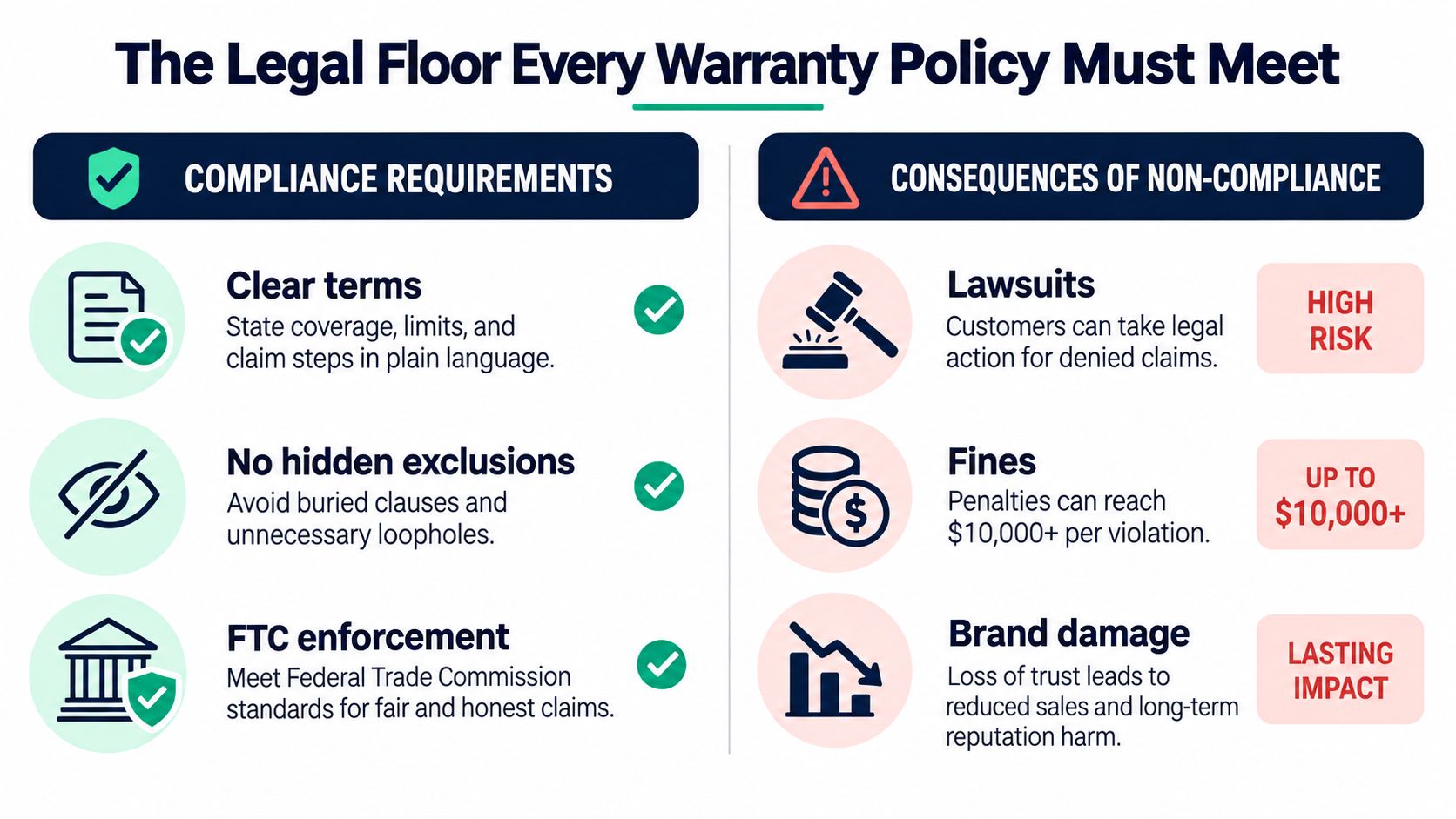
A policy can promise a replacement in one sentence and deny it in the next support interaction. That contradiction turns warranty management into a legal exposure and a margin-control problem, not merely a customer-service workflow. It's a written promise that must match the process the brand follows.
In the United States, the Magnuson-Moss Warranty Act, passed by Congress in 1975, governs written warranties for consumer products. It requires clear coverage information, directs the Federal Trade Commission to establish disclosure standards, defines conditions for “full” warranties, and limits some disclaimers of implied warranties. For ecommerce operators, the operating test is simple: shoppers must understand coverage before purchase, and the claims team must apply those terms consistently.
That does not require every brand to publish identical language. It does require the warranty page, product page, order confirmation, support scripts, and remedy workflow to agree. If the policy promises repair but an agent applies an unpublished exclusion, the business faces both customer friction and legal risk. Product-liability planning belongs in the same control system, especially for goods that could cause injury or property damage. Review product liability and insurance alongside the warranty design.
EU sellers must distinguish a contractual commercial warranty from the statutory legal guarantee. Your Europe's consumer guarantee guidance explains that consumers generally have rights to free repair or replacement when goods do not conform, with the legal guarantee normally lasting two years. The responsible party, shipping duty, evidence standard, and escalation path can vary by market and sales channel.
The EU Right to Repair framework adds obligations for covered products. Member states must apply its provisions by 31 July 2026, and covered manufacturers may face repair duties lasting five to ten years, depending on the product and part, as described in the European Commission's Right to Repair questions and answers.
A cross-border operating model therefore needs jurisdiction rules, product-eligibility logic, repair-versus-replacement decisions, and auditable timestamps. An RMA form cannot determine whether the seller, marketplace, distributor, or manufacturer owes the remedy. Set those rules before volume exposes the gaps.
The policy should be a working artifact that an agent, finance analyst, warehouse operator, and legal reviewer can interpret in the same way. Start with product-line coverage, then translate broad legal and commercial promises into observable conditions.
For each product family, define:
Don't ask customers for every possible document. Excessive evidence creates friction and can produce inconsistent treatment. Request only what separates plausible failure modes, such as a serial number, order match, short video, photograph, or diagnostic result.
A useful taxonomy is specific enough to identify action. “Product issue” isn't. “Battery fails to hold charge,” “housing cracked on arrival,” “motor stops under normal load,” and “missing accessory” lead to different investigations and remedies.
The taxonomy should capture both the customer-facing symptom and the operational cause. Keep the first classification simple for the customer, then let an agent or diagnostic workflow refine it. Every final code should connect to supplier, engineering, reserve, and fulfillment reporting.
Here's a practical starting matrix:
| Failure Mode | Default Remedy | Evidence Required | Auto-Approve? |
|---|---|---|---|
| Confirmed defect within coverage | Repair or replacement, based on product and market rules | Order or serial match, failure description | Low-risk cases only |
| Damage on arrival | Replacement or refund under channel policy | Delivery timing, photos, order match | Often, if evidence is clear |
| Missing component | Component shipment | Order match, packaging or accessory detail | Yes, when duplicate risk is low |
| Suspected misuse | Review before remedy | Photos, usage context, diagnostic questions | No |
| Repeat failure on the same unit | Escalated repair, replacement, or supplier review | Prior claim and repair history | No |
The table shouldn't replace judgment in injury-related, high-value, suspicious, or supplier-disputed cases. It should remove judgment from routine cases where the facts are clear.
Publish the canonical policy in three places: the product page before purchase, the order confirmation after purchase, and the help center during support. Store the version used for each claim. That timestamped policy reference is essential when terms change without changing the customer's original entitlement.
A claim becomes manageable when every transition has a rule, an owner, and a timestamp. The pipeline should begin with the customer's submission and end only when the remedy is fulfilled or the case reaches a documented closure condition.

An Oracle warranty-management survey reported that roughly one in five respondents processed at least 20% of claims manually, one in three manually reviewed every claim, and most companies processed claims within 15 days. The survey source supports a sensible automation strategy: automate low-risk, high-volume decisions first, while preserving human review for exceptions.
Start with order matching, coverage-window validation, serial or lot checks, duplicate detection, and straightforward remedy eligibility. Don't automate every denial. A false denial can create chargebacks, marketplace escalation, negative reviews, and repeat contacts that cost more than the original remedy.
The cheapest approval is the one that follows a correct rule. The cheapest denial is not always the one that saves a replacement.
A ticketing layer can help when claims require technician ownership, status changes, parts, and customer updates. Teams evaluating repair ticketing software should look for product history, evidence, work-order status, parts usage, and customer communication in the same record.
For standardization, document the workflow as an SOP rather than leaving it in an experienced agent's memory. This guide on how to create standard operating procedures is useful when assigning owners and exception paths.
Track these metrics on one dashboard:
The goal isn't maximum automation. It's reliable decisions at the lowest total cost.
A product can look profitable until its warranty obligations arrive months later. Finance should recognize that exposure before claims reach support or the warehouse. For cross-border brands, the reserve must reflect both customer entitlement and margin risk, not only historical service spend.
Public automotive data offers a reference point rather than an ecommerce target. In 2023, U.S. car and cycle manufacturers paid $10.508 billion in warranty claims, up 12%, or $1.084 billion, from 2022. Their industry-average claims rate was 2.47% of sales, while the average accrual rate was 2.57%, according to Warranty Week's industry analysis. Consumer goods brands face different products, price points, jurisdictions, and repair economics. Use the comparison to test reserve discipline, not to copy an automotive benchmark.
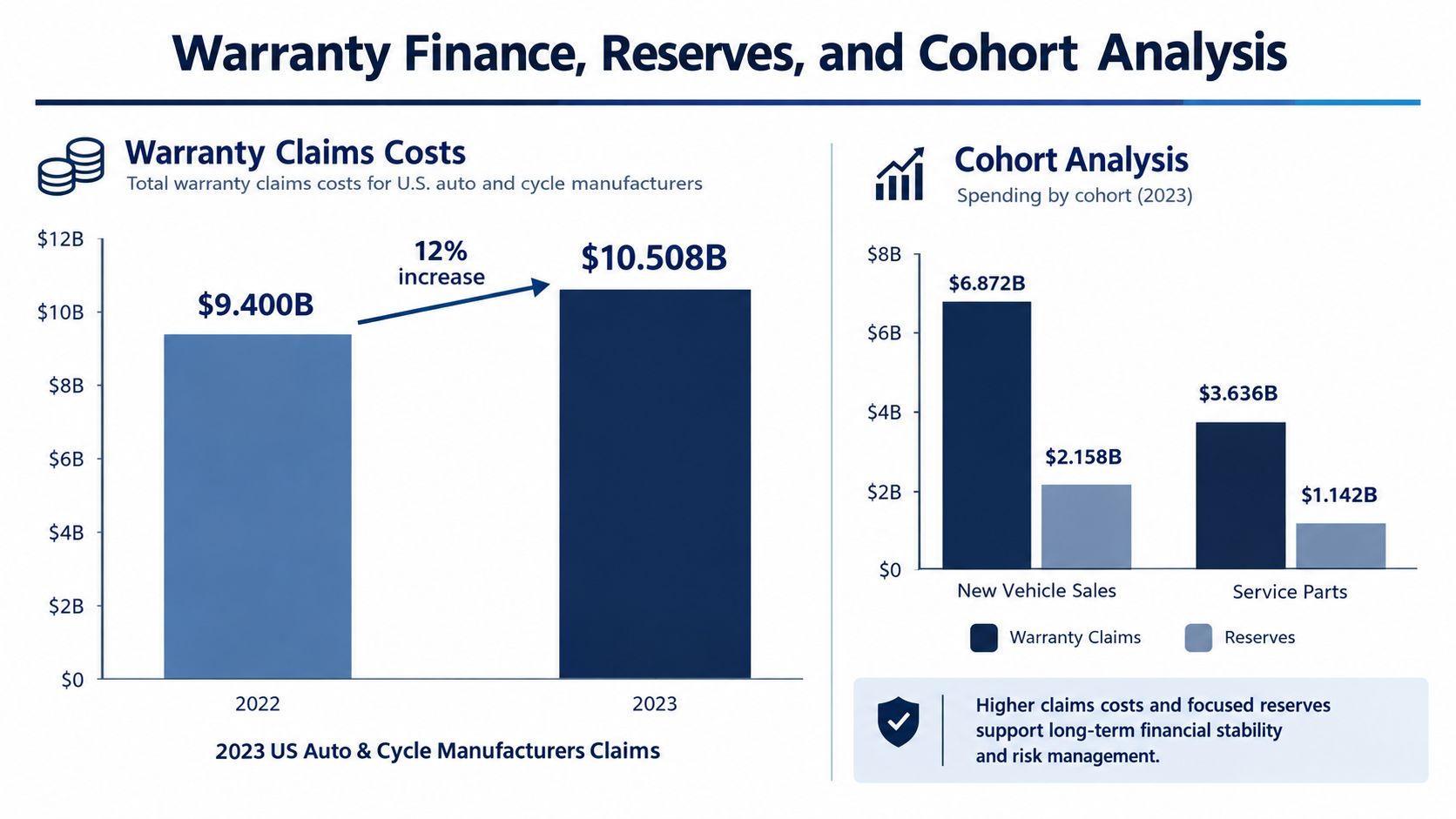
A reserve should represent expected future obligations by product cohort, coverage window, failure mode, jurisdiction, and remedy cost. A single claims-to-sales ratio can conceal an early-life defect in a new SKU because mature products dilute the result.
Normalize every claim by:
Cohort claim rates and time-to-failure distributions help estimate future exposure. Survival models such as Weibull analysis can distinguish early-life defects from random-use failures. The output depends on accurate failure codes, dates, entitlement decisions, and remedy costs.
Reserve work also needs a legal view. A claim accepted under U.S. warranty terms may carry different cost and remedy implications from an EU statutory repair entitlement. Segment reserves by market and policy basis so finance does not treat every obligation as the same customer-service expense.
Each month, compare predicted claims and expected costs with the reserve. Investigate material variances instead of burying them in overhead. A SKU whose normalized failure rate or cost per unit moves outside its historical cohort pattern warrants review by product, supplier, and finance owners.
At month-end, reconcile approved claims awaiting fulfillment, open repairs, replacement inventory, refunds in transit, logistics charges, supplier recovery, and claims outside the coverage window. Compare actual cost with expected cost for each launch cohort.
The dashboard should show the amount, cause, jurisdiction, and owner. Teams looking for a practical framework for designing KPI dashboards that work should apply one rule: every metric must support a decision.
Connect the analysis to advanced financial planning, so reserve changes, launches, supplier negotiations, and inventory decisions use one forecast. Ask which future obligations changed, why they changed, and what action will reduce them.
A replacement can close a ticket quickly while turning a recoverable failure into a full product loss. For a seven-figure brand, that decision affects more than support speed. It determines reverse-logistics cost, inventory consumption, recovered value, and future failure exposure.
For the covered categories and repair-obligation windows set by the EU Right to Repair framework, as noted in the legal-floor section, replacement by default becomes harder to defend. The operating question is whether the brand can meet the applicable entitlement without creating a larger margin leak.
Repair works only when diagnosis, parts supply, data protection, technician capacity, and unit tracking operate as one process. The warranty record must preserve the failure date, repair date, remedy selected, jurisdiction, parts used, and post-repair result. In markets where a repair can affect the guarantee period, those fields are part of compliance, not optional service detail.
Compare the full cost and customer value before choosing the remedy:
A practical example is a premium device with a predictable component failure. If the replacement unit costs more than the part, technician time, two-way transport, and a reasonable repeat-failure allowance combined, repair can protect margin. If diagnosis consumes too much labor or transport costs exceed the product's recoverable value, replacement or credit may be rational. The decision still needs to respect the customer's legal entitlement and record the reason.
The right position is design repairability where the economics and legal exposure support it, then use replacement or credit where repair creates more cost than value.
Start with products that have expensive units, known failure modes, accessible parts, and a service network capable of consistent work. Track the failed component, diagnostic result, repair time, part used, shipping route, post-repair outcome, and repeat-failure status. Product teams can use those records to redesign weak points. Supplier managers can pursue corrective action. Finance can test whether the repair program reduces total warranty cost rather than merely shifting it into labor and logistics.
Independent repair requires guardrails. Provide the necessary diagnostic information and parts, separate personal customer data from product records, and maintain a tamper-resistant history of work performed. Repairability improves margins only when quality, traceability, and legal obligations remain under control.
A warranty rebuild doesn't need to wait for a perfect platform. It needs a canonical policy, a controlled queue, reliable data, and a finance owner. Build those foundations in phases, then automate only what the evidence supports.
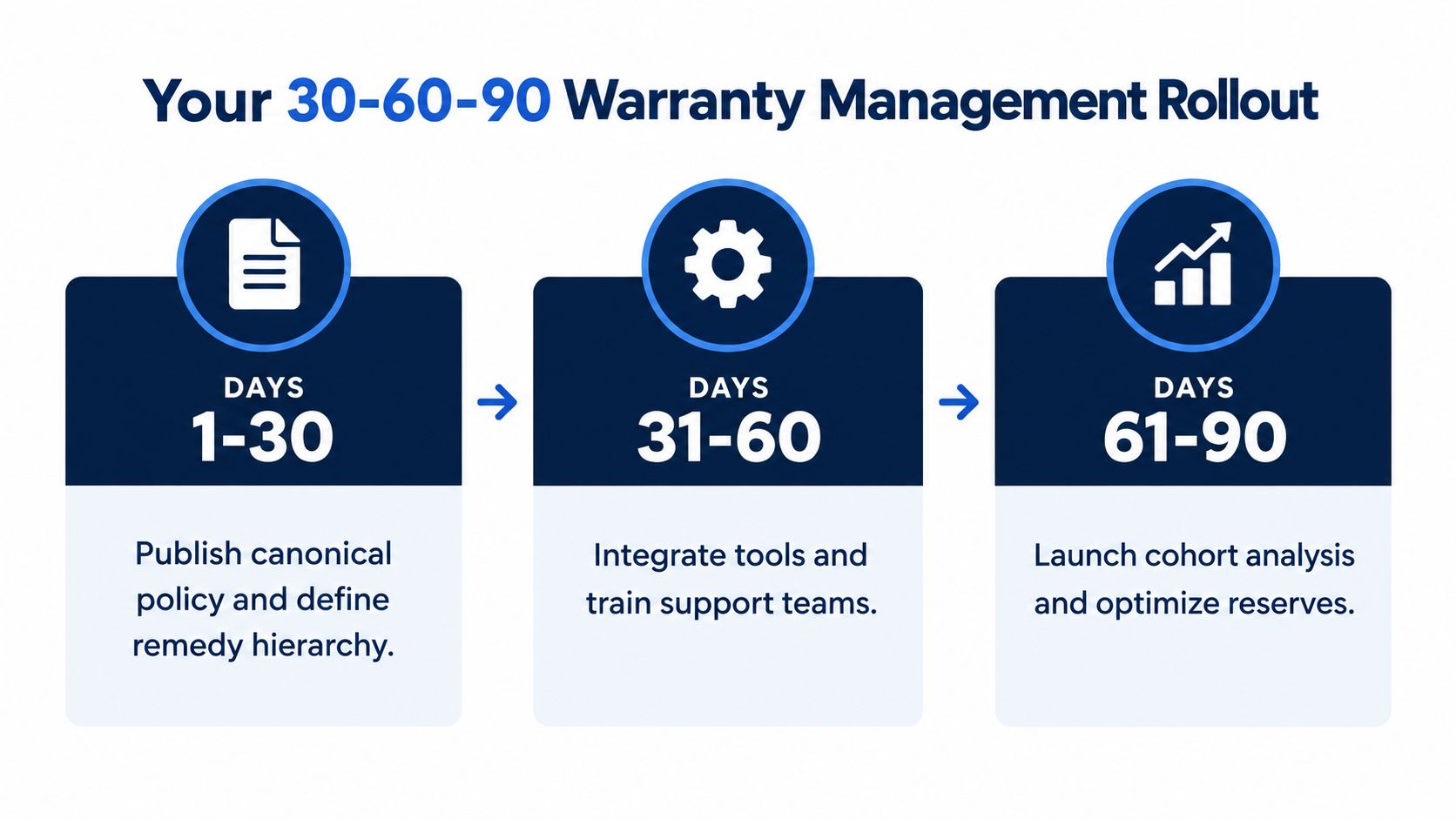
Write the canonical warranty policy for every major product family and market. Put coverage, exclusions, evidence requirements, remedy hierarchy, and escalation rules in one controlled document, then align the product page, order confirmation, help center, and agent macros.
Stand up one claim queue, even if the first version lives in a simple service platform. Every record should include:
Instrument the seven operating KPIs immediately. Baselines matter more than polished dashboards at this stage. A founder should be able to see approval accuracy, straight-through processing, cycle time, repeat contact, resolved-claim cost, leakage, and post-resolution satisfaction without asking an analyst to rebuild the report.
Automate the checks that are repetitive and low-risk. Match orders, validate coverage windows, confirm serial or lot formats, flag duplicates, and route claims by failure mode and value. Auto-approve only the cases whose evidence and remedy are clear.
At the same time, connect the claim queue to the systems that need its output:
Train agents on the taxonomy, not just the script. A script tells an agent what to say. A taxonomy tells the business what happened.
Run cohort analysis by SKU, launch period, channel, geography, and failure mode. Reconcile the expected obligation with the reserve each month, then identify products where failure rate or cost per unit has moved beyond the historical pattern.
Make a repairability decision for each important product family. Use actual claim data to separate repairable failures from uneconomic repairs. Confirm parts availability, technician capability, customer-data controls, and the legal rules for each target market.
Then bring suppliers into the loop. A supplier recovery claim should include the affected product or lot, failure evidence, cost, remedy history, and requested corrective action. The point isn't to create an adversarial process. It's to stop the brand from absorbing a supplier-caused defect as ordinary customer service.
A Monday-morning checklist is simple: assign one owner, freeze the policy version, export open claims, add the missing product fields, define the remedy matrix, and schedule the first reserve review. Don't buy a larger system to compensate for an undefined process. First decide what the business must know about every claim, then choose tools that preserve those decisions.
Million Dollar Sellers offers ecommerce operators a peer environment where founders share operating practices across Amazon, DTC, and omnichannel brands. Its Elite Seller offering also includes post-purchase funnel capabilities that can deliver a warranty alongside materials such as a PDF manual or gift card, which can support a more deliberate ownership and warranty experience.
If warranty claims are leaking margin, Million Dollar Sellers gives serious ecommerce operators access to peer discussions and operating insights from founders managing scaled Amazon, DTC, and omnichannel businesses. Visit Million Dollar Sellers to explore whether its community and post-purchase resources fit the warranty system you're building.
Join the Ecom Entrepreneur Community for Vetted 7-9 Figure Ecommerce Founders
Learn MoreYou may also like:
Learn more about our special events!
Check Events