Chilat Doina
December 15, 2025
Before you can even think about how to find a mastermind group, you need to be crystal clear on why you need one. This isn't just another networking event or a casual coffee chat. We're talking about a strategic alliance—a personal advisory board of peers who can give you unbiased feedback and help you solve problems at lightning speed.
These are founders who are in the trenches, just like you, and have probably wrestled with the exact same challenges keeping you up at night.
Let's be real. As an ecommerce founder, you’re making high-stakes decisions every single day, usually with about half the information you wish you had. You're trying to figure out supply chains, deal with insane ad costs, and outsmart the competition, all while feeling like you're on an island.
A mastermind completely flips that script.
Imagine having a small, trusted circle of founders—not your employees, not your investors, but your equals. These are people who can pressure-test that new marketing strategy you're hesitant about, share the nitty-gritty details of what's actually working in their own multi-million dollar brands, and call you out (in a good way) when you're about to make a costly mistake. That's the real magic: it’s a dedicated space for unfiltered truth, a massive shortcut to shared wisdom that you just can't get at a conference.
This isn't a social club; it’s your personal board of directors. Benjamin Franklin actually pioneered this idea with his group, the Junto. It was a society for “mutual improvement” where members debated business, politics, and ethics. The entire point was collective growth, not just hanging out.
A top-tier mastermind works the same way. It's all about tangible results.
"A mastermind is a strategic alliance with others who will encourage you to think and act in ways that you might not on your own. It's the fastest way to put your success on an entirely new trajectory."
The idea isn't new. It was a cornerstone principle in Napoleon Hill's 1925 classic, The Law of Success, where he observed it in action with industry titans like Andrew Carnegie. The real power comes from the blend of accountability and shared commitment.
Don't just take my word for it. Research from the Association for Talent Development found that simply committing your goals to someone else increases your chance of success to 65%. But get this—if you have a regular accountability meeting with that person, your success rate skyrockets to an incredible 95%. That's the built-in advantage a mastermind gives you. If you're curious, it's worth a deep dive into the history of famous masterminds.
Ultimately, your search for a mastermind has to be intentional. You're not just looking for a room full of smart people. You're looking for a carefully curated environment built for exponential growth. Framing it this way turns your search from a casual hunt for connections into a strategic mission to lock in your ultimate competitive advantage.
Alright, you're sold on the value of a mastermind. Now for the real work: finding one. Let’s be clear, the best groups aren't found with a quick Google search. High-caliber circles are rarely advertised; they're uncovered through deliberate action and strategic networking.
Think of it as a campaign. First, you define your own goals. Then, you actively hunt through the right channels. Only then do you start vetting your options. This whole journey can be broken down into three core phases, which this flowchart maps out nicely.
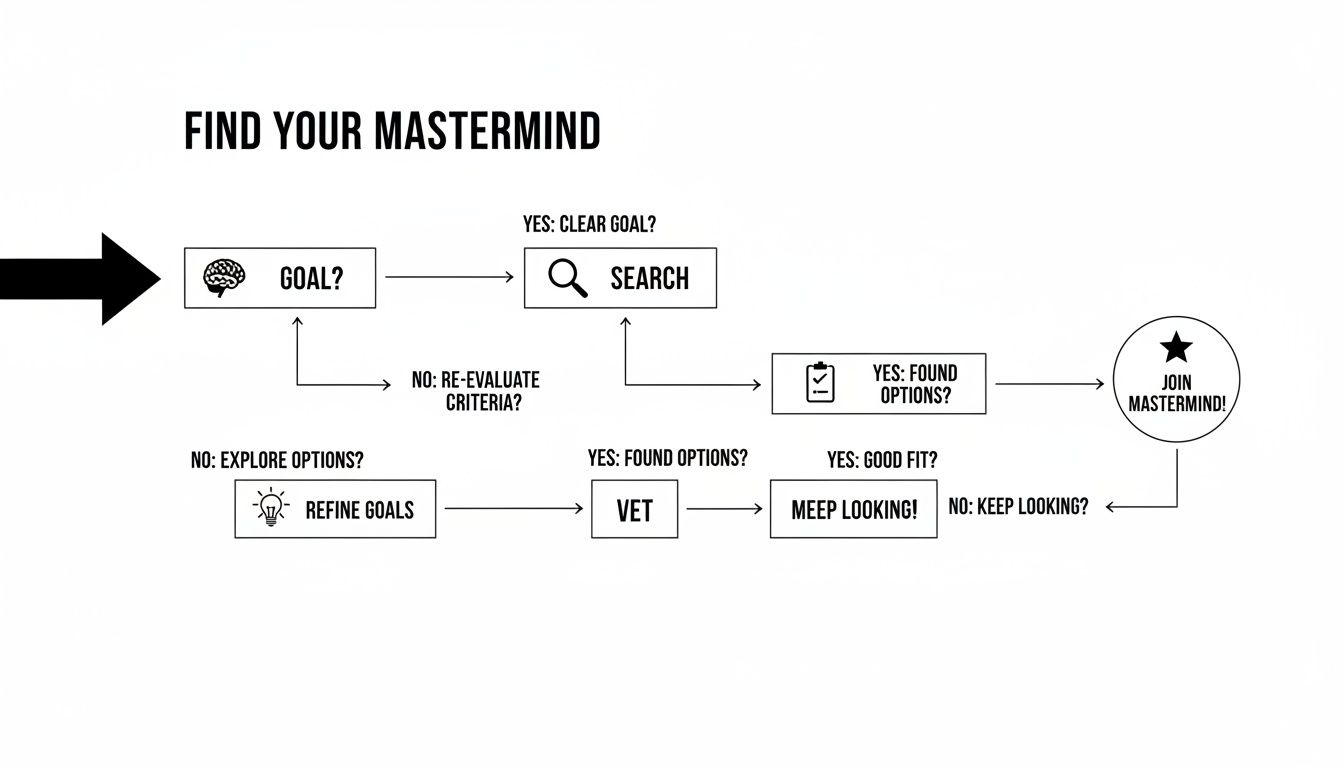
As you can see, a successful search always starts with internal clarity before you ever move outward to evaluate a specific group.
Before you start cold-emailing strangers, tap into the warmest connections you have. Your mentors, agency partners, investors, and even your top-tier suppliers are your most direct path to a quality mastermind. These people already have a stake in your success and a bird's-eye view of the industry.
A simple, direct ask works wonders. Try reaching out to a trusted agency partner with something like, "I'm looking to join a peer advisory group for 8-figure DTC founders. Do you know of any reputable masterminds or have clients who are part of one?" It's that easy.
Industry conferences are goldmines for this stuff, but only if you play it smart. Don't just wander the expo floor collecting swag and business cards. The real work happens weeks before you even pack your bags.
Get your hands on the speaker and attendee lists ahead of time. Use LinkedIn to pinpoint founders who are at a similar revenue stage and wrestling with the same challenges you are. Engage with their posts, then send a personalized connection request mentioning you'll both be at the upcoming conference. Just like that, you've turned a cold interaction into a warm meeting with a purpose.
If you meet certain revenue or leadership criteria, established networks are a solid, reliable option. These organizations have a proven structure, a formal application process, and a global footprint. Essentially, they've done the heavy lifting of curating members for you.
Beyond the big, formal organizations, a ton of high-value groups exist inside niche online communities. These are often private Slack channels, paid forums, or membership sites built specifically for segments like DTC founders, Amazon sellers, or SaaS entrepreneurs.
The key here is finding communities where the signal-to-noise ratio is high. Look for groups that have a real vetting process, a clear code of conduct, and active moderators. These platforms often become incubators for smaller, self-formed masterminds among members who have built trust over time. For a deeper dive on where to look, check out our guide on the top online business networking groups.
A word of caution: The easy access of online groups is both a blessing and a curse. You'll have to sift through a lot of low-quality options to find the gems. A group's value is directly tied to the quality and engagement of its members, not its size.
By mixing these strategies—tapping warm intros, working events, exploring formal networks, and digging into niche communities—you build a strong pipeline of opportunities. This approach ensures you're not just finding a group, but the right group to help you scale.
Finding a few promising mastermind groups is just the start. The real work—the part that saves you from flushing time, money, and energy down the drain—is the vetting process. Trust me, joining the wrong group can set you back way more than having no group at all. It bogs you down with advice that doesn't fit your business and totally kills your focus.
Think of this process as your due diligence. A slick landing page or a smooth-talking founder can sell a compelling vision, but you need to see past the sales pitch and check for actual substance. A structured vetting approach is the only way to confidently assess if a group’s members, structure, and value are the real deal.
Hands down, the single most important factor is the quality of the other members. You're looking for a room full of true peers—not a mix of mentors you can't relate to and newbies you have to teach. The sweet spot is a group of founders at a similar business stage, but who aren't your direct competitors.
This alignment is everything. A recent survey of over 100 paid mastermind participants found that a staggering 62.5% were unhappy with their experience, mostly because of mismatched business stages. But here's the telling part: 75% of those same people said they'd join another group if it was the right one. That proves just how critical getting the vetting part right is. You can read more about these mastermind group satisfaction findings to see the data for yourself.
You have to ask direct questions to figure this out:
If a group gets cagey or can't answer these, it’s a massive red flag. Vague answers like "we have a diverse mix of entrepreneurs" usually mean the group has no focus. You'll end up giving out basic 101 advice instead of getting the high-level strategy you need.
A mastermind without a solid structure is just a glorified chat room. It’s the operational framework that separates productive problem-solving sessions from meandering conversations that lead nowhere.
A huge piece of this is the facilitator. Does the group have one? Is their role clearly defined? A good facilitator is a neutral guide who keeps meetings on track, makes sure everyone contributes, and manages group dynamics.
A great facilitator doesn't provide all the answers. They create an environment where the best answers can emerge from the collective intelligence of the group.
Look for a clear, repeatable format. The "hot seat" model, where one member presents a specific challenge to the group for feedback, is a proven winner. Ask the organizer to walk you through exactly how meetings are run.
Questions to Ask About Structure:
If their answer is something like, "we like to keep it organic," that's code for "we have no structure." Run. A well-managed group will have a documented process for everything from onboarding to scheduling hot seats.
Finally, you need a crystal-clear picture of the total investment—both your time and your money. This goes way beyond the sticker price on the website.
Start with the time commitment. Get specific. How long are the meetings? How often are they? Is there an active Slack channel that requires daily check-ins? Are there in-person retreats? If so, what are the real time and travel costs involved?
Next, dig into the money. Some groups have a simple annual fee, but many have other costs you need to be aware of.
A transparent group will lay out all potential expenses upfront. Be very wary of any organizer who is hesitant to give you the "all-in" cost. Your goal is to find a group where the value you get massively outweighs the total investment, and you can only calculate that if you have all the numbers. A thorough vetting process ensures you join a group that will be a catalyst for your growth, not an anchor holding you back.
I've put together a checklist to help you systematically evaluate any group you're considering. Don't skip these questions—they'll save you from making a very expensive mistake.
Use this checklist of critical questions and criteria to evaluate any mastermind group you're considering. It covers everything from member quality to logistics.
Vetting CategoryKey Questions to AskIdeal Answer / Red FlagMember Quality & CompatibilityWhat is the revenue range of members? What business models are represented? Can I see anonymized member profiles?Ideal: Narrow, defined range (e.g., $1M-$10M DTC). Red Flag: "We accept everyone" or vague, non-specific answers.Group Structure & FacilitationIs there a dedicated facilitator? What is the meeting agenda? How is the "hot seat" managed? How is accountability tracked?Ideal: A professional facilitator and a clear, documented process. Red Flag: "We just go with the flow" or "organic."Commitment (Time)What is the frequency and duration of meetings? Is there an in-person component? What is the expected between-meeting engagement?Ideal: Clear expectations that fit your schedule. Red Flag: A mismatch between your availability and group requirements.Commitment (Financial)What is the total annual cost, including membership, retreat fees, and travel? Are there any hidden software costs?Ideal: Complete transparency with a clear breakdown of all costs. Red Flag: Evasive answers or unexpected add-on fees.Logistics & RulesHow are new members onboarded? What is the policy for confidentiality (NDAs)? What are the grounds for removing a member?Ideal: Formal onboarding, strict confidentiality, and clear rules of engagement. Red Flag: No formal policies in place.Value & ROICan you share testimonials or connect me with a current member? What specific outcomes have members achieved?Ideal: Specific success stories and a willingness to connect you with members. Red Flag: Only vague promises of "growth."
Take your time with this. The right group can be a game-changer, but only if you do the upfront work to make sure it's truly the right fit for you and your business.
You’ve done the hard work, vetted the options, and found a group that feels right. This is where the rubber meets the road—turning that potential into a real spot at the table and, more importantly, into tangible results for your business. It's time to move from evaluating to executing.
Your first outreach needs to cut through the noise. Whether it's a formal application or a warm intro, you have to show you've done your homework. A generic "I'd like to join" email is a fast pass to the trash folder. Get specific about why you want to be in this group.
A simple but effective outreach could look something like this:
This approach immediately signals you're a giver, not just a taker. It positions you as a thoughtful, proactive candidate right from the get-go.
Most high-caliber groups will invite you to a trial session or a guest meeting. Think of this as a two-way interview. They're sizing you up, and you're getting a final, real-world feel for the group's energy and dynamics.
Don't just show up and wing it. Ask the facilitator for the agenda and if there's a specific format. If you can, get a little background on the other members who will be there.
During the meeting, nail two things: listening and adding concise value. Pay close attention to the conversation. When you do speak, make your point relevant and direct. Nobody likes the guest who hijacks the conversation or starts pitching their business.
The fastest way to earn respect in a new group is by asking insightful questions. It shows you're engaged and thinking deeply about someone else's challenge, not just waiting for your turn to talk.
If the trial goes well and you get the invite, the real work starts. Onboarding isn't just about paying an invoice; it's about weaving yourself into the fabric of the community.
The value you get from a mastermind is a direct reflection of the value you give. Passive members who just log on for meetings get almost nothing in return. The members who see exponential growth are actively engaged, both during and between sessions.
Here’s how to handle feedback like a pro:
Your commitment has to live beyond the scheduled calls. If a member posts a problem in the group’s Slack, jump in with a helpful link or a quick thought. If someone mentions they’ll be in your city, offer to grab a coffee. These small gestures build the deep trust that separates a good mastermind from a truly great one.
These relationships often become just as powerful as the ones you build at top-tier ecommerce networking events, but with a level of trust that’s a hundred times deeper.
Ultimately, your goal is to become an indispensable part of the group's collective brain. Be reliable, be prepared, and be generous with what you know. When you commit to being a high-value member, you’ll find that the group becomes one of the most powerful assets in your entire business.
So, you’ve hunted through networks, kicked the tires on a few potential groups, and walked away empty-handed. It happens. Maybe the vibe was off, the members weren’t quite at your level, or the focus was too general for the niche e-commerce battles you’re fighting every day.
When the perfect mastermind group seems like a myth, the answer is simple: build it yourself.

This isn’t just a last resort. It's a power move for founders who want to engineer a hyper-curated brain trust from scratch. By hand-picking every single member, you guarantee alignment from day one and transform a handful of smart people into a cohesive, powerhouse advisory board.
Before you even think about sending an invite, you need to nail down the "why." A mastermind built on a flimsy premise like "let's help each other grow" is destined to fizzle out. Your group needs a razor-sharp mission that acts as a North Star for every decision.
Get granular. Is the goal to help every member smash the $10 million revenue ceiling? To untangle the knotty challenges of international expansion? Or maybe it's a deep dive into capital allocation for bootstrapped brands. The more specific your purpose, the easier it is to attract the right people and deliver insane value.
A clear purpose statement is the foundation for your group's culture and rhythm, ensuring everyone is rowing in the same direction.
This is where the magic happens. Your founding cohort will set the entire tone and trajectory of the group. Don't rush it. You're looking for 4-8 trusted peers who are playing the same game but bring different playbooks to the table.
Who’s on the list?
When you reach out, make it personal. Explain the core purpose you’ve laid out and, more importantly, why they are a perfect fit. Frame it as a co-creation process—an invitation to help shape the group's DNA. This feels less like a sales pitch and more like an exclusive opportunity to build something special.
Once your founding members are in, the first order of business is to write your constitution. An "operating agreement" isn't about stiff rules; it’s about creating clarity and managing expectations so you can spend your time on what matters: solving big problems. This is crucial for building psychological safety.
Your agreement should cover a few key pillars:
Agreement CategoryKey Points to DefineConfidentialityA strict "what's said here, stays here" policy. Some groups even use a simple NDA.Attendance & PunctualityWhat’s the attendance policy? What happens if someone flakes?Meeting StructureAre we doing a "hot seat" format? How long are meetings? How often do we meet?ContributionThe expectation is simple: show up prepared to both give and receive high-value help.
Don't just hand this down from on high. Co-create this document with your founding members to foster a deep sense of ownership. Getting everyone’s buy-in on these fundamentals is the secret to long-term success and heads off most common issues before they even start. For inspiration, looking at how established organizations run can be helpful; for instance, this EO vs YPO comparison breaks down different successful structures.
The goal of an operating agreement is to make the "how" automatic so the group's full energy can be spent on the "what"—solving its members' most significant challenges.
Building your own mastermind is an investment of time and energy, but the payoff is immense. You get a perfectly tailored growth engine, you control the quality, you set the culture, and you create an invaluable asset that will accelerate not just your business, but the businesses of your most trusted peers.
Even with a clear plan, a few questions always come up when you're on the hunt for the right mastermind. I get it. This is a big decision. Let's walk through the most common ones I hear from ecommerce founders so you can feel confident you're making the right move.
This is always the first question, and the honest answer is: it’s all over the map. The price tag depends entirely on what’s being delivered.
I’ve seen groups that are completely free, run by a tight-knit group of peers, and I've seen elite networks that run upwards of $30,000 a year. Don't automatically assume free means low-value; a dedicated, self-run group can be a game-changer.
But paid groups bring something crucial to the table: skin in the game. When people invest money, they show up. They do the work. They take their commitment seriously.
For most ecommerce founders who are really looking to scale, the sweet spot is usually in the $2,000 - $10,000 annual range. This typically gets you professional facilitation, a carefully vetted group of members, and a genuine, measurable return on your investment.
Here’s how I think about the cost: If one conversation in your mastermind helps you land a deal that adds $50,000 to your bottom line, or helps you sidestep a $20,000 operational blunder, the fee becomes irrelevant. It's an investment, not an expense.
Joining the wrong group isn’t just a waste of money—it's a massive drain on your time and energy. You need to go into this with your eyes wide open. Be on the lookout for these classic warning signs.
A group is probably not for you if you spot:
This really boils down to your personal style and what you want to get out of the experience. There’s no right or wrong answer here, just different strengths.
FormatBest ForKey AdvantageVirtualTactical problem-solving and access to a global network.The sheer convenience is unbeatable. You can connect with brilliant founders from across the world without ever leaving your office.In-PersonForging deep, trust-based relationships that last a lifetime.There's a certain magic that happens when you're in the same room. The energy, the side conversations, the shared meals—it builds bonds incredibly fast.
Honestly, the best model I've seen is a hybrid. You get the best of both worlds with regular virtual check-ins for the week-to-week grind, plus one or two epic in-person retreats a year to build those deeper connections and do some big-picture thinking.
Easy one. One.
A truly great mastermind requires your focus. It demands your time, your mental bandwidth, and a real commitment to contributing value to others.
Trying to juggle multiple groups is a classic mistake. You end up being a passive lurker in all of them instead of a key player in one. Your attention is your most valuable resource as a founder. Find the single best group for where you are right now, and go all-in.
At Million Dollar Sellers, we've built the premier mastermind community exclusively for elite ecommerce entrepreneurs. Our members are vetted 7-, 8-, and 9-figure founders who share actionable strategies in a trusted, private environment. If you're ready to scale faster with a network of proven operators, learn more about MDS.
Join the Ecom Entrepreneur Community for Vetted 7-9 Figure Ecommerce Founders
Learn MoreYou may also like:
Learn more about our special events!
Check Events