
Chilat Doina
November 25, 2026
A mastermind group is a small, recurring peer forum, typically 6 to 14 members meeting monthly, in which founders advise on each other's real business decisions and hold each other to specific follow-up commitments. You bring a live problem, peers challenge it, and you leave with one action you have to report on next time.
If you already employ a team, pay an agency and have an accountant on speed dial, what can a handful of other founders tell you that those people can't? That's the question most explanations of masterminds skip, because they sell the format as a networking perk: better contacts, more ideas, motivational company.
The honest answer is narrower and more useful. A mastermind isn't an idea dispenser. It's a decision system with a built-in accountability loop, and it works on the decisions your staff can't challenge because they report to you, and your specialists can't challenge because they only see one slice of the business.
Think of a personal board of advisors you assemble yourself, then meet with every month. Nobody on that board owns equity, nobody votes, and nobody has a legal duty to your company. What they have is operating experience from businesses shaped like yours, plus permission to tell you your plan is weak.
That's the closest analogy for anyone asking what is a mastermind group and getting a fuzzy answer. The difference from a real board is that the advice runs in every direction. You sit on everyone else's board too.
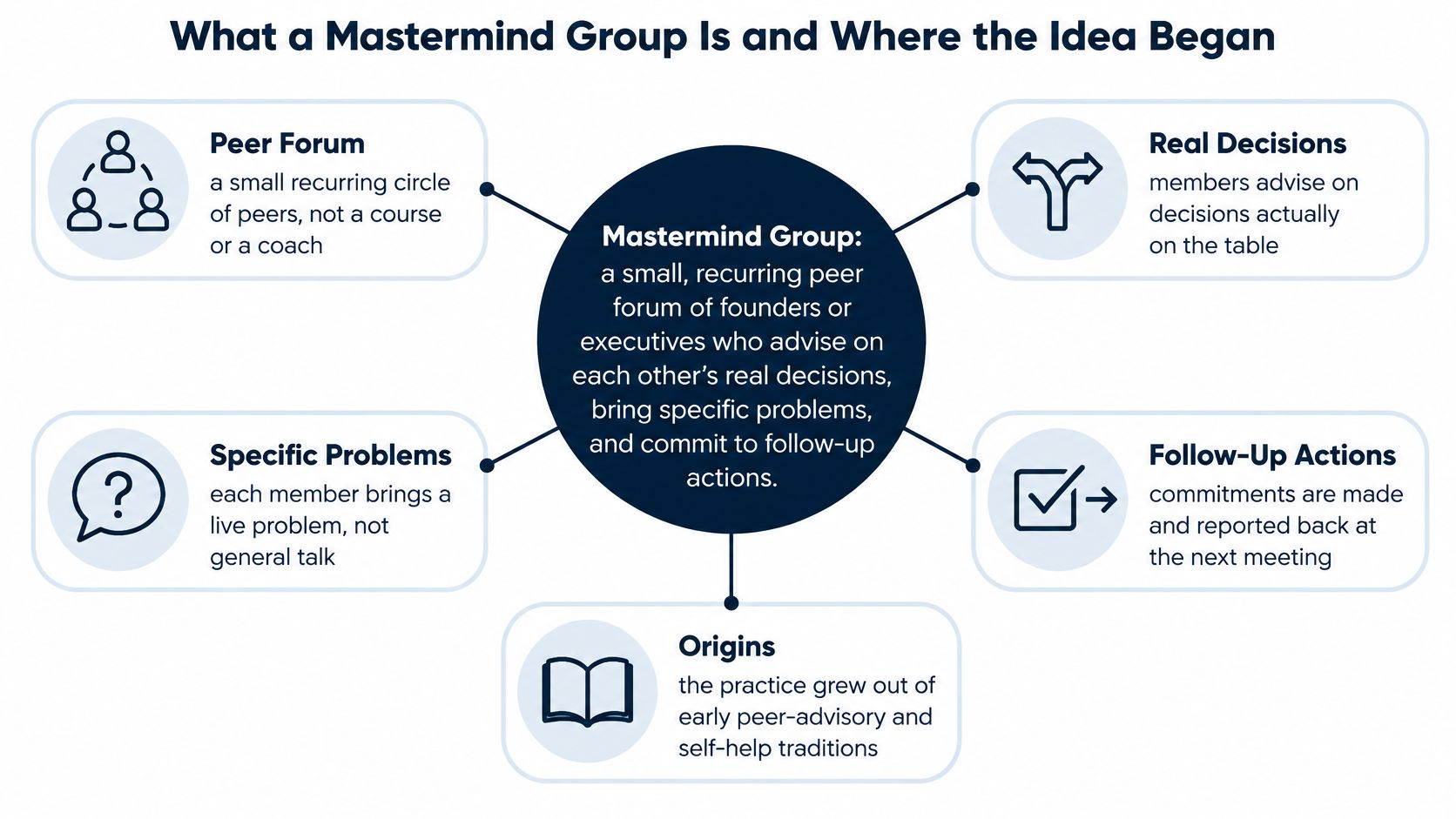
The label is younger than the habit. The Wikipedia entry on mastermind groups credits Napoleon Hill with introducing the "Master Mind" principle in The Law of Success (1925) and expanding it in Think and Grow Rich (1937), where he described two or more people coordinating knowledge and effort in harmony toward a definite purpose. The same entry records an earlier version of the practice: Benjamin Franklin's Junto, founded in Philadelphia in 1727 as a mutual-improvement club, initially 12 members discussing moral, political, scientific and commercial questions.
Franklin's club had no growth framework and no revenue targets. It had a fixed group, a recurring meeting and an expectation that members would bring their thinking to be tested. Those three ingredients are still the whole format.
A networking event optimizes for new contacts. A course optimizes for transferring one person's curriculum into your head. In both, you're mostly receiving. In a mastermind, you're obligated to contribute to someone else's decision, and they're obligated to contribute to yours.
A mastermind combines advisory-board thinking with peer mentoring, and its value depends less on the size of the network than on the relevance, candor and execution discipline of the people in it.
If you want to see how that discipline translates into commercial outcomes, Chicago Brandstarters' notes on how mastermind groups drive growth are a useful companion read on the entrepreneur side of the model.
The practical test you can now apply: if nobody in the room is expected to change a decision or report back on a commitment, you're at a networking circle or a lecture, not a mastermind.
A business mastermind is a small recurring forum, not a membership community with a stage and an audience. A description of the format from Leaders Adapt puts the common operating range at approximately 6 to 14 participants, meeting monthly or more frequently, with a member placed in a "hot seat" to present a live decision, take questions and recommendations, and finish with a measurable commitment. A monthly rhythm gives you 12 formal accountability checkpoints a year, and a 90-minute meeting split evenly among six members works out to about 15 minutes of focused time each.
Those numbers are design implications, not industry law. They explain why size and facilitation matter more than prestige.
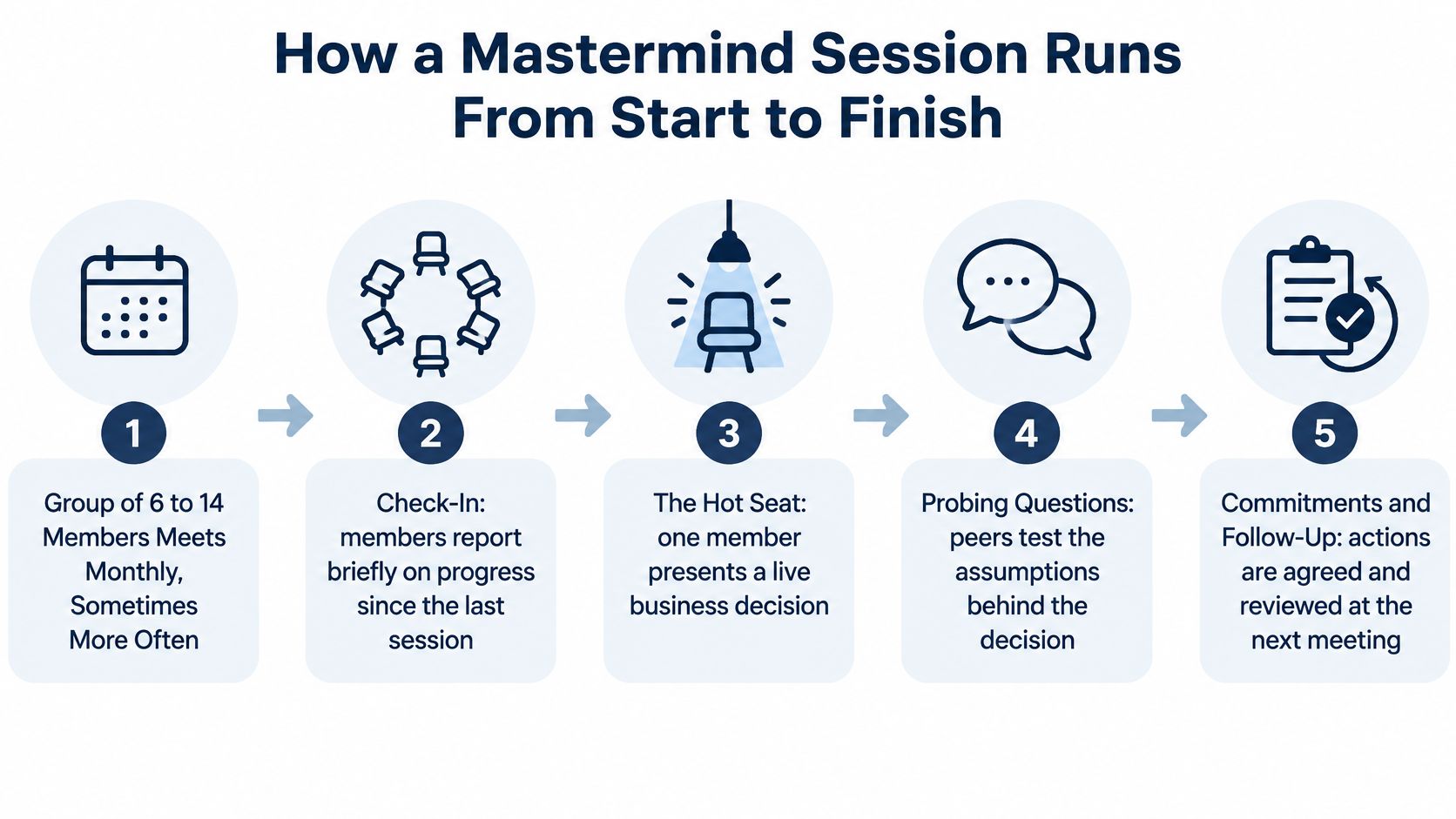
The hot seat is the engine. One member puts a decision on the table with the numbers behind it, then sits still while peers interrogate the framing. Questions first, advice second, because most bad decisions in a peer room get rescued by advice that answers the wrong question.
Say a seller wants to know whether to open a second marketplace. The useful questions aren't "which marketplace." They're "what's your contribution margin after returns," "who runs it," and "what breaks if your main channel dips 20% while you're distracted."
| Stage | What Happens | Time |
|---|---|---|
| Review last month's commitments | Each member reports whether the action was done and what it changed | 15 minutes |
| Quick check-ins | Each member names one win and one blocker in a sentence or two | 10 minutes |
| Hot seat presentation | One member presents a live decision with the numbers behind it | 10 minutes |
| Probing questions | Peers ask questions to test assumptions before anyone advises | 15 minutes |
| Advice and challenges | Members offer recommendations and push back on weak reasoning | 25 minutes |
| Commitments and close | The hot-seat member names one testable action and a report-back date | 15 minutes |
Notice what's missing: no keynote, no open-floor catch-up, no pitching. Preparation, a defined agenda, confidentiality and direct feedback are what separate this from a casual founder chat.
Larger groups need rotating hot seats or tighter facilitation, otherwise depth collapses into a round of shallow opinions. We run Squads as small groups of 6 to 8 people meeting monthly with a trained moderator for exactly this reason, since a moderator can cut off a monologue without a member having to do it.
Healthy session, one test: every member leaves with one testable action and a date to report the result.
Peers can only be as sharp as the information you hand them. Vague framing produces vague advice, and you'll leave with a to-do list you don't believe in.
A study of 160 Norwegian management teams covering 1,150 leaders found that psychological safety influenced team effectiveness indirectly through behavioral integration, meaning mutual collaboration, information sharing and ownership of decisions. Applied to a founder group, the chain is straightforward: safety enables disclosure, disclosure improves information sharing, and shared information improves the decision. A standardized brief is how you make that sharing happen in ten minutes instead of forty.
Separate facts from hypotheses as you write. "Margin fell" is a fact. "Because ad costs rose" is a hypothesis, and labeling it that way invites the room to test it instead of accepting it.
"Increase advertising" isn't a recommendation, it's a mood. A testable version sounds like this: a seller raises spend by a fixed amount only if incremental blended return clears a stated threshold across 30 days, and pauses the increase if it doesn't. The threshold and the amount are yours to set from your own margin, and the point is that the room can prove you wrong later.
Record the original forecast, the intervention, the observed result and the variance at the next meeting. That single habit turns peer opinion into a learning system. For a wider look at how groups reach decisions together, Acheloa Wellness on shared decisions is worth reading alongside your brief template.
Track four things across meetings: decision cycle time, experiments launched, unresolved risks and commitments completed. Include only figures you can source from your own dashboard.
Founders usually weigh four formats as if they were substitutes. They aren't. They solve different problems, and the table below lines them up on the same criteria so the trade-off is visible.
| Feature | Mastermind group | Networking group | Online course | Advisory board |
|---|---|---|---|---|
| Main purpose | Solve members' live business decisions | Meet new contacts | Teach a fixed curriculum | Govern and advise the company |
| Typical size | Small, fixed circle of peers | Open, often large | One instructor, many students | A few appointed directors |
| Meeting rhythm | Monthly or more often | Irregular events | Self-paced or scheduled cohorts | Quarterly or more often |
| Accountability | Specific commitments reviewed at the next meeting | Little or none | Self-driven or optional | Formal duties to the company |
| Source of advice | Peers who run similar businesses | Anyone present | The instructor | Directors with legal duties |
Read the accountability row first, because it's where the formats diverge hardest. A course can be excellent and still change nothing, since nobody checks whether you applied module four. If your bottleneck is a fixed skill gap, that's fine. If your bottleneck is a decision you keep deferring, it isn't.
The purpose row tells you which room to book. Need new contacts and referrals? A networking group wins, and our rundown of the best business networking groups covers how to pick one that fits your stage. Need formal governance, fiduciary oversight and challenge to your strategy at company level? That's a board's job, not a peer group's.
A mastermind earns its place when you need peers to stress-test a live operating decision and then hold you to it. Say an ecommerce seller is deciding whether to cut a slow SKU range or expand into a second marketplace. Peers who have faced that exact trade-off will ask about liquidation cost, cash freed up and management bandwidth, then check next month whether you acted. No instructor, contact list or quarterly board meeting does that.
These options stack rather than compete. Plenty of founders keep a board for governance and a mastermind for operating decisions, and some add a lighter peer circle for support between the two, similar to the peer groups at Madeira Remote.
The mechanism is a chain, and each link has to hold. A member discloses a live strategic problem, peers challenge its assumptions, and the discussion converts into an experiment that member owns and reports on.
That's what it looks like in a room where members trust each other enough to be blunt.

In a field study of 51 work teams published in Administrative Science Quarterly, psychological safety was associated with learning behavior, and learning behavior mediated the relationship between safety and performance. Team efficacy alone didn't explain the learning effect.
For a founder, that reframes confidentiality. It isn't a courtesy, it's the control that determines whether bad news surfaces early: margin compression, inventory exposure, attribution errors, channel concentration. A founder who fears judgment mentions the margin problem three meetings late, and the group can only advise on the version of the business they were shown.
Senior founders often have plenty of advisors and nowhere to think out loud. Research involving 107 Canadian CEOs and interviews with 46, published by HEC Montréal's Pôle Dirigeant, found that outside networks, including CEO peer groups, help leaders step back and gain perspective. Hierarchical roles can make relationships feel transactional, which limits honest talk with colleagues.
Peers who don't report to you can question your judgment without risking their job. That's the distinctive value, and it's also the boundary. A mastermind doesn't replace therapy, executive coaching, a board or specialist advice on tax, legal or technical questions.
Three misconceptions worth correcting before you join:
Watch how a group handles accountability in practice, and see our guide to accountability systems for the reporting side of this.
Write the safety rules down: confidentiality, anonymized case discussion, conflict-of-interest disclosure, non-solicitation expectations, and an explicit way to admit a failed test without penalty. Safety never means low standards. It means high standards applied to someone who feels safe enough to tell the truth.
Judge a mastermind the way you'd judge any business purchase, on structure rather than testimonials. Run any group through these checks before you share a single number.
Ask to sit in on one session before you commit. Ten minutes of watching how a group handles a hot seat tells you more than any sales page.
If you're weighing a mentor against a peer group, our comparison of how to find a business mentor will help you decide which gap you're trying to close.
Three things to do this month: write down the decisions currently sitting on your desk, score two or three groups against the checklist above, and attend one session as a guest.
Million Dollar Sellers is an invite-only community of vetted ecommerce founders where the peer decision loop described here runs every month, through moderator-led Squads, member-led mastermind workshops and tactics calls with operators who've faced the same trade-offs. Every member is a founder or CEO with P&L ownership, so the challenge you get comes from people who've carried the same risk. If you want your next hard decision tested by peers rather than guessed at alone, visit Million Dollar Sellers and see whether you qualify.
Join the Ecommerce Community for Founders Scaling from 7 to 9 Figures
Learn MoreYou may also like:
Learn more about our events!
Check Events