Chilat Doina
July 12, 2026
You can feel the ceiling before you can explain it.
Revenue is up, the team is bigger, and the brand looks healthier from the outside. But inside the business, too many things still route through you. Creative approvals. Inventory calls. Margin decisions. Agency follow-ups. A product launch stalls because one person is waiting on another person, and both are waiting on you.
That stage messes with founders because it doesn't look like a discipline problem. You're still working hard. The issue is that hard work has started masking weak operating design. The business is running on founder intervention instead of team accountability.
That's where most e-commerce accountability systems break down. They stay stuck at the level of founder habits, morning routines, public commitments, Slack check-ins, and personal productivity hacks. Those can help. They just don't solve the core scaling problem, which is turning execution into a system the team can run without your constant pressure.
The founder bottleneck usually shows up in ordinary ways.
Your paid media lead knows the campaign is under target, but doesn't have a clear threshold for when to cut spend. Operations sees inventory risk coming, but nobody owns the final call on reorders versus cash preservation. Customer service flags a rising issue, but it sits in a queue because no one has authority to fix the root cause across departments.
Meanwhile, the founder becomes the unofficial approval layer for everything.

I've seen this happen even in good businesses with smart operators. Nobody is lazy. Nobody is checked out. The company just hasn't made the shift from personal accountability to institutional accountability.
That shift matters because data from top 1% ecommerce founders reveals that 80% of scaling failures stem from misaligned financial and operational accountability, not a lack of personal discipline. The same source notes that top founders separate profit from growth capital and review numbers weekly to build systemic accountability, not just founder willpower (The Bootstrapped Founder on accountability systems for founders).
At lower scale, brute force covers a lot of operational sins. You can remember key numbers in your head. You can chase people manually. You can clean up handoff failures yourself.
That stops working once the business has multiple channels, a larger payroll, more inventory exposure, and specialized team leads.
A few signs you've crossed that line:
If your business is dealing with the last one, tighten the handoffs before you add more management layers. A clean place to start is documenting repeatable work through standard operating procedures for scaling teams.
The best accountability systems don't create more founder oversight. They create clear ownership, visible metrics, and regular decision rhythms.
You don't scale by becoming better at reminding adults to do their jobs. You scale by making ownership impossible to confuse.
That changes how you lead. Instead of asking, “Why didn't this get done?” you start asking, “Was the owner clear, was the metric clear, and did we review it early enough to intervene?”
Once you operate that way, the business becomes less emotional. Fewer surprises. Fewer rescue missions. Less hero mode.
Most founders damage accountability the moment they introduce it. They use it as a pressure tactic.
The team hears “accountability” and translates it as surveillance, blame, or a new reporting burden. That's why good people start giving polished updates instead of honest ones. They protect themselves instead of exposing problems early.
That gap is real. Analysis reveals a 16-percentage-point disconnect between leadership perception and team reality: 46% of leaders believe they are exceptional at accountability, while only 30% of their teams agree (Rhythm Systems on accountability problems).
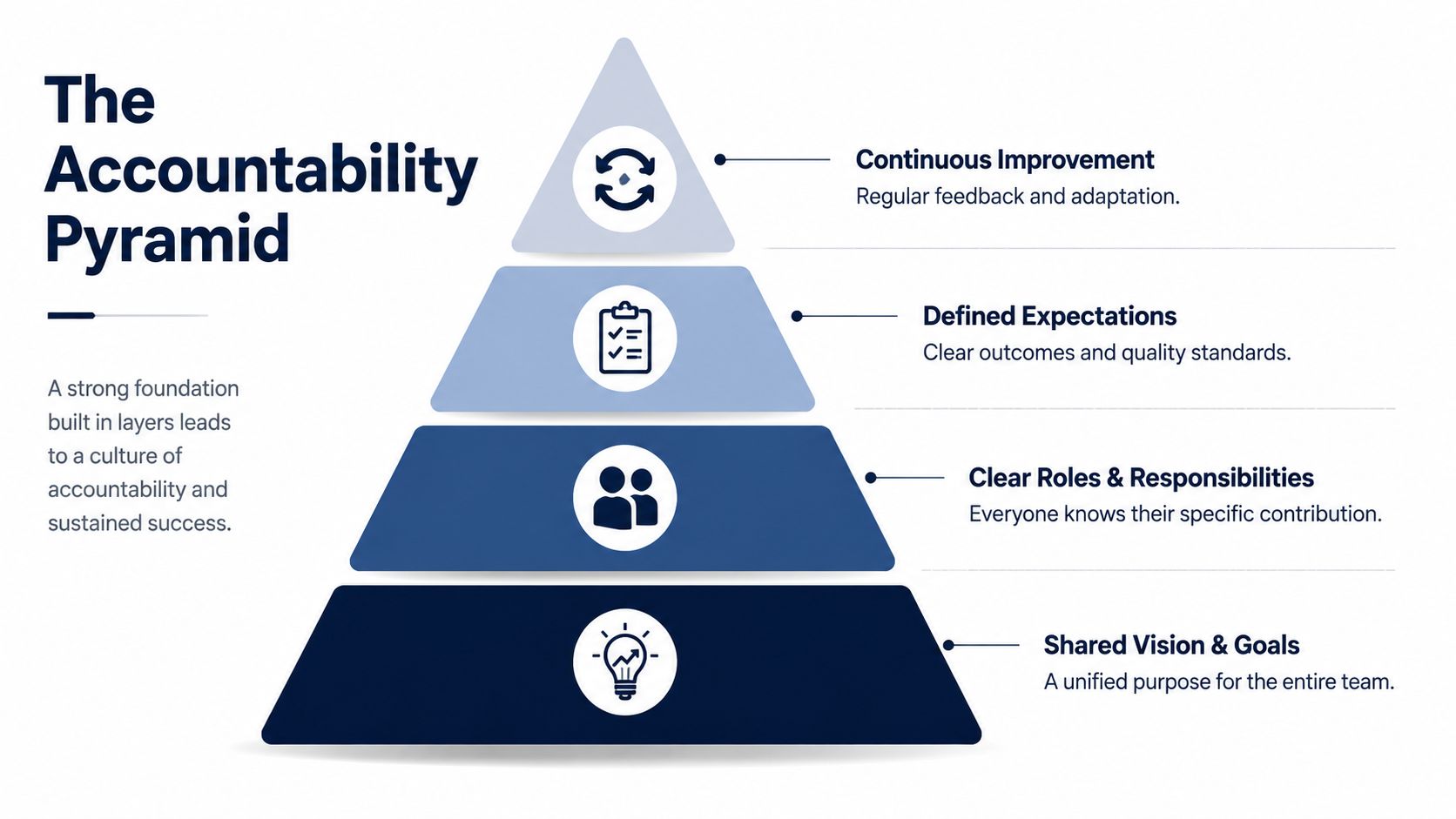
The simplest useful model I've found is the 5 C's Framework:
Most companies skip the first two and jump straight to consequences. That creates fear, not execution.
Good accountability systems are boring in the best way. People know what they own. They know how performance is judged. They know when metrics are reviewed. They know what happens if something slips.
That stability matters more than fancy software.
Here's what I'd want in place before adding another dashboard, another meeting, or another planning framework:
| Foundation | What it looks like in practice |
|---|---|
| Shared goals | The team can state the current priorities without guessing |
| Role clarity | One owner is attached to each key outcome |
| Visible scorekeeping | Metrics are easy to see and hard to reinterpret |
| Fast escalation | Problems move up quickly when the owner needs support |
Practical rule: If two people think they both own it, nobody owns it.
Founders undermine the very foundations of the system. They ask for accountability from the team while staying vague themselves. They change priorities midweek, skip review meetings, or make off-cycle decisions that bypass the system.
People notice that immediately.
If you want a tighter performance culture, show your own numbers, your own commitments, and your own misses. The article on insights on OKR accountability is useful here because it reinforces a point many founders ignore. Accountability works when goals are visible, discussed often, and tied to real ownership rather than aspirational language.
The team doesn't need a harsher founder. It needs a more consistent one.
Founders get tripped up by frameworks because they try to pick one ideology for the whole company.
That's the wrong question.
You don't need one master system. You need the right tool for the job. In practice, most strong accountability systems use a mix of KPIs for departmental performance, RACI for cross-functional projects, and OKRs for short strategic pushes.
A launch calendar and a quarterly growth target are not the same management problem.
If you're rolling out a new product, updating creative, coordinating inventory, briefing support, syncing Amazon and DTC listings, and lining up email and paid media, you need role clarity across functions. That's where RACI earns its keep.
In project management, successful accountability requires a RACI matrix documented for each major deliverable, and systems that require explicit ownership with defined support roles perform better than those relying on collective responsibility (Workzone on project management accountability strategies).
If your challenge is keeping the retention team focused on repeat purchase rate, subscription health, or campaign output, a KPI scorecard is cleaner than an OKR stack. If your challenge is a quarter-long push into retail readiness or international expansion, OKRs can force sharper alignment.
| Framework | Best For | E-commerce Example | Primary Focus |
|---|---|---|---|
| RACI | Cross-functional projects | Product launch involving ops, creative, paid media, CX, and finance | Role clarity |
| KPIs | Ongoing departmental management | Weekly scorecard for paid media, inventory, and customer support | Performance tracking |
| OKRs | Strategic quarterly pushes | Increasing contribution from a priority channel or fixing retention execution | Strategic alignment |
| Balanced Scorecard | Leadership-level review | Looking across finance, customers, operations, and team execution | Business balance |
A lot of operating pain comes from using the right framework in the wrong place.
For founders building personal discipline alongside team execution, lightweight peer structures can help at the individual level. If you want a simple example of how groups achieve goals with group habits, Habit Huddle shows the behavioral side well. Just don't confuse that with operational accountability inside the company. One supports founder consistency. The other runs the business.
The first version should fit your business as it exists today, not the org chart you want next year.
I'd usually start with:
If your team is already blurry on expectations and role ownership, adding a dense planning layer will make things worse. Tighten basic performance structure first. Then add complexity if the business actually needs it.
If you need a clean mental model for that layer, this overview of a performance management system for growing teams is a useful reference.
Most e-commerce teams don't have a motivation problem. They have a measurement problem.
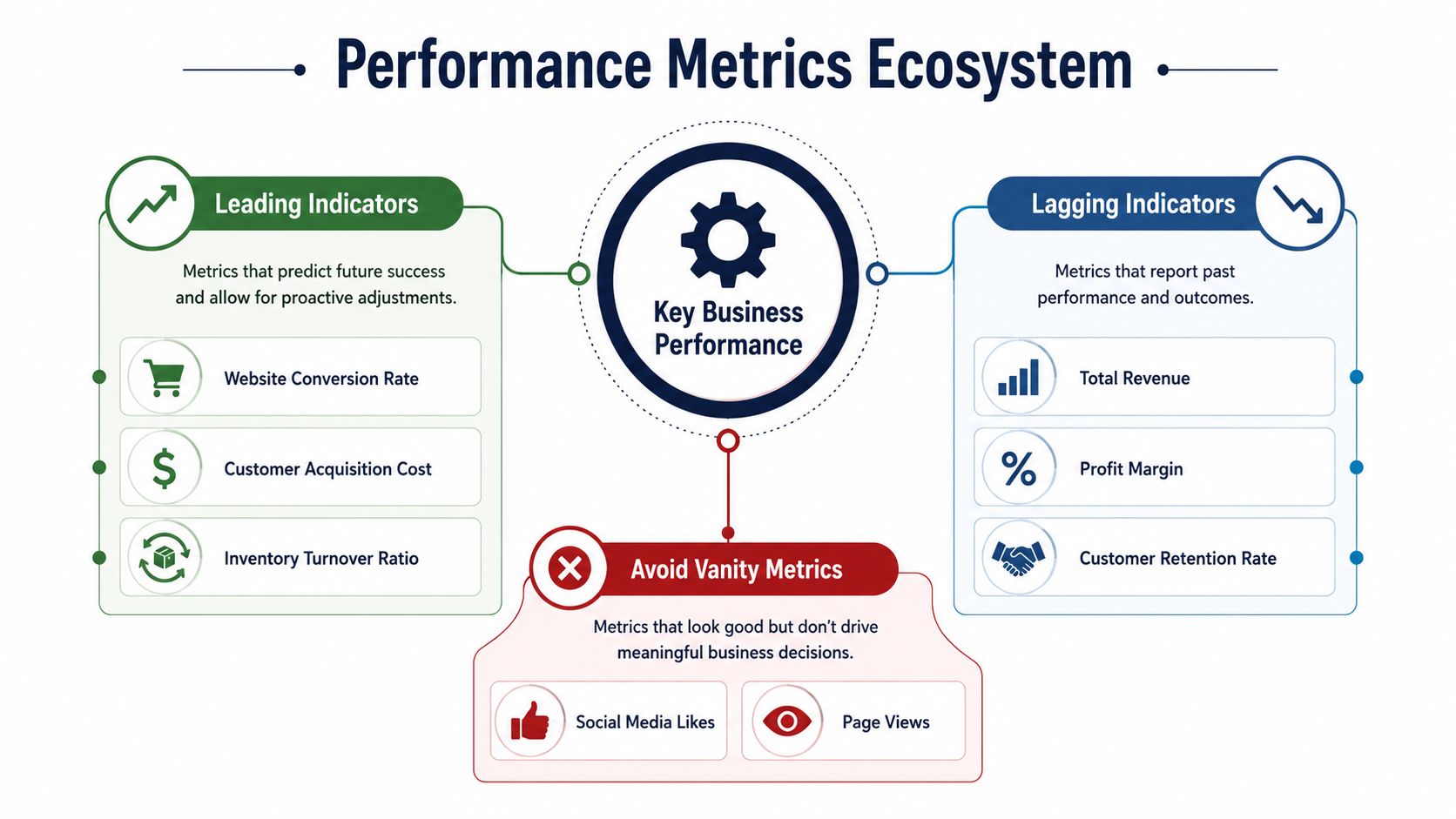
They track what's easy to see, not what helps them intervene early. Revenue, MER, blended ROAS, and contribution margin matter. But those are mostly outcome signals. By the time they move hard in the wrong direction, the underlying problem has already been alive for weeks.
That's why strong accountability systems need both lagging indicators and leading indicators.
Outside e-commerce, the smartest accountability models don't wait for final outcomes. Under ESSA, accountability systems were required to include non-academic indicators, and by 2024 at least 36 states included chronic absenteeism in their calculations, which shows a shift toward tracking signals that predict downstream performance, not just final results (Parent Center Hub on ESSA accountability and school supports).
That's the right lesson for operators. Don't wait for the monthly P&L to tell you what your team should've seen earlier.
A practical scorecard usually has a few layers.
For marketing, I'd care about efficiency and demand quality, but also about the inputs that explain movement. Creative testing volume, landing page conversion behavior, and channel-specific CAC trends tell you more than one top-line ad number.
For operations, inventory health is usually underweighted until it becomes painful. You need metrics that expose stock risk, fulfillment reliability, and exception handling before margin gets crushed by rush decisions.
For customer service, speed matters less than resolution quality if the business has repeat purchase economics. Fast replies that don't solve anything just move the problem.
A simple way to organize it:
If your team needs a plain-language refresher on metric design, this guide on what are key performance indicators is worth sending around before scorecard reviews.
Bad metrics create fake confidence. Good metrics create earlier conversations.
A metric without an owner is trivia.
For every number on the dashboard, answer three questions:
That last part matters. Accountability systems fail when teams think ownership means isolation. The owner is responsible for driving the result. The rest of the business still has to support execution.
Most dashboards fail because they're built for analysis, not management.
A founder opens the file and sees twenty tabs, color codes everywhere, mixed time windows, and numbers nobody fully trusts. That isn't visibility. It's friction.
Your dashboard should answer one question fast: Are we on track, off track, or blind?

I don't care whether the first version lives in Google Sheets, Airtable, Looker Studio, Triple Whale, or another BI layer. I care that a department lead can open it and understand performance in under a minute.
That means the dashboard needs:
A useful pattern is one company-level dashboard plus department scorecards underneath it. The company view should stay tight. Leadership needs signal, not a data museum.
If you're building from scratch, this walkthrough on a performance metrics dashboard for business visibility is a practical starting point.
One of the better lessons from broader accountability design is the focus on growth over static achievement. In 2024, analysis of accountability systems found that student growth was the most common metric used to evaluate performance, with Student Growth Percentiles serving as the primary measure in 24 states (Education Commission of the States comparison of school accountability systems).
For operators, the principle is simple. Don't just ask, “What is the number?” Ask, “Is the number moving in the right direction?”
That changes the conversation. A team can still be below target and making progress, or above target and subtly deteriorating. Accountability systems should surface trajectory, not just position.
The rhythm is what turns data into behavior.
I like a cadence that separates operating review from strategic review:
This video is a useful companion if you want to tighten how those reviews turn into action rather than more discussion.
The biggest mistake is changing the rhythm every time things get noisy. Keep the cadence stable. Change the decisions inside it.
The weekly accountability meeting is where the system either becomes real or turns into theater.
Often, teams call a meeting, review a dashboard, let each person give a status update, and run out of time before solving anything. Everyone leaves informed. Almost nothing changes.
That format kills momentum because updates are not execution.
A good accountability meeting has one job. It identifies what's off track, finds the underlying blocker, and assigns the next action to one owner.
That means you need an agenda that protects time for decisions. Not polished explanations. Not storytelling. Not cross-functional drift.
A practical format looks like this:
Open with the scorecard
Review key metrics quickly. Flag only what's off target, trending badly, or blocked.
Review last week's commitments
Done, not done, or partially done. No long defense.
Surface issues
Pull out the few items that matter most right now. If everything is a priority, the meeting is already broken.
Discuss and resolve
Stay on one issue until there's a decision, next step, or clear owner.
Close with new commitments
Every action item gets one name and one deadline.
At this stage, senior leaders often create drag without realizing it.
If the meeting ends without a named owner and a due date, you had a conversation, not an accountability review.
I'd keep these essential:
| Rule | Why it matters |
|---|---|
| Start with the numbers | It grounds the meeting in facts instead of opinion |
| One owner per action | Shared ownership diffuses follow-through |
| Discuss exceptions only | Healthy metrics don't need airtime every week |
| Capture blockers live | People forget, reinterpret, or soften them later |
The founder's role in this meeting is to maintain standards and clarity. Not to dominate the room.
When the cadence is working, the team starts coming in prepared. They know their numbers. They know where they're stuck. They know what decision they need. That's when accountability systems stop feeling heavy and start creating speed.
Most accountability systems don't fail because the framework was wrong. They fail because leadership introduced the system in a way the team couldn't trust or sustain.
The usual self-inflicted mistakes are predictable.
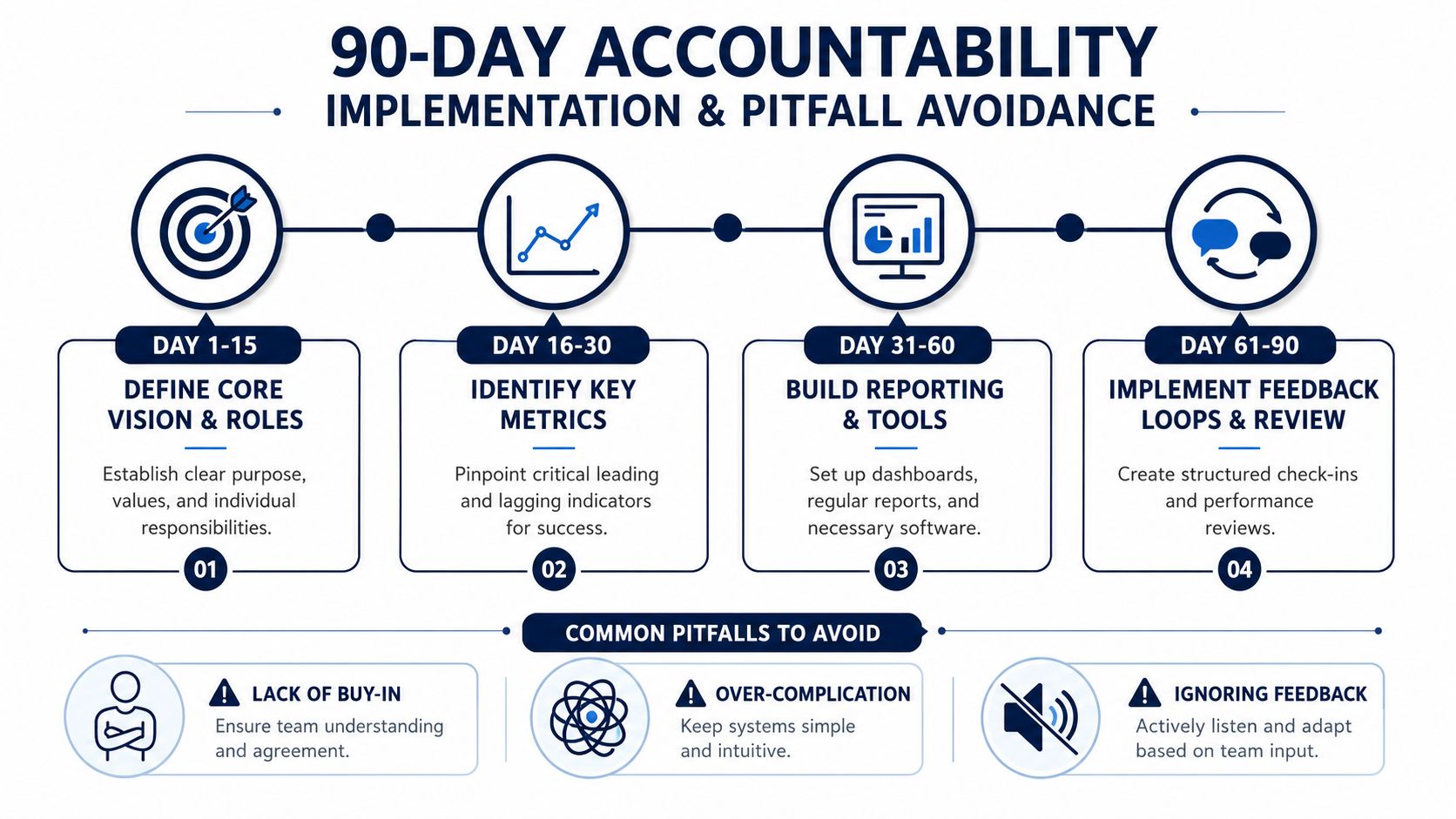
Some of these show up immediately. Others creep in once the novelty wears off.
The cure for most of this is simplicity plus consistency.
Build the smallest system that creates clarity, then strengthen it through repetition.
You do not need a six-month transformation project. You need a disciplined first version.
Start with focus.
Pick the company's most important current objective. Not five priorities. One. Then define the handful of outcomes that prove progress is happening.
At the same time, map role ownership across the leadership team. If a key result doesn't have one clear accountable owner, fix that before you touch software.
Use this phase to answer:
Build the first scorecard and start the rhythm.
Create a simple dashboard with company metrics and a few department-level measures. Keep it narrow. Train the owners to update, explain, and escalate from it.
Then pilot the weekly meeting with one team or the senior leadership group. Don't roll this across the whole business at once if the language of ownership is still soft.
If you want one peer-based option outside your org chart, Million Dollar Sellers includes small accountability squads as part of its community structure, which can help founders pressure-test commitments with other operators. That's useful for founder consistency, but your internal operating cadence still has to stand on its own.
Tighten what's already in motion.
Drop dead metrics. Clarify messy ownership lines. Rewrite vague recurring commitments. Review which issues keep resurfacing and fix the underlying process rather than treating the symptom every week.
By the end of this phase, you want:
| Milestone | What done looks like |
|---|---|
| Clear ownership | Every core metric and project has one accountable owner |
| Stable scorecard | The team trusts the numbers and reviews them consistently |
| Working meeting cadence | Weekly reviews lead to decisions and follow-through |
| Feedback loop | Leaders refine the system based on real friction, not theory |
The point of the first quarter isn't perfection. It's reliability.
If the system helps your team surface problems earlier, make cleaner decisions, and move work without founder rescue, it's working. You can refine from there.
If you're the kind of operator who wants sharper execution, trusted peer feedback, and practical accountability from people already scaling serious brands, Million Dollar Sellers is built for that level of conversation.
Join the Ecom Entrepreneur Community for Vetted 7-9 Figure Ecommerce Founders
Learn MoreYou may also like:
Learn more about our special events!
Check Events