
Chilat Doina
January 23, 2026
A rock-solid foundation for your Amazon Ads isn't just about spending money; it's about making every dollar work towards a specific goal. It's the blend of the right ad formats, a structure built on data, and clear naming conventions that turns clicks into actual revenue.
This is the framework that sets you up to launch, defend, or liquidate with precision.
Before you even think about setting a budget, you need to ask yourself one question: What am I trying to accomplish? Are you launching a new product, defending your turf from competitors, or clearing out old inventory? Answering this upfront ensures every campaign you build serves a clear, strategic purpose.
Choosing between Sponsored Products, Sponsored Brands, and Sponsored Display isn't a random decision. Each one is a tool designed for a specific job.
Think of it like a strategic playbook. The decision tree below breaks down exactly how to align each ad type with your core objective.
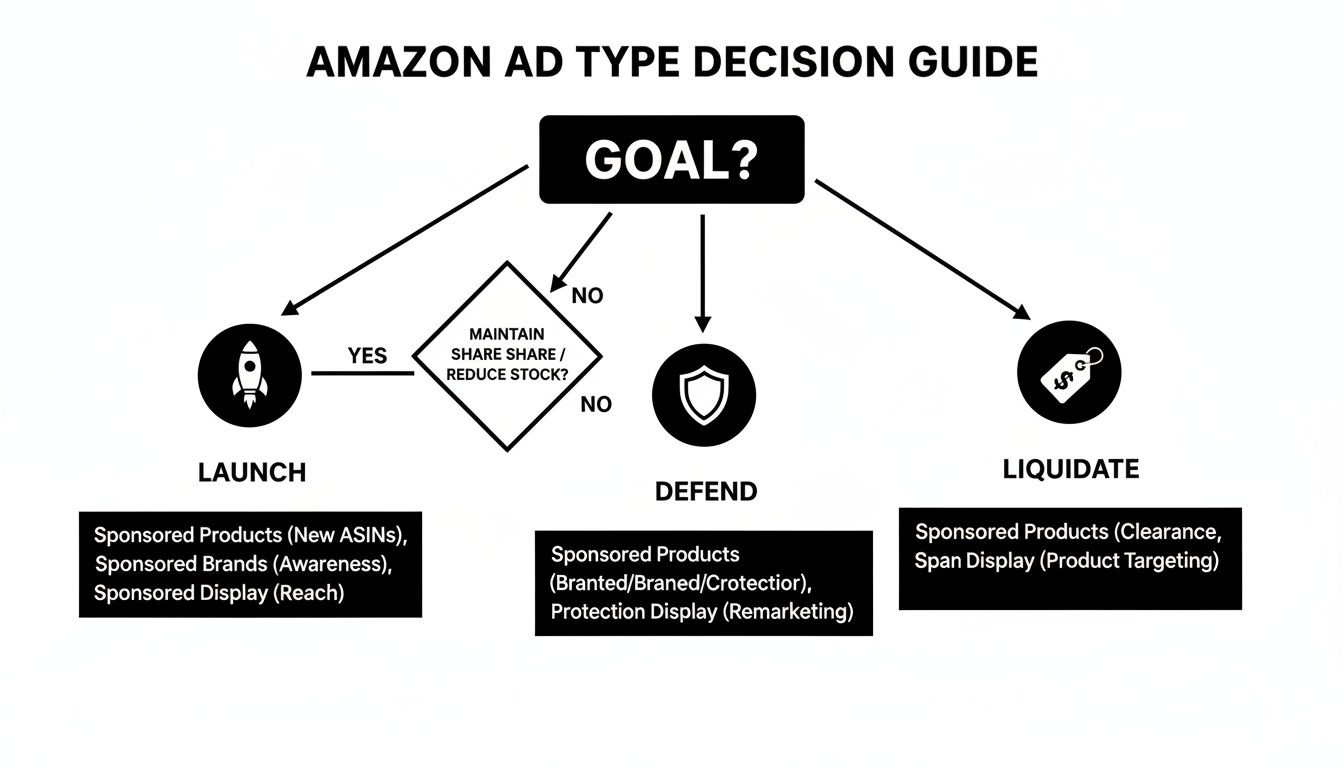
As you can see, the rocket icons point to launch strategies, the shields are for defense, and the price tags are all about liquidation.
With Amazon's ad revenue exploding to $56.2 billion globally—with a single quarter bringing in $17.7 billion (a 24% year-over-year jump)—this isn't a game you can afford to play without a plan. The competition is fierce, and a smart structure is your edge.
For a new launch, Sponsored Products should be your anchor. They get you right in front of shoppers actively searching for what you sell. Once you have some traction, Sponsored Brands come in to build brand recognition with eye-catching banners and video.
I've always found it best to start with a layered keyword approach:
This method of "graduating" high-performing search terms from auto campaigns into tightly controlled manual ones is how you scale what's working while keeping your costs in check. I once worked with an electronics seller who saw "wireless earbuds noise canceling" pop off in a phrase match campaign. We immediately bumped the bid by 30%, and their ACoS dropped by 12% as a result.
Give each product variation its own campaign. I know it sounds like a lot of work, but it gives you surgical control over your budget. From there, group your campaigns logically by brand, product category, and overarching goal. This makes analyzing performance and adjusting bids so much easier.
A pro tip is to group campaigns by season or promotion. For example, your Q4 holiday campaigns should always live in a separate portfolio. This isolates their performance and prevents you from blowing your budget when CPCs inevitably spike.
To help you decide which ad type to deploy for your specific goals, here’s a quick-glance matrix I use with my own team.
This table breaks down the primary use cases and key performance indicators (KPIs) for the three main Amazon ad types. Use it to quickly match the right ad format to your campaign's objective.
Ad TypePrimary GoalBest ForKey MetricSponsored ProductsLaunchNew SKUs, core best-sellersClick-Through RateSponsored BrandsDefendBrand keywords, top-of-search bannersROASSponsored DisplayLiquidateSlow-moving inventory, retargetingConversion Rate
This simple matrix makes it crystal clear which ad type fits your goal—whether it's a launch, defense, or liquidation play—and tells you exactly which KPI to keep your eye on.
A clean, consistent naming convention will save you hours of headaches when it comes time to pull reports. Seriously. Make it a rule to include the goal, ad type, match type, and date in every single campaign name.
Using a standardized date format like YYYYMMDD allows you to sort chronologically in your reports, and adding region codes (like US or EU) at the beginning is a lifesaver if you sell internationally.
“Granular structure and clear names shorten your analysis loop, letting you pivot bids and budgets in minutes, not days.”
Once you're comfortable with individual campaigns, start thinking in terms of portfolios. Building multi-tiered portfolios lets you organize your ad spend by product line or business unit, giving you a much clearer picture of performance.
This approach essentially mimics a corporate P&L, giving you and any stakeholders a clear view of the return on every single ad dollar.
For a deeper dive into structuring your campaigns for massive growth, check out our guide on advanced Amazon advertising strategy. We unpack some complex architectures and share real-world examples from sellers pulling in seven figures.
Building this kind of intentional framework from the start is what allows you to scale with confidence. As Amazon Ads gets more complex, a strong foundation isn't just nice to have—it's your biggest competitive advantage.
Let's be honest: your Amazon Ads campaign lives or dies by its ability to reach the right shopper at the right moment. This isn't about just bidding on a few obvious keywords. It's about building a dynamic targeting machine that combines automated discovery with surgical, manual control to capture customers at every single stage of their buying journey.
The foundation of a truly successful strategy is the keyword harvesting loop. Think of this less as a one-time tactic and more as a systematic, ongoing process for unearthing profitable search terms. You kick things off with an automatic campaign, basically letting Amazon's algorithm do the initial heavy lifting. It'll test your product against a huge range of search queries, often uncovering the exact language customers use—phrases you might never have thought of yourself.
Give that auto campaign a couple of weeks to run, then dive into the search query report. This report is an absolute goldmine. You’re hunting for two specific things: high-performing search terms that actually led to sales, and all the irrelevant queries that just wasted your ad spend.
The terms that convert are your winners. You "harvest" them by strategically moving them into manual campaigns where you get precise control over every bid.
While you're promoting your winners, you have to be ruthless with your negative keywords. Any search query that's clearly irrelevant or has a high click count with zero sales needs to be added as a negative exact match in your auto campaign and as a negative phrase match in your manual ones. This one action can slash wasted ad spend and dramatically improve your ACoS.
Think of it like gardening. Your auto campaign plants hundreds of seeds. The search query report shows you which ones are sprouting into valuable crops. You then move those crops to a dedicated, well-tended garden (your manual campaigns) and pull out all the weeds (negative keywords) that are choking them.
This continuous loop—discover in auto, graduate to manual, and eliminate waste with negatives—is the real engine of a scalable Amazon ads operation.
While keywords are the bedrock of search, relying on them alone is a huge mistake. Product Attribute Targeting (PAT) is an incredibly powerful way to place your ads directly on competitor or complementary product detail pages. This is less about capturing search intent and more about intercepting a shopper mid-browse.
Let's say you sell a premium coffee grinder. With PAT, you can target:
This strategy is fantastic for stealing market share or upselling a customer who is already considering a related item. If someone is buying gourmet coffee beans, showing them an ad for your high-end grinder at that exact moment is just plain powerful. For sellers looking to go even deeper, understanding the nuances of how long-tail keywords perform can give you an additional edge in your campaigns.
The search query report isn't just a list for finding keywords. It’s a direct window into the mind of your customer. When you're analyzing the report, stop looking at just the sales column.
Pay close attention to the click-through rate (CTR) and conversion rate (CVR) for individual search terms.
A term with a high CTR but low CVR might indicate that your ad creative is compelling, but your product page isn't closing the deal for that specific query. Maybe your price is too high, or your bullet points don't address their specific need.
On the flip side, a low CTR but high CVR suggests a hyper-relevant term that you should be bidding much more aggressively on to get more visibility. This level of analysis turns your data from a simple report into an actionable strategic playbook for your entire Amazon ads campaign.
In the hyper-competitive world of Amazon Ads, a “set it and forget it” bidding strategy is a surefire way to burn through your budget. The most successful sellers treat bidding and budget management as a dynamic, ever-changing game. It’s about more than just setting a default bid; it’s about pulling the right levers at the right time to drive profitability.
The whole game revolves around mastering Amazon’s dynamic bidding strategies. Each one has a specific job, and knowing which one to deploy is what separates the pros from the amateurs.
Your choice of bidding strategy needs to be a direct reflection of your campaign's goal. Are you aiming for aggressive growth, consistent profit, or just defending your brand turf?
It's also critical to understand the financial battlefield you're on. The average cost-per-click (CPC) on Amazon recently jumped to $1.12, a sharp 15.5% increase from the previous year. This cost varies wildly by category—from just $0.28 in Culinary to $1.41 in Health. This proves you need a data-driven approach to stay ahead.
Beyond the basic bid, placement modifiers are the secret weapon for grabbing that prime ad real estate. These settings let you bid more aggressively for specific spots, mainly "Top of search (first page)" and "Product pages."
Here’s how it works: you can set a rule to increase your bid by as much as 900% for top-of-search placements. So, if your base bid is $1.00, this modifier tells Amazon it can bid up to $10.00 to secure that all-important first spot. This tactic is a goldmine for your highest-converting, exact-match keywords where being seen first is everything.
A smart placement strategy isn’t about winning every auction; it’s about winning the right auctions. Over-invest in top-of-search for your proven winners and let less critical keywords compete on product pages.
Once you have dozens of campaigns running, managing individual budgets is a recipe for chaos. This is where more advanced techniques like portfolio budgets and the waterfall method become essential.
Portfolio budgets let you group campaigns and assign a single, shared budget. This is brilliant for managing spend for a specific product line, brand, or even a seasonal event like a "Q4 Holiday" portfolio. It gives you a bird's-eye view and stops one rogue campaign from blowing up your entire strategy.
The waterfall method is a more hands-on approach to divvying up your cash:
This tiered approach ensures every ad dollar is working as hard as possible. To really get an edge, developing Real-Time Bidding expertise is crucial for maximizing spend in a competitive auction environment. By shifting from a reactive to a proactive bidding mindset, you turn your Amazon ads from a simple expense into a powerful engine for growth.
Getting clicks to your product page is just the start. The real magic happens when that traffic converts into sales, and that's what fuels a profitable Amazon Ads campaign. A killer ad can get a shopper to your digital doorstep, but it’s the product listing that actually invites them inside and closes the deal.
These two pieces aren't separate tasks to be checked off a list—they are two halves of the same conversion-focused system.
Think of it like this: your ad makes a promise, and your listing has to deliver on it, instantly. This is a concept we call ‘ad scent’. It’s the seamless trail a shopper follows from the ad creative they just clicked to the information on your product detail page. When the scent is strong—meaning your ad’s main image, headline, and keywords perfectly match your listing’s title, images, and A+ Content—the customer journey feels natural and trustworthy.
But a disconnect creates friction. That friction leads to a quick exit. If your ad for a "silent, portable fan" leads to a listing that doesn't mention the word "silent" right away in the bullet points, you’ve broken the ad scent. And you've probably lost the sale.
To build this seamless experience, start by mirroring the language from your best-performing ad campaigns directly onto your product listing. Dive into your search query reports and find the exact phrases customers are using to find and buy your product.
A great Amazon Ads campaign doesn't just generate traffic; it generates qualified traffic. The best way to qualify that traffic is to ensure your ad and listing tell the same compelling story, leaving no room for doubt.
This synergy has a direct impact on your conversion rate. A higher conversion rate doesn't just mean more sales; it also improves your ad’s relevance in Amazon’s algorithm, which can lead to better ad placements and lower CPCs down the road. To get the most out of your ads, you have to optimize Amazon listings so your product pages are primed to convert after the click.
Never assume you know which ad creative will land the best. Sponsored Brands offer a fantastic playground for testing different creative elements to see what actually gets a response from your audience.
Run simple A/B tests on your ad creative, but make sure you only change one variable at a time:
By constantly testing, you’re not just optimizing ads; you're gathering a goldmine of data on what messages and visuals drive action. These insights are invaluable and should be used to refine your entire product listing. For a deeper dive, our guide on Amazon listing optimization covers more advanced tactics.
Relying solely on Advertising Cost of Sales (ACoS) to measure your Amazon ad success is like driving a car while only looking at the speedometer. It tells you one important thing, but you’re missing the bigger picture of where you're going and how the engine is really performing.
Any seasoned seller will tell you that true performance is measured by looking at the entire business, not just isolated ad spend. To get that holistic view, you need to bring in a few other metrics that show the real impact of your advertising on your brand’s overall health.

The first metric you absolutely need to adopt is Total Advertising Cost of Sales (TACoS). This one is a game-changer.
While ACoS measures the efficiency of your ads against your ad-driven sales, TACoS measures your ad spend against your total sales—both paid and organic. Why does this matter? Because it reveals the "flywheel effect" of your advertising.
If you see your TACoS decreasing over time, even while ACoS stays flat, that’s a huge win. It's a clear signal your ads are successfully boosting organic rank and driving organic sales. You're not just buying sales for today; you're building brand momentum for tomorrow.
A healthy TACoS is the clearest sign that your Amazon Ads campaign is creating a sustainable growth engine, not just a temporary sales spike. It proves your ad dollars are an investment in your brand’s long-term organic visibility.
Next up is Return on Ad Spend (ROAS). While ACoS is an Amazon-specific metric focused on cost, ROAS flips the script to focus on revenue.
It’s calculated by dividing your ad-attributed sales by your ad spend. So, a ROAS of 4 means you’re generating $4 in revenue for every $1 spent on ads. Simple.
ROAS helps you tie your advertising performance directly to your broader business goals. It answers the one question every stakeholder wants to know: "For every dollar I put in, how many am I getting back?" This makes it much easier to communicate performance to people who aren't living and breathing Amazon acronyms all day.
Understanding these metrics is more important than ever as Amazon's ad platform continues to explode. We’re talking about an ecosystem that generated a staggering $17.7 billion in ad revenue in a single recent quarter.
The platform is evolving fast, now letting advertisers buy space on services like Netflix and Spotify directly through Amazon Ads. This shows just how serious Amazon is about becoming a full-blown advertising network.
While this means we're reaching an audience with high purchase intent, it also means competition—and costs—are on the rise. You can discover more stats on Amazon’s ad services to get a sense of this massive growth.
To keep things straight, here’s a quick-glance table breaking down these three core metrics. It helps to see them side-by-side to understand when and where to use each one.
MetricCalculationWhat It MeasuresBest Used ForACoS(Ad Spend ÷ Ad Sales) × 100Ad campaign efficiencyOptimizing individual campaigns for profitability.TACoS(Ad Spend ÷ Total Sales) × 100Impact of ads on overall business healthAssessing brand growth and organic sales lift over time.ROASAd Sales ÷ Ad SpendRevenue generated per dollar of ad spendAligning ad performance with broader business profitability goals.
By tracking ACoS, TACoS, and ROAS together, you get a multi-dimensional view of your campaigns. This is how you move from just tweaking bids to making smart, data-driven decisions that drive sustainable, long-term growth for your entire brand on Amazon.
Even the most seasoned Amazon sellers hit a wall sometimes. The platform never stops changing—new tools, new ad formats, and new competitors popping up every day. Let's tackle some of the most common questions we hear from advanced sellers who are trying to stay ahead of the curve.
There’s no magic number here; it really comes down to your campaign's age and what you're trying to accomplish.
For a brand-new product launch or during a huge sales event like Prime Day, you need to be in there daily. CPCs can swing wildly in these moments, and you have to be nimble. You’re either capturing a wave of momentum or you're cutting your losses before they sink you.
On the other hand, for mature, stable campaigns that have been chugging along for months, a weekly or bi-weekly check-in is usually plenty. The biggest mistake you can make is overreacting to one bad day. Always look at your data over a solid 7 to 14-day window to smooth out the natural dips and account for conversion lag before you go making any big changes.
Amazon's AI and generative tools are getting surprisingly good. If you’re managing a massive catalog or just don't have the hours for manual tweaking, they can be a huge help. For example, some of the new AI assistants can scan your product page and whip up campaign ideas, headlines, and even lifestyle images—a massive leg up for smaller brands.
These tools are fantastic for getting the ball rolling and handling optimization at a broad level. But they are absolutely not a "set it and forget it" solution.
Think of Amazon's AI as a highly skilled co-pilot. It can manage the controls and suggest routes, but you, the experienced seller, should always remain the captain, ready to take over and make the final strategic decisions.
Let the AI handle the broad strokes, but keep your hands on the wheel for your most important, highest-spend campaigns. That's where a human touch and nuanced strategy really pay off.
Launching a new product is all about aggressive data collection and building momentum—fast. Too many sellers play it safe, and their launch fizzles out. You have to come out swinging.
Here's a solid launch structure:
This layered attack lets you learn, expand, conquest your competition, and defend your own turf all at the same time.
The idea of a "good" ACoS is probably one of the most misunderstood concepts in this game. There is no magic number. The right ACoS for you depends entirely on your product's profit margin and your goal right now.
First, figure out your breakeven ACoS. It’s just your pre-ad profit margin. If your profit margin is 30%, then an ACoS of 30% means you’re breaking even on ad-driven sales. Anything lower, and you're profitable.
But your target ACoS is a moving target. It should change based on what you're trying to do.
Campaign GoalTarget ACoS GuidelineNew Product LaunchAim at or even slightly above your breakeven. You're buying data and sales velocity, not profit.Maximize ProfitabilityTarget an ACoS well below breakeven (e.g., 15-20% on a 30% margin product).Liquidate InventoryACoS could be way above breakeven. The goal isn't profit; it's getting your capital back.
Think of your ACoS target as a flexible lever you pull, not a fixed rule you follow.
With the average CPC on Amazon constantly climbing, this is the million-dollar question. The single best defense against rising costs is an obsessive focus on your conversion rate.
When you improve your conversion rate, every click you pay for becomes more valuable. This lets you stay profitable even when your competitors are getting squeezed by high CPCs.
Here's what to focus on:
Ultimately, winning in a high-cost environment isn't about finding the cheapest clicks. It's about making sure the clicks you do buy have the best possible chance of turning into a sale.
At Million Dollar Sellers, we know the best advice comes from people who are actually in the trenches, scaling seven- and eight-figure brands. Our private community is where top e-commerce entrepreneurs share the real-world strategies that work. If you're serious about scaling and want to learn from the best, see what MDS is all about.
Join the Ecom Entrepreneur Community for Vetted 7-9 Figure Ecommerce Founders
Learn MoreYou may also like:
Learn more about our special events!
Check Events