Chilat Doina
April 5, 2026
For most e-commerce founders, Amazon feels like a giant, bustling retail mall. Your entire strategy is built around attracting individual shoppers and winning them over, one at a time, with great listings and sharp pricing.
That’s a powerful model, but it’s only half the picture.
Now, imagine an exclusive wholesale district right next to that mall. This is a place where entire organizations—from small startups to Fortune 500 companies—show up to buy products in bulk. That’s Amazon Business.
It isn't just a minor feature or some add-on. It's a dedicated B2B marketplace that opens up a massive growth channel for sellers who are ready to scale. This parallel ecosystem lets you tap into enterprise-level demand without having to build a traditional outbound sales team from scratch.
You’re basically getting access to a completely new type of customer, one with entirely different buying habits and needs than your average shopper.
Think about the sheer difference in scale. A single customer might buy one desk lamp for their home office. An organization, on the other hand, could order 500 of them to furnish a new corporate campus.
Amazon Business is built from the ground up to handle these bigger, more complex sales. A few key features make this possible:
This structure shifts your focus from just selling to individual shoppers to supplying entire operations.
The scale of this opportunity is hard to overstate. Amazon Business has exploded into a B2B powerhouse, driving over $35 billion in annualized gross sales as of late 2026. This isn't just a number—it's your brand's ticket to scaling globally. Business Prime now serves over eight million organizations across 11 key markets. Dive deeper into this massive B2B sales channel and what it means for sellers.
Activating Amazon Business does more than just open a new sales channel. It signals to professional buyers that you’re set up to handle their needs, which instantly builds a level of credibility a standard B2C listing can't match.
For founders shooting for 7- and 8-figure growth, understanding these B2B online marketplaces is no longer a "nice-to-have." It’s a vital piece of a smart, diversified sales strategy. Your products can land in offices, warehouses, and boardrooms all over the world—all powered by Amazon's incredible infrastructure.
Jumping into Amazon Business isn't just about flipping a switch to get a few new features. It's about fundamentally changing who you can sell to and how you sell to them. It gives you a direct line to a massive new customer base: verified organizations.
These aren't your average shoppers. We're talking about professional buyers from local government agencies, procurement managers for multinational corporations, and small business owners stocking up for their teams. Their needs are different, their budgets are bigger, and they care deeply about efficiency—a huge opportunity for brands ready to meet them on their terms.
This image really clarifies how Amazon's market is split, showing the difference between individual consumers and the organizations you can reach with Amazon Business.
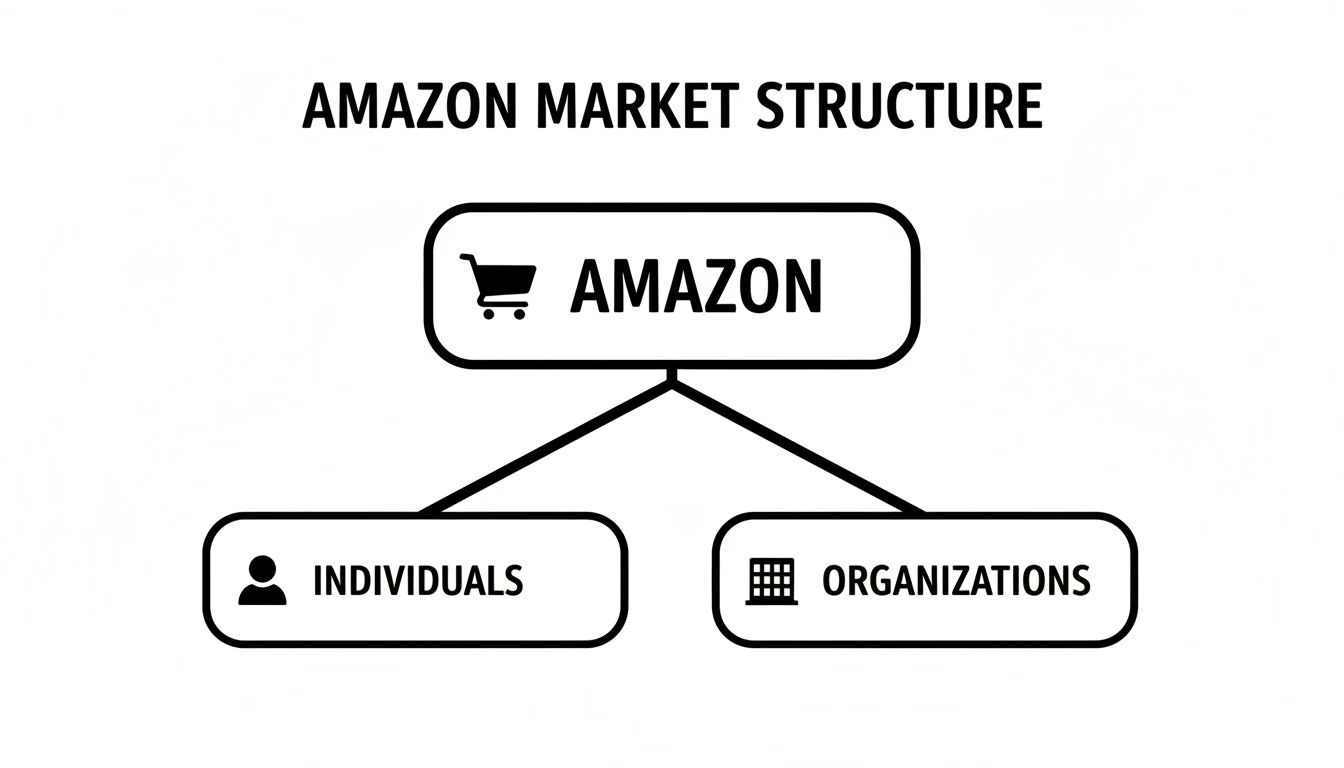
What this shows is that by turning on the business features, you're strategically setting up your brand to serve two very different, high-value customer groups all from a single account.
Before we dive into the specific features, it's helpful to see a side-by-side comparison. Here’s a quick breakdown of what you unlock by becoming an Amazon Business Seller.
| Feature | Standard Seller Account | Amazon Business Seller Account |
|---|---|---|
| Customer Base | Primarily B2C (individual consumers) | B2C + a vast B2B network of verified organizations |
| Pricing Options | Standard retail pricing only | Business Pricing and Quantity Discounts available |
| Tax Handling | Standard sales tax applied to all purchases | Automated tax-exempt purchasing for eligible organizations |
| Seller Profile | Standard seller information | Enhanced profile with quality certifications & diversity credentials |
| Product Content | A+ Content for retail audience | Ability to add user guides and CAD files for professional buyers |
| Analytics | Standard sales and traffic reports | Access to Amazon Business Analytics for B2B performance |
| Brand Credibility | Build credibility with retail reviews and ratings | Build B2B credibility with tailored content and certifications |
This table makes it clear: Amazon Business isn't just an add-on; it’s a toolkit designed to help you win over an entirely new and lucrative market.
One of the most immediate perks is the ability to set up a tiered pricing strategy. This lets you offer exclusive, lower prices just for verified business accounts, completely hidden from your regular retail customers. Even better, you can set up quantity discounts to reward buyers for placing larger orders.
Think about it this way: a retail customer buys one bag of your premium coffee. A business buyer, on the other hand, needs to stock an entire office breakroom for the month. By offering a 10% discount on orders of 10 bags and a 15% discount on 20, you're directly encouraging a much higher average order value (AOV).
This stuff works. In the first half of one recent year, business buyers saved over $150 million just from quantity discounts in the U.S. When you enable this, you aren't just offering a deal; you're aligning with the core goal of every procurement department: getting more value for their budget. For a deeper look, check out our guide on how to master your Amazon Business pricing strategy.
For a lot of organizations—think nonprofits, schools, and government agencies—sales tax is a huge purchasing hurdle. The paperwork involved in getting reimbursements or filing for exemptions is a total nightmare for their accounting teams.
Amazon Business gets rid of that friction entirely. Verified organizations can apply their tax-exempt status directly to their accounts. When they buy from you, the tax is automatically stripped out at checkout.
By removing this single point of friction, you make your products instantly more attractive to a huge segment of the B2B market. This isn't just a convenience; it's a powerful conversion driver that can be the deciding factor between a buyer choosing your product over a competitor's.
This simple, automated process makes it far easier for these organizations to buy from you, opening the door to customers who might have otherwise been impossible to reach.
Professional buyers aren't just looking for a product; they're vetting a supplier. Amazon Business gives you the tools to speak their language by tailoring your branding and content for a B2B audience.
You can use your Enhanced Brand Content (A+ Content) and Storefront to address their specific concerns. Instead of focusing only on lifestyle benefits, you can highlight things like:
When you create content that speaks the language of business procurement, you build instant credibility. You're no longer just a random seller; you're a reliable partner for their operational needs. This shift in perception is what sets the stage for long-term, high-volume relationships and helps you build a much more resilient brand.
A lot of sellers write off Business Prime as just a perk for buyers. That’s a huge miss.
Think of it less as a shipping program and more as a high-powered magnet for your ideal B2B customers—the ones who buy in bulk and come back for more. It’s a system designed to funnel the most active and loyal business buyers straight to your listings.
When a company signs up for Business Prime, they’re making a real commitment. They've essentially decided to consolidate their purchasing with sellers who meet the program's fast, free delivery standards. For you, this isn't just a nice-to-have; it's a massive competitive advantage.
This image of a warehouse manager orchestrating procurement from a tablet is the perfect visual. It’s the modern, efficient B2B world that Business Prime powers. As a seller, your products become a seamless part of that fast-moving supply chain.
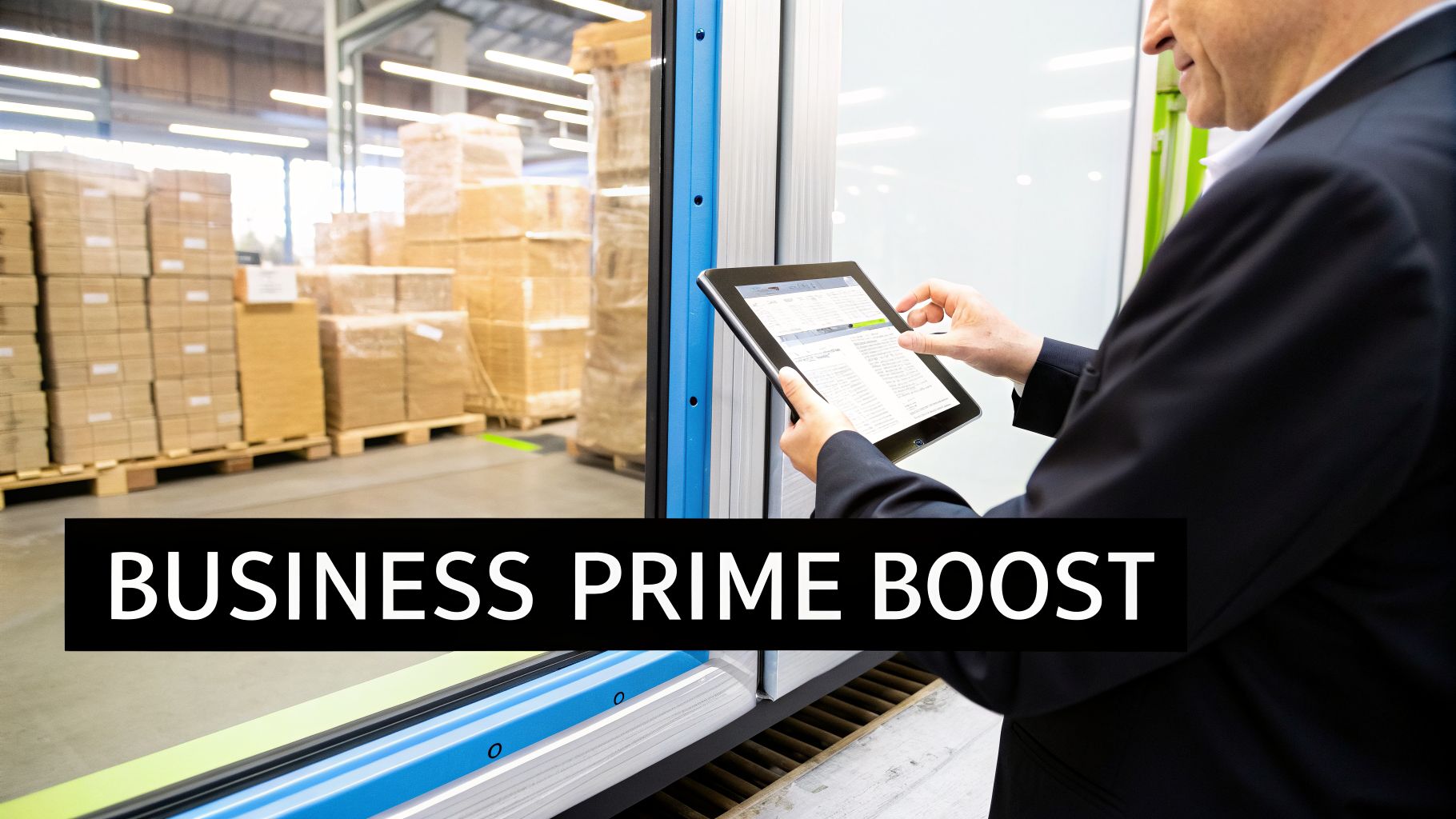
This level of efficiency is what drives serious sales velocity. The sheer convenience of getting fast, free shipping for an entire team removes a major roadblock in the procurement process, paving the way for bigger and more frequent orders.
For any business buyer, shipping costs aren't a minor detail—they're a line item that can make or break a budget. Business Prime completely wipes that concern off the table.
When a buyer knows their whole team can get what they need delivered quickly, with zero shipping fees, their buying habits change. Instantly.
Suddenly, ordering from you is the easiest, most logical choice. This translates into some very real benefits for your brand:
This whole dynamic builds an incredibly "sticky" customer base. Once a company gets used to the ease of Business Prime, they have almost no incentive to go back to sellers who can't offer the same speed and savings.
Selling on Amazon Business unlocks speed and savings that directly fuel e-commerce scaling. In fact, Prime members saved $750 million in shipping fees globally in 2026, while enjoying same-day or next-day delivery on nearly 50% of orders worldwide and over 70% in the US. This is a game-changer for brand owners aiming to hit million-dollar milestones. You can discover more insights about this trend and its impact on e-commerce.
It’s not just about the shipping, though. Business Prime comes with a whole suite of tools that simplify life for buyers, which is great news for you. Features like Spend Visibility and Guided Buying give procurement managers tight control over their team's spending.
These tools let companies create purchasing policies that can actively steer buyers toward certain products or sellers. For instance, a company could set up a rule to prioritize products from sellers with specific diversity certifications or those who offer quantity discounts.
By enrolling in the Amazon Business seller program and setting up your offers correctly, you're making it incredibly easy for these large organizations to channel their budget toward your products.
You're no longer just selling an item. You're offering a complete solution that slots perfectly into their managed buying system. This is how you go from being a one-off supplier to a trusted, preferred vendor locking in consistent, high-volume sales.
For any seller with big ambitions, gut feelings and experience will only get you so far. Real, lasting growth is built on data. This is where one of the best perks of Amazon Business really shines: a powerful set of analytics and integration tools that completely change how you see and connect with your B2B customers.
These tools are a massive step up from basic sales reports. Think of your standard Seller Central analytics as a rearview mirror—it only shows you where you’ve been. Amazon Business Analytics, on the other hand, is like having a GPS and a weather radar all in one. It helps you see the road ahead and spot opportunities before they even hit.
This is a game-changer for any brand that wants to scale with a clear plan, not just by pure luck. It gives you the hard data you need to make smarter calls on your products, pricing, and marketing.
Amazon Business Analytics gives you a dedicated dashboard with a microscope-view of your B2B performance. It goes way beyond just looking at total sales, breaking down exactly who is buying from you and how they’re doing it.
With these reports, you can finally get answers to the tough questions that were nearly impossible to track before:
This kind of detail is a goldmine for your strategy. If you find out that hospitals are a huge chunk of your sales, you can start building product bundles just for them or run targeted ads to catch the eye of more healthcare procurement managers. This is how you start actively chasing growth instead of just waiting for it to show up.
Beyond its own analytics, the way Amazon Business connects with other professional tools is a huge signal of how serious it is about the B2B world. Even if you, as a third-party seller, don't directly use every single integration, their very existence is a massive plus for you.
When big companies see that Amazon Business plays nicely with their essential procurement and accounting software, it sends a clear message: this is a professional ecosystem built for serious business. This builds a layer of trust that makes them comfortable making large, regular purchases—which is great news for every seller on the platform.
This seamless experience is a core reason big buyers are flocking to the platform. A recent procurement report found that a whopping 74% of business leaders are focused on using data to be more efficient, and 24% see procurement’s main job as simplifying internal processes. By offering tools that do just that, Amazon makes the entire marketplace more appealing. You can dig into how procurement leaders are using data to reshape their strategies to see just how important this is.
At the end of the day, data is only useful if you do something with it. The insights from Amazon Business Analytics should be the driving force behind your sales and marketing moves. It lets you swap out guesswork for smart, data-backed decisions.
Here’s what that looks like in the real world:
This is so much more effective than just casting a wide net and hoping for the best. It lets you put your time and money where they’ll actually make a difference. For sellers serious about scaling, learning to drive sales with AI and advanced analytics is what separates the good from the truly great.
Alright, you see the potential of Amazon Business. Now, how do you actually get in on the action? Good news: this isn't some month-long ordeal. It's a straightforward process within Seller Central that any Professional Seller can complete to open their brand up to a massive new B2B audience.
Think of it like this: your standard Seller Central account is a retail storefront. Activating Amazon Business is like adding a wholesale warehouse out back. The foundation is there, but you're installing new loading docks, setting up bulk pricing, and putting up a sign that says "We're open for big orders." Let's get it done.
Before you can flip any switches, you need to make sure Amazon sees you as a qualified B2B partner. They have a couple of non-negotiable requirements to ensure business buyers get a consistent, high-quality experience.
You absolutely must have:
These aren't just hoops to jump through. They're smart quality control measures that protect the integrity of the B2B marketplace, which is a win for every serious seller on the platform. If you meet these criteria, you’re ready to move on.
Your next move is to build out a profile that speaks directly to a procurement manager, not a casual shopper. This is your first handshake, and it happens right in the B2B section of Seller Central.
This is where you'll set up your Business Profile, adding your company logo and telling your story from a B2B perspective. A well-written profile adds an immediate layer of credibility, separating you from the sellers who just haven't bothered.
Your Business Profile is where you signal that you're a serious B2B partner. This is the place to build trust before a buyer even looks at your products. Think of it as your digital business card for the entire Amazon Business ecosystem.
With your profile in place, it’s time to activate the features that actually drive B2B sales. This involves two critical steps that can make or break your success.
By taking the time to configure these settings, you’re doing more than just "activating" an account. You're strategically positioning your brand to attract and win over the biggest buyers on Amazon.
Alright, you’ve flipped the switch on your account and set up some business pricing. Now the real fun begins.
Getting past the setup phase and into the 7-figure mindset means you have to stop treating Amazon Business as just another add-on. Think of it as its own dynamic sales channel that needs constant attention and optimization. This is where you graduate from simply having the features to strategically using them to drive some serious growth.
For established sellers, this is about more than just your current product lineup. It's about taking a hard look at your catalog and aligning it with the very specific, often unmet, needs of professional buyers.
Here’s a hard truth: your best-selling retail product might completely miss the mark with a business buyer. They aren't thinking about a single item; they're thinking about efficiency, bulk orders, and how a product fits into their daily operations. You can get way ahead of the curve by creating product variations just for them.
This could look like:
These aren't just new listings—they are direct answers to the daily headaches of procurement managers. They signal that you get their world and are built to serve it.
The most successful 7-figure sellers don’t wait for B2B customers to stumble upon them; they actively build a product ecosystem that anticipates what these buyers need. It’s a powerful feedback loop where you dig into B2B reviews and Q&A to fuel your next product development cycle, treating the channel as a goldmine of market intelligence.
One of the biggest perks of Amazon Business is the ability to run razor-sharp ad campaigns. You’re not just throwing keywords at the wall anymore. Now, you can point your ad spend directly at specific types of buyers, which makes your campaigns incredibly efficient.
With Sponsored Display ads, for instance, you can target audiences by:
Imagine you sell ergonomic office chairs. You can run a campaign that only appears for buyers Amazon has identified as working in the "IT & Tech" industry at companies with over 500 employees. That level of precision means nearly every dollar you spend lands in front of a relevant, high-potential customer. For 7-figure sellers looking to really nail their presence, a winning Amazon marketing strategy can offer deeper insights into these advanced tactics.
This strategic approach completely changes the game, turning your advertising from a wide net into a precision tool for B2B customer acquisition.
Transitioning from a purely retail mindset to a B2B focus can feel like uncharted territory. Let's walk through some of the most common questions we see from sellers about Amazon Business to clear up the confusion and help you figure out if it's the right play for your brand.
Think of it less like a separate account and more like unlocking a new set of features on your existing Seller Central dashboard. Your "regular" account is your B2C storefront, built for individual shoppers. When you flip the switch on Amazon Business, you're just adding a powerful B2B toolkit on top of it.
This opens up the ability to set business-only pricing, offer tiered quantity discounts, and dig into B2B-specific analytics. You also get your products in front of buyers using tax-exempt purchasing, which is a massive, often untapped, customer base.
This is a point of confusion for a lot of people, but the answer is surprisingly simple: there is no extra monthly fee to sell on Amazon Business. All you need is a Professional Selling Plan, which any serious seller already has.
Your standard referral fees still apply. But here's the kicker: for certain high-volume B2B transactions, Amazon has a tiered fee structure that can actually give you lower fees on larger bulk orders. That difference goes straight to your bottom line.
One of the biggest wins with Amazon Business is managing everything—B2C and B2B—from a single Seller Central account. Your current listings are instantly visible to business buyers. From there, you just layer on your business-specific offers without having to create a single duplicate listing. It makes managing both channels incredibly efficient.
While almost any product can find a business buyer, some categories are just a natural fit. Think about items that businesses, schools, or government agencies need to buy over and over again for their daily operations. For more general business questions, a resource like this general FAQ can provide broader context.
The categories that often see immediate traction include:
One of the smartest strategies we see is taking your best-selling B2C products and simply bundling them for a business audience. Think about creating multi-packs, case packs, or office-ready kits. This makes it a no-brainer for a procurement manager to click "buy."
At Million Dollar Sellers, we believe in turning insights into action. Our community is built for top-tier founders who are ready to move beyond the basics and master advanced strategies for channels like Amazon Business. If you're ready to scale alongside the best in the industry, find out what MDS is all about. Learn more at Million Dollar Sellers.
Join the Ecom Entrepreneur Community for Vetted 7-9 Figure Ecommerce Founders
Learn MoreYou may also like:
Learn more about our special events!
Check Events