Chilat Doina
March 29, 2026
If you're already selling on Amazon, you're running a retail shop. But what if you could open a wholesale warehouse right next door, serving a completely different type of customer? That’s the simplest way to think about Amazon Business pricing. It’s your gateway to serving professional buyers who need to buy in bulk and want a reliable supplier, not just a one-off deal.
For ambitious e-commerce founders, this isn't about just knocking a few cents off your products. Think of it as a powerful lever you can pull to open up a whole new B2B revenue stream that runs alongside your current retail sales. It lets you court a different kind of buyer—one who values efficiency, simplified purchasing, and a consistent supply chain far more than just the rock-bottom price.
This is a shift in mindset. You're not just trying to move more units; you're building relationships with loyal, high-volume buyers. These are the customers who keep coming back: small businesses, schools, hospitals, large corporations, and even government agencies all looking for a go-to source for their operational needs.
By setting up separate pricing for business customers, you can effectively cater to both your everyday shoppers and professional B2B buyers at the same time. You’re essentially serving two distinct markets from one storefront, without one eating into the other's sales.
To give you a clearer picture, let's break down the key differences between your standard consumer-facing store and your B2B setup.
FeatureStandard Amazon (B2C)Amazon Business (B2B)Primary CustomerIndividual consumersVerified businesses of all sizesPricing ModelSingle unit price for allExclusive business price + quantity discountsOrder SizeTypically small, single-item ordersOften large, bulk ordersKey Buyer MotivationBest price, fast shipping, reviewsEfficiency, reliability, procurement easeTaxStandard sales taxTax-exempt purchasing options availableVisibilityPrices visible to all Amazon usersSpecial pricing only visible to business accounts
As you can see, it’s a fundamentally different ballgame. While your B2C strategy might focus on impulse buys and broad appeal, your B2B strategy is all about becoming a trusted, long-term supplier.
Figuring out how to structure your business offers is absolutely critical for scaling your brand. This isn't just about slashing prices for bulk orders; it's about making a calculated bet based on your costs, margins, and the wider market. The competitive field on Amazon is constantly in flux. For instance, an analysis of top-selling products in 2023 showed that 53% had actually increased their prices from the previous year, as sellers wrestled with inflation and supply chain costs. Knowing these trends helps you position your business prices smartly.
When you tap into the Amazon Business ecosystem, you unlock some serious advantages:
Of course, this isn't the Wild West. You have to play by Amazon's rules. Before you dive in, it’s essential to get familiar with guidelines like the Amazon Fair Pricing Policy For Sellers Explained. Getting your pricing system right means having a rock-solid grasp of these rules and your own numbers. To get a complete picture, our guide on Amazon pricing strategies is a great place to start.
To really nail your Amazon Business pricing, you have to get inside the head of your customer. And let me tell you, a business buyer thinks on a totally different wavelength than your average retail shopper. They aren't just scrolling for a one-off impulse buy; they're on a mission, executing a professional procurement strategy for their company.
Think of it this way: a retail customer is like someone grabbing a single coffee on their way to work. A business buyer is the office manager tasked with stocking coffee for a 50-person company for the next three months. Their decision isn't about the cheapest cup today. It's about the total cost, delivery reliability, how easy it is to reorder, and getting the whole thing approved by accounting.
For a business buyer, the price tag is just one piece of a much larger puzzle called Total Cost of Ownership (TCO). They’re constantly weighing factors that boost efficiency and keep their budgets in check. If you want to win their business, you need to understand what actually drives their decisions.
It almost always boils down to making their internal processes smoother:
This is exactly why Business Prime memberships are so appealing to them. As Amazon’s own portal shows, the whole value proposition is built around control and efficiency, not just a race to the bottom on price.
The screenshot doesn't just scream "cheap." It highlights benefits like "Spend Visibility" and "Guided Buying," which speak directly to a procurement manager's core needs for control and compliance.
A Business Prime membership fundamentally changes how these buyers use the marketplace. For you as a seller, figuring this out is the key to getting your pricing and listings right. When a buyer has Business Prime, they are actively hunting for sellers and products that make their job easier.
A business buyer gets rewarded for saving time and ensuring compliance, not just for saving a few bucks. If your product helps them do that, you can become their go-to supplier—even if you aren't the absolute cheapest option.
For example, a construction manager might use Guided Buying to set a policy that only ANSI-certified safety vests can be bought by their team leads. If you sell certified vests and call that out in your listing, you’re automatically funneled to this high-value buyer. They don't have to waste a second sifting through non-compliant junk.
This same logic applies everywhere, from libraries needing specific book cataloging data to IT departments ordering standardized keyboards. Your pricing strategy, then, becomes more than just a number; it's a signal that you get it—you understand their professional needs and are here to meet them.
Alright, enough with the theory. Let's get our hands dirty in Seller Central and start setting up the pricing that actually wins over B2B buyers. This is where you move from just knowing about Amazon Business to actually using it to pump up your revenue and average order value.
The easiest way to start is by setting a single, exclusive business price. Think of this as your "welcome" mat for professional buyers. It’s a special price that only verified Amazon Business accounts can see, and it’s your first step in showing the B2B world you’re open for business.
To get this going, jump into your Seller Central dashboard, go to the "Pricing" tab, and click "Manage Pricing." Find the SKU you want to work on. You'll see your standard price, and right next to it, a field for "Business Price."
All you have to do is type a number in there. For instance, if you sell an item for $20, you might set the business price to $19. It's a small but powerful signal that you recognize and value professional customers.
But the real money in B2B isn't in single-unit sales. It's in quantity discounts. This is how you incentivize those big, juicy bulk orders that can transform your sales figures. You’re essentially building a wholesale model directly into your Amazon listing.
To do this right, you need to get inside the head of a business buyer. They're not just bargain hunting; they're juggling budgets, efficiency, and company rules.
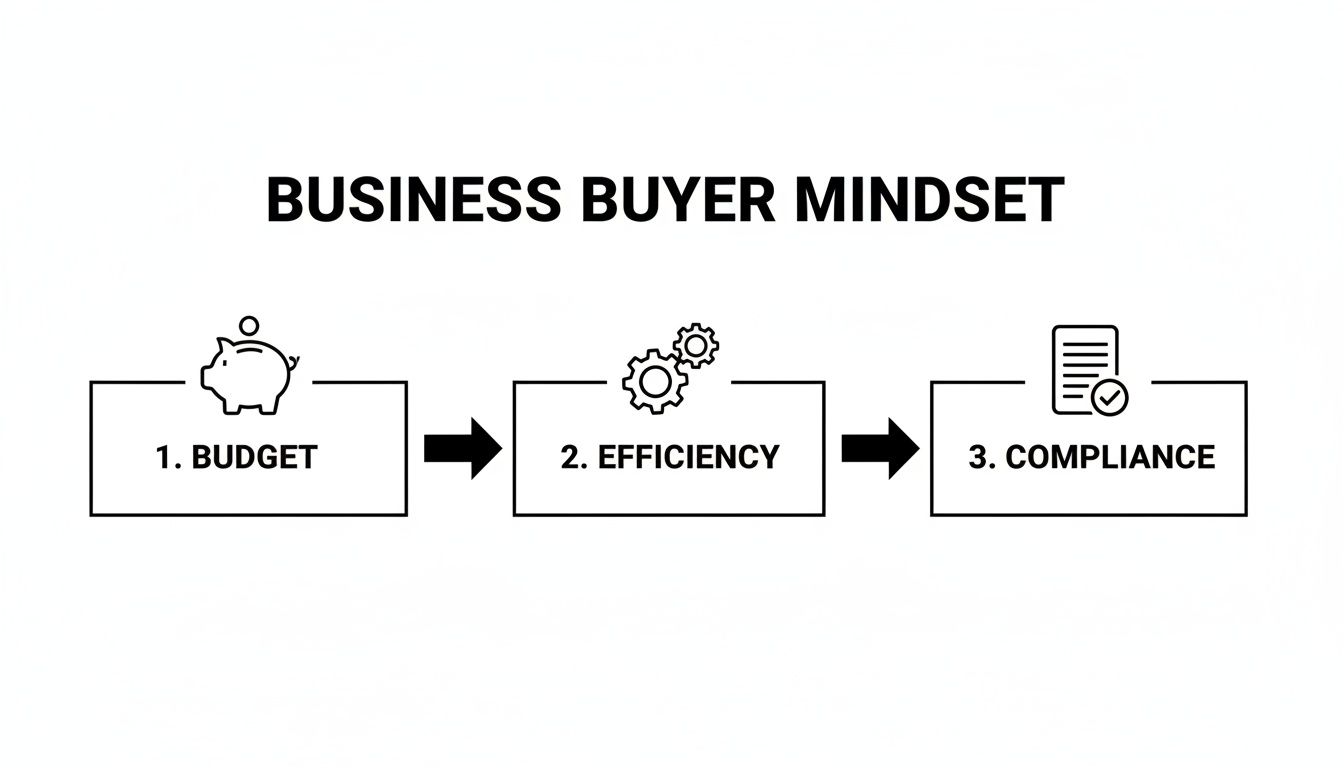
As you can see, their decisions are a mix of hitting budget targets, making purchasing easy, and staying within their company’s policies. Your pricing strategy needs to speak to all three.
Let’s walk through a real-world example. Say you sell high-end ergonomic office chairs for $200 a pop. A solo entrepreneur might buy one. But a startup that just got funding? They need to furnish their whole office. That's the order you want.
You can use tiered pricing to make it a no-brainer for them to buy from you.
Suddenly, when a purchasing manager sees your listing, they don't just see a chair. They see a clear path to saving their company thousands of dollars by outfitting the entire team. You've just shifted from selling a product to winning a contract. For a deeper dive into this model, check out our complete guide on how to sell wholesale on Amazon.
Key Insight: Don't just throw random discounts out there. Your tiers should be strategic. Each price break needs to feel like a compelling upgrade, nudging the buyer to hit that next volume target.
Setting this up for one or two products is easy. But for a catalog with hundreds of SKUs? Forget doing it manually.
Amazon gives you a couple of ways to do this in bulk. You can download a pricing template file from Seller Central, which is basically a spreadsheet. Fill in the business prices and quantity tiers for all your products, then upload the file. Done.
For a truly set-it-and-forget-it approach, you can use Automated Business Pricing Rules. You can create a simple rule like, "Set my Business Price to be 5% lower than my Standard Price," and apply it to your entire catalog or just specific groups of products. This keeps your B2B pricing competitive without you having to babysit it, freeing you up to work on growing your business.
Once you’ve got the basics down, it's time to get strategic with your Amazon business pricing. This is about more than just offering a discount; it’s about engineering real profit. Any seller can slash prices, but the top-tier founders build a B2B pricing model that protects their margins and creates a powerful, defensible sales channel.
It's time to stop guessing. Start by digging into what your top competitors are offering their business customers. Are they just setting a simple business-only price, or are they using more complex quantity tiers? This little bit of intel is gold. It helps you find that strategic sweet spot where your offer is compelling, but you're not giving away the farm.
In the B2B space, the cheapest option almost never wins the most loyal customers. This is where you need to get good at value-based pricing. It’s the art of justifying a premium price by delivering value that goes far beyond just the product itself.
For a business buyer, "value" can mean a lot of different things. It might be the peace of mind that comes from knowing your product has specific certifications (like ANSI or ISO). It could be the clarity of your A+ Content that lets them make a fast, confident decision. Or it might just be the rock-solid reliability of your FBA fulfillment.
Here are a few ways you can build that extra value into your B2B offer:
This simple shift changes the entire conversation. You move from "How cheap can you go?" to "How much value can you provide?" When a buyer trusts you to make their job easier, price suddenly becomes a much smaller part of the equation.
Figuring out if your B2B sales are truly profitable requires looking at the numbers a little differently. You might be offering a lower price per unit, but the economics of bulk orders can actually lead to much healthier margins. As you build out your pricing strategy, using the right financial tools is non-negotiable. A good wholesale profit margin calculator, for instance, can give you a crystal-clear view of your profitability on these larger orders.
B2B sales often come with a higher average order value (AOV) and a much lower per-unit marketing cost. The cost to acquire one massive order from a business can be a fraction of what it costs to acquire dozens of individual retail shoppers.
To get the real picture, you have to factor in these unique advantages. Think about the reduced marketing spend and the operational efficiency of packing and shipping one huge order instead of 50 small ones.
Data-driven founders know that when competitors slash prices—sometimes by 15-30% during big sales events—they only match if they can maintain a healthy 25-30% margin. This isn't about winning a price war; it's about winning the profit game. When you build all these factors into your calculations, you’ll quickly see how a smart Amazon business pricing strategy can become one of your most lucrative channels.

Setting your Amazon Business pricing is just the opening move. The real secret to building a profitable B2B channel is using data to see what’s working and what isn’t, then constantly tweaking your approach. Data turns guesswork into a clear roadmap for growth.
Think of your sales data as a direct line to your business customers. It tells you exactly what they want, how much they’re buying, and where your biggest opportunities are hiding. Amazon gives you a whole suite of reports designed for this, helping you close the loop between setting prices and seeing the results.
Deep within Seller Central, you have access to B2B-specific reports that are pure gold. These dashboards are your command center for understanding B2B performance, breaking down your sales and revealing metrics that can shape your entire strategy.
You’ll find them by navigating to the "B2B" section and then clicking into "B2B Central." This is where you can see which of your products are hits with business buyers, track your average order size, and even get a peek into the types of industries buying from you.
These reports help you answer some crucial questions:
This isn't just about collecting data for the sake of it. It’s about turning observations into action. Discovering that hospitals are buying your hand sanitizers in bulk is a game-changer. Now you can tailor your A+ Content and ad campaigns to speak directly to healthcare procurement managers.
The insights you pull from these reports should directly feed your pricing and marketing efforts. If you see a specific industry, like construction, is a top buyer, you can create a targeted campaign showcasing exactly how your products solve their unique problems. This flips you from being a passive seller to a proactive, strategic one.
Interestingly, Amazon Business Analytics—a free tool built for buyers—offers some incredible clues for sellers, too. It tracks spending trends and orders, revealing that bulk amazon business pricing is often 10–20% below standard retail. Smart sellers use this intel to make sure their own pricing is competitive for those high-volume contracts. You can discover more about how spend insights drive B2B growth on Amazon's official page.
Let's say your analytics show that office supply sales spike at the end of each quarter. That’s your cue. You can plan targeted promotions around those times to capture businesses trying to spend the last of their quarterly budgets.
This cycle of analysis and optimization is what separates the good sellers from the great ones. If you want to go even deeper on this, our guide on how to analyze sales data is an excellent place to start. By constantly reviewing your performance, you can refine your B2B strategy for maximum revenue and stronger margins.
Once you start exploring B2B sales, a lot of questions are going to come up. That’s perfectly normal. Think of it as wading into a new—and very profitable—part of the Amazon ecosystem. Let's clear up some of the most common questions high-growth sellers have about Amazon Business pricing.
Getting straight answers is the only way to build a strategy that actually works. This is your quick guide to getting past the usual sticking points and making smarter decisions.
This is the first thing everyone asks, and for good reason. The short answer is a simple, straightforward no. Your business price and any quantity discounts you set up are completely separate from the price your regular retail customers see.
These special B2B offers are only visible to verified Amazon Business buyers who are logged into their accounts. Your everyday shoppers will keep seeing and paying your standard retail price, completely unaware of the B2B deals. This lets you run two different pricing strategies from a single listing, targeting both consumers and professional buyers without worrying about cannibalizing your retail sales.
Here's where it gets interesting. The referral fees on Amazon Business sales can actually be lower than your standard B2C fees, especially when you land a large order. This is a big reason why a solid B2B strategy can be so good for your margins.
For many product categories, Amazon uses a tiered referral fee structure for business orders. That means the fee percentage often drops on the portion of a sale that goes over a certain dollar amount.
For example, on a large equipment sale, you might pay a 15% referral fee on the first $1,000. But for any amount over $1,000 on that same order, the fee could drop to just 8%. This setup is built to reward you for landing those bigger B2B contracts, making them much more profitable.
Not quite. The first thing you need is a Professional seller account—that’s non-negotiable. Once you have that, you can enroll in the Amazon Business Seller Program for free.
But it’s not just about having the right account type. Amazon also needs to see that you’re a reliable operator. You’ll have to keep your seller metrics in great shape to stay in the program.
They’re looking at things like:
Hitting these benchmarks proves you’re a supplier businesses can count on. At the end of the day, that’s all that matters to a professional buyer.
At Million Dollar Sellers, we believe in turning complex challenges into scalable growth. Our community is built on the shared knowledge of 7, 8, and 9-figure founders who have mastered these strategies firsthand. If you're ready to scale smarter and join an elite network of e-commerce leaders, see what MDS is all about.
Join the Ecom Entrepreneur Community for Vetted 7-9 Figure Ecommerce Founders
Learn MoreYou may also like:
Learn more about our special events!
Check Events