Chilat Doina
August 10, 2026
You can run a clean Amazon P&L and still get blindsided by a line item that looks vague on the statement. A customer sees AMZN DIGITAL and thinks, “What did I buy?” A seller sees the same phrase and needs a different question, “Is this a purchase, a royalty deduction, or a cross-border fee hitting margin?”
That distinction matters because the phrase amazon digital downloads charge gets used loosely across two very different worlds. On the consumer side, it usually points to a digital purchase tied to an account. On the seller side, it can mean the KDP delivery fee or Amazon's newer Digital Services Fee (DSF), both of which affect profitability in ways most operators underestimate.
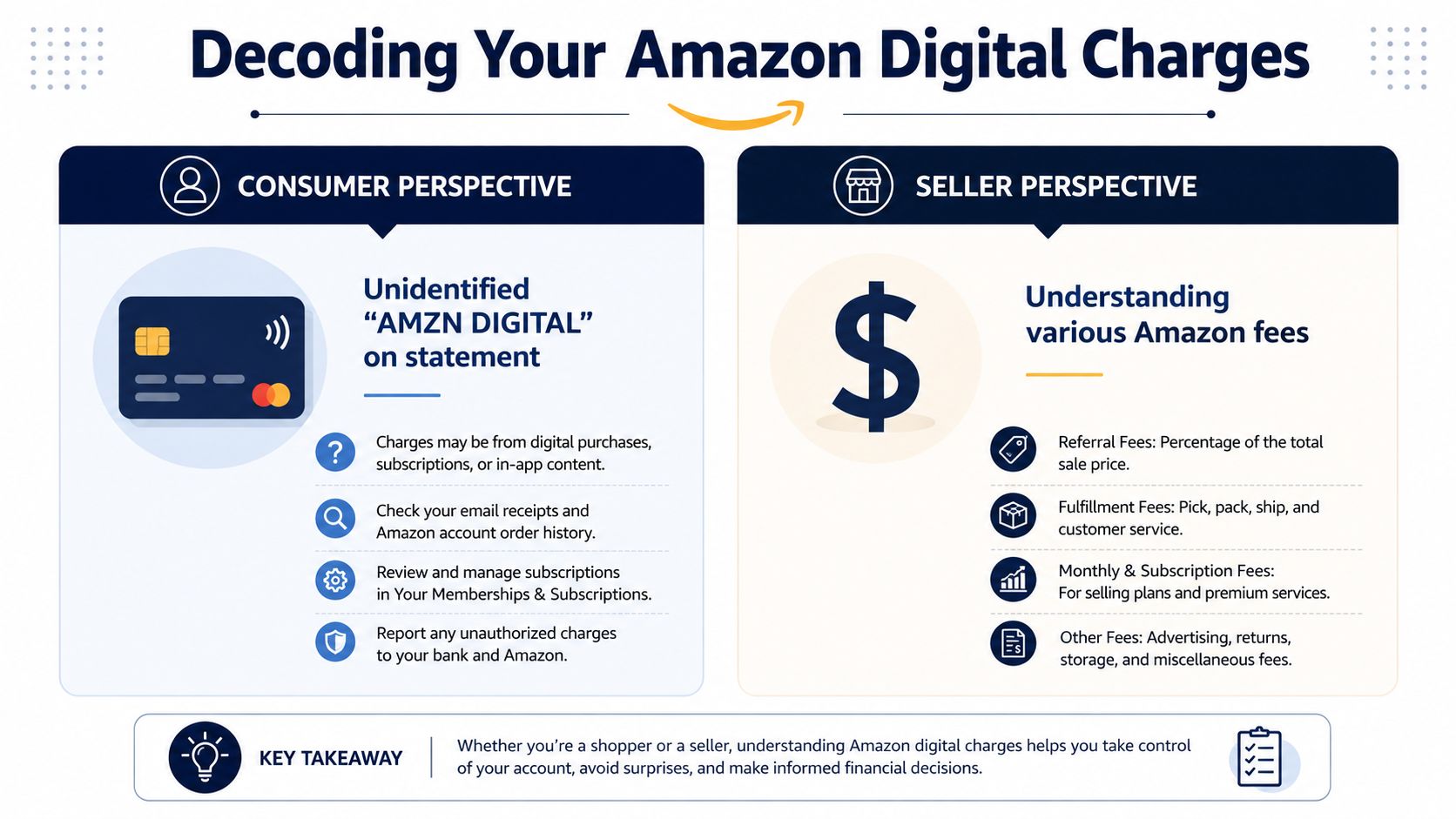
A vague digital charge can hide very different costs, and treating them as one bucket will distort your books fast. A consumer card statement, a KDP royalty report, and a cross-border seller fee all belong to different workflows, even if the wording looks similar on the surface.
Amazon's help guidance tells shoppers to check Transactions or Order details and match the amount to the digital order record when they are trying to identify a statement line. That is the right starting point for a buyer who wants to confirm whether a charge belongs to an ebook, audiobook, app, movie, or other account-tied digital purchase.
For sellers, the financial risk sits elsewhere. The phrase amazon digital downloads charge often gets used loosely, but the primary margin issues are usually the KDP delivery fee on eligible ebook sales and Amazon's Digital Services Fee (DSF) in certain countries, which affects seller economics in a separate way from a consumer-facing AMZN DIGITAL charge (Oreate AI overview).
Practical rule: if the charge ties to a customer purchase, reconcile it with an order. If it ties to a seller report, reconcile it with royalties or marketplace fees.
That separation keeps your P&L clean. It also prevents finance teams from forcing seller-side fees into a generic “digital” bucket and missing the margin hit that matters.
A card statement line that reads AMZN DIGITAL usually points to a real Amazon digital purchase, not a random merchant error. It is the label Amazon uses for account-based digital goods, so the charge typically traces back to something delivered through the account instead of a box on a porch.
That can be an ebook, audiobook, movie, app, or subscription-style digital content tied to the account. The label is broad, which is why it causes confusion, but the transaction is usually easy to identify once you line it up with the right order record.
Start with the Amazon account used for the purchase. Check the order history and digital transactions, then compare the date, amount, and store name with the statement line. If those details match, the charge is usually confirmed without any need to escalate it.
The cleanest workflow is straightforward:
Digital purchases are easy to miss in the moment. Free trials, one-click buys, and family-account activity can all create valid charges that look unfamiliar at first glance.
If the amount still does not match anything in the account, the issue is no longer a generic “Amazon digital” label. It becomes a specific transaction review, where card authorization details, shared-account access, and recent subscription changes matter more than the billing descriptor itself. Amazon also points buyers toward its own help flow for reviewing digital orders, and that same habit applies if you are checking how digital products are sold through a storefront such as selling digital products on Amazon.
Treat the descriptor as a pointer, not proof of fraud. In most cases, the audit trail is already sitting in Amazon's own order history.
Do not start with a dispute if the order record has not been checked. That creates extra work and can slow resolution. If the purchase is legitimate, the right fix is usually account cleanup, not a chargeback.
A Kindle Direct Publishing delivery fee can change your margin math because it sits inside the royalty calculation, not beside it as a separate line item. Amazon says KDP ebook royalties use either the 35% or 70% royalty option, and books on the 70% plan include a delivery fee tied to file size rather than a flat transaction charge. The KDP help page explains the structure here: KDP help.
On the U.S. rate, that fee is $0.15 per MB. A 5 MB file works out to about $0.75 in delivery fees, while a 20 MB file works out to about $3.00 at the same rate. Larger files reduce the author's payout dollar for dollar, so file bloat shows up directly in royalty math.

That fee structure changes publishing decisions in a very practical way. Image-heavy layouts, oversized cover files, and uncompressed media all raise delivery cost, which means two books with the same retail price can produce very different net results. For publishers who produce a lot of illustrated content, this is a margin issue, not just a formatting issue.
The fix is operational discipline. Compress media carefully so you trim file bloat without hurting readability. Avoid unnecessary image inflation, especially when the visual adds little sales value. Check the final file size before launch so the fee is built into your royalty model. Price with the fee in mind if the book is already close to the break-even line at a 70% royalty rate.
For sellers who want the broader digital-product setup around Amazon, the operational basics are covered in this guide on selling digital products on Amazon, but the point here stays simple. KDP delivery costs are predictable, so they should be modeled before release, not discovered after sales start coming in.
A shopper sees a charge line and assumes it is a purchase issue. A seller sees the same kind of Amazon-related fee and needs to ask a different question, because the Digital Services Fee (DSF) hits marketplace margin, not customer checkout behavior. It is tied to digital taxation in certain countries, so it belongs in your international P&L, not in the same bucket as KDP delivery charges or consumer-facing transaction noise.
Amazon's own help guidance separates these cases, and Amazon Seller Central help shows that DSF can vary by country, store, and seller setup. A separate seller analysis from Sequence Commerce says Amazon began passing this cost through in October 2024, with rates ranging from 0% to 3% depending on marketplace and seller location. That same analysis says Canadian sellers pay 3%, while U.S. sellers pay 0% on Amazon.com, which makes DSF a jurisdiction-driven cost instead of a universal Amazon fee.
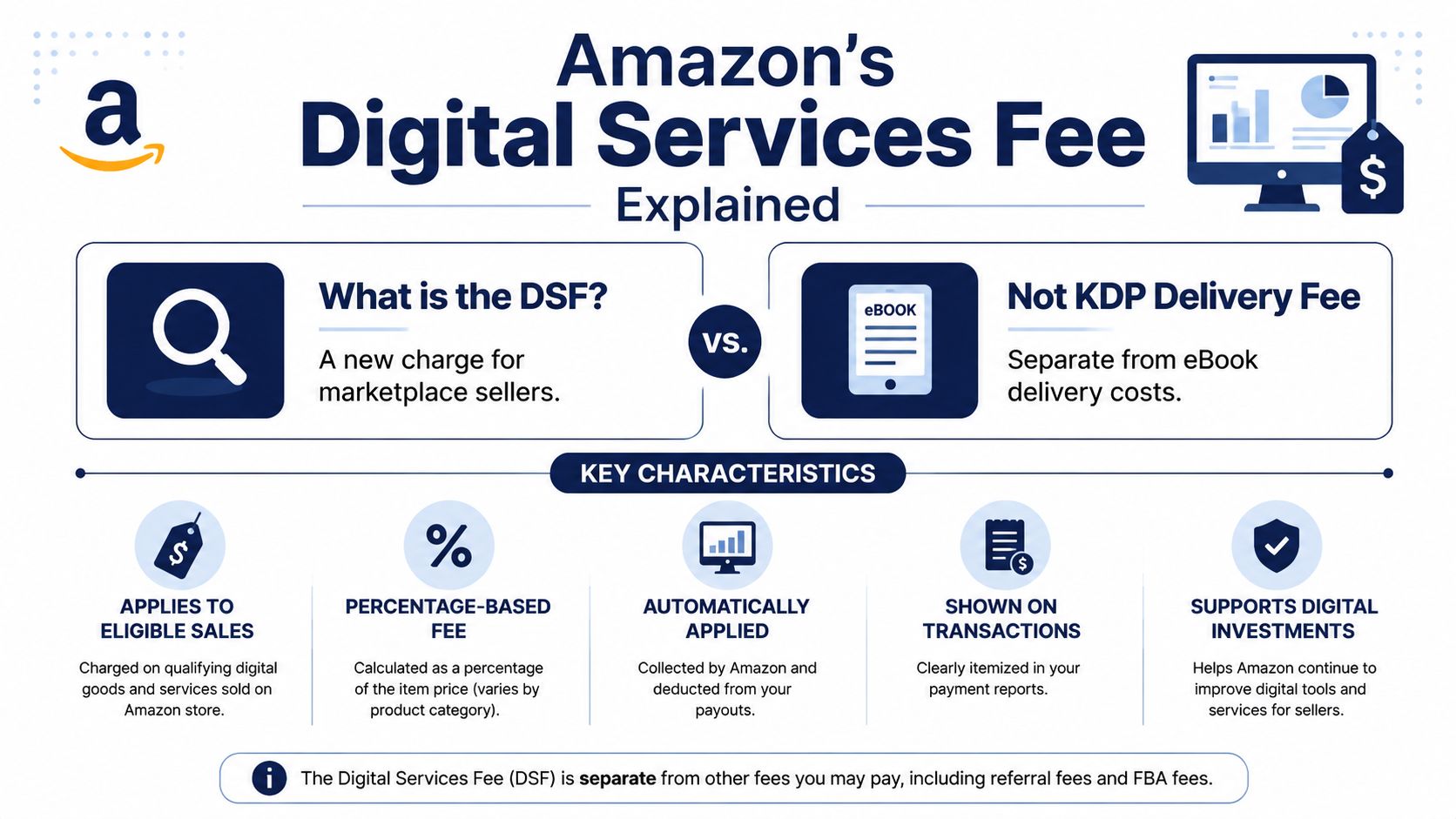
The label hides the underlying issue. DSF stacks on top of referral fees, fulfillment, and other marketplace costs, so a SKU that looked healthy on paper can turn marginal once the international deduction is applied. For brands already selling close to the line, that extra take rate changes the economics fast.
The practical response is to model DSF as a structural cost. If you sell into the U.K., France, Spain, Italy, or Canada, you need to know whether the fee applies in that marketplace and how it flows through settlement. Amazon's help table also shows country and store combinations where DSF can range from 0% to 3%, and it notes that some FBA fees in France carry a 3% digital-services surcharge (Amazon Seller Central help).
That matters most for forecasting and expansion decisions. If you are building a country plan, DSF should sit beside referral, storage, and fulfillment assumptions before you launch, not after the margins start slipping. Sellers who track total cost to serve in advance tend to catch these deductions early, which is why this breakdown of what Amazon costs to sell is useful context for the broader fee stack.
Keep the fee assumptions tied to each marketplace in your operating model. Treating DSF as a separate line item makes it easier to spot where international growth is profitable, and where it only looks profitable until settlement.
If your team is reconciling seller charges at scale, build a process for statement review and receipt capture, including how to automate receipt forwarding, so fee records do not get lost between marketplaces and entities.
Start with classification, or the rest of the P&L gets noisy fast. A consumer purchase, a KDP delivery deduction, and a DSF pass-through all hit the books in different ways, and if your team codes them together, you end up chasing the wrong margin problem.
For consumers, the check is straightforward. Match the descriptor in the account's transaction history to the digital order record, then confirm the amount against the purchase details. If the charge does not line up, route it to support and resolve it there rather than guessing at the source.
KDP authors need a different workflow. The delivery fee belongs in royalty reporting, where it can be tied back to the title, format, and marketplace that created it. That is the level of detail that lets you see whether a file-size decision is subtly eating into royalties.
Keep the fee source attached to the report, not to memory. Memory is where these costs go missing.
Marketplace sellers have to treat DSF as a settlement issue. Pull it from Seller Central payment records, code it by marketplace, and separate it by seller entity so the margin hit is visible in the right place. If you only look at the deduction total, you miss the country-level pattern and the store-level exposure.
Automation helps when the volume starts piling up. If your team is still forwarding receipts and statements by hand, use a workflow like how to automate receipt forwarding so the records land in finance without getting buried in inboxes.
For larger reconciliation jobs, fee cleanup works better when it sits alongside inventory and settlement matching. The process in this Getida reconciliation guide is a useful reference because fee variance is easier to spot when inventory and payment records are already aligned.

The goal is cleaner decision-making. These charges need to land in the right part of the business so pricing, royalty planning, and international expansion decisions are based on actual margin, not a blended fee line that hides the problem.
The lesson is that amazon digital downloads charge is too broad a phrase to be useful on its own. For consumers, it's usually a digital purchase that should be matched to order history. For KDP sellers, it's a file-size-based delivery deduction. For marketplace sellers, it can also mean DSF exposure in countries where Amazon is passing through digital-services taxation.
Those are different levers, so they need different controls. If you publish ebooks, keep file size tight and model the delivery fee before launch. If you sell internationally, bake DSF into pricing and margin reviews before you expand a catalog into new marketplaces.
The brands that stay ahead here don't wait for statements to surprise them. They review fee logic monthly, separate consumer and seller charges in reporting, and audit international settlements as a normal operating habit. That discipline protects margin better than any one-off cleanup after the fact.
If you need outside support on the finance side, Bookkeeping and Accounting of Florida Inc. is a useful resource for sellers who want cleaner bookkeeping around ecommerce fees and deductions. The right accounting partner won't just code expenses correctly, they'll help you see which fees are worth changing and which are just part of the business.
Million Dollar Sellers is where serious Amazon operators compare notes on the stuff that moves margin, including hidden fees, international expansion, and the P&L details most sellers miss. If you want sharper operator-level perspective on topics like this, visit Million Dollar Sellers and see how top founders stay ahead of the curve.
Join the Ecom Entrepreneur Community for Vetted 7-9 Figure Ecommerce Founders
Learn MoreYou may also like:
Learn more about our special events!
Check Events