Chilat Doina
May 10, 2026
Most advice about hiring a tiktok shop marketing agency is backwards.
It starts with vendor lists, flashy creator reels, and promises about “going viral.” That's the wrong sequence for any serious brand. If you already sell across Amazon, DTC, Walmart, or retail, TikTok Shop isn't just another acquisition channel. It's a new operating model with its own margin structure, inventory demands, attribution gaps, and content cadence.
Founders who treat it like a bolt-on social experiment usually get one of two outcomes. They either generate activity with no clean read on contribution, or they push too hard on in-app sales and create channel conflict they didn't model upfront. The agency isn't the strategy. The agency is an execution layer inside your strategy.
A good partner can accelerate learning, compress setup time, and build a creator engine you'd struggle to assemble internally. A bad one will spend your money producing content you can't attribute, driving orders you can't reconcile, and sending your team into weekly meetings full of views, clicks, and excuses.
TikTok Shop deserves the attention it's getting. Since its U.S. launch, sales have grown rapidly and are projected to surpass $20 billion by 2026, with 8-12% conversion rates versus 2-4% for traditional e-commerce, while the platform is projected to capture nearly a quarter of U.S. social commerce by 2027, according to eMarketer's TikTok Shop social commerce analysis.
That still doesn't mean “being on TikTok Shop” is a win.
For an established brand, the fundamental question is whether TikTok Shop improves blended contribution, not whether it produces isolated GMV. If your agency can't explain how TikTok Shop affects Amazon rank, DTC repeat rate, paid social efficiency, inventory turns, and promo exposure, they're managing a channel. They're not managing your business.
The common assumption is simple. TikTok Shop is growing fast, so you need an agency now. That logic skips the hard part. A fast-growing platform can still be an unprofitable platform for your brand if your unit economics rely on discounting, high creator fees, or operational complexity your team can't absorb.
A founder should ask:
Practical rule: If an agency starts with ad spend recommendations before asking about contribution margin, inventory constraints, and channel conflict, they're selling media management, not channel strategy.
There's also an org chart issue. TikTok Shop often touches paid media, affiliate, social, ops, finance, and customer support at the same time. Teams that already run multiple brand accounts sometimes need a clearer governance structure around permissions, creator communication, and testing environments. If that's your situation, this guide on setting up multiple TikTok accounts is useful operational background before you hand the keys to an outside partner.
Profitable integration starts with one decision. You treat TikTok Shop as a line in the P&L, not a campaign.
That means your agency should report against business questions such as:
| Business question | What a serious agency should show |
|---|---|
| Is TikTok Shop incremental? | Clear view of channel overlap, promo impact, and assisted demand |
| Is margin holding? | All-in economics, including creator and affiliate costs |
| Is the content engine improving? | Which creative themes convert and which should be retired |
| Can ops support growth? | Inventory readiness, fulfillment rhythm, and return patterns |
Founders who want a baseline view of how sellers are approaching the channel can review TikTok seller considerations for ecommerce brands. It's a helpful reference point before agency conversations start.
Most agency searches fail before the first discovery call. The internal brief is vague, the CFO has one expectation, the brand team has another, and the operator running channel expansion just wants someone to “own TikTok.”
That's how brands end up buying a tiktok shop marketing agency that looks good in a pitch and feels wrong in execution.
A 2025 Shopify benchmark report noted that 68% of merchants using TikTok Shop struggle to reconcile TikTok sales with their broader customer-lifetime-value models, as summarized by Influencer Marketing Hub's agency overview. That finding matters because it exposes the core issue. Brands aren't just struggling with performance. They're struggling with what success even means inside a broader portfolio.
You can absolutely get multiple benefits from TikTok Shop over time. But when you hire, you need one primary mission. Not three.
The usual missions fall into three buckets:
This is the cleanest lens. You want TikTok Shop to stand on its own as a channel with acceptable economics. That pushes your agency toward SKU selection, conversion-focused creator content, offer discipline, and tighter budget control.
In this model, you may tolerate weaker first-order economics if TikTok is introducing buyers to the brand who later repurchase through DTC, Amazon, or retail. If this is the mission, your reporting model can't stop at in-app sales.
Some brands should treat TikTok Shop as a content system first and a sales channel second. The shop creates native purchase opportunities, but the bigger value sits in creative learning, creator relationships, and discoverability that spills into other channels.
Don't let your agency choose the mission for you. Agencies often default to whatever they sell best.
Most founders underestimate TikTok Shop because they think in media spend only. That's not how this channel works.
Your internal budget should account for:
If you don't model all of that, you'll think the agency underperformed when the actual problem was your planning.
Not every brand needs a full-stack partner. Some need a specialist.
Use this simple decision frame:
| Need | Best-fit agency type |
|---|---|
| You have internal paid media but weak creator sourcing | Creator and affiliate specialist |
| You have strong brand and social teams but no shop operator | TikTok Shop operations specialist |
| You need one partner to coordinate content, creators, ads, and reporting | Full-service TikTok Shop agency |
| You already have creators and content but weak scale discipline | Paid amplification specialist |
Broader brand positioning matters here. If your product promise, offer architecture, and channel role aren't clear, the agency will end up guessing. For that internal work, brand strategy development for ecommerce operators is the kind of prep that saves months of wasted testing.
Before outreach, I'd get these stakeholders in one room:
Then I'd force answers to four questions:
That last question matters more than is often acknowledged. It gives you a kill threshold before enthusiasm clouds judgment.
The fastest way to spot a weak agency is to listen to how they talk about ads.
If they treat TikTok Shop like Meta with different creative specs, move on. Strong agencies understand that the channel runs on a different sequence. They don't lead with budget. They lead with content systems, creator fit, and validation before amplification.
The best framework I've seen is the four-pillar model described in 2 Point Agency's TikTok Shop marketing guide. Their core point is right: elite agencies organize around creator-led content, LIVE shopping, affiliate programs, and ads, and they follow a content graduation rule. First validate 3-5 organic creator videos, then boost with Spark Ads, then bring in GMV Max only after the creative library is proven.
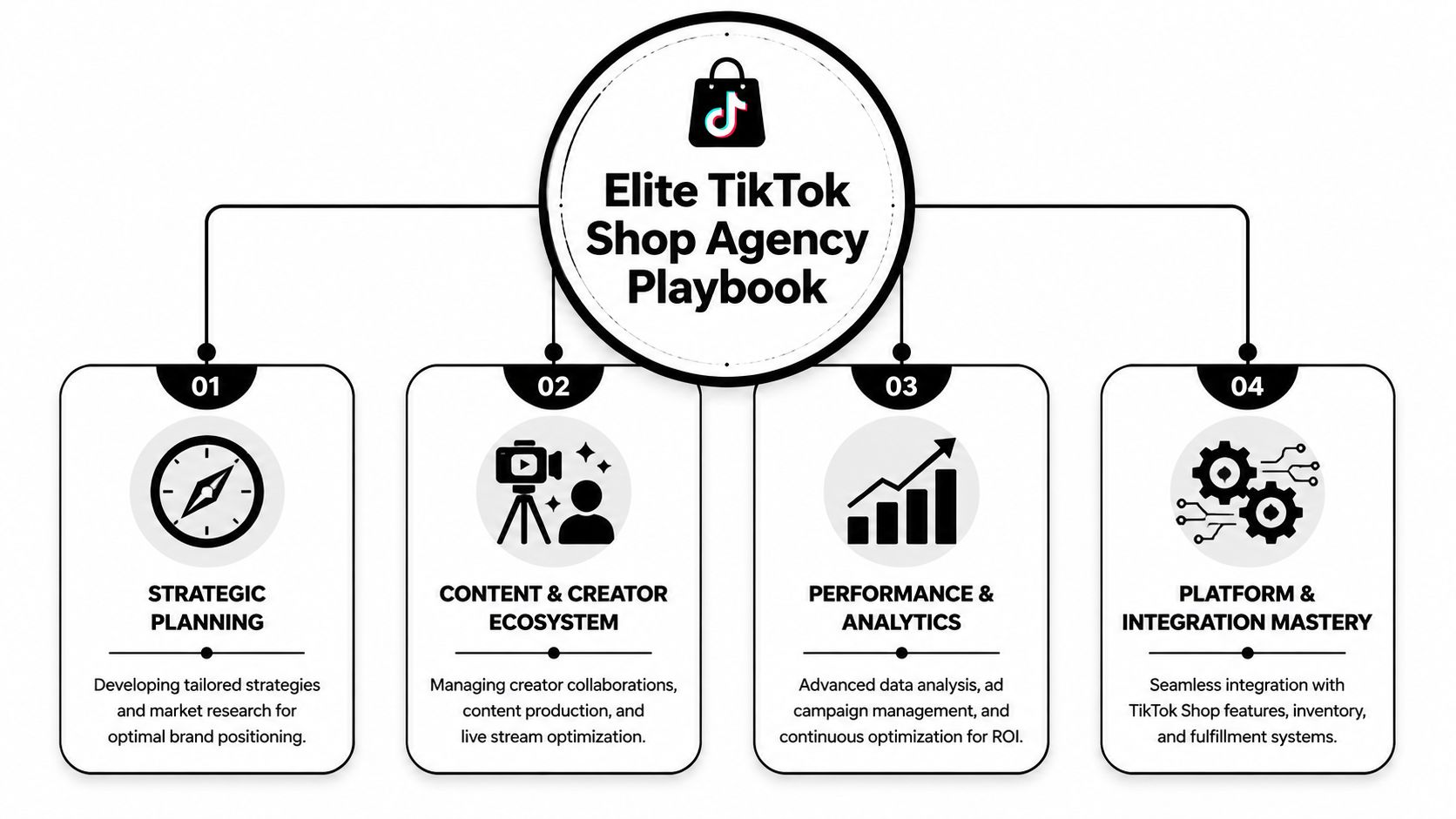
The first half of the playbook is not media buying. It's creator-led content and LIVE shopping.
Creator-led content matters because TikTok buyers don't respond to polished catalog ads the way they respond to product-native demonstrations, reactions, routines, and comparisons. A good agency will know which creator archetypes fit your category. More important, they'll know how to brief creators tightly enough to protect the brand without scrubbing out the native feel that makes the content work.
LIVE shopping is where many agencies overpromise. The best ones don't treat LIVE as a magic button. They treat it as an event format that needs hosts, scripts, offers, inventory readiness, moderation, and follow-up clipping into reusable short-form content.
A top agency doesn't ask, “Do you want to do LIVE?” It asks, “Do you have a host, an offer, enough velocity products, and a post-LIVE cutdown plan?”
The second half is affiliate programs and ads.
Affiliate management on TikTok Shop isn't just sending product to creators and hoping for posts. The agency should recruit, organize, follow up, track activation, and maintain enough creator throughput that the system doesn't depend on a handful of personalities. This is operational work, not just “influencer marketing.”
Ads come last in the sequence for a reason. Paid amplification should scale validated creative, not rescue weak creative.
A lot of brands lose money because they turn on GMV Max too early. The platform can optimize well when it has enough proven inputs. It struggles when the brand gives it thin, unvalidated creative and expects automation to do the thinking.
A useful walkthrough sits below.
A mature agency usually works in this order:
That sequence is the difference between a testing system and a spending system.
Here's the core diagnostic I use in agency calls:
| Agency answer | What it usually means |
|---|---|
| “We'll launch paid immediately and optimize from there” | They don't respect TikTok's content dependency |
| “We need proven organic winners first” | They understand the platform's learning process |
| “Our media buyers can handle creative strategy too” | Creative will probably become an afterthought |
| “We run creator, affiliate, paid, and LIVE together” | They may actually understand the full stack |
A few patterns almost always break:
A strong agency knows TikTok Shop is a system of inputs. Content, creator selection, affiliate activation, and paid scaling all depend on each other.
Most founders under-vet agencies because they confuse familiarity with fit. A slick proposal, recognizable clients, and a good salesperson can hide a weak operating team.
Your job is to test whether the agency can manage a channel that crosses content, affiliate, ads, and operations, while still speaking the language of contribution margin and channel mix. That's a higher standard than “they know TikTok.”
Start with operators, not search results.
A Google search gives you agencies that rank well. It doesn't tell you who can survive inside a high-accountability ecommerce business. Peer referrals are better because founders will tell you what the agency is like after the pitch deck disappears.
I'd build a list from three places:
If you want a useful non-TikTok-specific lens for screening agency maturity, this roundup of solid factors for a marketing agency is a decent cross-check. It won't answer TikTok Shop-specific questions, but it does help pressure-test basics like communication, transparency, and fit.
There's also value in borrowing a vetting mindset from adjacent channels. A lot of the same accountability rules apply when you evaluate Amazon PPC agency hiring criteria for ecommerce brands. Different platform, same principle. You want proof of operating discipline, not just channel jargon.
A weak RFP invites vague answers. A strong one forces comparability.
Use this as a base:
| Component | Key Questions to Include | Your Internal Target |
|---|---|---|
| Business objective | What primary business outcome are you optimizing for? | One clear mission only |
| Scope | Which parts of TikTok Shop will you own? | No ambiguity between paid, creators, affiliate, ops |
| Creative process | How do you source, brief, approve, and iterate creators? | Fast iteration with clear approvals |
| Paid strategy | When do you use Spark Ads and when do you scale further? | No paid-first shortcutting |
| Attribution | How do you evaluate TikTok influence beyond in-app sales? | Blended view across channels |
| Reporting | What appears weekly, monthly, and quarterly? | Business metrics, not vanity metrics |
| Team structure | Who actually runs the account day to day? | Senior operator involvement |
| Escalation | What happens when performance stalls or creators fail to deliver? | Defined response plan |
| Data access | Who owns accounts, dashboards, and creative assets? | Brand ownership |
| Commercial terms | How are fees structured and what triggers review? | Flexibility with accountability |
Most agencies rehearse answers to generic prompts. Don't ask generic questions.
Ask these instead:
The best answers are specific, operational, and slightly unglamorous. Real operators talk about process friction, approval lag, inventory issues, and reporting gaps. Pretenders talk about trends.
Some warning signs are obvious. Others are easier to miss.
Any promise around guaranteed ROAS, guaranteed virality, or guaranteed sales should make you cautious. TikTok Shop performance is too dependent on product, content, creator fit, and offer structure for clean guarantees to mean much.
If the agency only talks about in-platform numbers, they probably don't know how to operate in a multi-channel business. That doesn't mean they need a perfect attribution model. It means they need a sane one.
Outsourcing isn't automatically bad. But if the agency can't explain who manages briefs, reviews creator output, and decides what gets boosted, creative quality will drift fast.
Strong agencies know their boundaries. Weak ones say yes to everything.
I like a simple weighted scorecard. Not because it's fancy, but because it keeps founder bias in check.
| Category | What good looks like |
|---|---|
| Strategy fit | Understands your channel role and economics |
| Creative system | Has a repeatable process for briefing and iteration |
| Operator quality | Clear day-to-day ownership with accountable leads |
| Reporting maturity | Can tie execution to business outcomes |
| Commercial structure | Incentives line up with your goals |
| Communication | Direct, fast, and not defensive |
If two agencies look equal, choose the one that tells you where TikTok Shop is likely to be hard for your brand. Real partners show you the friction before you sign.
Most agency relationships don't fail in month six. They fail in the first month, then linger.
The usual pattern is predictable. Access gets delayed. Product feeds aren't clean. Nobody agrees on reporting. Creative approvals take too long. Finance wants one dashboard, growth wants another, and the agency starts spending before the operating system is ready.
That's why the first 90 days need structure.
According to Funnel's TikTok Shop setup guide, the setup starts in the TikTok Seller Center on desktop, not mobile, includes business verification that typically completes within 24 hours, and then connects your public TikTok account and ecommerce platform such as Shopify. That setup opens up the core dashboards for orders, marketing, and analytics. An agency should know this cold. If they don't, they're too early for your brand.
The first two weeks are about infrastructure and decision rights.
You need the agency inside the right systems, but not with vague permissions and improvised workflows. Give access intentionally.
At minimum, onboarding should include:
This is also when you define ownership. Who approves discounts? Who signs off on creators? Who resolves fulfillment issues? If nobody owns those calls, the agency will fill the vacuum, and you may not like the decisions.
This stage is where impatient founders often break the process.
You are not buying immediate scale yet. You are buying signal. The early period should focus on creator sourcing, briefing, content production, posting, and evaluation. If the agency jumps to broad paid deployment before enough organic learning exists, they're skipping the part that makes TikTok Shop work.
I'd expect these outputs during this phase:
| Workstream | What should happen by this point |
|---|---|
| Creator pipeline | Active outreach, onboarding, and content submissions |
| Content testing | Multiple creative angles in market, not one polished concept |
| Shop readiness | Core products merchandised correctly with offers aligned |
| Reporting layer | Weekly dashboard in place with agreed definitions |
| Escalation path | Clear process for underperforming creators or assets |
The first month should feel operational, not celebratory. If the agency keeps presenting “big opportunities” but can't show disciplined testing, they're avoiding the hard work.
By the second month and into the third, you should know more than you knew at signing.
You should know which hooks get attention, which creator styles fit the product, which SKUs are easiest to sell in-platform, and which offers create demand without wrecking margin discipline. Then you can decide what deserves Spark Ads and broader scaling.
This is also where reporting needs to mature. Weekly dashboards should cover activity and trend lines. Monthly reviews should answer business questions.
I'd want to see these discussions in the first formal performance review:
You don't need more meetings. You need cleaner ones.
A healthy first-90-day cadence often looks like this:
Short, tactical, and specific. Review creator status, content approvals, launch blockers, and spend decisions.
Longer. Focus on economics, creative lessons, channel role, and what changes next.
Used for approvals, creator issues, and time-sensitive changes. Not strategy.
One more point matters here. The agency should be expected to teach your team what it's learning. If they turn every insight into black-box expertise, you'll stay dependent and under-informed.
The best agency relationship feels less like outsourcing and more like managed specialization. Your team owns the business. The agency owns a defined execution layer and brings pattern recognition from the market.
That only works when incentives are aligned.
TikTok Shop adds another wrinkle because creator management is a core lever. The platform's ecosystem now includes over 100,000 creators in the affiliate program, and paid influencer recommendations drive purchases for 44.7% of TikTok consumers, according to Capital One Shopping's TikTok shopping statistics. That means a lot of value sits in relationships, workflows, and content rights. Your agreement has to reflect that.
No pricing model is perfect. Each pushes behavior in a different direction.
| Model | Upside | Risk |
|---|---|---|
| Flat retainer | Predictable cost and clearer scope | Agency may protect time instead of chasing upside |
| Percentage of spend | Simple to understand and scales with budget | Encourages more spend, not always better economics |
| Performance hybrid | Aligns incentives better when structured well | Hard to define cleanly if attribution is messy |
| Project-based add-ons | Useful for LIVE events or creator sprints | Can fragment accountability over time |
For most established ecommerce brands, a hybrid tends to work best if the definitions are tight. You want a stable operating fee plus incentives tied to outcomes that the agency can influence. If attribution is noisy, tie part of the upside to agreed leading indicators, not just one end metric.
Your contract should answer the ugly questions before they happen.
Non-negotiables:
If an agency controls the data, the ad account, and the creator relationships, leaving them gets expensive fast.
A mature partnership has recurring cadences and a clean task system. Even simple project-management discipline helps. Some founders use heavyweight PM software. Others do better with lighter systems. If your internal team is lean, this overview of marketing systems for solo builders is a useful reminder that the best process is the one people maintain.
The rhythm I like is straightforward:
You're not just managing output. You're managing drift. Left alone, agencies tend to keep doing what worked last quarter, even if your business no longer needs the same thing.
Only if roles are clear. If your current paid social team understands TikTok Shop operations, creator workflows, affiliate management, and content sequencing, you may not need a second partner. If they mainly buy media, adding a specialist can make sense. Just define ownership before launch so creators, paid campaigns, and reporting don't overlap.
Expect learning before scale. A good partner should help you build a repeatable content and creator system, identify which products belong in-channel, and show whether TikTok Shop is acting as a profit center, a customer acquisition layer, or a broader discovery channel. If month two already looks like a mature, stable engine, your reporting is probably hiding something.
Yes, but only if you plan assortment, pricing, and promotions intentionally. The risk isn't the platform itself. The risk is running TikTok Shop with no channel strategy and allowing creators or offers to dictate your economics.
They outsource judgment. Founders hand the channel to an agency before deciding what they want the channel to do. Then they evaluate performance against shifting expectations.
Ask them to walk you through creator sourcing, affiliate operations, Seller Center setup, content validation, Spark Ads logic, and how they'd report blended impact across channels. If they answer like a generic media buyer, they're not ready.
Replace them when the pattern is clear. Not after one bad week, but after repeated signs that they can't learn, can't report truthfully, or can't operate inside your business model. The deciding factor usually isn't poor performance alone. It's poor performance plus weak diagnosis.
If you're running a serious ecommerce business and want sharper peer insight on channel expansion, operator-vetted service providers, and the economics behind growth decisions, Million Dollar Sellers is where high-level founders compare what's working.
Join the Ecom Entrepreneur Community for Vetted 7-9 Figure Ecommerce Founders
Learn MoreYou may also like:
Learn more about our special events!
Check Events


