Chilat Doina
April 26, 2026
Most advice on how to sell digital products on amazon is wrong in the first sentence.
You can’t just upload a PDF to the main marketplace, turn on ads, and collect passive income. That playbook confuses Amazon’s massive traffic with Amazon’s actual product rules. Serious sellers know those are two different things.
The opportunity is still real. Digital products can produce margins above 90% because they don’t carry the same inventory, storage, and replenishment burden as physical goods, and Amazon sits in front of a marketplace with 9.7 million total sellers worldwide and about 1.9 million active sellers across categories, which makes any underdeveloped high-margin segment worth attention according to Helium 10’s Amazon seller market overview. But the way you monetize that opportunity on Amazon is not obvious.
The right model is two-pronged. First, use the channels Amazon officially supports for digital distribution, like KDP and adjacent media ecosystems. Second, use Amazon’s traffic, brand trust, and product discovery engine to feed demand into platforms built for digital fulfillment, recurring access, and customer ownership.
This is the effective strategy. Not “sell downloads on Amazon.” More like: build an Amazon-native front end, then route each asset to the channel that preserves margin, compliance, and control.
The lazy take is that selling digital products on Amazon is impossible. That’s not true.
The equally lazy take is that it’s easy. That’s also not true.
Amazon’s main marketplace restricts direct third-party digital product sales. In Amazon’s own seller forum guidance, the platform only permits physical products on the core marketplace, and the workaround is to place digital content on a physical storage device and ship it as a tangible item. That destroys the economics that make digital products attractive in the first place, and it can also require proof of OEM status or manufacturer permission in some cases, as noted in this Amazon Seller Forums discussion.
That restriction matters because Amazon still commands enormous demand. The same forum reference notes $447.5 billion in projected annual web sales in 2024 and 8.6% year-over-year growth. So the question isn’t whether demand exists. The question is how to capture it without forcing a digital business into a physical-product workflow that ruins speed and margin.
Practical rule: If your offer depends on instant access, subscriptions, updates, member accounts, or direct customer communication, the main Amazon marketplace is usually the wrong checkout layer.
Experienced operators set themselves apart from beginners. Beginners ask, “Can Amazon host my file?” Advanced sellers ask, “Which part of Amazon should I use for discovery, and which part should I avoid for fulfillment?”
That shift changes everything. You stop trying to hack unsupported listings. You start choosing between Amazon-native channels, hybrid funnels, and off-Amazon delivery based on product type.
Amazon doesn’t have one digital products strategy. It has several disconnected ecosystems that happen to share the same parent company.
If you map them correctly, the situation becomes much simpler to manage.
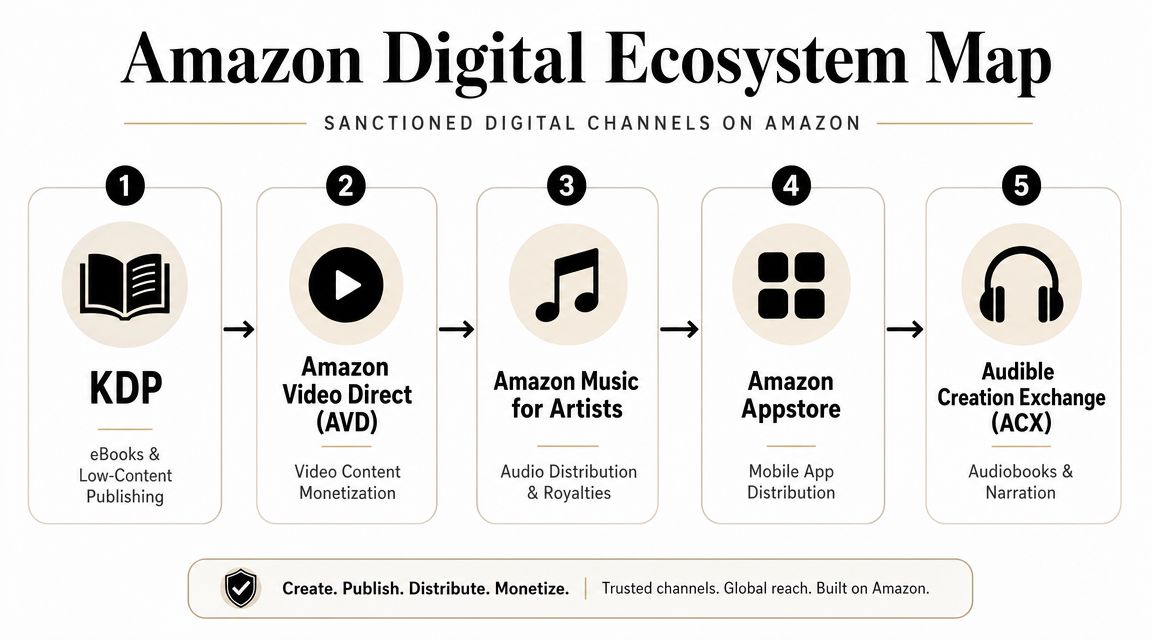
The first decision isn’t whether your offer is “digital.” It’s whether your asset behaves like a book, audio title, video property, app, or design layer attached to a physical item.
That distinction matters because Amazon’s systems are built around media categories, not creator intent.
Here’s the fast map:
| Amazon channel | Best fit | What it does well | Where it breaks |
|---|---|---|---|
| KDP | Ebooks, written guides, low-content publishing | Fast publishing, global Kindle distribution, Amazon-native discoverability | Weak for complex access, memberships, software, or premium training |
| ACX | Audiobooks | Extends a written asset into audio, reaches Audible listeners | Requires audio production discipline and stronger rights management |
| Prime Video Direct | Video content | Useful when the asset stands alone as watchable content | Not ideal for cohort courses, community-based learning, or heavy support |
| Amazon Appstore | Apps, software, game-like products | Native route for software distribution inside Amazon’s ecosystem | Product, support, and update expectations are much higher |
| Merch on Demand | Designs monetized on physical goods | Lets digital artwork earn through printed products | It’s not direct digital delivery |
If you run an established brand, this often overlaps with broader channel architecture. Teams building cross-platform operations usually need cleaner catalog, order, and system sync, especially when Amazon is only one part of the stack. That’s where practical strategies for Amazon integration development become relevant, because digital-adjacent offers often depend on connecting Amazon activity with external fulfillment, CRM, or product systems.
KDP is the most accessible path. If your expertise can be packaged into a book, workbook, reference guide, or low-content product, KDP is usually the first place to test.
ACX is an extension engine. It works best when the written asset already has traction or when the audience naturally consumes long-form audio.
Prime Video Direct is for content that holds up as a standalone viewing experience. That’s different from a premium course with worksheets, gated communities, and staged releases. Video as media and video as education product are not the same business.
The Appstore is a software lane, not a “maybe this download counts” loophole. If you’re a developer, this channel is real. If you’re not, trying to treat it like a shortcut usually creates support debt you don’t want.
Merch on Demand belongs in the conversation because many “digital creators” own designs that monetize better on physical products than as standalone files.
Use this framework before you build anything:
Some founders miss the larger point. Amazon is rarely a single business model. It’s a portfolio of business models. That’s why operators who understand Amazon business model choices for modern brands tend to make better channel decisions than sellers who try to force every product into one storefront logic.
The wrong channel doesn’t just reduce sales. It creates friction that the product should never have had.
KDP is where most sellers should start, because it’s the cleanest sanctioned path for digital publishing inside Amazon’s ecosystem.
It’s free to sign up, and ebooks can publish in 72 hours through KDP according to this step-by-step guide to selling digital products on Amazon. That same source also notes that a Seller Central Professional account costs $39.99 per month for software or print-on-demand use cases. For written digital assets, KDP is the lower-friction lane.

Most first-time KDP launches fail for one reason. The seller publishes a finished manuscript when they should have published a tested offer.
The better approach is an MVP. Create the smallest version that still solves a real problem. That might be a focused guide, a concise field manual, a workbook, a checklist-led handbook, or a low-content product with a sharper use case than the generic journals flooding the platform.
The same Wise reference recommends an iterative feedback loop. That’s exactly right. Draft the initial version, get peer feedback on confusion points, objections, and missing sections, then revise quickly. On Amazon, speed matters less than relevance, but relevance usually comes from fast iteration.
Formatting errors kill trust fast. Bad spacing, broken tables, messy image placement, and unreadable mobile layouts all create refund risk and poor reviews.
Wise recommends using DRM or watermarks and adding tutorials or support to reduce refund friction. That matters more than many sellers admit. Digital buyers are less forgiving when they don’t understand what they received or how to use it.
A clean production checklist looks like this:
Don’t treat formatting as admin work. On KDP, formatting is product quality.
KDP gives mediocre products visibility when metadata is sharp, and it buries strong products when metadata is vague.
The Wise source specifically recommends SEO titles and descriptions, relevant categories, and tracking performance through KDP reports. That aligns with what experienced operators already know. Search intent drives discovery, and discovery drives whether your product even gets a chance to convert.
The fastest way to lose momentum is to title the asset the way you would title a keynote, not the way a buyer searches.
Good metadata usually has three traits:
A weak title sounds clever. A strong title tells the buyer what problem gets solved.
Pricing isn’t static. It should change based on launch objective.
Early on, the job is visibility and feedback density. Later, the job is margin. Wise recommends tiered pricing, launch pricing, and testing with tools like Kindle Countdown Deals, Unlimited, and sponsored ads. That’s the right lens.
The same source includes several useful warnings. It notes that 70% to 80% of new KDP titles see fewer than 100 sales per month without optimization, and that 50% or more of listings commonly fail to gain initial traction when SEO is poor. It also notes 5% to 10% loss in early sales from refund abuse when products lack support, plus a suggested target of 4+ star reviews early and weekly price testing for better visibility in that source’s guidance.
Those numbers all point to one truth. Publishing is the easy part. Optimization is the business.
A practical KDP launch sequence looks like this:
| Stage | Primary goal | Main action |
|---|---|---|
| Pre-launch | Validate angle | Share MVP with peers, fix objections |
| Launch | Earn visibility | Start with strategic pricing and clean metadata |
| Early traction | Improve conversion | Gather reviews, refine description, monitor reports |
| Post-launch | Expand profit | Test pricing, ads, category placement, companion products |
This walkthrough is worth watching before you optimize your listing flow:
Low-content products still work, but generic planners and undifferentiated journals are a race to obscurity.
The stronger move is to make low-content products feel operational. Think buyer-specific logs, guided planners for a narrow audience, workbooks tied to a clear outcome, or companion materials connected to an existing brand. If the product can’t explain why it exists in one sentence, it probably won’t hold ranking or reviews.
KDP gets most of the attention, but some brands have stronger digital assets in formats that don’t belong in Kindle.
That doesn’t mean every adjacent Amazon platform is worth your time. It means each one has a narrow use case, and you should only enter when the asset already fits the channel.

ACX makes sense when your written content already performs or when your audience prefers listening over reading.
A good audiobook is not a repackaged manuscript with weak delivery. It needs pacing, clean narration, rights clarity, and production standards that match the expectations of Audible buyers. The upside is strategic. One content asset can become two monetizable formats with different use patterns.
This is especially strong for founders who already use books as authority builders. Audio turns a credibility asset into something more portable.
Prime Video Direct is useful if you’ve created something that can stand on its own as media. That could be educational video, documentary-style content, or episodic material.
It’s a weaker fit for offers that require live onboarding, gated communities, submissions, or frequent file updates. If the customer experience depends on interaction, not just watching, Prime Video Direct usually becomes a container that strips away value rather than enhancing it.
Some content is better sold as media. Some content is better sold as a product. Those are different packaging decisions.
The Appstore is the only serious route inside Amazon for software-style products. If you sell an app, utility, game, or software-like experience, this is the channel to assess.
But treat it like product distribution, not listing creation. Users expect updates, support, compatibility, and documentation. That means your cost isn’t just development. It’s maintenance.
For operators used to physical products, this can be a blind spot. A software asset compounds differently than a catalog item. It needs version control, issue handling, and user support rhythm.
| Platform | Best for | Operational burden | Brand extension value |
|---|---|---|---|
| KDP | Written content and low-content publishing | Moderate | High for authority and lead generation |
| ACX | Audio versions of written IP | Moderate to high | Strong when audience likes long-form listening |
| Prime Video Direct | Standalone video content | Moderate | Good for visual education or entertainment |
| Amazon Appstore | Apps and software | High | Strong if software is core to the brand |
The common mistake is trying to force expansion too early. A founder sees one ebook working and decides they also need an audiobook, app, and video library. Usually that just multiplies complexity.
The better move is sequence. Start with the channel that matches the strongest asset. Expand only when the next format extends the same demand, not when it creates a second unrelated business.
One successful digital asset is proof of concept. A scalable digital business needs a system that compounds demand, margin, and customer data across formats.
On Amazon, that means thinking beyond individual listings. A KDP title can pre-qualify buyers for a higher-value resource. A physical product can provide access to training, templates, or onboarding assets off-Amazon. Search term reports can shape the next offer. Ad spend can justify itself across the whole funnel, not just the first order.

A high-margin move many Amazon sellers miss is attaching digital access to a physical product that already converts.
The mechanics are simple. Sell the physical item on Amazon. Inside the packaging, include an insert, onboarding card, QR code, or support URL that gives the buyer access to a bonus course, setup guide, template library, or private resource hub on your own platform. This stays aligned with Amazon’s marketplace structure while increasing perceived value and creating a direct relationship you do not get from the order page alone.
This works best when the digital asset improves product outcomes, reduces confusion, or increases repeat usage.
I’ve seen this work especially well in categories where the physical item solves only part of the problem. The add-on digital asset closes the gap.
Broad keyword demand is a weak signal on its own. The better opportunity sits where buyers are already spending money and still feel underserved.
A practical research process usually includes:
The pattern matters more than any headline metric. If buyers keep asking the same follow-up questions after purchase, there is often room for a paid digital asset or a value-add bonus that improves conversion on the physical product.
For sellers building a broader brand, this approach fits well with a larger plan for diversifying ecommerce revenue streams instead of relying on one ASIN or one format.
Amazon ads look expensive when judged only on the first sale. They look far better when the product feeds a second sale, a subscriber list, or a premium offer off-Amazon.
A short ebook is a good example. It may only break even on its own, but if the right readers move into a paid workshop, software trial, or template vault, the ad economics change fast. That is how serious operators scale digital assets around Amazon traffic. They measure system profit, not isolated SKU profit.
This also changes reporting discipline. If you are pulling Amazon performance data into spreadsheets to compare ad spend, conversion trends, and downstream buyer behavior, this Amazon Seller Central Google Sheets tutorial is a useful reference.
A scattered catalog creates more files to manage. A product ladder creates more revenue per customer.
Here is a simple structure that works:
| Entry asset | Mid-tier asset | High-value asset |
|---|---|---|
| KDP ebook | Template pack or paid workshop | Course, software access, or membership |
| Physical product bonus | Private resource hub | Subscription, certification, or premium training |
Each asset should prepare the buyer for the next step. The entry product solves one narrow problem. The mid-tier asset speeds up implementation. The high-ticket offer adds depth, support, or ongoing access.
That progression is where digital margins start to compound. Amazon can drive discovery, but the strongest operators build an asset stack that turns one buyer into multiple transactions across channels.
The sellers with the best digital margins on Amazon usually do not force every digital product through Amazon checkout.
They use Amazon as the discovery layer and send serious buyers into a platform built for access control, delivery, billing, renewals, and customer retention. That matters because Amazon’s core marketplace is strong at demand capture, but weak at handling digital products that need nuance after the sale.
The cutoff is simple. Keep the transaction on Amazon when the product fits an Amazon-native format and the buyer only needs a straightforward purchase experience. Move the sale off-Amazon when the offer depends on ongoing access, version control, gated files, recurring payments, onboarding, or upsell logic.
Products that usually belong off-Amazon include:
That is not a workaround. It is channel selection.
Amazon is still valuable at the top of the funnel. A focused KDP book, workbook, or companion print product can rank for a problem-aware keyword, build trust fast, and pre-frame the next offer. The mistake is assuming the highest-margin asset also belongs on the same platform.
In practice, a hybrid path often works better:
That structure protects margin and gives the business more room to grow.
A weak platform choice can erase the upside of the hybrid model. The right stack depends on what the customer is buying.
Gumroad or SendOwl fit simpler downloads and lightweight checkout flows. Teachable or similar course platforms fit educational products that need lesson structure and student progress tracking. Podia, Patreon, or a self-hosted setup fit membership-style offers, recurring content, and community layers, although each comes with trade-offs around branding, fees, and customer experience.
For sellers comparing recurring-content platforms, this guide to features and pricing of Podia vs Patreon is useful because it shows where the economics and feature gaps start to matter.
There is also a portfolio reason to build this way. Operators who care about durability do not want digital revenue trapped inside one platform’s rules, fee structure, or policy changes. A broader plan for diversifying revenue streams across channels usually creates a more stable business, especially when digital offers sit next to a physical catalog.
Own the customer journey where the product needs depth.
For low-friction books and simple media, Amazon can handle the sale. For courses, premium templates, software access, and membership products, the hybrid model usually produces a stronger business and a better customer experience.
The winning approach is simple once you stop forcing one model onto every asset.
If the product naturally fits an Amazon-supported channel, use it. KDP is the obvious first move for written assets. Audio, video, and apps only make sense when the underlying product already belongs in those formats.
If the product needs access control, recurring billing, customer data, or a richer post-purchase experience, Amazon should generate trust and discovery while another platform handles fulfillment and monetization.
The smartest operators build this out as a roadmap, not a one-off experiment. One asset proves demand. The next asset deepens the buyer relationship. The third creates a ladder into higher-margin offers. That’s the same thinking behind a disciplined product roadmap for multi-stage growth.
Digital products are not a side hustle attached to an Amazon business. They’re a high-margin asset class that can strengthen the whole portfolio when you assign each product to the right channel.
Million Dollar Sellers is where elite ecommerce operators compare notes on moves like this before they become public playbooks. If you’re building at scale and want sharper conversations around Amazon, DTC, and omnichannel growth, explore Million Dollar Sellers.
Join the Ecom Entrepreneur Community for Vetted 7-9 Figure Ecommerce Founders
Learn MoreYou may also like:
Learn more about our special events!
Check Events