Chilat Doina
March 1, 2026
Remember the Amazon Early Reviewer Program? It was Amazon's official, now-discontinued answer to one of the biggest headaches for new sellers: getting those crucial first few reviews. The program was designed to solve the classic "cold start" problem, where a brand-new product struggles to gain traction without any social proof. It officially closed its doors in 2021, but its legacy offers a masterclass in review generation strategy.
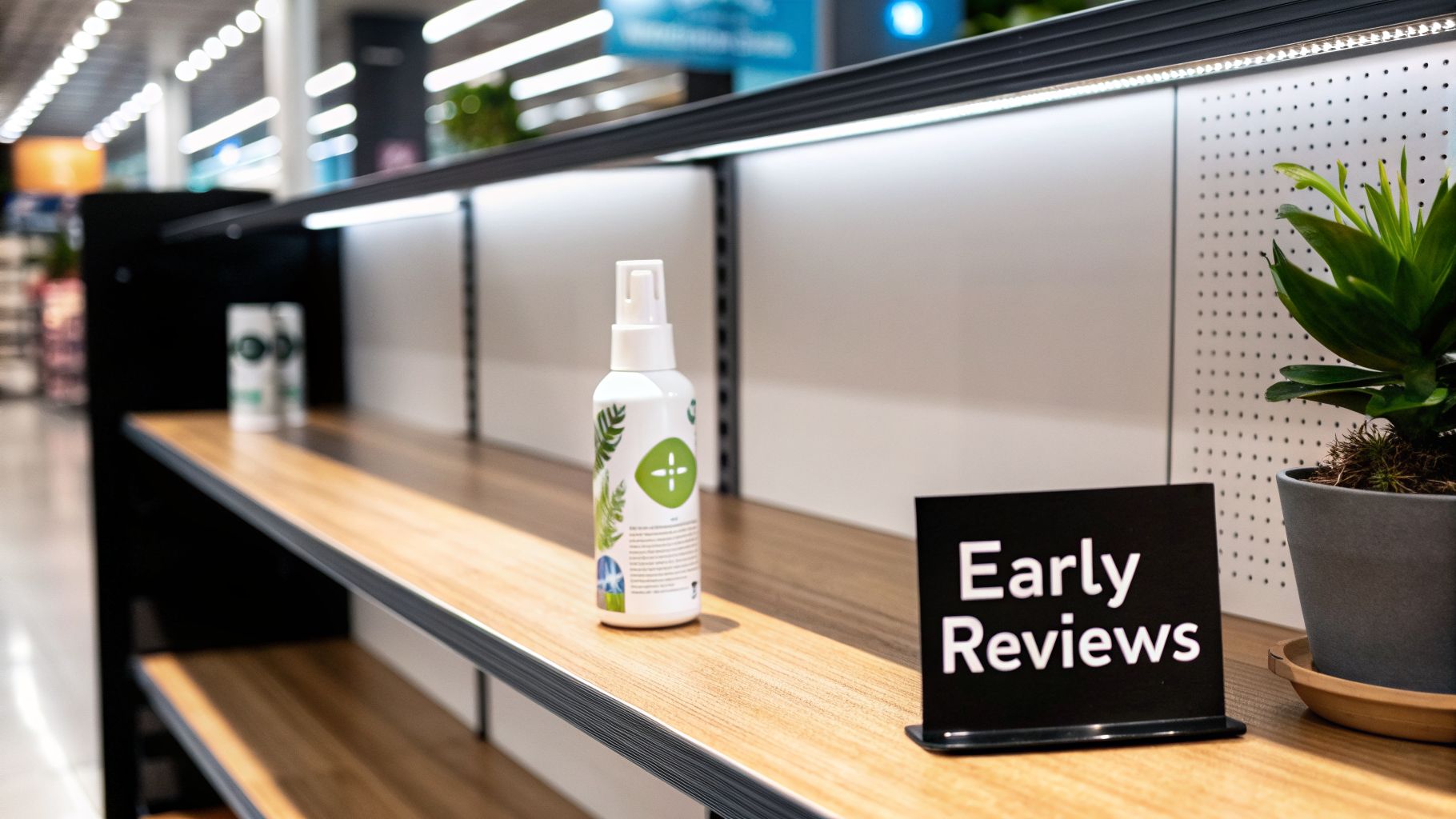
Picture this: you launch a fantastic new product. It’s sitting there on a digital shelf, but shoppers just scroll past. Why? No reviews. It’s like opening a restaurant on a busy street with empty tables; potential customers are hesitant to be the first ones to walk in. This is the exact challenge every new Amazon product faces. Without reviews, buyers are far less likely to take a chance and click "Add to Cart."
The Early Reviewer Program was Amazon's official solution to this problem. It gave sellers a fully compliant way to get those initial pieces of feedback, building the trust and momentum needed to start competing in a crowded marketplace.
The beauty of the program was its simplicity and hands-off nature, which ensured total authenticity. Sellers couldn't hand-pick reviewers or nudge them for a 5-star rating. Instead, they just paid a flat fee to enroll a product, and Amazon handled the rest.
Launched back in 2018, the program was a massive help for new brands, especially in the private label space. For a flat $60 fee per parent ASIN, sellers could enroll products that had fewer than five reviews. Amazon would then randomly select recent, real customers of that product—specifically those with a clean track record—and offer them a small incentive, like a $1 to $3 Amazon gift card, to share their honest opinion. You can find more details about how the program was structured in this overview on Headlinema.com.
This was a game-changer because, on average, only about 1-1.5% of buyers bother to leave feedback on their own. Yet, data shows that a product with just five reviews is 270% more likely to be purchased than one with zero. The program turned that initial social proof into a powerful sales engine.
The core idea was simple: bridge the gap between a new product launch and the first wave of organic customer feedback. It was Amazon's way of priming the pump for sellers who followed the rules.
Once a customer left their review—whether it was glowing or critical—it appeared on the product page with a distinct orange badge that read "Early Reviewer Rewards." This badge created complete transparency, letting other shoppers know the reviewer was a verified buyer who received a small token of appreciation for their time.
The program was built around a few core principles to maintain trust and effectiveness. It was never a way to "buy" positive reviews, but rather a method to accelerate the honest feedback process.
For a quick reference, here’s a breakdown of how the program was structured:
.tbl-scroll{contain:inline-size;overflow-x:auto;-webkit-overflow-scrolling:touch}.tbl-scroll table{min-width:600px;width:100%;border-collapse:collapse;margin-bottom:20px}.tbl-scroll th{border:1px solid #ddd;padding:8px;text-align:left;background-color:#f2f2f2;white-space:nowrap}.tbl-scroll td{border:1px solid #ddd;padding:8px;text-align:left}FeatureSpecificationSeller CostA one-time, non-refundable $60 fee per parent ASIN.Product EligibilityProducts had to have fewer than five existing reviews.Reviewer SelectionAmazon exclusively chose from actual purchasers of the product.Customer IncentiveA small reward ($1-$3 gift card) was offered after the review was submitted.Review IdentificationAn orange "Early Reviewer Rewards" badge disclosed the review's origin.Program GoalThe program ran for up to one year or until five reviews were generated, whichever came first.
Ultimately, Amazon pulled the plug on the Early Reviewer Program in 2021. This wasn't because it was a failure; think of it as a strategic evolution. As Amazon’s tools and seller services matured, it paved the way for faster and more robust alternatives—which we’ll get into later.
Even though it’s gone, understanding how the Early Reviewer Program worked provides critical context for the powerful review-generation strategies that have taken its place.

For any brand trying to get a foothold on Amazon, those first few customer reviews are so much more than just social proof. Think of them as direct messages to Amazon's A9 search algorithm. A product with zero reviews is often handled with kid gloves by the algorithm, which usually means it gets buried deep in the search results.
But once you get even a handful of early reviews, you’re signaling to Amazon that your product is real, it’s shipping, and people are engaging with it. This initial feedback is like turning the key in an engine. It kickstarts a powerful flywheel where reviews build trust, trust boosts conversions, and higher conversions tell the A9 algorithm to rank your product higher and show it to more shoppers.
That journey from having zero reviews to getting your first five is arguably the make-or-break moment for a new product. It’s the difference between being invisible and starting to build real momentum. Every single one of those initial reviews dramatically boosts a shopper's confidence and their willingness to click "Add to Cart."
Don't just take my word for it. A study from the Spiegel Research Center found that the chance of a product being purchased skyrockets by a massive 270% once it gets five reviews. That's a huge jump. It’s precisely why programs like the old Amazon Early Reviewer Program were so valuable. For a $60 fee, sellers could bridge this critical gap and get up to five reviews, each marked with a clear orange badge. If you want to see how that program was built to solve this exact problem, check out this deep dive on Amazon Growth Lab.
This early traction is what separates the products that fizzle out from the ones that take off. It proves to both shoppers and the algorithm that your item is worth a look.
The A9 algorithm is essentially a relevance engine. Early reviews provide the initial data points it needs to determine your product's relevance and value, directly impacting its visibility and sales trajectory.
The magic of early reviews doesn't stop with organic search; it pours right into your advertising performance. A better conversion rate is a huge piece of the puzzle for determining your Ad Rank in sponsored product campaigns. When Amazon sees your listing is good at turning clicks into sales, it rewards you with better ad placements, often at a lower cost-per-click (CPC).
This translates into a much more efficient ad spend and a healthier Advertising Cost of Sale (ACoS). Suddenly, your budget stretches further, driving more sales for the same amount of money. It creates a beautiful, self-sustaining cycle:
This upward spiral is the secret to scaling on Amazon. The sales velocity you build from this initial push opens the door to more organic review opportunities, creating the sustained momentum you need for long-term dominance. Without those first few reviews, this whole growth engine can barely get started.
When Amazon pulled the plug on the Early Reviewer Program back in 2021, it wasn’t because the program failed. It was more of a calculated upgrade. For any brand serious about growth, the program had one major flaw that made it a tough sell in a fast-paced market: it was just too slow. Waiting weeks, or even months, to collect just a handful of reviews can feel like an eternity during that all-important product launch window.
This sluggish pace wasn't a bug; it was a core feature of the program's design. It all hinged on real customers buying your product and then being randomly chosen to get a review request. While that process was certainly authentic, it was also unpredictable. A brand could shell out the $60 fee only to get stuck in limbo, watching competitors with plenty of reviews gobble up sales. For a business that needs to be quick and agile, that was a deal-breaker.
Amazon saw this friction point clearly. As the marketplace got more crowded, sellers needed a faster, more dependable way to build that initial social proof. The solution was already there, just waiting for its moment in the spotlight: Amazon Vine.
Think of the Early Reviewer Program like pinning a flyer on a local community board and just hoping someone gives you a call. Amazon Vine, on the other hand, is like hiring a dedicated focus group of expert product testers. It’s a quicker, more powerful system built for serious sellers who need quality feedback—and need it now.
Vine is an invitation-only program that connects sellers with Amazon’s most trusted reviewers, known as Vine Voices. These are customers with a proven track record of writing detailed, helpful, and unbiased reviews. Instead of crossing your fingers for a random buyer to leave a comment, Vine puts your product right into the hands of people who are committed to providing in-depth feedback.
The difference in the quality of the reviews is night and day:
This distinction is massive. While any review is better than none, the thorough feedback from Vine Voices gives you priceless insights into your product. Sellers can spot potential design flaws, learn about unexpected ways customers are using their product, and get high-quality user-generated content for their listings—all in a fraction of the time.
The end of the Amazon Early Reviewer Program wasn't a step back; it was a clear signal that the platform was doubling down on better tools for brand growth. Amazon's own data pointed to rising organic review rates, helped along by features like the 'Request a Review' button, which made the slower, paid program feel redundant.
The evolution from the Early Reviewer Program to Vine points to a bigger strategic pivot by Amazon. The platform understood that for sellers competing in major global markets, speed is everything. Study after study shows that products with as few as five reviews can see their conversion rates jump by up to 270%. Getting that early momentum is simply not negotiable.
Shutting down the old program was an admission that a better system was already in place. As one report highlighted, Vine was just plain superior in both speed and quality, making the Early Reviewer Program obsolete. In fact, many seasoned sellers had already been skipping it, seeing the cost as an unnecessary expense when other, more effective methods were right there. This move streamlined the options, pushing sellers toward a more powerful tool for launching their products. You can dive deeper into why Amazon made this change in this detailed analysis by Modern Retail.
Ultimately, prioritizing Vine was a win for brands looking to scale. It swapped a slow, uncertain process for a reliable system that delivers higher-quality feedback much faster. This gives sellers the actionable insights and social proof they need to compete effectively right from day one.
With the Amazon Early Reviewer Program officially retired, sellers are looking for a new, reliable system to get those critical first reviews. The game has changed. We've moved away from slow, unpredictable methods and toward a smarter, multi-pronged approach that combines speed, compliance, and genuine customer engagement. This modern playbook is built on three core pillars that work in tandem to create unstoppable review momentum for any growing brand.
The shift is clear: we're moving from old, sluggish programs to faster, more agile methods that define today's best practices.
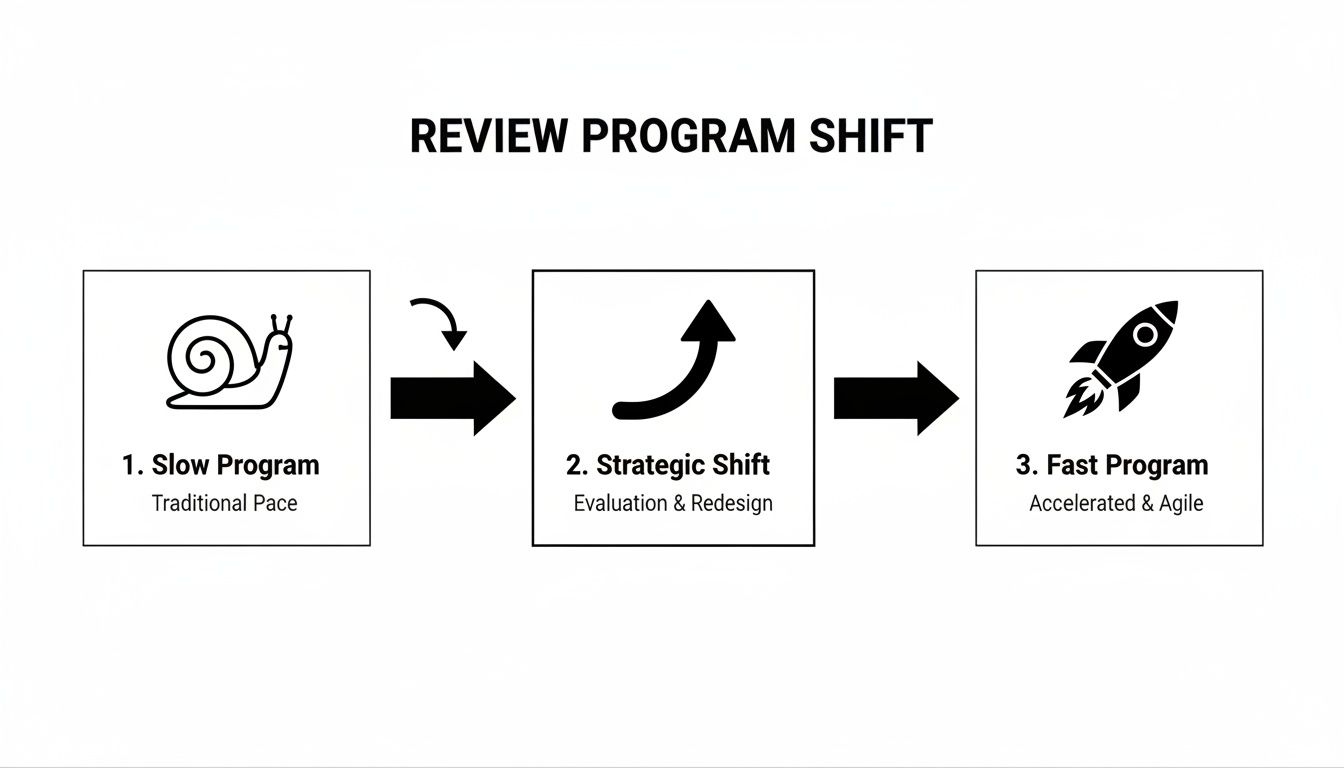
This evolution prioritizes speed-to-market and higher-quality feedback, giving savvy sellers a serious competitive edge.
Amazon Vine is the cornerstone of any modern review strategy. Think of it as the designated successor to the old program, but on steroids. It's a powerful accelerator for new products, giving you direct access to a hand-picked group of reviewers called Vine Voices, who are known for leaving detailed, honest, and thoughtful feedback.
For a new product, enrolling in Vine is one of the smartest investments you can make. You can land up to 30 high-quality reviews, often within just a few weeks. This rapid influx of social proof is a game-changer for a few key reasons:
The trick is to deploy Vine immediately at launch to capture that critical early momentum. Yes, there's an enrollment fee, but the ROI from faster ranking and higher conversion rates makes it a non-negotiable tool for serious brands.
While Vine kickstarts your launch, the "Request a Review" button is your engine for steady, long-term review generation. It's a simple, one-click tool inside Seller Central that sends a standardized, Amazon-approved email to customers asking for both a product review and seller feedback. It is 100% compliant with Amazon's Terms of Service, which removes all the guesswork and risk.
By using the 'Request a Review' button, you're leveraging Amazon's own system to prompt buyers. This avoids the compliance pitfalls of custom email campaigns and has been shown to significantly increase organic review rates.
Many sellers see their review rate jump from the typical 1-2% baseline to double or even triple that by consistently using this feature. You can even automate it with approved third-party software to save hundreds of hours and ensure no opportunity slips through the cracks. This pillar is all about building a simple, scalable habit that pays dividends over time. Of course, a key part of this playbook is ensuring your page converts the traffic these reviews will drive through effective Amazon Listing Optimization.
Your final pillar is turning the unboxing experience into a review-generating machine. And no, this isn't about blatantly asking for a 5-star review, which is a major policy violation. It’s about creating a memorable moment that naturally inspires customers to share their thoughts.
A great way to do this is with product inserts that add real value. For example, include an insert with a QR code for warranty registration. This gives you a legitimate reason to engage with the customer after their purchase. Once they register, you can compliantly follow up with a thank-you message that happens to include a link to leave a review. For a deeper dive, check out our guide on how to get reviews on Amazon.
To help you decide where to focus your efforts, here’s a quick comparison of the primary compliant strategies available to Amazon sellers in 2026.
.tbl-scroll{contain:inline-size;overflow-x:auto;-webkit-overflow-scrolling:touch}.tbl-scroll table{min-width:600px;width:100%;border-collapse:collapse;margin-bottom:20px}.tbl-scroll th{border:1px solid #ddd;padding:8px;text-align:left;background-color:#f2f2f2;white-space:nowrap}.tbl-scroll td{border:1px solid #ddd;padding:8px;text-align:left}StrategyBest ForCostSpeedReview QualityAmazon VineNew product launches needing fast, initial reviews.Enrollment fee per parent ASIN + cost of free products.Fast (days to weeks).High (often detailed and well-written)."Request a Review"Consistent, long-term review generation for all products.Free (or small fee for automation tools).Slow & steady (tied to order volume).Varies (standard customer reviews).Product InsertsBuilding brand loyalty and encouraging organic feedback.Design & printing costs.Slow (relies on customer action).Varies (can be highly positive if experience is great).
Ultimately, these methods aren't mutually exclusive. The most successful brands don't just pick one; they use all three.
By combining the launch power of Vine, the consistent follow-up of the "Request a Review" button, and the subtle encouragement from a great customer experience, you create a complete and compliant system. This is how you generate the reviews that help your brand not just survive, but scale effectively on Amazon.
For any brand selling on Amazon, your account's health is asset number one. It’s everything. While old programs like the Amazon Early Reviewer Program once offered a safe, sanctioned path to getting those crucial first reviews, that ship has sailed. Today’s landscape is a minefield of compliance traps where even well-meaning sellers can make costly mistakes.
It’s about more than just avoiding the obvious no-no of buying fake reviews. We need to talk about the gray areas—the subtle missteps that can put your entire operation at risk. Staying compliant with Amazon's review policies feels a lot like walking a tightrope. One wrong move, even an accidental one, can lead to some seriously painful consequences. The real goal is to build social proof without ever crossing the line into review manipulation, a violation Amazon’s algorithms have gotten incredibly good at spotting.
This is where so many sellers get tripped up. It’s not usually about outright fraud, but about the small, subtle tactics that Amazon considers manipulative. These actions are designed to tilt the odds in favor of positive feedback, which completely undermines the whole point of Amazon's review system: to be a neutral, unbiased platform for all customers.
The most common blunders fall into a few buckets:
The core principle is simple: You can absolutely ask for a review. What you can't do is influence the content, the rating, or even the timing of that review. Amazon has to be a level playing field for every customer experience, the good and the bad.
Let's walk through a real-world (but anonymous) example. A brand launches a new electronics gadget and uses a third-party email service to follow up with customers. The email asks, "Are you happy with your purchase?" If the customer clicks "Yes," they're directed to the Amazon review page. If they click "No," they're sent to a private customer service form.
Within weeks, Amazon's algorithm flags the lopsided review pattern. Boom—an immediate ASIN suspension for review manipulation. The brand is now stuck in a stressful, drawn-out appeals process, losing thousands in sales every single day.
For any serious brand, the risk of getting suspended will always outweigh the short-term benefit of using shady tactics. If you want to learn more about the fallout and recovery process, you can find great information on how to handle a suspended Amazon account and the steps required for reinstatement.
Beyond just Amazon's rules, building a brand for the long haul means adopting ethical marketing practices across the board. For a deeper dive into compliant strategies that can boost your brand's presence off-Amazon, check out this guide to White Hat Link Building. Sticking to the rules, both on and off Amazon, is what protects your brand's reputation and long-term value. For ambitious sellers, a clean record is your most valuable asset.
For top-tier sellers, the game isn't just about getting reviews. It's about what you do with them.
While programs like the old Amazon Early Reviewer Program were great for kickstarting that initial feedback, the real, long-term power comes from treating customer comments as a direct line to your market. It’s a goldmine of business intelligence, hiding in plain sight.
The best brands don’t just count their stars; they dissect the stories behind them. This means building a real system for digging into both the good and the bad reviews. The goal is to stop seeing feedback as just a sales metric and start using it as a core part of your R&D cycle.
Think of your reviews section as a live, always-on focus group. Your customers are telling you, in no uncertain terms, exactly what they love, what they hate, and what they wish your product could do. Systematically collecting and analyzing this is how you find priceless insights your competitors are probably overlooking.
The process involves spotting recurring themes and patterns. You can start with a simple spreadsheet or use specialized review analysis software to tag and categorize feedback, which makes it much easier to see the trends emerge.
Here are the key things to look for:
By turning raw customer comments into structured data, you build a massive competitive advantage. You're no longer guessing what the market wants; you're letting the market tell you directly, ensuring your brand is always evolving to meet real demand.
This kind of systematic analysis turns customer service into a profit center.
Imagine a seller who sees ten separate reviews mentioning their kitchen gadget is a pain to clean. Instead of just seeing this as negative feedback, they treat it as an R&D directive. For the next version, they re-engineer it with dishwasher-safe materials and a simpler design.
They can then update their listing to call out this specific improvement, maybe even using A+ Content to show a before-and-after of the cleaning process. This proactive approach doesn't just solve a customer's problem—it creates a brand new, compelling reason to buy. If you want to see how this works, check out our deep dive on what is A+ Content and how to use it to really make your product pages pop.
This cycle—listen, analyze, iterate, and market—is what separates the top brands from everyone else. It guarantees your product line doesn't get stale. Instead, it stays highly relevant and desirable, creating a brand that customers trust and come back to again and again.
Even though the Amazon Early Reviewer Program is a thing of the past, sellers are still hungry for answers on how to get reviews the right way. Let's tackle the most common questions head-on to help you build a review strategy that’s both compliant and effective.
For a new product, absolutely. The enrollment fee might look a little steep at first glance, but you have to think about what you're buying. The speed and quality of reviews you get from Vine Voices give your new listing instant credibility and a nice little bump in Amazon's algorithm.
This can seriously accelerate a product's initial sales velocity. For any brand that's serious about scaling, the ROI from ranking faster and converting more shoppers usually blows the initial cost out of the water. Think of it as a crucial investment in your launch.
Yes, but you'll be fighting with one hand tied behind your back. Without Brand Registry, you're locked out of Amazon Vine, which is hands-down the most powerful way to kickstart reviews for a new ASIN.
Your main compliant options will be pretty limited:
This is why getting your brand registered should be priority number one for any seller looking to grow. It unlocks the tools you actually need.
The bottom line is that Brand Registry acts as a key. It unlocks access to Amazon Vine and other essential brand-building tools that are unavailable otherwise, putting non-registered sellers at a significant disadvantage.
There isn't a magic number, but the data is pretty clear: the single biggest jump in conversion happens when a product goes from zero reviews to its first five. A solid early goal is to get 15-25 high-quality reviews to build that initial layer of social proof.
After that, the game changes. It's less about hitting a specific number and more about maintaining a steady flow of recent reviews. Shoppers care a lot about recency—it tells them the product is still popular and the feedback is relevant. The real key is continuous momentum, not just hitting a one-time milestone.
At Million Dollar Sellers, we know that getting reviews is just one piece of a much larger puzzle. Our members—an exclusive group of top 7-, 8-, and 9-figure founders—share the exact playbooks they use to dominate their categories, from launch strategies to supply chain optimization. If you're ready to break through your current roadblocks and learn from the absolute best in the business, see if you qualify for our community. Learn more at Million Dollar Sellers.
Join the Ecom Entrepreneur Community for Vetted 7-9 Figure Ecommerce Founders
Learn MoreYou may also like:
Learn more about our special events!
Check Events