Chilat Doina
February 9, 2026
For a lot of Amazon sellers on the rise, the big question isn't if you'll need help with your ads, but when. The tipping point usually sneaks up on you—maybe sales suddenly hit a wall, ad costs start spiraling, or you realize your competitors are just plain outmaneuvering you. Making the call to hire one of the many Amazon PPC agencies is a massive step in your brand's growth journey.

Look, running Amazon PPC yourself makes total sense when you're just getting started. It keeps your overhead low and gives you a real, hands-on feel for what makes your customers click. But here's the thing: the strategies that get you to six figures in revenue rarely scale to seven or eight. As your brand gets bigger, the ad game gets exponentially more complicated.
The first move is usually weighing the pros and cons of in-house vs agency marketing. This isn't just about handing off tasks; it's about knowing when you truly need a specialist to keep climbing.
The classic sign you’ve hit a ceiling? You're pouring more time and money into your ads, but your sales have gone completely flat. Maybe your Advertising Cost of Sale (ACoS) is slowly creeping up, eating away at your margins. You're constantly tweaking bids and adding negative keywords, but the needle just won't budge.
This usually means you've maxed out the basic tactics. A good agency doesn't just do the basics; they bring advanced strategies, powerful software, and a team whose entire job is to smash through performance plateaus like yours.
As a founder, your time is your most valuable currency. Every hour you spend lost in search term reports is an hour you’re not spending on product development, locking down your supply chain, or building your brand. The opportunity cost is staggering when you actually stop to think about it.
Let's do some quick math. If you spend 10 hours a week on PPC, what's that time actually worth? Could paying an expert a few thousand dollars a month free you up to generate tens of thousands in new value somewhere else? For most founders, the answer is a resounding yes.
A common mistake is seeing an agency purely as an expense. The right partner is an investment—in expertise, in growth, and most importantly, in buying back your own time to focus on what you do best: scaling the business.
Amazon advertising isn't just about Sponsored Products anymore. To really own your category, you need a full-funnel strategy that pulls in everything Amazon has to offer. We're talking about:
Getting good at these requires deep, specialized knowledge and a commitment to constant learning. If terms like "DSP" or "Sponsored TV" are new to you, that's a huge sign you could benefit from a team that lives and breathes this stuff daily.
For a deeper dive into building a complete Amazon presence, you might want to check out our guide on how to find the best full-service Amazon agency.

Alright, this is where the real work begins. You're not just hiring a service provider; you're bringing on a growth partner. The goal here is to slice through the polished sales pitches and slick presentations to find the team that can actually move the needle on your bottom line.
Your initial search is going to give you a ton of options. The trick is to quickly filter that firehose of agencies down to a manageable shortlist of three to five real contenders. A great starting point is to look for teams that specialize not just in Amazon, but in your specific product category and business size.
Every agency will show you their highlight reel. It’s your job to poke holes in it. A flashy revenue number is completely meaningless without the backstory. Don't let the big numbers dazzle you—ask pointed questions to get the real story behind their wins.
A truly confident agency will be open about their successes and the hurdles they had to clear to get there. They won’t just show you a pretty graph; they’ll explain the why behind their strategy.
Use this quick-reference table to systematically score potential agencies based on critical performance and compatibility indicators for high-growth brands.
.tbl-scroll{contain:inline-size;overflow-x:auto;-webkit-overflow-scrolling:touch}.tbl-scroll table{min-width:600px;width:100%;border-collapse:collapse;margin-bottom:20px}.tbl-scroll th{border:1px solid #ddd;padding:8px;text-align:left;background-color:#f2f2f2;white-space:nowrap}.tbl-scroll td{border:1px solid #ddd;padding:8px;text-align:left}Vetting CriteriaWhat to Look ForRed Flag ExampleCase Study DepthDo they explain the why behind the results, including starting metrics?"We 3X'd their sales!" (with no mention of the original sales volume or profit impact).Team TransparencyWill you meet the actual account manager before signing the contract?"Our senior strategist oversees all accounts." (Translation: a junior will do the work).Tech StackDo they use proprietary software or third-party tools? How do these tools drive decisions?Vague answers about using "advanced algorithms" without naming specific platforms.Profit FocusDoes their language center on TACOS, contribution margin, and profitability?Overemphasis on vanity metrics like ACoS or impressions without tying them to profit.Strategic ScopeDo they talk about full-funnel strategy, including DSP and Sponsored Display?They only focus on bottom-funnel Sponsored Products campaigns.
This checklist isn't exhaustive, but it helps ensure you’re asking the right questions to separate the true partners from the slick salespeople.
Who, specifically, is going to be running your account? This is one of the most important questions you can ask. A lot of the bigger agencies roll out the A-team for the sales call, only to pass your account off to a junior manager who's still learning the ropes.
Be direct. Ask, "Can I meet the person who will be managing my account day-to-day?" Their answer reveals everything about their transparency and internal structure. An elite agency will be proud to introduce you to their expert operators.
Next, dig into the tools and software they use. Custom dashboards are pretty standard, but what's running behind the scenes? Are they relying on third-party software for bidding and analytics, or have they built their own proprietary tech? Neither is automatically better, but their answer shows you their level of investment and sophistication. Reviewing a breakdown of the 7 Best Amazon PPC Agencies for Profitability & Scale can give you some solid benchmarks for what top-tier teams bring to the table.
The best Amazon PPC agencies don’t just manage keywords; they orchestrate a full-funnel advertising strategy. They get how Sponsored Display ads build awareness at the top of the funnel and how Amazon DSP can be used to retarget shoppers off-platform. They should be able to talk fluently about how your PPC efforts need to sync up with inventory levels, new product launches, and your broader business goals.
The results from a truly specialized team can be mind-blowing. In the hyper-competitive Amazon arena, the top firms have driven incredible outcomes, with some managing over $1.5 billion in annual sales for their clients and boasting retention rates as high as 95%. These are the partners that help brands scale from seven to nine figures because they focus on profitability, not just vanity metrics.
Finally, seek out a specialization that matches your specific needs. Expanding into Europe? Find an agency with a proven track record there. Is your business built on Subscribe & Save? You need a team that lives and breathes customer lifetime value. Finding the best Amazon PPC agency really boils down to this alignment of expertise. By focusing on these core areas—real results, the right people, and true strategic depth—you can build a shortlist of agencies that are genuinely equipped to fuel your brand’s growth.
Agency proposals can sometimes feel like they're written in another language. But getting a firm grip on the financial and legal frameworks is the key to a healthy partnership. When you can crack the code on pricing models and contract terms, you're in a much better position to find a partner whose incentives are perfectly aligned with your growth.
Most proposals you’ll see from Amazon PPC agencies fall into one of three buckets. Each has its pros and cons, and the right one for you will depend on your brand's scale, budget, and specific goals. There's no single "best" model—it’s all about finding the right fit for your situation.
Over the years, agency pricing has evolved quite a bit, shifting to better align with what sellers actually need. This infographic gives a great visual of how we've moved from simple retainers to more sophisticated, performance-driven structures.
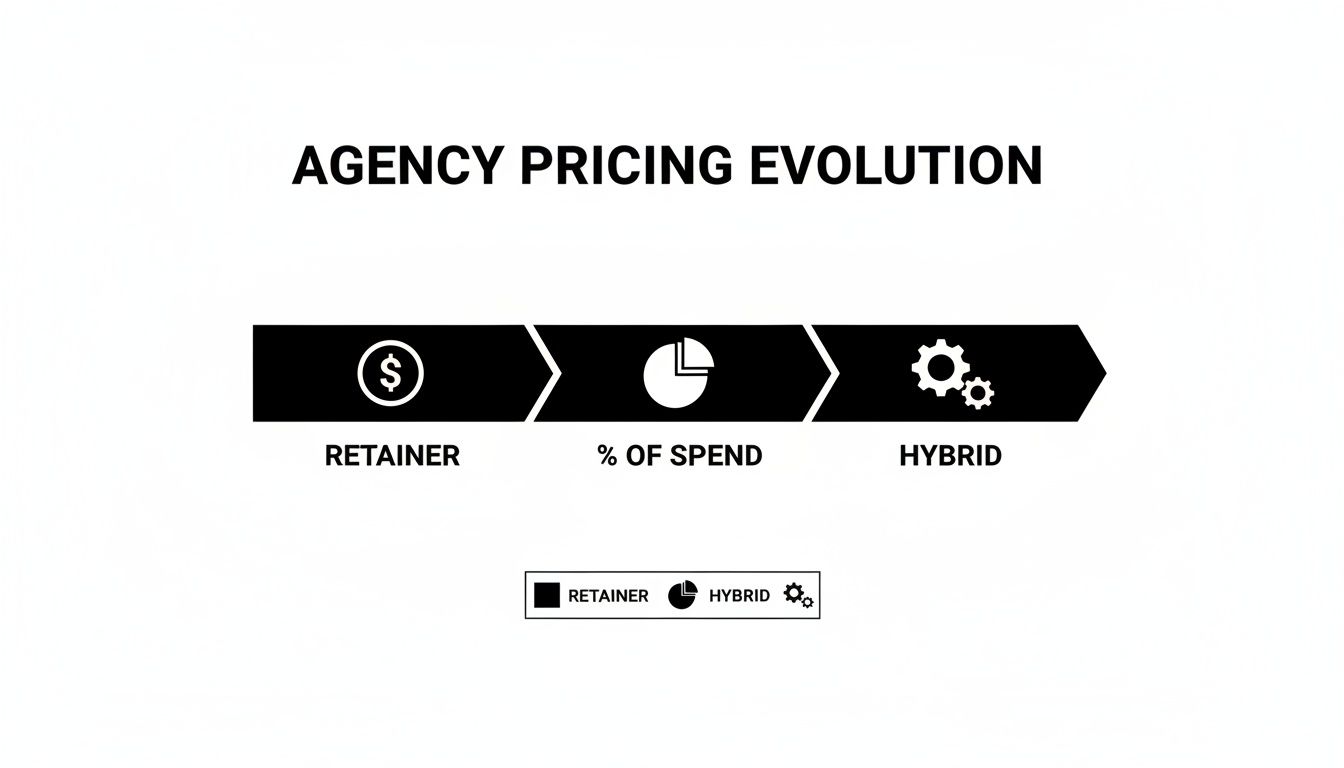
This shift is a direct response to founders demanding true partnerships where the agency has real skin in the game. It’s all about tying their pay directly to the results they deliver.
The most straightforward model is the flat monthly retainer. You pay a fixed fee, month in and month out, regardless of ad spend or performance. It’s predictable and simple, which can be great for brands with stable budgets needing consistent management. The main drawback? It doesn't inherently push the agency to scale your ad spend aggressively.
Then you have the percentage of ad spend model, which is probably the most common structure you'll see, especially for growing brands. The agency's fee is a direct percentage of your monthly ad spend. This model is popular because it aligns the agency's interests with scaling your advertising—they earn more when you spend more.
The catch, of course, is that a less sophisticated agency might be tempted to just crank up the spend without focusing on efficiency. This could easily wreck your profitability, which is why your vetting process is so critical.
Finally, there are hybrid or performance-based models. For scaled brands, these are often the most appealing because they directly tie the agency's compensation to KPIs like hitting a target ACoS or specific revenue growth. This creates a genuine partnership where the agency only wins big when you do.
So, what should you really expect to pay? The numbers can be all over the place, but there are some reliable benchmarks. Elite Amazon PPC agencies will command premium pricing, typically charging 10-20% of monthly ad spend or flat retainers from $1,500 to over $10,000.
Rates often scale down for higher volumes. You might see 15-20% for spends in the $10K-$50K range, dropping to 10-15% for spends over $50K. Performance-based models are a game-changer for brands stuck with a high ACoS, as they can unlock serious profitability. These costs reflect the value you get from advanced tools, deep strategic planning, and documented profit gains, making it a crucial investment. For a deeper dive, check out this advanced operator's guide to top agencies.
A premium price tag should always come with premium service. This typically includes:
Once you've landed on a pricing model, the contract is your final hurdle. Don't just skim it—this document governs your entire relationship. Pay close attention to a few critical clauses that can make or break the partnership down the road.
The contract isn't just a formality; it's the rulebook for your partnership. Scrutinize the termination clause, data ownership terms, and performance expectations before you sign anything. A good partner will have clear, fair terms that protect both parties.
First up, the termination clause. What does it take to end the agreement? A 30-day notice period is standard and fair to everyone. Be wary of long-term contracts with hefty cancellation fees; they can trap you in an underperforming relationship.
Next, get crystal clear on data and account ownership. You must retain full ownership of your Amazon advertising account and all its historical data. The agency should only get access as a user, never an owner. This is non-negotiable. It protects your most valuable asset if you ever decide to part ways.
Finally, make sure the scope of work and communication protocols are spelled out. What, exactly, will the agency be doing each month? How often will you meet? What's the expected response time for emails? Getting this in writing from day one prevents misunderstandings and sets clear expectations for accountability.
The first 90 days with your new agency will absolutely set the tone for the entire relationship. I've seen it time and time again: a clunky, disorganized start almost always leads to friction and missed targets down the road. But when the onboarding is seamless? That's a clear sign you’ve found a true strategic partner, not just another vendor.
This initial phase is all about deep discovery and getting perfectly aligned. Your new agency should be relentlessly curious, digging into every corner of your account history, your product profit margins, and your bigger business objectives. This isn't just about handing over login access; it's about them understanding your brand's DNA so they can build a strategy that actually moves the needle.

A smooth handover is a two-way street. Yes, you need to provide them with a firehose of data, but they need to come back with a clear, actionable plan. The more prepared you are, the faster they can start delivering real results.
Walk into that kickoff meeting ready to share:
In return, the agency's first move should be a thorough audit of your existing campaigns. This initial analysis is their chance to impress you by identifying quick wins, pinpointing wasted ad spend, and highlighting the strategic gaps in your current setup.
Generic monthly reports filled with vanity metrics are a complete waste of everyone's time. A top-tier agency will collaborate with you to build a custom reporting framework that zeroes in on the KPIs that actually impact your bottom line. It's time to move the conversation way beyond a simple ACoS.
Your regular reporting should be built around a few core metrics that tell the full story of your account's health:
A great agency won’t just send you a dashboard and call it a day; they’ll interpret the data for you. Each report should come with a summary that explains the why behind the numbers and clearly outlines the strategic adjustments they plan to make.
Finally, you need to nail down a communication rhythm that keeps you in the loop without creating micromanagement headaches. Especially in the first few months, over-communication is far better than radio silence. A well-defined structure keeps everyone aligned and accountable.
Here’s a communication framework that works incredibly well:
This kind of structured approach ensures you always know what's going on and that the agency is proactively steering your account toward the goals you’ve set together. It’s the bedrock of a long and profitable partnership.
Once your new agency is in the driver's seat and the campaigns are live, the real work begins. This is where the rubber meets the road—managing performance. To make sure your investment is actually paying off, you need a solid framework for setting Key Performance Indicators (KPIs) and, just as importantly, holding your agency accountable to them. This means getting way past a simple obsession with Advertising Cost of Sale (ACoS).
A truly great agency partnership is built on a foundation of shared goals. You both need to be crystal clear on what "success" actually looks like for your brand, and that requires a much broader view of performance that ties ad spend directly to the health of your entire business.
Look, ACoS is a decent starting point for judging campaign efficiency, but it only tells a fraction of the story. A low ACoS isn't automatically a win, and a high ACoS isn't always a problem. For instance, you'd probably be more than happy to accept a higher ACoS during a product launch to build up that crucial sales velocity or when you're aggressively trying to steal market share from a competitor.
Measuring true performance means building a dashboard of KPIs that reflect your real strategic goals. This is how you'll be able to tell the difference between an agency that just "manages spend" and one that genuinely drives growth.
The real goal of your advertising isn’t just to get cheap clicks; it’s to grow your total business profitability. If your agency isn't focused on how their work impacts your bottom line, you have a vendor, not a partner.
Your performance conversations should really boil down to a few key metrics:
To really get a handle on performance, you need to be tracking the right things. The table below breaks down the essential KPIs that separate surface-level metrics from the data that truly reflects business impact.
.tbl-scroll{contain:inline-size;overflow-x:auto;-webkit-overflow-scrolling:touch}.tbl-scroll table{min-width:600px;width:100%;border-collapse:collapse;margin-bottom:20px}.tbl-scroll th{border:1px solid #ddd;padding:8px;text-align:left;background-color:#f2f2f2;white-space:nowrap}.tbl-scroll td{border:1px solid #ddd;padding:8px;text-align:left}KPI CategoryMetricWhy It MattersTop-Line ImpactTotal ACoS (TACOS)The ultimate measure of ad efficiency. Shows if your advertising is creating a "flywheel" effect that lifts all sales, not just ad-attributed ones.Growth & AcquisitionNew-to-Brand (NTB) %Measures how many sales are from brand new customers. Critical for understanding long-term brand growth vs. just selling to existing customers.Campaign EfficiencyAdvertising Cost of Sale (ACoS)A classic efficiency metric. Great for diagnosing performance at the campaign or ad group level, but shouldn't be your only KPI.ProfitabilityAd-Driven ProfitMoves beyond revenue to measure the actual profit generated by your ad spend after accounting for COGS and ad costs.Market DominanceShare of Voice (SOV)Tracks your brand's impression share for key strategic keywords vs. competitors. Essential for measuring brand visibility and market penetration.Organic HealthOrganic Ranking for Target KeywordsA secondary KPI that shows if your ad-driven sales velocity is successfully boosting your organic search position over time.
By tracking this mix of primary and secondary KPIs, you get a much richer, more accurate picture of your agency's contribution to your business's success.
Setting the right targets is half the battle. The benchmarks for a brand slugging it out in the supplements category are going to look wildly different from someone selling niche kitchen gadgets. Your agency should be a partner in setting realistic goals based on a few key factors.
First up is your product category and the competitive landscape. Super competitive categories almost always demand higher ad spend and come with a higher baseline ACoS. It's just the cost of doing business. Second, your targets have to line up with your current business objectives. Are you launching something new? Defending your turf? Squeezing every last drop of profit from mature products? Each of these goals requires a totally different PPC playbook. To get ahead, you have to understand the core principles behind the most effective Amazon PPC strategies.
The Amazon ad space is enormous and still growing, projected to capture a huge slice of all retail media spend. This cements Amazon's spot as a top-tier ad platform where the average CPC is just $0.77. But with over 9.7 million sellers globally, the competition is fierce. This is precisely where expert agencies earn their keep, using sophisticated tools and real-time data to drive results.
The Quarterly Business Review (QBR) is your dedicated time to pull back from the day-to-day campaign management and look at the big picture. This isn't just a boring reporting meeting; it's a strategic alignment session. A good QBR makes sure your agency's efforts are perfectly synced up with where your business is headed for the next 90 days.
Here’s what the agenda for every QBR should cover:
This regular, high-level check-in is your system for keeping the partnership proactive and focused on constant improvement. It’s how you build the kind of accountability that drives real, long-term results.
Even after you've done all the homework and narrowed it down to your top pick, it's totally normal to have a few last-minute questions before you sign the contract. Let's be real, you're about to hand over the keys to a huge part of your business. You should feel 100% confident about the partnership.
Here are some of the most common questions we see from founders right before they team up with an Amazon PPC agency.
This is the classic "how long is a piece of string?" question, but I can give you some solid goalposts. There’s no single magic number because your ideal budget is tied directly to your product’s price, how cutthroat your category is, and what you’re trying to achieve right now.
As a general rule of thumb, you should be ready to spend at least $3,000 to $5,000 per month in ad spend, not including the agency's fee.
Anything less than that, and you're handcuffing the agency. They simply can't gather enough data to make smart, impactful decisions. They need enough budget to run tests on different keywords, ad types, and bidding strategies to figure out what actually moves the needle for your brand.
Don't think of this as a cost. It’s an investment in data. The whole point of the first few months is often less about immediate profit and more about learning. A healthier initial budget just massively speeds up that learning curve.
Now, if you're in a hyper-competitive space like supplements or consumer electronics, you might need to start closer to $10,000 or more just to get your foot in the door and see any real traction. A good agency will be upfront about this and help you set a budget that aligns with the reality of your market.
Let's be honest, a huge reason to hire an agency is to get time back in your day, so this is a big one. While you won't be in the trenches managing campaigns daily, you can't just "set it and forget it." The best results come from a real partnership.
You should plan to commit a few hours a month, especially right at the beginning. Most of that time will break down like this:
Your job is to stay involved at the strategic level, not get buried in the tactics. You provide the business context—hey, we've got a big promotion coming up, inventory is low on this SKU, we're launching a new product—and they translate that into a killer advertising plan.
First off, don't panic. PPC performance has its ups and downs; it's the nature of the beast. An Amazon algorithm change, a new competitor going nuclear on bids, or even seasonal trends can cause a temporary dip. One bad week doesn't mean your agency is failing.
The moment you see a dip, the first step is to communicate. Hop on Slack or send an email to your account manager and ask what they're seeing from their side. A proactive agency will likely have already spotted it and started digging in.
They should be able to give you a clear, data-backed reason for why performance shifted and what specific steps they're taking to turn it around.
Honestly, this is where you see the true quality of your agency partner. A great one will be transparent, own the numbers, and welcome your questions. If they get defensive, blow you off, or can't explain the downturn, that's a much bigger red flag than the performance dip itself.
Ready to connect with a network of founders who have mastered the art of scaling with agency partners? In Million Dollar Sellers, you'll find vetted recommendations and unfiltered advice from the top e-commerce entrepreneurs in the world. Apply to join MDS today.
Join the Ecom Entrepreneur Community for Vetted 7-9 Figure Ecommerce Founders
Learn MoreYou may also like:
Learn more about our special events!
Check Events