Chilat Doina
April 28, 2026
Prime Day can create a quarter’s worth of demand in a few days. Sellers who win those spikes do not start with the promo calendar. They start with contribution margin, reorder windows, FBA capacity, and a clear answer to one question. Which event should drive profit, and which event should buy rank?
I’ve seen the same pattern repeatedly in large accounts. A brand posts record event revenue, then spends the next six weeks cleaning up the damage. They stock out on hero ASINs, keep bids too high after conversion rates normalize, and walk into the next event with weaker margins and less optionality. The revenue headline looks strong. The operating result is worse.
The right way to use amazon sale dates is to connect each one to a specific operating decision. Prime Day might justify deeper discounts on a hero SKU because the rank lift pays back over the next 30 days. An October event might be better used to move slower inventory and preserve your best units for Black Friday. A smaller deal window can be the right moment to test price elasticity, push FBM as a backup lane, or build remarketing pools for branded search and DSP after the spike.
That is the playbook. Sale dates are checkpoints for inventory placement, pricing control, PPC aggression, and cash flow timing.
Treat the calendar that way and each event does a job. Ignore that and you get the outcome many mid-market brands get every year. High top-line sales, lower contribution profit, and a weaker position heading into the next demand surge.
Most public guides on amazon sale dates make the same mistake. They give you a list of holidays and call it strategy.
That’s useful for junior planning. It’s not useful when you’re managing real cash exposure, thin replenishment windows, and ad volatility across multiple channels. At scale, the Amazon calendar becomes a sequencing problem. You’re not asking, “When is the event?” You’re asking, “What should this event do for my business?”
A top seller usually assigns each event a job.
One event pushes new-to-brand customer acquisition. Another clears inventory you don’t want sitting in FBA later. Another is used to defend rank on a core keyword set. Another is there to stress-test pricing elasticity before Q4. If every event gets the same promo treatment, you’re not planning. You’re reacting.
Three practical lenses help:
Practical rule: Every sale date should have one primary objective and one secondary objective. If your team gives an event five goals, execution gets muddy fast.
They build around the full year, not around one launch memo from Amazon.
They know a summer sale can affect Q4 reorder timing. They know October pricing behavior changes what customers expect in November. They know one stockout during a high-velocity period can damage more than the units lost that day.
The primary advantage in amazon sale dates comes from stacking moves:
That’s the difference between “having a good sale” and using Amazon’s calendar to build the next quarter.
The 2026 Amazon calendar matters because it sets your purchasing rhythm, your FBA send-in rhythm, and your ad budget rhythm. Some dates are fixed by the retail calendar. Others are best treated as projected planning windows until Amazon confirms them.
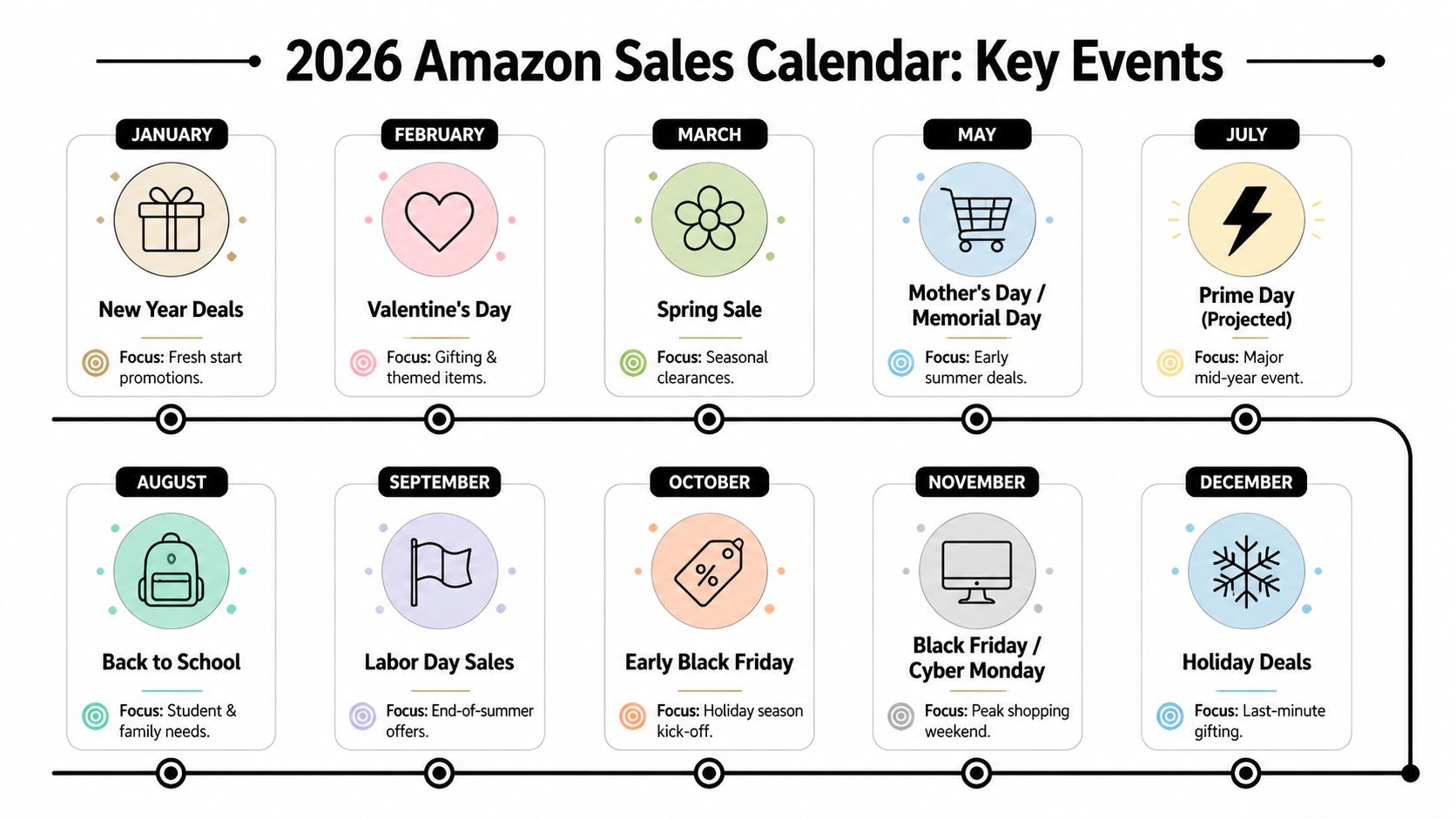
For most established brands, the year breaks into five useful sales phases.
Early-year reset
January through March is where a lot of brands clean up seasonal carryover, test refreshed bundles, and reposition listings. Spring-oriented products, home, organization, wellness, and practical gifting tend to fit this window well.
Gift-driven spring and early summer
Valentine’s Day, Mother’s Day, and Memorial Day are less universal than Prime Day, but they matter if your catalog sells well through gifting, home upgrades, or seasonal transitions.
Prime Day period
Mid-July is still the anchor expectation for sellers planning 2026, based on Amazon’s recent pattern. This event is the clearest mid-year traffic spike and usually rewards brands with strong reviews, clean detail pages, and pricing discipline.
Back-to-school and early fall
August and September are often underestimated. They help sellers move practical categories, family-oriented products, electronics-adjacent items, and products that feed into Q4 retargeting pools.
Q4 peak season
October through late December is the main event. Prime Big Deal Days acts as the warm-up and data-gathering phase. Black Friday and Cyber Monday are the biggest pressure points. Late December can still convert well if you stay in stock and switch the offer structure intelligently.
| Event Name | Projected Dates (2026) | Strategic Focus & Key Categories |
|---|---|---|
| New Year Deals | January | Fresh-start promotions, organization, wellness, home resets |
| Valentine’s Day | February | Giftable products, beauty, accessories, themed items |
| Big Spring Sale | March 25 to March 31 | Seasonal clearances, home, lifestyle, practical spring refresh items |
| Mother’s Day and Memorial Day | May | Gift-oriented products, home, outdoor, early summer demand |
| Prime Day | Projected mid-July | Member-focused tentpole event, broad demand, hero SKUs, ranking pushes |
| Back to School | August | Student and family needs, practical goods, tech-adjacent and organization products |
| Labor Day Sales | September | End-of-summer promotions, seasonal inventory transitions |
| Prime Big Deal Days | Projected early to mid October | Q4 kickoff, holiday audience warming, pricing tests, catalog exposure |
| Black Friday and Cyber Monday | November 27 to December 1 | Peak shopping corridor, aggressive promotional competition, high-intent demand |
| Holiday Deals and Boxing Day period | December through December 26 and beyond | Last-minute gifting, gift card demand, post-Christmas self-purchase behavior |
Don’t give every event equal weight. Rank them by expected contribution margin, inventory confidence, and category fit.
A simple way to do that:
If an event doesn’t fit your catalog, forcing participation usually means unnecessary discounting and weak sell-through.
They build the calendar from the front end. Promo dates, ad flights, creative swaps.
The better approach is to build it from the back end first:
That’s the difference between seeing amazon sale dates as traffic opportunities and using them as an operating advantage.
A four day Prime Day can compress weeks of normal sales velocity into a handful of checkout-heavy windows. That kind of demand does not reward the seller with the biggest discount. It rewards the seller whose inventory, ad structure, pricing logic, and fulfillment plan were built for concentrated traffic.

Prime Day exposes operating weaknesses fast. Forecasting errors show up as stockouts. Broad couponing shows up as margin bleed. Lazy campaign structure shows up as wasted branded spend. Sellers who treat it like a traffic spike usually get revenue and leave profit behind. Sellers who treat it like a coordinated operating event usually get both.
The best Prime Day ASINs do not start cold.
They enter the event with stable conversion rates, enough review depth to hold trust under heavier traffic, and inventory positioned to survive a hard first-day surge. Once that traffic hits, sales velocity can improve rank, rank can improve placement, and placement can feed more sales. That sequence is why Prime Day decisions need to be made weeks earlier than vendors might prefer.
I usually judge event readiness with one question: if this SKU gets more clicks than expected on day one, does the business want more of that traffic or need to slow it down? If the answer is unclear, the listing is not ready for aggressive event exposure.
Prime Day punishes average-based planning. Demand rarely spreads evenly across a full event window, and it definitely does not spread evenly across a catalog.
Split ASINs into roles before inbound decisions are final:
That role-based view changes how much stock each SKU should carry, how much discount pressure it can absorb, and whether FBA is the right placement for all of it. Hero SKUs need deeper protection against check-in delays and faster-than-plan demand. Margin SKUs need restraint. Oversupplying the wrong ASIN is just a slower form of stockout because the capital is trapped where it cannot compound.
Prime Day pricing should reflect purpose, not enthusiasm.
Some ASINs are there to win more sessions and improve market share for a category term. Others are there to monetize the brand traffic created by the hero products. Mixing those jobs leads to bad discounting. I see this often with catalogs that put a deal on every decent SKU, then wonder why blended margin collapses while the hero listings still run out first.
The practical trade-off is simple. A deeper price cut can buy more conversion rate and more ad efficiency, but it also increases the risk of cannibalizing full-price units, triggering faster stock depletion, and leaving you weak for the post-event halo. Strong operators choose a few listings to carry the event instead of asking the whole catalog to do the same job.
Operator note: The best Prime Day SKU is often the one with the cleanest mix of review count, conversion stability, replenishment confidence, and ad elasticity. It is not always the current bestseller.
Prime Day ad accounts need separation by objective. A single blended structure hides signal and makes budget decisions slower right when speed matters most.
At minimum, break out:
That structure makes it easier to see where higher CPCs are healthy and where they are waste. A strong Amazon advertising strategy also starts before Prime Day. The goal is to improve query data, identify which search terms deserve budget concentration, and make sure bids are not being set for the first time under event pricing pressure.
A lot of Prime Day postmortems blame ads or pricing when the actual failure was logistics.
Units were not fully received. Packaging slowed prep. Restock limits were ignored until it was too late. Merchant Fulfilled backup was never tested. Prime Day magnifies every one of those errors because there is no time cushion once the event starts.
The sellers who stay stable usually build a control plan for exceptions, not just a forecast for the happy path. They know which ASINs can shift budget down if sell-through gets ahead of stock, which listings can hold price if inventory gets thin, and which SKUs are not allowed to chase volume at all.
Prime Day has an internal sequence, and the first surge matters most.
A SKU that enters day one fully stocked, competitively priced, and aggressively defended in ads has a better chance of earning stronger placement for the rest of the event. A SKU that opens weak often spends the remaining days trying to recover lost rank, lost click share, and lost conversion history. Recovery is possible, but it is expensive.
That is why I prefer front-loaded discipline over late-event improvisation. If a listing deserves event traffic, it should be ready to take that traffic immediately.
| What works | What usually fails |
|---|---|
| Concentrating inventory on a small set of event ASINs | Spreading stock evenly across the catalog |
| Assigning each SKU a role before setting discounts | Applying similar discount depth across unrelated ASINs |
| Splitting PPC by campaign objective and query type | Running one blended campaign structure with shared budgets |
| Building a logistics backup plan before traffic starts | Assuming replenishment or check-in issues can be fixed during the event |
| Using Prime Day to improve rank, audience pools, and post-event demand | Treating the event as a short-term revenue burst only |
Prime Day is not just a sale date. It is a stress test for the whole business. Sellers who connect pricing, PPC, inventory, and fulfillment before the event usually leave with stronger rank, cleaner data, and more profit after the traffic fades.
Q4 isn’t one event. It’s a stamina test with multiple peaks, and each one changes the next.

Amazon’s Q4 peak season runs from Prime Big Deal Days in early October through Cyber Monday, with discounts reaching up to 55% during Cyber Week. Prime Big Deal Days on October 7 to 8 in 2025 were forecast to become Amazon’s largest October event yet, with US GMV growing 7% year over year, according to this Q4 event analysis. That tells you two things. October now matters on its own, and November is no longer the only month where serious sellers need full operational readiness.
A lot of brands still misread Prime Big Deal Days. They either overvalue it and drain inventory too early, or undervalue it and lose a cheap chance to train the algorithm and gather buyer data before Black Friday.
The best use of October is selective aggression.
You want enough participation to learn:
You don’t need to blast the whole catalog. You need a controlled sample that teaches you something useful.
For teams tightening their Q4 planning process, a solid inventory forecasting method is what keeps October from cannibalizing November.
I’ve seen brands celebrate a great first half of Q4 and then limp into Black Friday with broken availability on their best listings. That’s not a win. It’s misallocated inventory.
Think of Q4 in phases:
Early October
Use Prime Big Deal Days to push selected ASINs, expose weaker listings to more traffic, and collect demand signals.
Late October to Thanksgiving
Rebalance. Tighten bids. Re-price where needed. Protect your core inventory. Start shifting ad emphasis toward proven terms and top converters.
Black Friday through Cyber Monday
During this period, you press hardest on the products that can absorb scale. By now, indecision should be gone.
The biggest Q4 mistake isn’t under-discounting. It’s exhausting your best ASINs before the highest-intent weekend arrives.
Q4 PPC gets expensive because everyone knows the traffic is there. That doesn’t mean you should chase every impression.
I prefer a layered budget mindset:
That’s also why ad decisions in Q4 should be tied to stock position every day. A high-converting keyword isn’t “good” if it accelerates a stockout that leaves your best ASIN unavailable for Cyber Monday.
Here’s a useful Q4 split.
| Phase | Primary goal | Common mistake |
|---|---|---|
| Prime Big Deal Days | Learn, rank, warm audiences | Treating it like a standalone revenue grab |
| November ramp | Protect winners, refine bids | Letting too many campaigns run unchanged |
| Black Friday and Cyber Monday | Maximize profitable scale | Overspending on SKUs with weak stock cover |
| Post-Cyber week | Extend momentum selectively | Turning everything off too early |
A lot of teams also miss the external context. Customers don’t experience Q4 as separate retail holidays. They experience one long promotional environment. Your listings, pricing, and ad sequencing need to feel coherent inside that environment.
A good breakdown of broader holiday timing and platform behavior can help reset how you plan this stretch:
It feels controlled. Not calm, because Q4 is never calm. Controlled.
Your team knows which ASINs are allowed to run hot. You know which offers are there to convert branded demand and which are there to win category share. You know when to push, when to hold, and when to stop feeding traffic into a listing that can’t support it operationally.
That’s how top sellers move through amazon sale dates in Q4. Not by chasing every spike, but by building momentum that survives the whole gauntlet.
A one-point pricing mistake during a major Amazon event can wipe out more profit than a big traffic lift can recover. Revenue forgives bad decisions. Margin usually does not.

Amazon’s pricing systems now react faster than many teams can manually adjust. SellerApp notes in its analysis of Amazon sale periods that Amazon’s dynamic pricing models weigh broader competitive signals, including other marketplaces. For operators, that shifts the job from “set a discount” to “control a pricing range.”
That distinction matters during sale events because pricing is tied to four other decisions at once. Buy Box retention. PPC efficiency. Inventory burn rate. Replenishment risk.
If the price is too high, conversion weakens and paid traffic gets expensive. If the price is too low, margin disappears and fast-moving SKUs can sell through before the event is over. The right move is usually a controlled band by ASIN, with a hard floor tied to contribution margin and a ceiling tied to Buy Box competitiveness.
Three rules hold up well in practice:
Teams building this into daily operations usually benefit from AI tools for ecommerce that support pricing, forecasting, and campaign decisions, not just reporting.
Margin rule: If the event requires pricing below your contribution floor, reduce exposure on that SKU. Do not buy unprofitable volume just to keep the graph moving.
A lot of brands overspend on the event itself, then disappear when traffic gets cheaper.
That is a miss.
Shoppers rarely complete the whole decision in one session, especially on higher-priced products, bundles, replenishment items with multiple options, or listings where comparison shopping is common. Event traffic creates the audience. The days after the event often create the cleaner profit.
Amazon Ads highlights retargeting and audience re-engagement across sponsored formats in its remarketing guidance for advertisers, which matches what I see in mature accounts. Once event-day urgency drops, the stronger message usually shifts from discount-first to confidence-first.
The best post-event setup is disciplined, not aggressive. Keep it simple enough to execute fast and strict enough to protect margin.
One more trade-off is easy to miss. Post-event remarketing works best when pricing stays credible. If you snap back to an uncompetitive price the moment the badge disappears, you pay to bring shoppers back to an offer they no longer like.
It rejects the idea that sale-event pricing should be handled as a catalog-wide discount exercise. Strong operators price by role, stock cover, and Buy Box sensitivity.
It also rejects the idea that demand ends when the event banner comes down. The event creates intent. The next few days decide how much of that intent turns into profit.
Treat amazon sale dates as operating windows, not just promotional dates. Price within controlled bands, protect margin floors, and use remarketing after the rush when weaker sellers have already gone quiet.
A sale event is usually won before the badge appears. By launch week, key variables are already set: which SKUs got inventory priority, which offers can absorb spend, and which listings are strong enough to convert expensive traffic without margin leakage.
Start with event economics at the ASIN level.
Every serious event plan begins by assigning each SKU a job. Hero SKUs bring in volume and rank momentum. Support SKUs lift basket size or catch spillover demand. Margin-protection SKUs hold profit if CPCs climb faster than expected. Some ASINs should sit out entirely because they are too stock-sensitive, too review-fragile, or too dependent on a price point that will not hold under event pressure.
Lock three decisions here:
If a SKU does not clear those tests, it should not get event traffic.
This is the build phase.
Listings need to be conversion-ready early enough for indexing, review accumulation, and retail readiness checks to settle before the rush. Teams that wait until the final two weeks usually end up making reactive edits while inventory is already in motion.
Use this window to get the operating system in place:
One missed detail here gets expensive fast. A broken variation family or a delayed FBA check-in can ruin a strong event plan even if demand shows up exactly as forecast.
Now the job shifts from planning to validation.
Check whether inventory is being received on schedule, not just marked as shipped. Review suppression risks, stranded inventory, retail contribution by ASIN, and campaign naming so reporting stays clean during the event. This is also the right moment to remove weak bets. Event plans get stronger when you cut borderline SKUs before they absorb budget and operational attention.
A practical readiness review should answer these questions:
| Area | Green light question |
|---|---|
| Inventory | Is event stock committed, receivable on time, and covered by a backup plan if check-in slips? |
| Pricing | Does each promoted ASIN have a clear floor that still protects contribution? |
| PPC | Are campaigns segmented by role so budget can be reallocated fast during the event? |
| Listing quality | Are hero detail pages conversion-ready on mobile, with no image, copy, or variation issues? |
The final stretch is about control, not creativity.
Do not flood the account with late experiments because the date feels close. Tight control beats last-minute motion. Watch receiving status, in-stock rates, campaign scheduling, coupon visibility, and detail page health every day.
During the event, manage the account like a trading desk:
Speed matters here. So does restraint.
The event is not over when the badge disappears. The next few days decide whether the traffic spike turns into clean profit or a messy reset.
Have the post-event checklist built before launch:
At this stage, disciplined operators separate revenue from profit. The event creates demand. The timeline above determines whether that demand lands on the right SKUs, at the right price, with enough inventory behind it to matter.
This is one of the key operator questions because multi-market overlap can create hidden strain.
A common example is India’s Great Indian Festival from September 22 to October 5 overlapping with the US Prime Big Deal Days in October. Sellers need to lock deals 4 to 6 weeks early per regional deadlines to capture 20 to 30% traffic surges, as discussed in this regional timing overview. If you sell across regions, don’t let each marketplace team plan in isolation.
Use one shared decision sheet that forces agreement on three things:
If you don’t centralize that, one market steals inventory from another and nobody sees the problem early enough.
Only when the event has a clear job.
A smaller event is useful if it helps you test pricing, push a seasonal subcategory, warm retargeting pools, or clear units that are strategically worth exiting. It’s not useful just because Amazon offers another promotional surface.
Smaller events are best used for learning or cleanup. Save broad aggression for windows with stronger buyer intent.
When the unit economics or stock position don’t support it.
That can mean your landed cost changed and the event price no longer makes sense. It can mean your best ASIN has weak stock coverage and should be protected for a later window. It can mean competitors are discounting irrationally and there’s no strategic reason to follow them into bad margin.
Sitting out doesn’t have to mean going dark. Sometimes the right move is to keep ads running on branded demand, hold pricing, and let weaker competitors burn margin.
Concentrate them.
Most brands do better when they pick a small number of event-worthy ASINs and make those offers sharp. Broad discounting often creates catalog cannibalization, thinner inventory, and weaker contribution margin without a matching gain in rank.
Stop asking which date is biggest. Start asking what each date should accomplish.
That one shift changes purchasing, deal depth, ad structure, and replenishment decisions. It also helps your team avoid the default Amazon seller habit of using every event the same way.
Serious sellers get better faster when they can compare notes with operators who’ve already been through the same scale problems. If you want that level of peer-to-peer insight, Million Dollar Sellers is the room. It’s an invite-only community of high-performing e-commerce founders sharing successful playbooks behind Amazon, DTC, and omnichannel growth.
Join the Ecom Entrepreneur Community for Vetted 7-9 Figure Ecommerce Founders
Learn MoreYou may also like:
Learn more about our special events!
Check Events