Chilat Doina
February 16, 2026
Managing your supplier relationships is really about how you work with your vendors to get more value, better performance, and spark some innovation together. It’s the difference between just buying stuff and building a real partnership that directly fuels your brand’s profitability and resilience.
For any high-growth ecommerce brand, this isn't just another task on the to-do list—it's one of the most powerful levers you can pull for success.
In the wild world of ecommerce, your supply chain isn't just a line item on a spreadsheet. It’s a living, breathing asset that can either rocket your brand forward or stop it dead in its tracks. Strong supplier relationships are the bedrock of a business that can pivot and weather any storm.
When you graduate from simple, transactional "I-buy-you-sell" interactions, you unlock a ton of strategic value that most of your competitors completely miss. This isn't just about haggling for lower prices. Mastering this is about creating an environment where both you and your suppliers are genuinely invested in making each other win. It’s about building trust, keeping communication lines wide open, and tackling problems as a team before they ever reach your customer.
So many founders get trapped looking at suppliers through a single lens: cost. And while you absolutely have to protect your margins, the smartest brands I've worked with know that the cheapest supplier is almost never the best partner.
Paying a little more per unit can be an incredible investment if it buys you better reliability, consistently higher quality, and a partner who's excited to work with you on new products.
When you manage your suppliers effectively, you're directly improving your ability to:
The big mindset shift is from seeing yourself as just a buyer to becoming a strategic partner. Once you make that change, you start building a supply chain that doesn’t just support your business—it actively helps it grow. This is what truly separates the market leaders from everyone else.
Ultimately, your goal is to build a network of suppliers that operates like a well-oiled machine, all pulling in the same direction toward your business goals. This takes a clear process, honest communication, and a real commitment to making it a win-win.
To get into the nitty-gritty of building these kinds of partnerships, check out our deep-dive guide on vendor relationship management best practices. It's a full playbook with frameworks to help you turn your supply chain into a serious competitive weapon.
Treating every supplier the same is a classic rookie mistake. I've seen it time and time again. Your time is your most valuable asset, and a one-size-fits-all approach to managing supplier relationships is a surefire way to waste it.
The secret is to segment your supply base. This lets you invest your energy where it actually generates a return, turning your supply chain from a cost center into a strategic weapon. It’s not about playing favorites; it's about being smart.
By sorting suppliers into different tiers, you can customize your management style, communication rhythm, and performance expectations to match their real impact on your business. This simple shift stops you from micromanaging a low-stakes packaging supplier while accidentally neglecting the partner who makes your flagship product.
This hierarchy gives you a simple but powerful model for segmenting suppliers into three buckets: Strategic, Core, and Transactional.
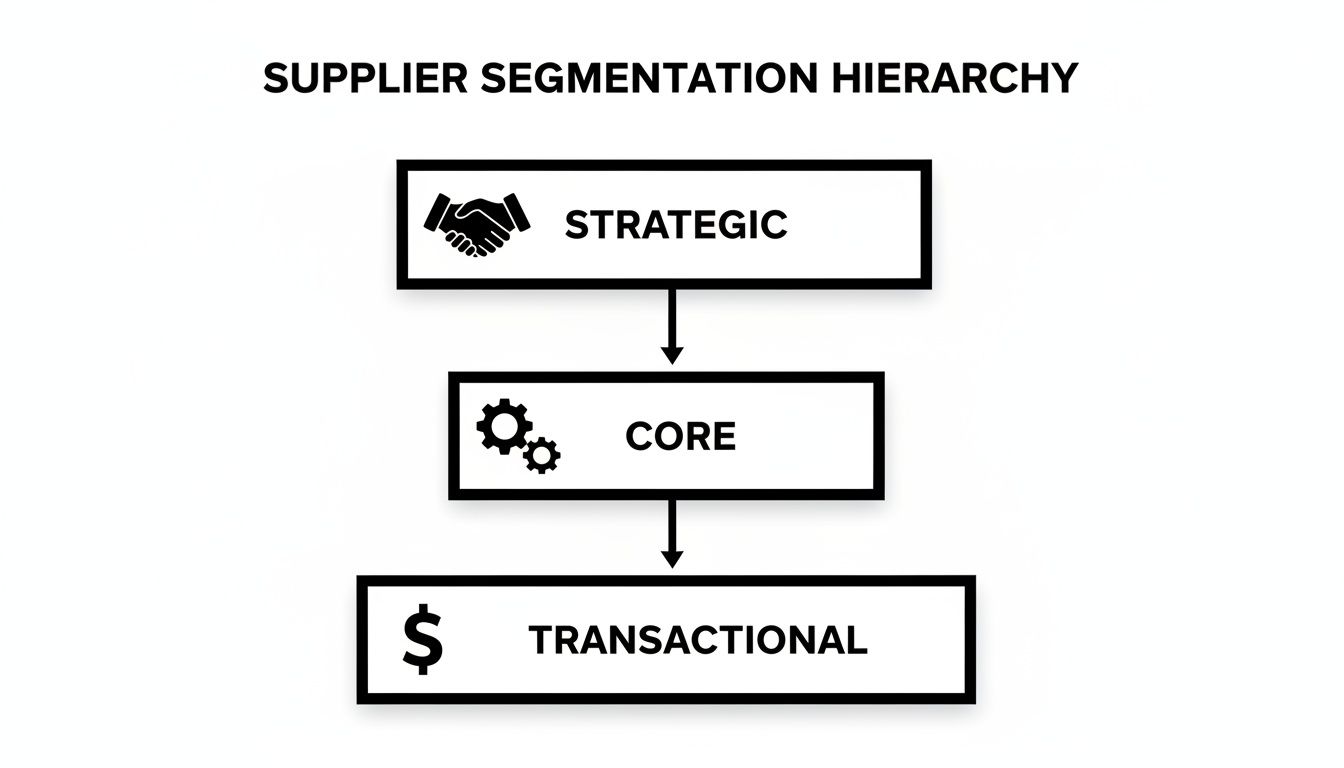
As you can see, the higher you go up the pyramid, the deeper the collaboration gets. That means a more hands-on, strategic management style is required for the suppliers at the top.
Let's get practical and break down what each of these tiers really means for a growing ecommerce brand. Getting this right is all about allocating your resources effectively, making sure your most critical partners get the attention they deserve.
Here's a framework I've used with dozens of brands to classify their suppliers and tailor management strategies for maximum impact and efficiency.
.tbl-scroll{contain:inline-size;overflow-x:auto;-webkit-overflow-scrolling:touch}.tbl-scroll table{min-width:600px;width:100%;border-collapse:collapse;margin-bottom:20px}.tbl-scroll th{border:1px solid #ddd;padding:8px;text-align:left;background-color:#f2f2f2;white-space:nowrap}.tbl-scroll td{border:1px solid #ddd;padding:8px;text-align:left}Supplier TierCharacteristicsManagement FocusCommunication CadenceKey MetricsStrategicHigh-spend, high-risk partners. Provide critical custom components or finished goods. High switching costs.Long-term, collaborative alliance. Joint innovation, shared business goals, and co-creating value.Quarterly Business Reviews (QBRs), executive-level engagement, weekly syncs.On-Time In-Full (OTIF), Defect Rate, Cost Reduction, Innovation Pipeline.CoreEssential for daily operations (e.g., 3PLs, key packaging). Moderate spend. Inconvenient, but not catastrophic, to replace.Performance and reliability. Focus on continuous improvement and operational excellence.Monthly check-ins, performance scorecards, regular operational meetings.Fill Rate, Lead Time, Cost of Poor Quality (COPQ), Inventory Accuracy.TransactionalLow-spend, low-risk vendors (e.g., office supplies, generic components). Many alternatives available. Easy to switch.Efficiency and automation. Minimize time spent managing. Manage by exception when problems arise.As-needed communication driven by purchase orders. No formal reviews.Purchase Price Variance (PPV), On-Time Delivery, PO Accuracy.
This model helps bring clarity to your supplier base, ensuring you're not just busy, but productive in your relationship management.
Okay, you've categorized your suppliers. Now what? The next step is to align your internal processes to match.
For example, your Quarterly Business Reviews with Strategic Partners should be forward-looking. Stop just reviewing past performance—talk about market trends, new product development, and where the industry is headed. For Core Vendors, your monthly check-ins should be data-driven, focused on hitting those performance scorecard numbers. And for Transactional Suppliers, it’s all about a slick, automated purchasing process.
The big idea here is to stop managing suppliers and start managing relationships. By tailoring your approach, you build a resilient, high-performing network that can adapt and grow with your business. It's a key piece of the puzzle we talk about in our guide to strategic sourcing best practices.
For the brands we work with at MDS, this means leaning on tools like AI-driven risk centers for predictive alerts and running "what-if" scenarios to reduce dependencies. Strong supplier relationship management doesn't just cut risks—it uncovers savings, drives performance, and gets all your partners pulling in the same direction.
To build out your own strategies for overseeing and optimizing your supplier network, it's worth checking out these actionable vendor management best practices as a solid external resource. This kind of thinking helps you move from a reactive to a proactive stance, catching potential disruptions long before they ever hit your bottom line.
A sloppy supplier onboarding process is a ticking time bomb. I’ve seen it countless times—it's the single biggest source of future headaches, from quality control nightmares to last-minute production delays that throw your entire launch calendar into chaos.
Treating this phase as a mere formality is a rookie mistake that can cost you dearly. A rigorous, well-defined process isn't just paperwork; it's your first and best line of defense.
This is about more than just collecting a few documents and signing a purchase order. A truly bulletproof onboarding system sets crystal-clear expectations from day one, puts a supplier's promises to the test, and legally shields your brand. It’s the foundation you build a healthy, long-term partnership on, making sure every new relationship starts on solid ground.

Your onboarding has to go deeper than just basic checks. While a solid vetting checklist is mission-critical (we have a detailed guide on building a supplier vetting checklist you should read), the real work kicks off after you’ve decided to move forward. This is about deep integration, not just a surface-level thumbs-up.
A robust process includes a few key stages:
This detailed approach ensures there are no ugly surprises waiting for you down the line. To make this easier, investing in a good system like a dedicated contractor management software can be a game-changer for integrating new suppliers and managing them long-term.
Think of your contract as your operational playbook, not just a legal formality. A vague agreement is basically an open invitation for disputes. Your goal is a document that's so clear it leaves zero room for interpretation on the things that matter most to your business.
This is where the Service Level Agreement (SLA) comes in. It’s how you define "what good looks like" in cold, hard numbers. It turns vague hopes into objective, data-driven targets and forms the backbone of your performance management.
Your contract defines the rules of the game, and your SLA defines how you keep score. Without both, you're flying blind and hoping for the best—a risky strategy in ecommerce.
For e-commerce founders, especially those dealing with international vendors facing tech gaps and language barriers, this is key. In fact, companies armed with strong supplier management processes slash supplier-related headaches by a whopping 70%, ensuring they get what they need on time and at the right quality.
Don't just grab a generic template off the internet. You need to insist on specific clauses that protect your brand from the common traps of e-commerce.
Here are the absolute non-negotiables:
By front-loading all this effort into a tight onboarding and contracting process, you’ll prevent 90% of the supplier issues that plague other brands. It sets a professional tone from the start, establishes clear boundaries, and creates the framework for a successful and secure partnership that can actually scale with you.
Once your supplier is onboarded and the ink is dry on the contract, the real relationship begins. This is where you shift from setup to day-to-day execution. It’s all about creating a partnership that’s proactive and driven by data, not just a series of transactions.
To get this right, you need two things: a solid communication rhythm and an objective way to measure performance. Without them, you’re flying blind. With them, you can spot trouble before it becomes a five-alarm fire, reward your top performers, and drive the kind of continuous improvement that separates the good brands from the great ones.

Ambiguity is the enemy of a healthy supply chain. The last thing you want is for your only communication to be a frantic call about a late shipment. A predictable communication cadence makes your supplier feel like an extension of your team, not just a vendor you call when something’s wrong.
Of course, this rhythm should be tailored to the supplier's tier, just like we talked about earlier.
This layered approach ensures you’re always synced up, from the nitty-gritty of daily operations to your long-term vision.
You simply cannot manage what you do not measure. A supplier scorecard is your best tool for keeping performance evaluations objective. It moves conversations out of the fuzzy territory of "I feel like..." and into the concrete world of "The data shows..." Every productive performance review starts here.
Your scorecard should be simple, visual, and focused only on the metrics that actually move the needle for your business. Resist the urge to track dozens of KPIs; stick to the vital few.
A great supplier scorecard isn't a report card for passing or failing. It’s a shared dashboard that helps both you and your supplier see exactly where to focus your joint efforts for improvement. It transforms subjective feedback into a collaborative problem-solving tool.
For most ecommerce brands, a handful of key metrics will tell you almost everything you need to know.
You need a balanced view of quality, delivery, and cost—the three pillars of supply chain performance. A scorecard focused on these areas gives you a clear, holistic picture of how a supplier is really doing.
Here are the key metrics to track in your supplier scorecard for a data-driven approach to performance management.
.tbl-scroll{contain:inline-size;overflow-x:auto;-webkit-overflow-scrolling:touch}.tbl-scroll table{min-width:600px;width:100%;border-collapse:collapse;margin-bottom:20px}.tbl-scroll th{border:1px solid #ddd;padding:8px;text-align:left;background-color:#f2f2f2;white-space:nowrap}.tbl-scroll td{border:1px solid #ddd;padding:8px;text-align:left}Metric (KPI)What It MeasuresCalculationWhy It Matters for EcommerceOn-Time In-Full (OTIF)The percentage of orders delivered on the agreed-upon date with the correct quantity.(Number of orders delivered on-time and complete / Total number of orders) x 100This is your reliability gauge. A low OTIF score leads directly to stockouts, lost sales, and unhappy customers.Defect RateThe percentage of units that fail quality inspection upon receipt.(Number of defective units / Total number of units received) x 100High defect rates are margin killers. They lead to rework costs, customer returns, and can seriously damage your brand's reputation.Cost VarianceThe difference between the quoted/standard cost and the actual invoiced price.(Actual Invoiced Cost - Standard Cost)This metric flags those nasty surprises—unexpected freight charges, duties, or other hidden fees that quietly eat away at your profitability.Lead Time AdherenceHow closely the supplier's actual production and shipping time matches what they quoted.(Actual Lead Time - Quoted Lead Time)Consistency here is critical for accurate inventory planning. It helps you avoid both stockouts and the cash-flow drain of excess inventory.
Tracking these KPIs consistently creates a powerful feedback loop. You can spot trends early on—like a defect rate that's slowly creeping up—and get ahead of it with your supplier before it turns into a full-blown quality disaster. This is what building a resilient, high-performing, and scalable supply chain is all about.
Once you've got a solid performance management system in place, you can finally start playing offense. This is where the sharpest founders create lasting value and build a business that can weather any storm. It’s time to stop just haggling over the unit price and start thinking about the total cost of ownership.
Let’s be clear: advanced negotiation isn't about squeezing every last penny out of your suppliers. It’s about building smarter deals that create value for both of you while insulating your brand from the inevitable chaos of the market. It's a strategic move that strengthens your partnerships and your bottom line at the same time.
That sticker price is just the tip of the iceberg. I've seen it a hundred times—a supplier with a 10% higher unit cost but zero defects and flawless on-time delivery is almost always more profitable than a cheaper, unreliable alternative. Your focus in any negotiation needs to shift to these high-impact areas that truly move the needle.
Here are a few smart levers you can pull:
The real goal here is to find those win-win scenarios. When you focus on terms that improve your cash flow, slash your risk, and reward growth, you build agreements that are far more valuable than a simple discount.
A perfectly negotiated contract is worthless if your supply chain shatters at the first sign of trouble. The past few years have taught every ecommerce founder a brutal lesson about risk mitigation. A resilient supply chain isn't a "nice-to-have"; it's a core requirement for survival.
This means you have to be actively hunting for and neutralizing vulnerabilities before they become full-blown crises. It's about building a system that can absorb shocks—whether from geopolitical turmoil, a sudden spike in raw material costs, or a key supplier unexpectedly going out of business.
The most dangerous risks are the ones you don't see coming. Proactive risk mitigation is about systematically asking "what if?" and having a clear, actionable plan ready to go before you ever need it.
The key is to flip your mindset from reactive to proactive. Research actually has a term for this, the 'Extended Enterprise,' which is a fancy way of saying you need to build deeper strategic ties that go beyond just hitting contract targets. For brand owners, this means you stop just monitoring service levels and start truly partnering with suppliers through open communication and transparency. You can dig into some of the findings in global supplier relationship management research to see how crucial this is.
Don't let this feel overwhelming. A practical risk mitigation strategy really just boils down to a few key actions you can put in place right now.
Building this kind of resilience is the ultimate competitive advantage. While your competitors are scrambling during the next inevitable disruption, your brand will keep operating smoothly, capturing market share and earning customer trust.
The theory of supplier management is one thing; the reality of a late shipment, a surprise price hike, or a dip in quality is another. This is where the rubber meets the road. Let's break down some of the most common—and trickiest—supplier challenges ecommerce founders face and give you some direct, in-the-trenches advice on how to handle them.
It’s a tough spot. A strategic partner you’ve trusted for years suddenly starts having issues. The first instinct might be to fire off an angry email, but that rarely helps. Your best move is to treat it like a shared problem that you need to solve together, at least at first.
Get a meeting on the books and come prepared with data from your supplier scorecard. The key is to frame the conversation around facts, not feelings.
For example, you could say, "Hey, let's look at the Q3 numbers. Our data shows the on-time in-full rate has dipped from 98% to 87%, and we saw the defect rate jump to 4% on the last two POs. This is starting to impact our stock levels and we're seeing a few customer complaints. Can we dig into what's happening on your end and map out a plan to get this back on track?"
This isn't an accusation; it's an invitation to collaborate. The next step is to put a formal Performance Improvement Plan (PIP) in place.
This structured process gives a valued partner a real chance to fix things. If they don't, you now have a clear, objective record that justifies a tough decision, whether that's shifting volume or fully activating your backup supplier.
When a supplier hits you with a price increase, especially one they blame on rising material costs, your response shouldn't be a quick yes or no. It should be a request for transparency.
Don't just take their word for it. Ask them to share documentation showing the cost increases they're getting from their own suppliers. While you wait, do your own homework. Look up market data for that specific commodity to see if their story holds water. This gives you the leverage to have a real negotiation, not just a surrender.
A price increase request isn't a simple transaction. It's an opening to have a bigger strategic conversation about managing total costs and finding more value in your partnership.
Use this as a chance to get creative and negotiate beyond just the per-unit price. Here are a few plays you can run:
This approach turns a potentially tense conversation into a problem-solving session. You protect your margins and might even make the partnership stronger.
The right time to find a backup supplier is long before you need one. If you're waiting for a crisis to start your search, you're already too late. You have to be proactive here, not reactive.
The biggest red flag is concentration risk. Take a hard look at your numbers. If a single supplier handles more than 70% of the production for one of your flagship products, you're exposed. It's time to diversify.
Other warning signs include any kind of instability: recurring quality issues, their best people leaving, or rumors of financial trouble. Don't brush these off.
The best practice is to qualify a second source and get them into your supply chain while things are still running smoothly. Start by giving them a small but consistent piece of the business, maybe 10-20% of your total volume. This keeps them familiar with your standards, engaged with your team, and ready to ramp up if your primary supplier ever falters. It’s not about mistrust; it’s about building a business that can withstand a few punches.
Ready to join a community of elite ecommerce founders who master these challenges every day? At Million Dollar Sellers, we connect you with 7, 8, and 9-figure entrepreneurs who share proven strategies for building resilient, scalable brands. Find out if you qualify for our exclusive network.
Join the Ecom Entrepreneur Community for Vetted 7-9 Figure Ecommerce Founders
Learn MoreYou may also like:
Learn more about our special events!
Check Events