Chilat Doina
June 16, 2026
You know the setup. Inventory is checked in, the listing is polished, the hero images are clean, the copy is tight, and PPC is ready to go. Then launch day hits and the product detail page still looks empty.
That empty review section is where a lot of launches stall.
Not because the product is bad. Because buyers hesitate when they're the first one through the door. They don't know if the zipper fails, if the supplement scoop is buried at the bottom, or if the “premium” kitchen tool feels flimsy in hand. On Amazon, trust doesn't come from your brand story first. It comes from visible customer feedback.
That's why serious operators don't treat Amazon Vine as a beginner tactic or a box to check. They use it as a controlled way to reduce launch friction. Used well, it helps a strong product get social proof faster. Used badly, it accelerates negative signals on an ASIN that wasn't ready.
The mistake is thinking Vine is a review vending machine. It isn't. It's a launch instrument. It works best when the listing is already conversion-ready, the product has been stress-tested, and the business can absorb the cost of giving away units to get early market feedback.
If you're tightening your launch process more broadly, this strategic guide for Amazon brands is useful alongside your review strategy because Buy Box control, offer health, and launch execution all interact. And if the issue is broader than reviews alone, tightening the page itself matters too. This piece on improving ecommerce conversion rates is worth revisiting before you send any traffic.
The cold-start problem is simple. Amazon gives you a shelf, but buyers still need a reason to trust what's on it.
A new ASIN has no review history, no buyer language on the page, and no visible proof that the product performs the way your listing claims it does. Even if your backend setup is sharp, that absence changes shopper behavior. The page feels unproven.
Zero reviews creates friction in places sellers often underestimate:
This is why hoping for organic reviews alone is usually too passive for a competitive launch. You can still use compliant follow-up, brand traffic, and strong merchandising. But if your category moves fast, waiting around is expensive.
A launch usually doesn't fail because the listing had no chance. It fails because the listing didn't earn trust fast enough.
Experienced operators don't use Vine on every SKU. They use it where early review velocity changes the trajectory of a launch.
That usually means one of three situations. A brand-new product entering a crowded search result. A strategically important variation that needs proof fast. Or a listing with strong fundamentals that just needs enough early customer feedback to reduce hesitation.
The key is this. Vine works best when the product is already likely to win. It is not a rescue plan for weak quality, unclear positioning, or sloppy manufacturing. If your insert, packaging, claims, or actual product experience still need work, Vine can expose those problems faster than the market would have on its own.
Most sellers misunderstand the reviewer side of Vine. They think it's a public panel of deal-seeking shoppers. It isn't.
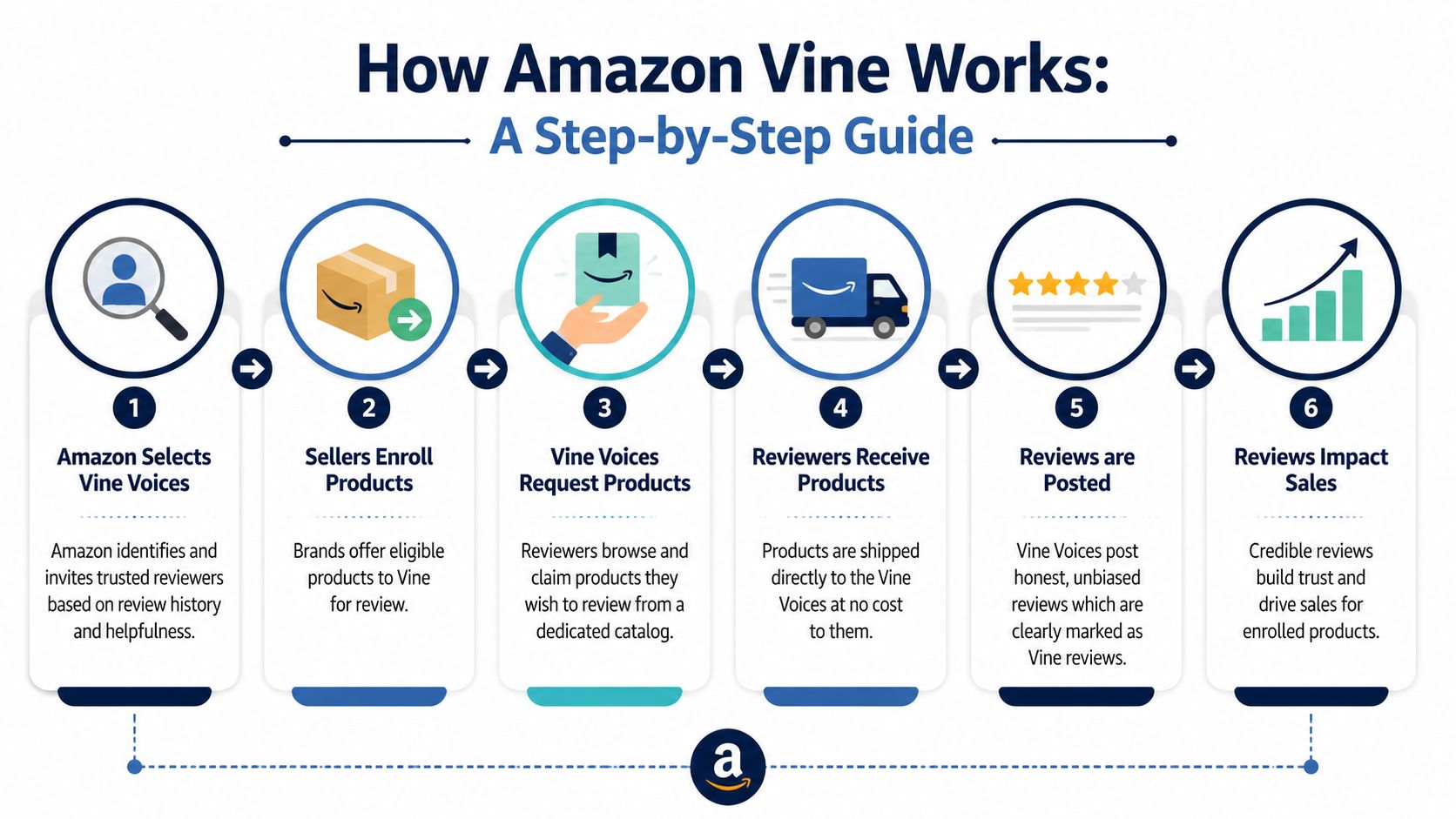
Amazon Vine reviewers are called Vine Voices, and they are not open to public application. Amazon says it invites them based on a history of writing accurate, insightful reviews that other customers find helpful. The program launched in 2007, and it operates as an invitation-based channel for products to receive reviews from Amazon-selected reviewers rather than general shoppers, as outlined in this overview of the Amazon Vine program and Vine Voices.
That invitation-only structure matters.
It means you're not getting random traffic from a rebate group or a handpicked audience you control. You're putting units in front of reviewers Amazon has selected. That gives the reviews a different kind of trust signal, but it also means you surrender control over who claims your product and how they evaluate it.
Vine Voices also tend to review with more scrutiny than a casual buyer. That's useful if your product is genuinely strong. It's dangerous if your product relies on forgiving customers, vague expectations, or category norms that hide quality issues.
The process is straightforward on paper:
The important point is honesty. Vine is not a pay-for-praise program. You are not buying positive reviews. You are funding access to early, unbiased product evaluation on Amazon's terms.
Practical rule: If your team talks about Vine as a way to “get five-star reviews,” stop the conversation there. That mindset leads to bad SKU selection and ugly launches.
Treat Vine as a structured feedback channel that also creates public social proof.
That distinction changes how you use it. If your offer has unresolved defects, confusing instructions, sizing ambiguity, or claim-risk, Vine becomes a public quality audit. If your offer is polished, differentiated, and easy to understand, Vine can help your page start looking credible faster.
This is why the best use case for Amazon Vine reviewers isn't “we need reviews.” It's “we're confident in the product, and we want trusted early feedback on an ASIN that's ready to scale.”
Enrollment is where a lot of sellers get sloppy. They assume any new SKU can go into Vine and then wonder why the rollout feels inefficient. It doesn't work that way.
Amazon's rules create a narrow lane. According to the official Vine FAQ summary for sellers, enrolled products must typically be FBA-fulfilled, brand-registered, and have fewer than 30 published reviews at enrollment. Amazon also allows up to 30 units per ASIN for Vine enrollment, and reviewers are expected to keep feedback focused on the product itself rather than shipping or packaging.

Before enrollment, verify four things internally:
The mechanics inside Seller Central are not the hard part. The hard part is choosing the right ASIN at the right time.
The most effective enrollment process is operationally boring. That's a good thing.
A disciplined team usually handles it in this order:
That sequence matters because Vine reviewers will judge the total customer experience they can see and use. If your title confuses the use case or your images create the wrong expectation, the product can get punished for merchandising mistakes, not just product defects.
Here's the simplest way to think about the unit decision. Don't default to the maximum just because it's available. Match enrollment volume to how important the ASIN is, how much margin it has, and how much confidence you have in the product.
For teams building a broader operational playbook, Rebus's comprehensive Amazon selling guide is a solid companion read because Vine works better when listing hygiene, fulfillment, and offer management are already handled.
Enroll only after your page says exactly what the product is, who it's for, and what it is not. Clear expectations prevent a lot of bad reviews.
Three mistakes show up repeatedly:
If a product still needs claim cleanup, instruction improvements, or insert revisions, pause. Vine is strongest when you've already done the hard work.
Sellers who misjudge Vine usually make the same mistake. They look at the fee and ignore the actual investment.
Your actual Vine cost includes the enrollment fee, the inventory you hand over, and the downstream fulfillment economics around those units. That's why I look at Vine as a launch P&L decision, not a review tactic.
Early planning gets easier when the cost stack is visible.
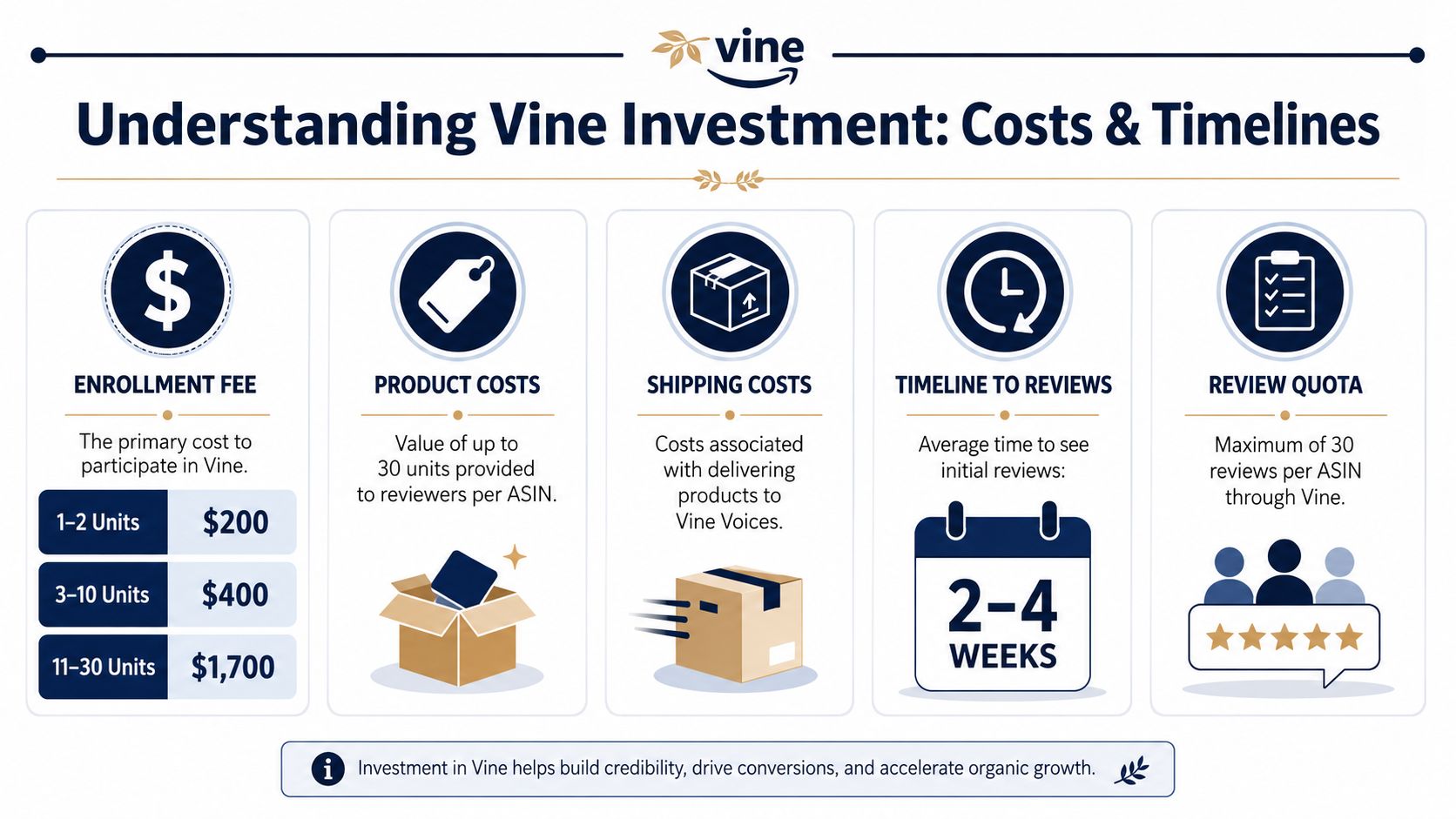
The infographic above includes fee and timeline figures, but the bigger strategic point is how to frame them.
Use this checklist when you evaluate a Vine enrollment:
Enrollment fee
This is the visible line item and the one that commonly draws initial attention.
COGS on surrendered units
These units are not samples you expect back. They are part of your launch spend.
FBA-related cost impact
If your economics are already tight, this matters more than most launch spreadsheets admit.
Opportunity cost
Units allocated to Vine cannot support retail sales, ranking pushes, or other launch channels.
Here's the practical read. Vine is easier to justify on products with healthy margin, stable manufacturing, and a strong chance of becoming a ranking asset. It's much harder to justify on products where every unit needs to carry the launch.
A second issue is timing. Sellers want reviews on a schedule. Vine doesn't operate on your media plan.
Some products get claimed quickly. Some sit. Some reviews post sooner than expected. Others take longer. That makes Vine a poor fit for any launch plan built around a fixed promise like “we'll have a full review base by this exact date.”
This walkthrough gives a helpful visual reference for how many sellers think about Vine timing:
The way to manage timing risk is to stop treating Vine as the only trust-building lever.
Use it alongside listing optimization, measured PPC, and compliant post-purchase review requests. Then structure your launch calendar so the ASIN can survive if Vine reviews show up slower than hoped.
A practical sequencing model looks like this:
| Launch component | Best role during Vine period |
|---|---|
| Listing content | Carries clarity before reviews accumulate |
| PPC | Tests search term relevance and page readiness |
| Brand traffic | Seeds cleaner early demand if your audience trusts the brand |
| Review requests | Supports organic review flow without depending only on Vine |
If your launch only works when Vine moves fast, the launch plan is fragile.
Vine has a clean sales pitch. Trusted reviewers, early social proof, and faster launch credibility. All true.
But the downside is just as real. Vine compresses feedback. That helps when the product is ready. It hurts when it isn't.
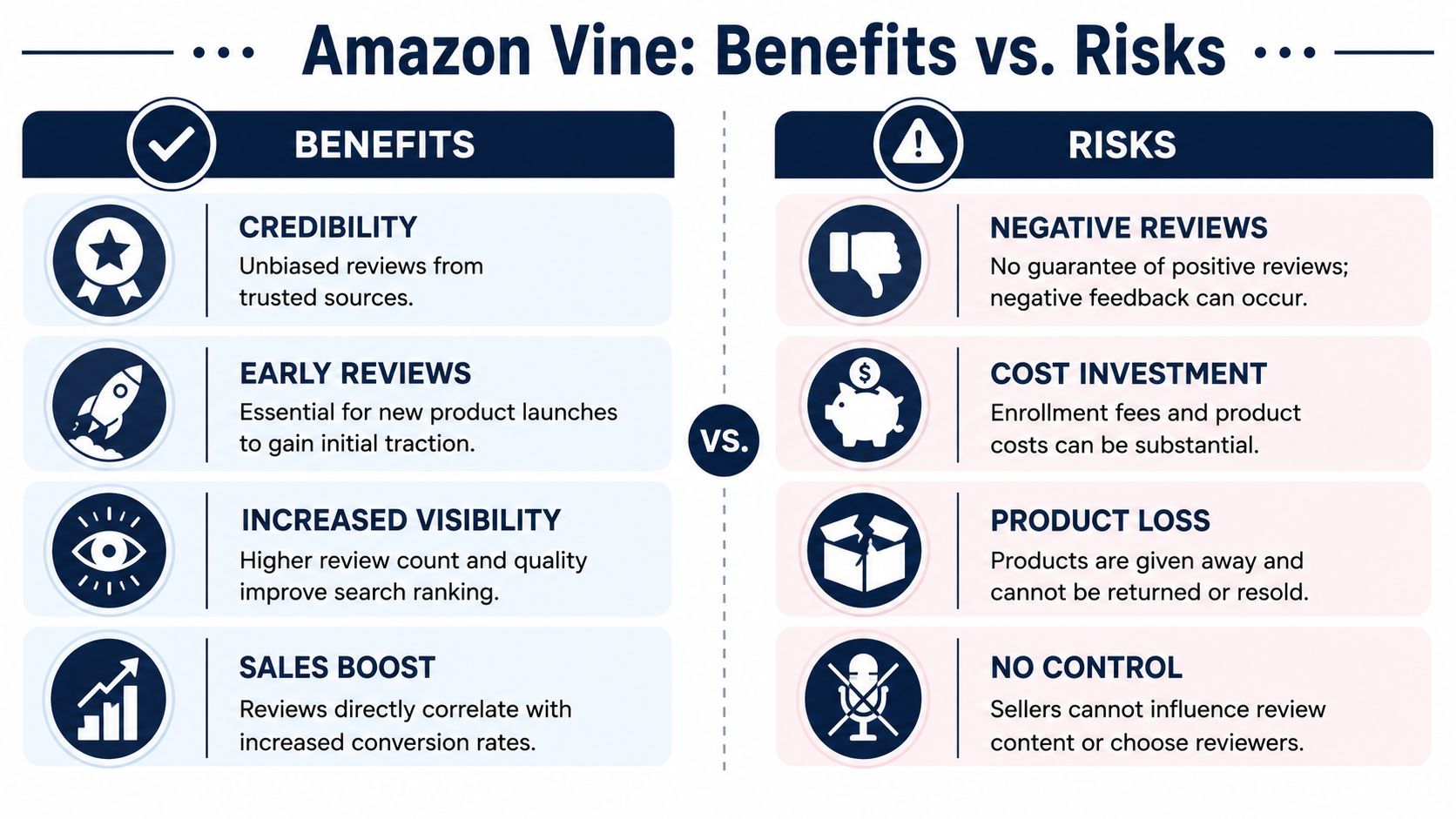
The biggest upside is speed to credibility.
A fresh ASIN with no review history asks the shopper for blind trust. A fresh ASIN with visible, detailed feedback asks for much less. Even when the reviews aren't glowing, thoughtful product-specific commentary often gives shoppers enough context to decide.
Vine can also sharpen your internal understanding of the product. Experienced sellers mine these reviews for language, objections, and use-case nuance. Sometimes the best outcome isn't the review count. It's discovering that customers consistently misunderstand a feature your listing explained badly.
Other benefits are less obvious but still useful:
The hidden risk is not just a bad rating. It's early narrative lock-in.
If the first visible feedback frames the product as confusing, flimsy, smaller than expected, hard to assemble, or not worth the price, later shoppers start reading the listing through that lens. That can drag down a launch before your team has enough order volume to dilute the effect.
You also have no control over review tone, length, or level of detail. Some Vine reviews are excellent. Some are brief and not especially helpful. None of that is yours to manage.
If you're worried your launch can't absorb a few tough reviews, that usually means the product shouldn't be in Vine yet.
There's also a compliance reality. Sellers can't shape the content, can't choose the reviewer, and can't clean up honest negative feedback just because the product is new. That's one reason teams concerned about manipulated review signals should understand the broader context around fake Amazon review patterns and detection issues.
Ask these questions before you enroll:
| Benefit side | Risk side |
|---|---|
| Is this ASIN strategically important? | Would negative early feedback materially hurt the launch? |
| Is the listing already conversion-ready? | Are there unresolved quality or expectation gaps? |
| Can the product margin absorb the spend? | Will giving away units strain inventory or cash flow? |
| Will early feedback help refine the page? | Are we using Vine to compensate for weak product confidence? |
If the left column is strong and the right column is manageable, Vine makes sense.
If the right column makes your team nervous, listen to that signal.
The best Vine strategy is selective. Not aggressive.
High-level sellers don't run Vine because it exists. They run it when the economics, product readiness, and launch importance line up. That discipline is what separates a useful Vine campaign from a sloppy one.
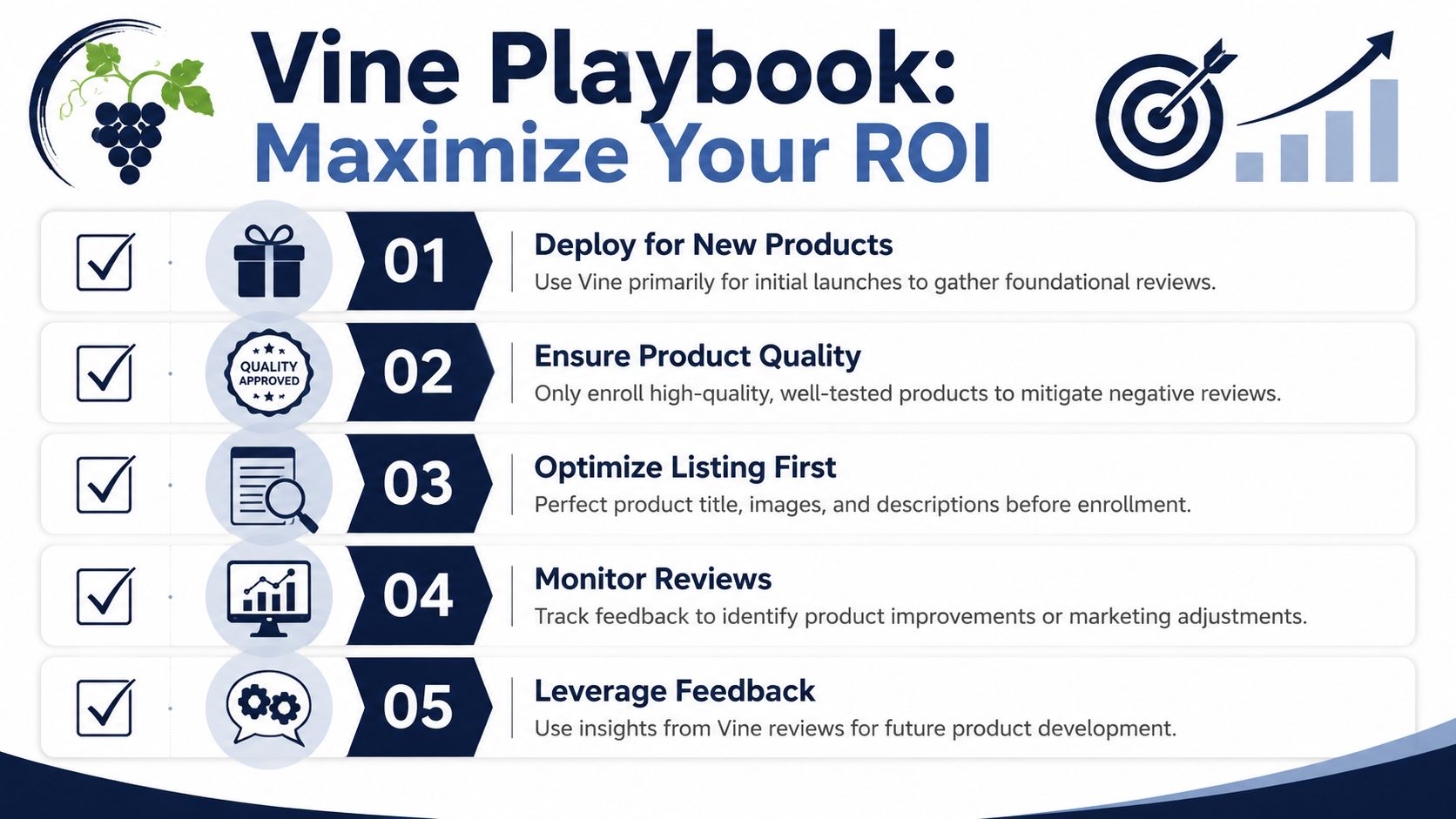
This is the first rule.
If you are still unsure whether the product deserves to exist, Vine is the wrong testing environment. Test uncertain products through smaller, lower-exposure channels first. Use Vine after you already believe the offer can win.
The best candidates usually share a few traits:
A hero launch, a premium add-on to a proven line, or a variation that matters for keyword coverage can all justify the spend. A random SKU with weak economics usually can't.
Vine reviews land on the listing you built. If the page is weak, reviewers and shoppers will both feel it.
Before enrollment, tighten these areas:
A lot of bad early reviews are expectation failures. The product may be fine, but the listing sold the wrong story.
Operator note: The cheapest review is the one you don't need to defend later because the listing set the right expectation from day one.
Counting reviews is too shallow. Review quantity is the output, not the return.
A better Vine scorecard tracks directional change in:
You don't need a fancy dashboard for this. You need discipline. Snapshot the listing before Vine, watch the nature of the reviews that appear, and compare shopper behavior after the page has real social proof.
For some teams, this analysis happens inside a founder group or operator network rather than software alone. Communities like Million Dollar Sellers can be useful in that context because members compare launch tactics, post-Vine outcomes, and category-specific patterns across real brands.
Run this quick pass before approving any ASIN for Vine:
| Question | If yes | If no |
|---|---|---|
| Is the product quality stable? | Proceed to listing check | Hold the ASIN |
| Is the listing finalized? | Evaluate economics | Fix the page first |
| Can margin absorb the giveaway? | Consider enrollment | Skip or reduce risk |
| Is this SKU strategically important? | Vine may make sense | Use other launch tools |
| Would honest scrutiny help, not hurt? | Enroll confidently | Delay |
That last row matters most. Vine is powerful when scrutiny validates the offer. It's painful when scrutiny reveals what your team hoped buyers wouldn't notice.
Sometimes the right move is skipping Vine.
If the SKU has thin margin, inventory is constrained, or the product still needs refinement, use slower but safer tools. Amazon's own review request workflow is less forceful, but it fits products that need a more organic ramp. Brands with an audience can also push qualified traffic from email, creator partnerships, or social and let compliant review generation happen downstream.
The old Amazon Early Reviewer Program is gone, but many sellers still search for it. This background on the Amazon Early Reviewer Program is useful mainly because it clarifies why Vine became the more relevant Amazon-native option.
Here's the decision frame I use:
| Strategy | Cost | Speed | Review Quality | Best For |
|---|---|---|---|---|
| Amazon Vine | Higher upfront commitment | Faster early momentum when the ASIN is ready | Often detailed, always uncontrolled | Important launches with strong products |
| Request a Review | Lower direct cost | Slower | Organic and variable | Established order flow |
| Off-Amazon audience seeding | Depends on your brand assets | Moderate | Can be strong if buyer fit is good | Brands with loyal customer lists |
| Wait for fully organic reviews | Lowest direct spend | Slowest | Natural but unpredictable | Low-priority or low-margin SKUs |
Vine is not the default answer. It's the sharp tool you use when the product deserves acceleration.
If you're building launch systems at a level where small execution edges matter, Million Dollar Sellers is one place to compare notes with other high-revenue operators on what is working across Amazon, DTC, and omnichannel brands.
Join the Ecom Entrepreneur Community for Vetted 7-9 Figure Ecommerce Founders
Learn MoreYou may also like:
Learn more about our special events!
Check Events