Chilat Doina
November 26, 2025
Picking the best 3PL for ecommerce is a huge strategic decision, not just an operational one. Think of it this way: the right partner becomes a direct extension of your brand. They can either delight your customers with fast, accurate shipping or totally frustrate them with delays and errors that tank your reviews.
In the world of ecommerce, your fulfillment operation is the final, crucial touchpoint in the customer journey. It's the moment your digital promises become a physical reality. Handing this responsibility over to a third-party logistics (3PL) provider is one of the biggest moves a growing brand can make.
You’re doing a lot more than just renting some warehouse space. You're entrusting your inventory, your reputation, and your customer experience to a partner.
A great 3PL does more than just pick, pack, and ship. They become a foundational pillar that actually supports your ability to scale. When you’re no longer spending your days printing labels and taping up boxes, you get back priceless time to focus on marketing, product development, and strategy—the stuff that actually grows your business.
It’s a classic mistake to view fulfillment as just another cost center. A much smarter way to look at it is as a competitive advantage. The right 3PL gives you access to a distributed warehouse network, letting you offer affordable 2-day shipping that can go head-to-head with the big retailers. This isn’t just a nice-to-have anymore; it's what modern shoppers expect.
Your 3PL partner directly controls the post-purchase experience. A seamless delivery process builds brand loyalty and encourages repeat business, while a poor one can erase all the hard work you invested in acquiring that customer in the first place.
This strategic importance is why the market is absolutely exploding. The global 3PL market was valued at around $1.15 trillion and is on track to hit $1.4 trillion by 2025. The U.S. market alone accounts for a massive $246.25 billion of that.
At the heart of any successful ecommerce business is solid operational management. A well-chosen 3PL partner can take complex ecommerce supply chain management strategies and turn them into a powerful engine for growth and customer happiness.
On the flip side, the wrong 3PL can create crippling bottlenecks for your brand. Imagine finding out thousands of dollars in inventory has just vanished because of shoddy warehouse management. Or seeing a flood of one-star reviews complaining about slow shipping times.
These aren't just hypotheticals. They are the real-world consequences of a mismatched partnership that can stunt growth and seriously damage your brand’s credibility. For Amazon sellers, fulfillment issues can get your listings suspended and send your rankings into a nosedive. We dive deeper into how 3PL logistics impact Amazon success in our detailed guide here: https://milliondollarsellers.com/blog/3pl-logistics-amazon.
Choosing the best 3PL for your ecommerce brand is a high-stakes decision. This guide will give you the framework to get it right.
Finding the right 3PL isn’t about picking the “best” one—it’s about finding the right partner for your business. The provider that’s a perfect match for a high-volume Amazon seller could be a total disaster for a boutique brand that lives and dies by its unboxing experience.
Think of it like this: you wouldn't hire a corporate tax attorney to handle a speeding ticket. The same logic applies here.
Understanding the different archetypes of 3PL providers is the fastest way to filter out the noise. It helps you zero in on partners who are already wired to solve your specific problems, saving you from countless dead-end sales calls.
These guys get it. They understand that for a direct-to-consumer brand, the package arriving at the customer’s door is one of your most powerful marketing moments. Their entire operation is built around making that moment memorable.
DTC specialists are pros at handling the custom touches that other, bigger 3PLs might see as a headache.
Who's it for? Brands in beauty, wellness, high-end apparel, and premium goods where the post-purchase experience is everything. If you’re banking on unboxing videos to drive buzz, this is your match.
Heads-up: This white-glove service usually comes at a premium. They also might not have the deep expertise needed for complex retail compliance or high-volume FBA prep.
This type of 3PL is laser-focused on one thing: helping you crush it on the world's biggest marketplace. They are masters of Amazon’s notoriously finicky and ever-changing rules. They know that one small mistake in this ecosystem can get your listings shut down in a heartbeat.
Everything they offer is designed to keep you compliant and efficient within Amazon's world.
Who's it for? Any business generating a big chunk of its revenue on Amazon or looking to go all-in on the platform. If terms like "FBA inbound" and "SFP cutoff times" are part of your daily grind, you need this specialist.
Omnichannel experts are built to wrangle complexity. They are the central nervous system for brands selling everywhere at once—on their own website, through marketplaces like Amazon, and in physical retail stores. Their superpower is managing wildly different fulfillment requirements from a single inventory source.
An omnichannel 3PL is your logistical command center. They ensure an order from your Shopify store gets the same care and accuracy as a 500-unit wholesale order heading to a big-box retailer's distribution center.
Their systems are designed to speak both B2B and B2C, handling everything from EDI compliance for your retail partners to standard parcel shipments for your online customers. You can find some excellent breakdowns of the top providers in our complete guide to the best ecommerce fulfillment companies.
This is the big leagues. Enterprise providers are for high-growth brands that are pushing thousands of orders out the door every single day. Their world is defined by three things: scale, technology, and automation. We're talking massive, strategically located warehouses humming with robotics and sophisticated software to squeeze every drop of efficiency out of the process.
Who's it for? Brands shipping over 15,000-20,000 orders a month or those with complex, multi-country fulfillment needs. If your growth chart looks like a hockey stick and you need a partner who won’t crumble under the volume, this is where you should be looking.
To make this even clearer, let’s break down how these different provider types stack up. Think about your own business—where do you see yourself now, and where do you want to be in 18 months? This table should help you start narrowing down the field.
Provider ArchetypeIdeal ForKey StrengthsPotential WatchoutsDTC SpecialistBrands focused on a premium unboxing experience, subscription boxes, and custom orders.Custom packaging, kitting, inserts, high-touch service, brand experience focus.Higher costs, may lack deep retail/B2B compliance or FBA prep expertise.Amazon-Centric PartnerSellers heavily invested in the Amazon ecosystem (FBA, SFP, FBM).Deep knowledge of Amazon's rules, FBA prep mastery, SFP operational excellence.Can be less flexible for non-Amazon channels; may not prioritize custom branding.Omnichannel ExpertBrands selling across multiple channels: DTC, marketplaces, and B2B/retail.Centralized inventory, EDI compliance, handling both B2B and B2C orders.Tech integration can be more complex; may not be the cheapest for simple DTC.Enterprise ProviderHigh-volume brands (15,000+ orders/month) with rapid growth or international needs.Massive scale, automation/robotics, advanced technology, multi-node networks.High minimums, less flexibility for smaller brands, can feel impersonal.
Choosing the right archetype from the get-go is half the battle. It ensures you’re talking to partners who not only want your business but are fundamentally built to help it succeed.
Alright, you've figured out what kind of 3PL you need. Now for the hard part: picking the right partner out of the lineup.
Moving from a broad category to a specific provider is where the real work begins. A flashy sales pitch can promise you the world, but it's your job to dig past the presentation and get to the operational reality. You need a systematic, data-driven way to compare your options.
The best way I’ve found to do this is with an evaluation scorecard. This isn't just a simple checklist. It’s a framework that forces you to ask the tough questions and makes potential partners prove they can actually do what they say they can. It’s how you compare apples to apples.
This kind of diligence is non-negotiable now that ecommerce has completely taken over the logistics world. Online retail is the main driver of demand for fulfillment, period. In fact, something like 95% of online retailers use a 3PL, and a wild 70% of all 3PL revenue now comes straight from ecommerce brands. This intense focus means the best 3PLs are highly specialized, and you need the right questions to find them. If you want to dive deeper into the numbers, this in-depth analysis of 3PL statistics is a great resource.
To help you get started on the right track, this decision tree maps out the first few questions you should be asking based on your sales channels.
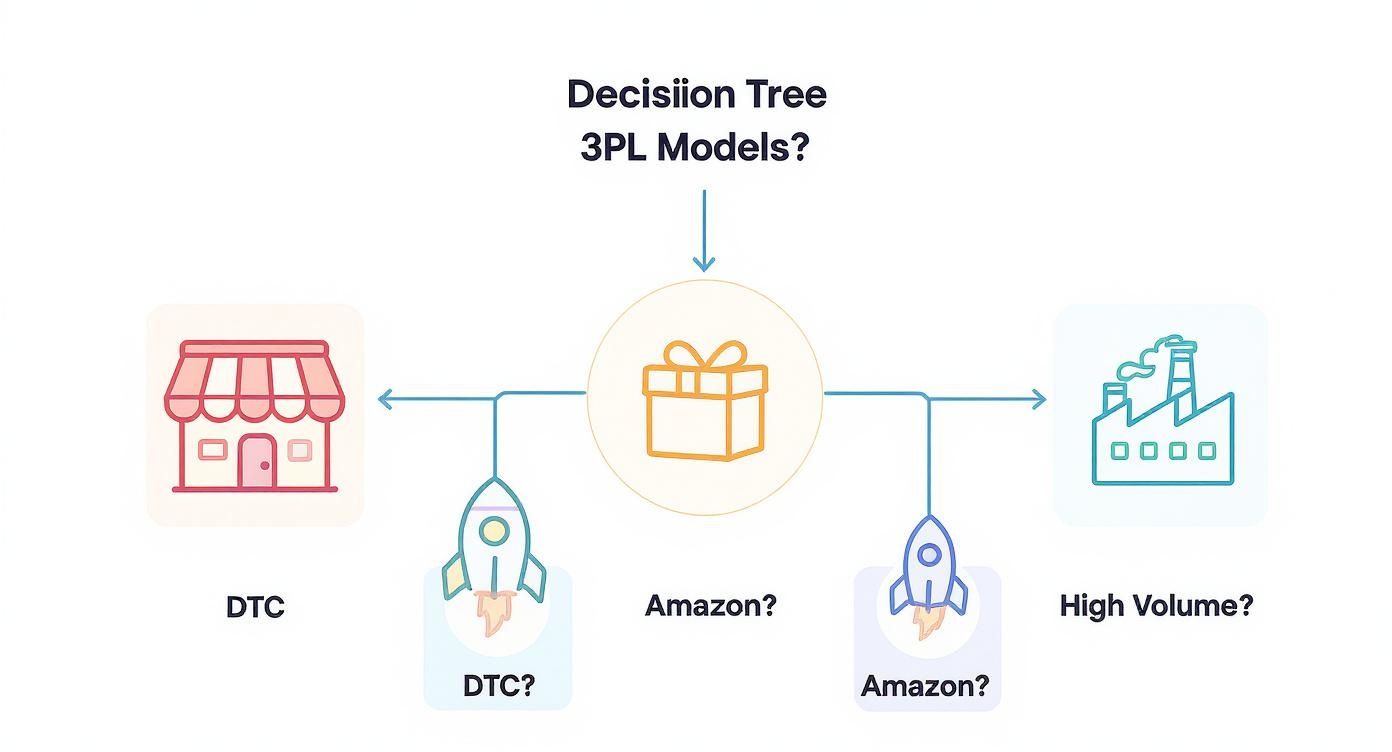
Think of this as your initial filter. It helps you align your business model—whether you're DTC-first, an Amazon powerhouse, or a high-volume enterprise—with the right kind of 3PL, narrowing down the search from the get-go.
A 3PL’s physical footprint is one of the biggest levers for your shipping costs and delivery speeds. Let's be clear: a single warehouse in the middle of the country just doesn't cut it anymore if you want to compete. You need to know exactly how their network gets products into customers' hands faster and cheaper.
For a brand shipping heavily to the coasts, having a 3PL with warehouses in both California and New Jersey is a game-changer compared to a single location in Kansas. That simple geographic advantage can slash your average shipping zone and cut costs by 15-25%.
A modern 3PL is really a tech company that happens to move boxes. Their software is the central nervous system for your entire fulfillment operation. If it's clunky, slow, or unreliable, your whole business will feel the pain.
The goal here is simple: seamless data flow and total visibility. You should never have to wonder where your inventory is or what’s happening with an order.
If their platform looks like it was designed in 2005, run. A dated tech stack is a massive red flag that points to operational inefficiency and an inability to innovate.
Your tech evaluation should hit three key areas:
The Service Level Agreement (SLA) is the most critical part of your contract. This is where promises become legally binding commitments. It’s where your 3PL puts specific, measurable standards in writing. If the SLA is vague, walk away.
You need to drill down and demand clear, numerical guarantees.
And here's the kicker: what happens if they miss these targets? A strong SLA includes penalties, like fee credits or other compensation, for performance failures. It shows they have real skin in the game.
Returns are a fact of life in ecommerce. How a 3PL handles them can make or break your profitability and customer loyalty. A sloppy, slow returns process leads to lost inventory and frustrated customers waiting for their refunds.
Your scorecard needs a whole section just for their reverse logistics process.
By methodically scoring every potential partner across these key pillars—network, tech, SLAs, and returns—you can move beyond gut feelings and sales pitches. You’ll be making an informed, strategic decision that sets your brand up for success.
A 3PL quote can feel like you’re trying to read a foreign language. It's often just a dizzying spreadsheet packed with line items, weird acronyms, and conditional charges that make it almost impossible to figure out what you'll actually be paying.
This complexity isn't always malicious, but it definitely makes it easy to hide fees that can blow up your budget down the road.
Nailing this part of the process is non-negotiable. Your fulfillment cost is one of your biggest operational expenses, and a single surprise invoice can completely wipe out your margins for the month. The only way to protect yourself is to break down their pricing model, piece by piece, and understand how every single fee applies to your business.
Before you can spot a hidden fee, you have to get a handle on the standard ones. Think of these as the fundamental building blocks of their service—nearly every 3PL quote will be built around these four core activities.
These four charges will make up the bulk of your fulfillment bill. The real trouble, however, often lurks in the less obvious, "special project" fees that pop up when you least expect them.
This is where having a sharp eye for detail really pays off. Hidden fees often masquerade as "one-off" charges for any work that falls outside the standard pick-pack-ship workflow. If you don't ask about them upfront, you won't know they exist until they show up on your first invoice as a nasty surprise.
Here’s a checklist of charges you need to explicitly ask every potential partner about:
The single best way to avoid surprises is to model a real-world scenario. Give them the data for a typical month—say, 2,000 orders, 1.5 items per order, and 5 pallets of inbound inventory—and ask them to build a fully-loaded, all-in cost estimate. This forces their hand and makes them account for every potential fee.
Your 3PL contract is your ultimate safety net. Don't just skim it. Read every single line, paying extra attention to the clauses that define liability, termination policies, and performance guarantees. This document lays out the rules of the entire partnership.
Key Contract Clauses to Scrutinize
By digging into the pricing structure and meticulously reviewing the contract, you shift from being a reactive customer to a proactive partner. You’ll be able to forecast your expenses accurately and build a fair, transparent relationship that’s actually set up to help you grow.
Signing the contract isn't the finish line—it’s the starting gun. Your real success with a 3PL partner hinges on everything that happens after the ink is dry.
A structured onboarding process and a real commitment to the relationship are what separate a simple vendor from a true growth partner. The transition from your garage or another provider is a delicate operation. This is where meticulous planning pays off big time, turning a potentially chaotic period into a smooth launch that sets the right tone for years to come.
The first 90 days are absolutely critical. A successful launch is all about tight coordination between your team and theirs. It all starts with the technical connection, which is basically the digital handshake that lets your systems talk to each other.
To make sure everything flows smoothly, you have to nail the tech. Evaluating their system integration capabilities is paramount for a seamless data flow between your platforms and their warehouse.
Here’s a practical checklist to get you through the initial setup:
A well-documented plan prevents a world of headaches. You might find our guide on how to create Standard Operating Procedures useful here; you can adapt it to outline your specific fulfillment rules for your new partner.
Once you’re up and running, the focus shifts from setup to continuous improvement. The best 3PL relationships are truly collaborative, built on transparency, clear expectations, and a shared obsession with delighting your customers.
This is where the real value gets unlocked. Your 3PL's operational excellence directly impacts your brand’s reputation, which is why it’s no surprise that an impressive 91% of 3PL users report better customer satisfaction.
Think of your 3PL as a direct extension of your operations team. The more they understand your business—your goals, your promotions, your product pipeline—the better they can support you. Over-communicate, especially when you’re planning big sales events or product launches.
To make this official, set up a regular, structured review cadence.
By investing in both a structured launch and an ongoing strategic relationship, you turn the vague idea of a "partnership" into a concrete set of actions that drives real, tangible business results.

Diving into the world of fulfillment always kicks up a ton of questions. Let's cut through the noise and get you some straight, practical answers to the things ecommerce founders are really asking when they're hunting for the best 3PL for ecommerce.
These aren't hypothetical scenarios; they're the real-world hurdles that pop up over and over again. Getting these right will help you make a much smarter decision.
The tipping point almost always arrives when fulfillment stops being just another task and starts becoming a major bottleneck. If you're spending more time taping boxes than you are on marketing, product development, or just about anything else that grows your brand, it's time for a change.
You're probably ready to outsource if you're nodding along to these:
As a general rule of thumb, once you're consistently hitting 100-200 orders per month, the math on using a 3PL starts to look very, very good. The efficiency gains and cost savings are hard to ignore at that point.
You absolutely need to approach vetting a fulfillment partner with a healthy dose of skepticism. There are a few major red flags that should make you pump the brakes and ask a lot more questions before you sign anything.
The biggest red flag of all? A total lack of transparency. If a potential partner is cagey about pricing, tech, or performance metrics during the sales process, trust me, it's only going to get worse once they have your inventory.
Keep an eye out for these warning signs:
Yes, the good ones can, but you can't take this for granted. This capability has to be a core part of your evaluation, especially for DTC brands where the unboxing experience is everything. Most 3PLs will call this "kitting" or "special projects."
You need to get specific here. Ask them to walk you through their exact process—and costs—for using your branded boxes, custom tissue paper, or marketing inserts. A fantastic question to ask is, "Can you show me a few examples of custom packaging you've executed for other clients?"
Most importantly, make sure these custom steps are written into the Standard Operating Procedures (SOPs) for your account. This is the only way you can guarantee every single order goes out the door looking exactly how you want it to.
Finding the right answers is the key to scaling your business without losing your mind. The smartest entrepreneurs I know have figured out that the ultimate shortcut is surrounding themselves with a network of peers who have already been there and done that.
At Million Dollar Sellers, our members share real-world playbooks on everything from 3PL negotiations to global logistics, helping you make better decisions, faster.
Learn more about joining our exclusive community of top ecommerce entrepreneurs.
Join the Ecom Entrepreneur Community for Vetted 7-9 Figure Ecommerce Founders
Learn MoreYou may also like:
Learn more about our special events!
Check Events