Chilat Doina
May 15, 2026
TikTok Shop probably landed on your priority list the same way it did for most serious operators. Sales started showing up there before your team had a clean process for content, affiliate outreach, inventory planning, or reporting. Then the inbound started. Every agency suddenly became a TikTok Shop specialist, every deck promised scale, and very few could explain how they'd run the channel once the first batch of creator videos went live.
That gap matters more now because TikTok Shop is already a material commerce channel. One 2026 industry roundup put global TikTok Shop GMV for 2024 at roughly $33.2 billion, with analyst estimates clustering in the $32 to $40 billion range and continued growth into 2025. At that scale, the best tiktok shop agency isn't the shop that can make a few good videos. It's the one that can turn content, creators, paid distribution, and store operations into a repeatable sales engine.
For larger brands, another shift is just as important. Top agency evaluations now point to firms managing creator programs at industrial scale, with some agencies handling 50 to 500 creators for TikTok Shop programs. That's the difference between a boutique influencer shop and an operator that can keep velocity up across affiliates, live, listings, and paid media.
Use a simple litmus test before you get impressed by a pitch deck.
If your Shopify site still leaks conversion after traffic lands, fix that in parallel. TikTok Shop can drive demand, but your broader funnel still matters. This guide on optimizing Shopify conversion rates is worth reviewing alongside agency conversations.
Practical rule: If an agency can't explain onboarding, reporting, creator ops, and shop operations in plain language, it probably doesn't own those functions tightly enough.
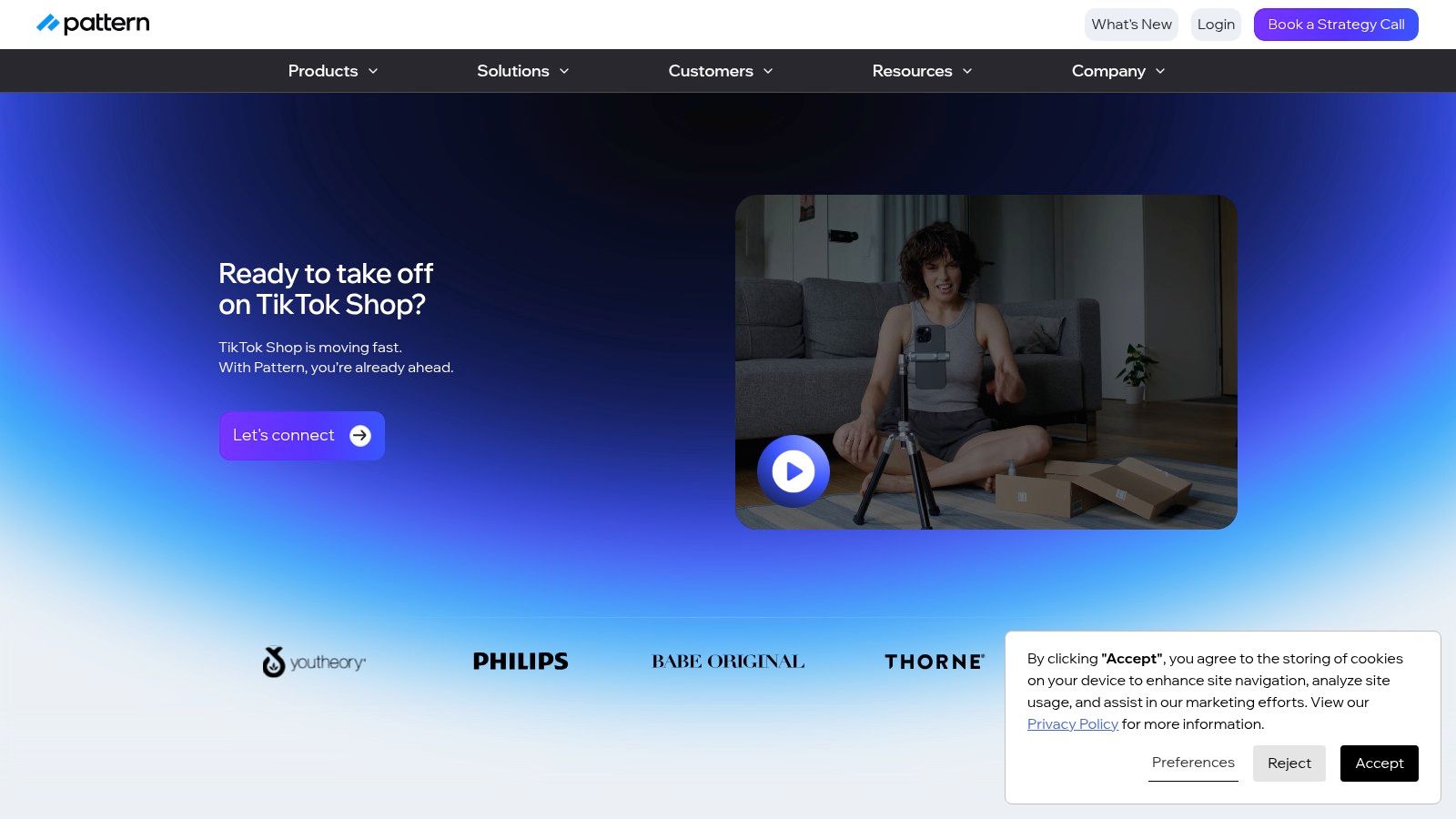
A common 7 to 9 figure brand scenario looks like this: paid social is working, Amazon is material, retail pricing needs protection, and TikTok Shop can no longer sit off to the side as a creator test. Pattern fits that operating reality better than agencies built around content volume alone. Its offer is designed for brands that need TikTok Shop connected to catalog management, fulfillment logic, channel conflict controls, and performance reporting.
That matters because larger ecommerce teams usually fail on coordination, not effort. The problem is rarely "we need more creators." The problem is getting listings, promotions, creator activity, media, and post-purchase operations to run as one system. Pattern is one of the few names on this list that appears built for that level of complexity.
Pattern is strongest for brands that already treat commerce channels as interdependent. If your team is managing Amazon, DTC, retail partners, and marketplace pricing at the same time, TikTok Shop decisions can create downstream issues fast. Discounting, assortment, fulfillment promises, and inventory placement all need tighter control than a typical influencer agency can provide.
That makes Pattern a credible option for operators who care about GMV impact without creating channel mess elsewhere.
Its appeal is less about flashy creator-first positioning and more about operating coverage. Setup, shop management, creator programs, paid support, and fulfillment alignment sit under the same roof. For experienced operators comparing service models, this broader overview of a TikTok Shop agency for ecommerce operators is a useful cross-check.
Pattern is not a light test partner. The likely upside is stronger ownership across the moving parts that break most Shop programs. The trade-off is a heavier engagement model and less tolerance for brands that want to micromanage every listing change, creator selection, or promo decision while still expecting agency accountability.
I would press on four areas before signing:
Pattern earns its place near the top for brands that need an operator with enough infrastructure to support meaningful TikTok Shop revenue, not just campaign activity. That is a different requirement from what a sub-scale brand needs.
One caution remains. Public agency pages still do a weak job of showing standardized ROI benchmarks, margin assumptions, and attribution rules. As noted earlier, that transparency gap slows diligence. Ask for sample dashboards, actual review cadences, and the metric definitions used in business reviews before you commit.
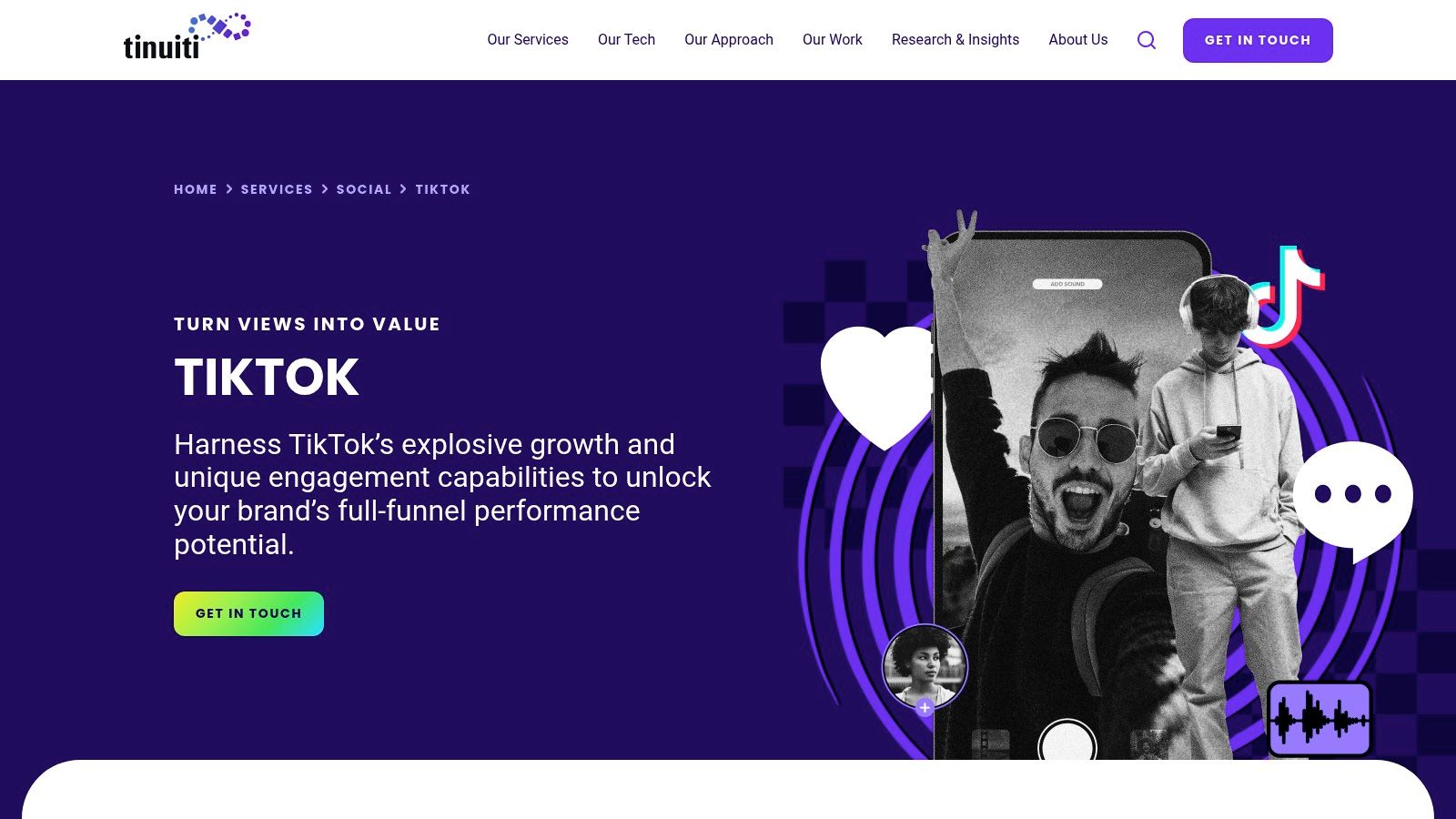
A common 8-figure scenario looks like this. Paid social is tightly managed, finance wants clean attribution, and TikTok Shop is no longer a side test. It needs to plug into the same operating cadence as Meta, Google, Amazon, and retention. Tinuiti fits that environment better than a creator-only shop.
Tinuiti is one of the stronger options for brands that want TikTok Shop run with performance media discipline and executive-level reporting. The practical implication is simple. The account structure, review process, and escalation path are usually built for teams that already expect forecast discussions, margin scrutiny, and channel-level accountability.
For larger operators, platform partner status also matters because it can signal process maturity and closer alignment with current TikTok workflows, as noted earlier in the article. That does not guarantee GMV. It does reduce the odds that you are onboarding a team still figuring out basic platform mechanics while your brand absorbs the learning curve.
Tinuiti makes the most sense when TikTok Shop has to sit inside a broader growth system instead of operating as a standalone creator program. That includes brands with internal media buyers, finance leads, and ecommerce operators who need to see how Shop affects new customer mix, blended CAC, promo efficiency, and contribution margin.
If your evaluation criteria center on who owns Seller Center operations, affiliate management, paid support, reporting, and day-to-day execution, keep this breakdown of what a TikTok Shop agency should handle end to end open during the sales process. It is a useful filter for separating real operators from agencies that mainly package strategy.
The upside is operating discipline. Tinuiti is better suited to brands that need structured reviews, clearer measurement, and cross-channel context.
The cost is speed in certain workflows. Large agencies often run through more layers, and that can create friction if your category depends on fast creator iteration, rapid sample drops, or constant listing refreshes tied to trend windows. For a 7 to 9 figure brand, that is not a dealbreaker. It is a staffing and ownership question you should settle before launch.
Ask them to show exactly how they separate Shop-driven GMV, paid conversion lift, affiliate sales, and standard TikTok ad performance in reporting. If those definitions blur together, your weekly numbers will look better than your actual commerce operation.
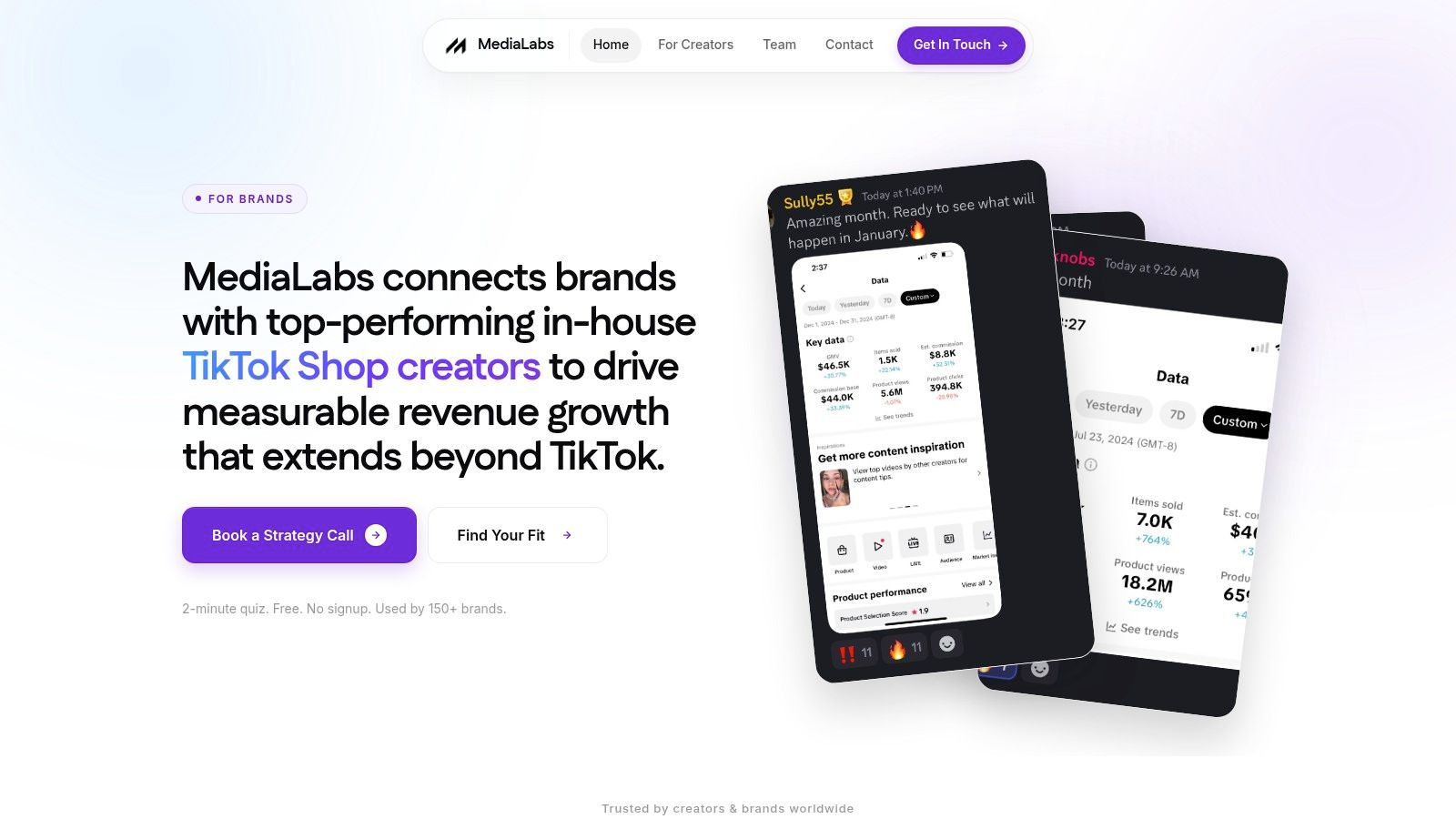
MediaLabs is built for brands that need constant creator output and don't want to assemble that machine themselves. Their pitch is straightforward. They handle Seller Center operations, listings, paid, live selling, and affiliate management under one roof. For brands trying to avoid handoff failure between multiple vendors, that's attractive.
The clearest differentiator is creator infrastructure. MediaLabs says it maintains a managed roster of 3,000+ creators trained on TikTok Shop best practices. Whether that exact roster composition fits your category is something you still need to verify, but the operating implication is obvious. They are built around throughput.
A lot of TikTok Shop programs stall because nobody owns the unglamorous middle. Listings lag. Samples go out late. Affiliate follow-up is inconsistent. Paid and organic teams optimize against different goals. MediaLabs looks designed to remove those coordination gaps.
That makes them especially relevant for brands that already know they need an end-to-end agency. If you're evaluating partners from that perspective, this overview of what a TikTok Shop agency should actually run end to end is worth keeping open during calls.
MediaLabs isn't the best fit for a brand that still lacks offer clarity, landing assortment logic, or content approval speed. An agency can supply creators and operations, but it can't fix a weak product hook or a team that takes too long to approve usable content.
Before signing, pressure test these points:
MediaLabs is compelling when your biggest problem is execution bandwidth. If your bigger problem is strategic indecision, the added engine won't solve that by itself.
Creatify is for brands that want aggressive creator-plus-paid acceleration and are comfortable doing hard diligence before signing. The agency positions itself squarely around TikTok Shop growth, and the framing is built for operators who care about speed, creator density, and ad scale rather than broad social media services.
This is one of the options that tends to attract supplement, beauty, and consumable brands because the model appears optimized for high-velocity content and heavy ad iteration. If your category responds well to creator repetition and fast offer testing, that can be useful.
Creatify presents itself as a TikTok Shop-focused operator with a large creator engine and heavy ad optimization emphasis. On paper, that's exactly what many fast-growing brands want. The appeal is obvious if your in-house team already understands merchandising and only needs more firepower on creator sourcing and media execution.
Still, operators must slow down and verify. Large network claims can sound impressive, but they only matter if the agency can show category-relevant creator depth, actual onboarding mechanics, and a clean approval process.
Treat Creatify as a due-diligence-heavy option. Ask for process detail, not just logos and headline claims.
A large creator roster is only useful if the agency can brief creators well, ship samples fast, clear rights properly, and kill weak content without drama.
Creatify can be a very strong fit for brands that already know TikTok Shop works for their SKU set and want to scale harder. It is a weaker fit for teams still trying to validate basic channel fit.
MomentIQ is a good match for founder-led DTC teams that want structure. Some agencies sell pure hustle. MomentIQ sells process. If your team wants documented playbooks for live selling, seeding, creator partnerships, and TikTok ads, that's a meaningful distinction.
That kind of operating system is often underrated by brands that are new to Shop. It becomes more valuable once a company is scaling and needs the same launch standards repeated across products, promos, and creator cohorts.
MomentIQ appears strongest when a brand wants a partner that can reduce avoidable mistakes. That usually means cleaner onboarding, better creator briefing, more repeatable live planning, and less improvisation once campaigns are in motion.
For founder-led teams, this matters because TikTok Shop creates a lot of micro-decisions. Which products should be seeded first. Which creators should get affiliate emphasis versus paid usage rights. How often should live happen. Agencies with explicit playbooks tend to answer those questions faster.
Playbook-driven agencies work best when the brand can also stay disciplined. If your internal team constantly changes promotions, inventory priorities, or approval rules midstream, a structured partner won't look as effective as it should. The system breaks when the brand side doesn't hold still long enough for feedback loops to work.
A few useful diligence questions for MomentIQ:
MomentIQ isn't the flashiest option on this list. That's not a weakness. For many 7- to 9-figure brands, boring process beats chaotic energy every time.
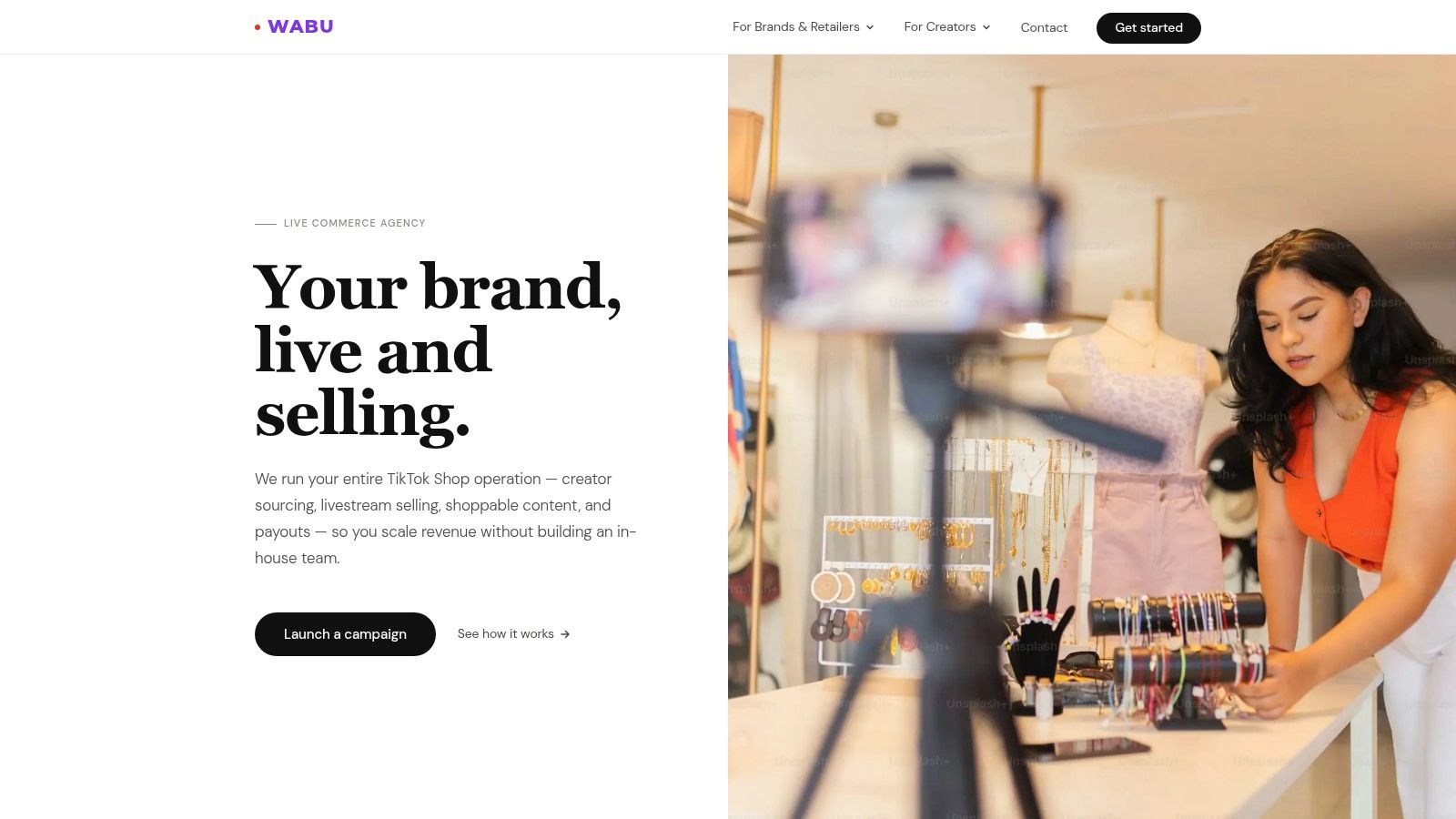
If your TikTok Shop growth thesis depends on live commerce, WABU deserves a hard look. Most agencies say they can "do live." WABU appears built around it. That's a major difference because recurring live shows require a different operating rhythm than standard creator seeding or paid creative testing.
Live needs hosts, show structure, moderation, attribution discipline, and payout management. It also needs people who understand how to keep a show commercially useful without making it feel like a tired infomercial.
For the right product categories, live commerce can become its own sales engine. But it also fails quickly when the host is wrong, the offer stack is weak, or the production process is improvised. A specialist agency can help avoid those obvious mistakes.
WABU's appeal is that it runs the moving parts many brands underestimate. Creator sourcing, show production, shoppable content, and tracking are all operational jobs. They're not side tasks for a social manager.
WABU fits brands that already believe live is central to the channel, or have evidence that live converts well for their products. It's also useful when a team wants English-language host coordination and a partner that can run recurring programming, not just one-off events.
The limitation is equally clear. If your strategy depends more on always-on short-form UGC and broad affiliate scale than host-led selling, WABU may need to sit alongside another agency or an internal team.
A lot of brands say they want live when they really want better short-form conversion. WABU is best when you know the difference.
ShopLiveX is another strong live-commerce pick, but the appeal is flexibility. Some brands need a partner to fully produce shows. Others want a co-pilot while keeping internal talent and merchandising control. ShopLiveX looks built to support both models, which makes it useful for companies that are still deciding how much to own in-house.
Its cross-platform experience with shoppable video also matters. A team that understands live as a format, not just as a TikTok feature, can usually help brands build stronger repeatable show mechanics.
Generalist agencies often treat live as a content extension. ShopLiveX treats it like production plus commerce. That sounds obvious, but it changes the workflow. Show scripting, pacing, host management, and conversion prompts all need more intentional planning than a standard short-form post.
ShopLiveX also notes certified partner status on its own materials, which adds some confidence around platform familiarity. That's especially useful if your team wants a partner who can speak both creative and technical language during launch planning.
For some brands, ShopLiveX can be the main TikTok Shop partner. For others, it's better as a specialist layered into a broader ecosystem. That's especially true if your business needs a high-output affiliate machine and a strong live program at the same time.
One more strategic point matters here. The market still has a gap around omnichannel operations. Many TikTok Shop agencies don't clearly address real-time inventory sync, unified analytics across TikTok Shop plus Amazon plus DTC, or fulfillment planning for multi-platform brands. That gap is called out directly in this discussion of omnichannel and inventory synchronization complexity for TikTok Shop agencies. If you sell across multiple channels, ask ShopLiveX exactly how show cadence and promotions interact with stock allocation.
Live specialists can drive real revenue. They can also create inventory headaches fast if nobody is coordinating product availability across channels.
ShopLiveX is a strong choice when live is central to the plan and you want flexibility in how much the agency owns versus how much your internal team keeps.
| Provider | Implementation Complexity (🔄) | Resource Requirements (⚡) | Expected Outcomes (📊 / ⭐) | Ideal Use Cases (💡) | Key Advantages (⭐) |
|---|---|---|---|---|---|
| Pattern | High 🔄 Full-service operator handling ops, catalog, logistics | High ⚡ Enterprise budgets; complex catalog & SLA readiness | Deep marketplace growth, platform support, catalog protection (📊 ⭐) | Mid-market / enterprise brands with complex catalogs | TikTok Strategic Partner; end-to-end ops & logistics |
| Tinuiti | Medium-High 🔄 Integrated media + commerce campaign complexity | High ⚡ Enterprise fees; needs creative/asset supply | Unified measurement and performance-driven Shop growth (📊 ⭐) | Brands wanting integrated paid/social/affiliate measurement | Platform beta access; enterprise reporting and process rigor |
| MediaLabs | Medium-High 🔄 End-to-end Shop ops including LIVE and affiliate | Medium-High ⚡ High content velocity and creator coordination | Faster creator activation and consistent content-driven GMV (📊 ⭐) | Enterprise clients needing high content throughput | Managed 3,000+ creator network; single-vendor ownership |
| Creatify | Medium 🔄 Creator-first with heavy ad optimization & scale focus | Medium ⚡ Scalable creator network and ad spend; cohort onboarding | Rapid scale via creator + paid ads (📊 ⭐) | Brands seeking quick growth in beauty, supplements, F&B | Large claimed creator network; aggressive Shop ad frameworks |
| MomentIQ | Medium 🔄 Playbook-driven operating system for live & seeding | Low-Medium ⚡ Requires brand operational alignment to follow playbooks | Predictable live & affiliate growth with fewer execution errors (📊 ⭐) | Founder-led DTC teams valuing process and onboarding speed | Documented playbooks and structured operating system |
| WABU | Medium 🔄 Specialized end-to-end livestream production & ops | Medium ⚡ Recurring show budgets, host sourcing, realtime payouts | Higher live-show conversion and real-time attribution (📊 ⭐) | Brands scaling recurring English-language TikTok live shows | Dedicated live-commerce methodology; US-based operations |
| ShopLiveX | Medium 🔄 Live/show-centric production or co-pilot support | Medium ⚡ Per-show production budgets; scoped pricing by cadence | Documented GMV from shoppable video and livestreams (📊 ⭐) | Brands focused on live/shoppable video across platforms | Cross-platform live expertise; flexible production models |
A 7-figure brand can survive a mediocre agency. An 8- or 9-figure brand usually cannot. Once TikTok Shop touches inventory planning, promo calendars, finance approvals, affiliate payouts, and channel conflict, a weak operator creates expensive friction fast.
That is why agency selection should start with operating fit, not pitch quality. Pattern makes sense when you want marketplace-style ownership. Tinuiti fits teams that already understand paid media discipline and want tighter performance management. MediaLabs and Creatify are better fits when creator throughput is the bottleneck. MomentIQ suits teams that want a defined system and clear process. WABU and ShopLiveX belong on the shortlist when live commerce is a meaningful part of the revenue plan.
For larger ecommerce brands, the evaluation standard is simple. Can this agency increase GMV without creating downstream problems for inventory, margin, reporting, and internal team speed? If the answer is unclear in a discovery call, keep looking.
A useful benchmark is full-stack coverage. Social Tale presents a service model that includes shop setup, listing optimization, creator and affiliate management, ad campaigns, and operational support through its TikTok Shop partner overview. You do not need that exact scope from every partner. But if an agency only handles content production or only runs influencer outreach, your team will still own the messy parts that usually decide whether the channel scales.
Ask direct questions. Push for examples, workflows, and owners.
Operational and strategy questions
Creator management questions
Experienced teams need to test cross-functional readiness, not just channel knowledge.
Tooling matters because it changes decision speed. FastMoss describes itself as a TikTok analytics and market intelligence platform covering products, shops, creators, ads, and live activity. Agencies that use this type of software well can make better weekly decisions on product focus, creator allocation, and live scheduling. Agencies without that visibility often rely on generic playbooks or delayed reporting.
Final takeaway. The best tiktok shop agency for a larger brand is the one built for your constraint. If your team needs end-to-end ownership, hire for operational capacity. If your in-house ecommerce team already runs a tight ship, hire the specialist that fills the missing gap, whether that is creator scale, paid media discipline, or live production.
Agency support helps. Internal readiness still decides the outcome. Brands that win on TikTok Shop usually respond quickly, approve offers fast, keep inventory clean, and treat the agency like an execution partner rather than an outsourced growth fantasy.
If you want operator feedback before signing, Million Dollar Sellers is one place to look. It is an invite-only community of established ecommerce founders, including sellers discussing TikTok Shop, Amazon, DTC, and omnichannel execution.
Join the Ecom Entrepreneur Community for Vetted 7-9 Figure Ecommerce Founders
Learn MoreYou may also like:
Learn more about our special events!
Check Events