
Chilat Doina
June 24, 2026
You've already done the hard part. The brand exists. Revenue is real. The team is no longer a few friends improvising on Slack.
Now the problems are nastier.
You're not trying to figure out how to launch a Shopify store. You're trying to fix margin compression without slowing growth. You're trying to reduce operational drag while your catalog expands. You're trying to find people who've already survived the exact mess you're in, not people who want to tell you how they would handle it in theory.
That's where most networking advice falls apart. It's built for beginners collecting contacts, not operators solving expensive problems. For a serious founder, brand founders meetups only matter when they compress the path to a decision, a partnership, a better hire, a better supplier, or a better strategic read on the market.
The best rooms do that. The weak ones drain a day from your calendar and send you home with empty enthusiasm.
A business can outgrow its founder's network long before it outgrows its market.
That usually happens in the middle zone. You're past the early hustle phase, but you're not yet running on fully institutional systems. The pressure builds, mistakes cost more, and generic founder circles stop being useful. Advice from someone building their first product line won't help much when you're renegotiating freight exposure, reworking paid media efficiency, or pressure-testing a wholesale expansion.
Old networks tend to have one of three problems.
That's why elite founder rooms work differently. They're not built around access for its own sake. They're built around pattern recognition. Someone in the room has already made the mistake you're about to make, or they know the operator, banker, supplier, or channel expert who can help you avoid it.
If you're still sorting through broad directories, practical resources like how to find networking groups can help narrow the field before you commit time. For founders who want a more focused look at peer communities, this roundup of business networking groups for entrepreneurs is useful as a starting filter.
The right room doesn't give you more contacts. It gives you fewer, better conversations.
For larger brand operators, meetups should serve four jobs:
| Function | What it looks like in practice |
|---|---|
| Decision support | Sanity-checking a major move before you deploy capital |
| Problem solving | Getting real operating answers from founders who've lived it |
| Opportunity creation | Finding distribution, supply-chain, investor, or partnership angles |
| Calibration | Seeing what's normal at your level and what isn't |
If a meetup can't do at least one of those well, it's probably just an event.
Your calendar is inventory. Treat it that way.
Most founder events sound good in the invite. Curated. Intimate. High level. Private. Those words mean nothing unless the structure enforces them. The difference between a valuable meetup and a dressed-up mixer usually shows up before you even arrive.
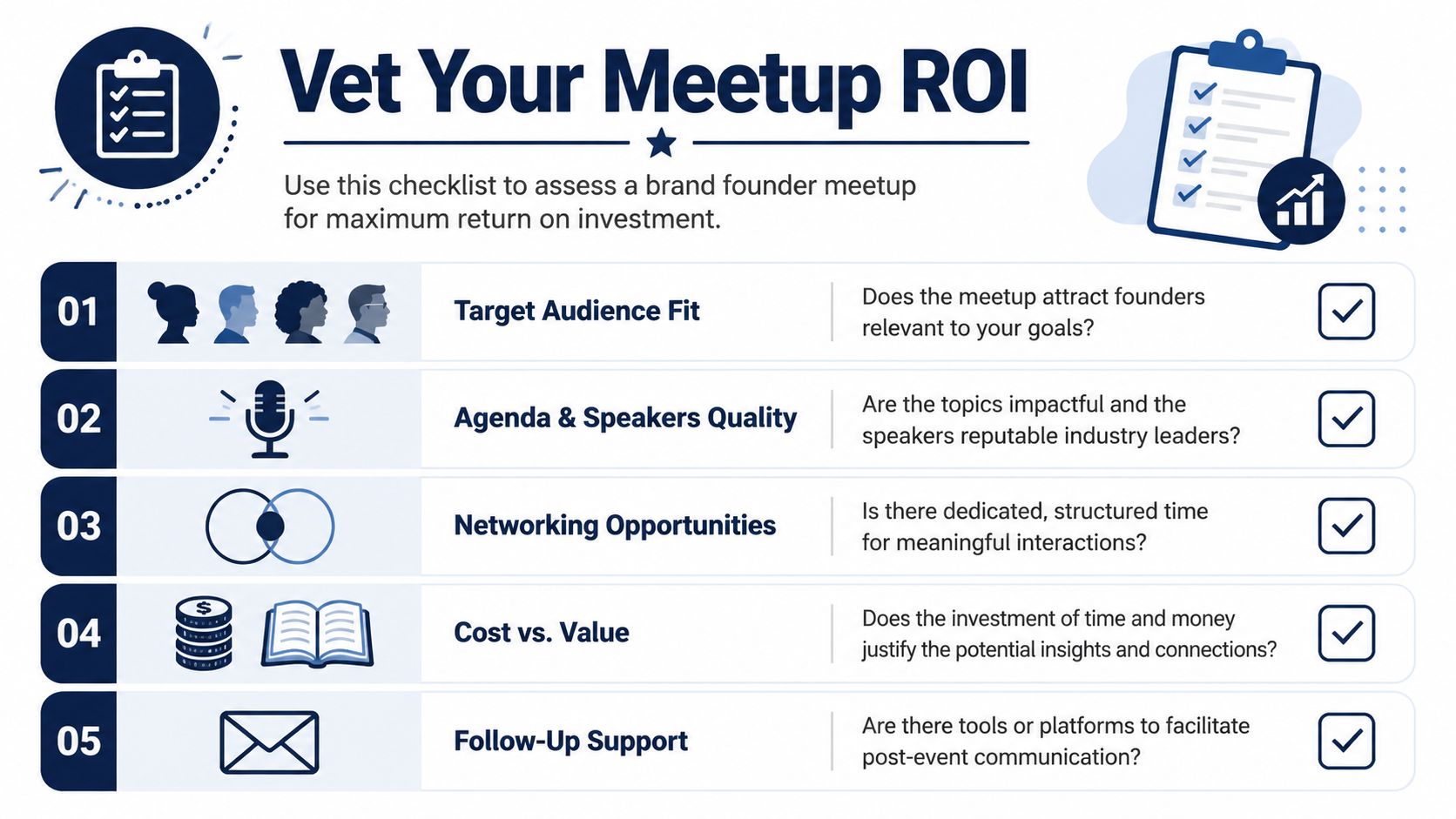
The strongest signal is who gets in.
Research on startup meetups found that events with strict vetting that accept only 15-20% of applicants and use structured mastermind sessions reach a 68% post-event conversion rate for ongoing peer collaboration, compared with 32% for unstructured events according to the startup statistics guide from Founders Forum.
That tracks with what seasoned operators already know. Rooms improve when admission gets harder.
A useful founder meetup should make it difficult for the wrong people to enter. If anyone with a credit card can join, the organizer is optimizing for ticket revenue, not member outcomes.
Most founders make the mistake of evaluating events by speaker lineup. That's the least important part.
What matters is whether the room is built for extraction of value. You want structured interaction, not passive consumption. If you're comparing event formats, this guide to business mastermind groups is a helpful benchmark for what a stronger peer-learning setup looks like.
Look for signs like these:
A bad meetup isn't always obvious. It often looks polished.
Open registration with no screening
That usually means you'll spend the day sorting the room yourself.
Sponsor-heavy programming
If the people on stage mostly sell to founders, the founder conversations become secondary.
Agenda built around inspiration
Motivation is cheap. Specific answers are expensive.
No attendee context beforehand
If you can't see who's coming or what they work on, you can't prepare.
Practical rule: If the organizer can't explain exactly how the room is curated, assume it isn't.
Before you register, ask three questions:
If you don't get strong answers, skip it. The highest-ROI meetups protect your time before they ask for it.
Walking into a founder meetup without preparation is the business equivalent of showing up to a board review cold. You might still survive the room, but you won't get the best out of it.
The founders who extract the most value usually decide the outcome before they arrive. They know what they need, what they can offer, and who in the room is worth deeper time.

Most founders waste meetup time explaining their business. That's backward.
You need one or two sharp operating questions. Not “we're trying to grow.” Something tighter. A problem another founder can attack with you.
Examples:
Those are discussion-grade problems.
If you need help framing issues before the event, reviewing strong networking group discussion topics can help you convert vague frustration into a conversation another operator can solve.
You do not need deep dossiers on attendees. You need enough context to sort people into buckets.
The goal isn't to meet everyone. It's to identify the handful of conversations worth protecting.
Rooms like this punish takers. Fast.
The easiest way to become forgettable is to arrive with a shopping list and nothing useful to contribute. Bring insight, context, referrals, or clarity. If you can point a founder to a logistics contact, share a retention framework that worked, or help them avoid a bad agency hire, you become someone worth continuing with.
A founder who only extracts value gets one meeting. A founder who compounds value gets invited back into the real conversations.
One more angle gets overlooked here. If your meetup sits inside a trade show, expo, or industry event, your prep should include physical presence too. Founders using premium booths or activation spaces often get more serious inbound conversations when the environment is designed well, which is why teams sometimes work with experienced exhibition stand designers before major event cycles.
Once you're in the room, speed matters. Not social speed. Signal speed.
You need to figure out quickly who is sharp, who is noisy, who has relevant experience, and where the actual opportunity resides. The best founders do this without seeming transactional because they listen well, ask precise questions, and move the conversation toward something useful.
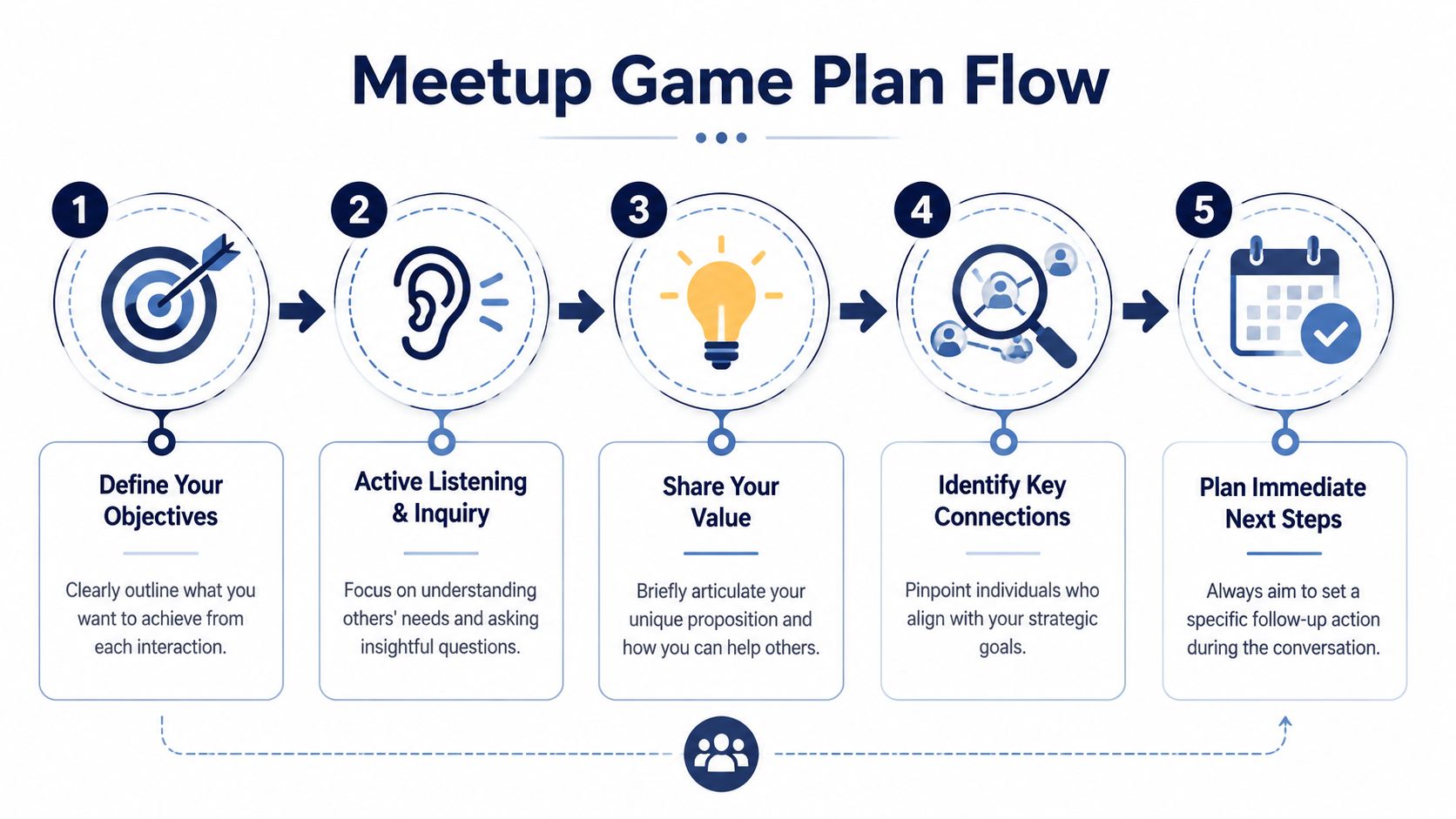
You don't need ten minutes of origin story.
A better early question is, “What are you focused on solving right now?” That tells you more in one sentence than a polished company intro will tell you in five minutes. It also moves the exchange into real territory where useful pattern matching can happen.
When the room is structured well, the table is where the money is.
Research shows founders who engage in regular, structured interactions within peer groups have a 30% higher success rate than those who attend less frequently, according to Swisspreneur's startup meetup analysis. That number matters because it validates what many experienced founders feel intuitively. Consistent, structured discussion beats sporadic networking.
Keep it tight.
Good operators don't rush to talk.
Try this sequence instead:
That rhythm keeps the table useful and stops the conversation from turning into free-form consulting theater.
Don't dominate the table. Improve the quality of the table.
Interesting people are everywhere. Strategic fits are rare.
At high-level brand founders meetups, the most valuable connections often fall into a few categories:
| Type | What to look for |
|---|---|
| Channel partner | Access to distribution you don't currently have |
| Supply-chain ally | Shared vendor intelligence or operational leverage |
| Capital connector | Credible path to aligned financing or investor intros |
| Operator peer | Someone close enough in scale to exchange real numbers and decisions |
This is one place where a vetted peer community can outperform open events. For founders in ecommerce, Million Dollar Sellers is one example of a network built around curated founder interaction, private forums, local chapters, and in-person meetups for larger operators.
There's a simple rule that keeps you out of the amateur tier.
Give something specific before you ask for something meaningful.
That doesn't mean performative generosity. It means proving you're worth another conversation. A useful referral, a candid warning, an operating insight, or a shortcut can earn more trust than a polished intro ever will.
The default founder follow-up is lazy.
“Great meeting you. Let's stay in touch.”
That message means the conversation is over.
If you want real value from brand founders meetups, follow-up has to convert momentum into structure. Otherwise you're just collecting names inside a prettier CRM.
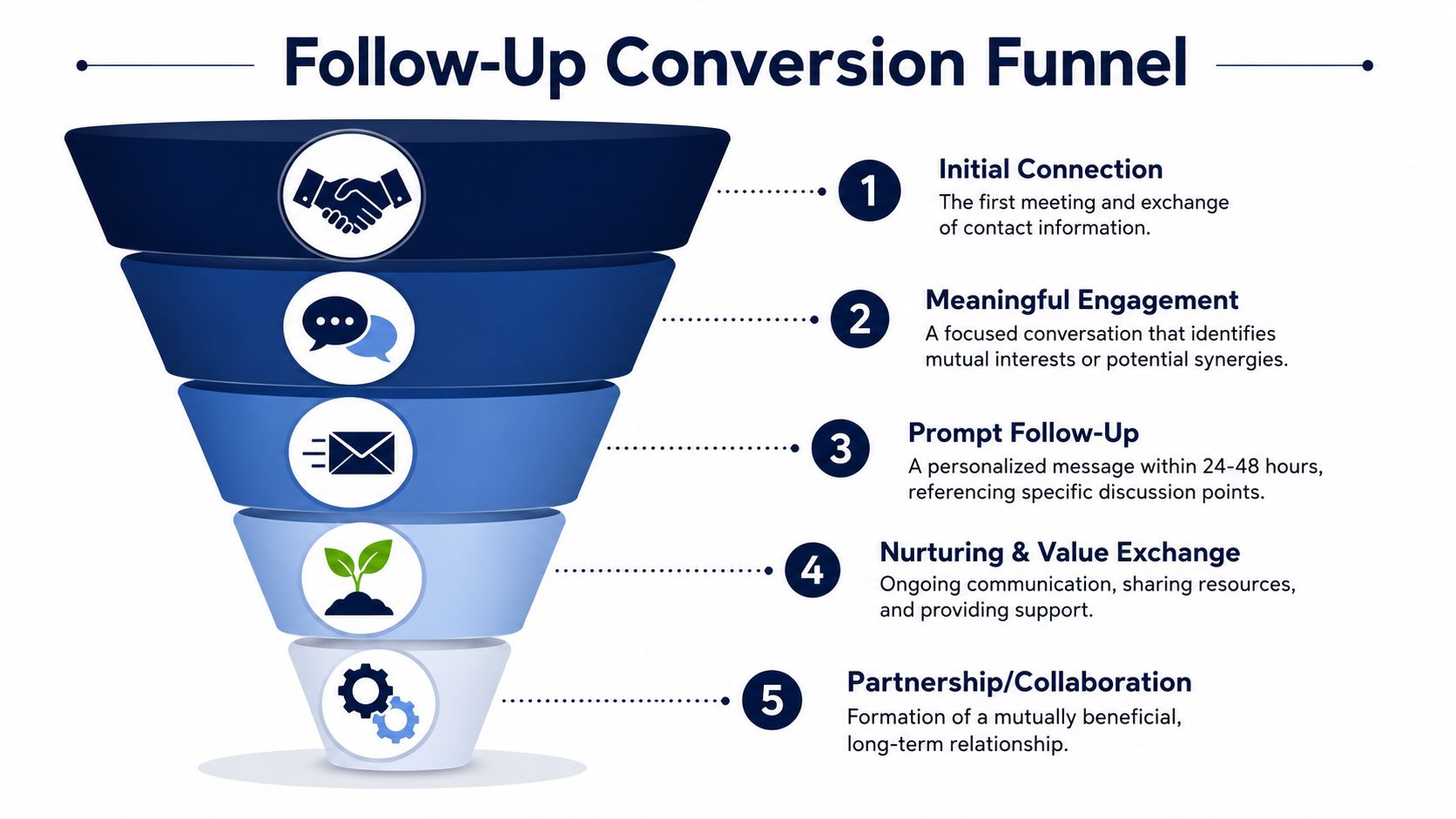
The gap is even sharper for founders who already face bias inside startup ecosystems. According to McKinsey, 73% of founders from underrepresented groups report that post-meetup interactions remain superficial without structured follow-up mechanisms, as noted in McKinsey's research on diversity and inclusion in the startup ecosystem. That's a strong warning against treating post-event contact as an afterthought.
A useful conversation on this topic is below.
After the event, divide new contacts into working categories.
Partnership potential
People where there's clear commercial or operational overlap.
Peer counsel
Founders you want in your ongoing circle because they think well.
Resource value
People with useful access, referrals, or specialist knowledge.
Low priority
Good conversation, no obvious next move.
This stops you from treating every contact the same. Most founders lose momentum because they don't assign a purpose to the relationship.
A strong follow-up references the actual conversation and proposes one low-friction next step.
Here are workable examples:
Good meeting you in New York. Your point about retailer terms changing after the first PO stuck with me. I'd like to compare notes on how you structured your team for wholesale expansion. Open to a short call next week?
Enjoyed the conversation on supplier concentration risk. I know a founder who recently diversified production across regions and can make an introduction if useful. If you want, we can also compare scorecards for vendor reviews.
Those messages work because they do three things. They prove you listened, they reintroduce relevance, and they make the next step easy to accept.
One message isn't a system.
Use a simple cadence:
A lot of promising relationships die because nobody takes ownership of the second step.
LinkedIn is a contact layer. It is not a follow-up strategy.
The founders who get the most from elite meetups treat follow-up like pipeline management. Not spammy. Not forced. Just disciplined.
At the highest level, meetups aren't about events. They're about assembly.
You're building a personal board of directors. A small set of peers, operators, specialists, and trusted truth-tellers who improve your judgment. Some will help you avoid bad decisions. Some will open doors. Some will call out the blind spots your team is too close to see.
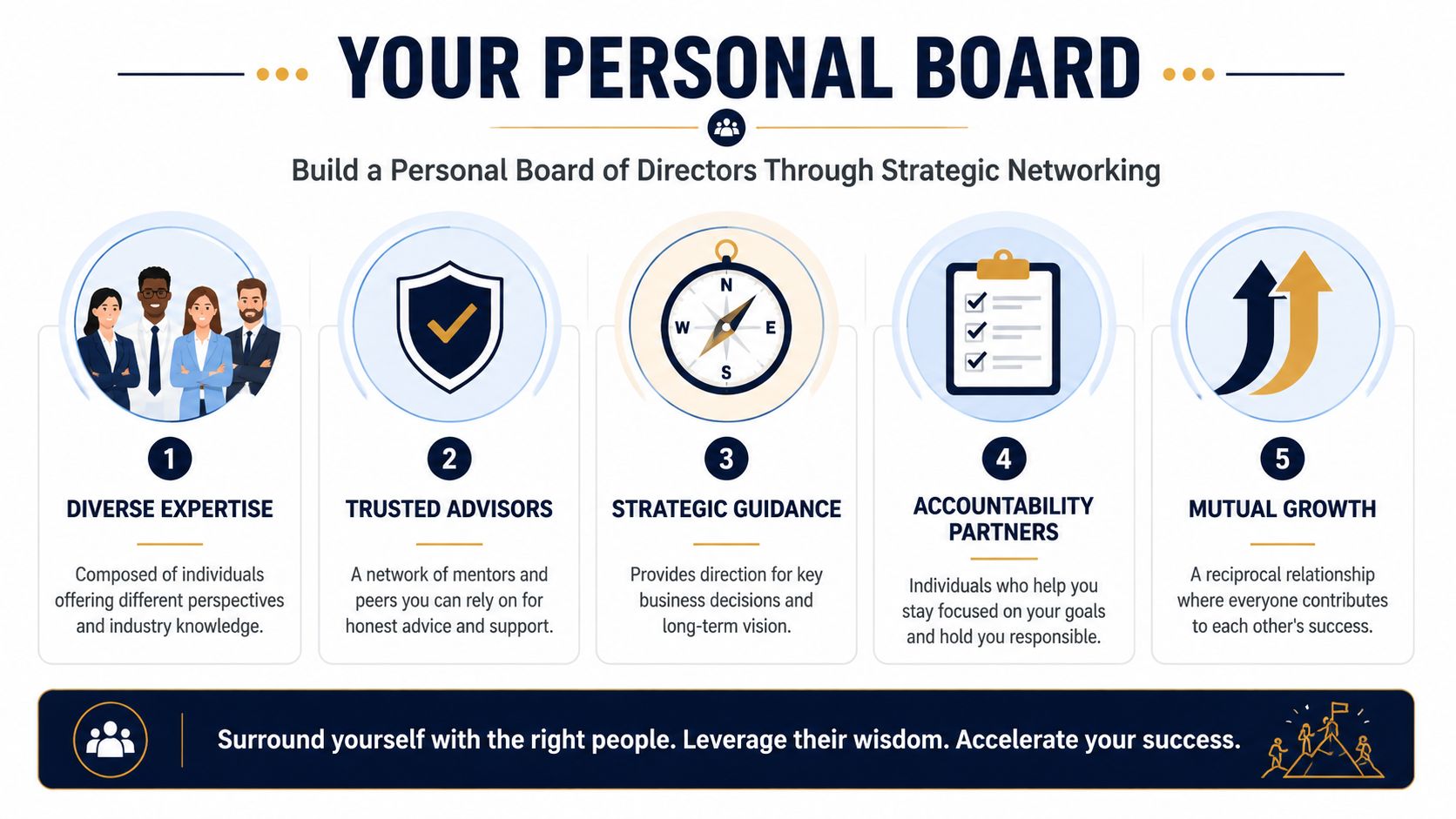
The logic is bigger than networking ROI. It's business survival.
While approximately 90% of startups fail, founders who actively participate in community meetups and mastermind groups show a statistically lower failure rate, according to the startup statistics breakdown from Impressit. You don't need to be a startup founder to understand the lesson. Isolation compounds risk. Strong peer networks reduce it.
A useful founder circle usually needs a mix.
That mix won't come from one event. It comes from repeatedly choosing the right rooms, showing up prepared, contributing at a high level, and following through after the handshake.
Capital helps. Talent helps. Timing helps.
But a trusted network of serious founders creates an advantage in a different way. It shortens learning curves, improves decision quality, and keeps you from solving expensive problems alone. That advantage compounds subtly over time, especially in categories where execution gaps are thin and one bad move can burn a year.
Treat your peer network with the same discipline you apply to cash flow, inventory, and channel mix. It deserves a line item in your strategy, because that's what it is.
If you want a more structured way to build that kind of peer network, Million Dollar Sellers is an invite-only community for established ecommerce founders where vetted 7, 8, and 9-figure operators connect through mastermind calls, private forums, local chapters, and in-person events designed for serious business discussion.
Join the Ecom Entrepreneur Community for Vetted 7-9 Figure Ecommerce Founders
Learn MoreYou may also like:
Learn more about our special events!
Check Events