Chilat Doina
June 22, 2026
You can feel the shift when your business gets big enough to stop being simple.
The revenue is better. The team is bigger. The problems look more complex from the outside. But inside the company, you're carrying a different kind of pressure. You're not asking beginner questions anymore. You're deciding whether to add a new channel, replace an operator who used to be solid, fix margin erosion without breaking conversion, or unwind a bad inventory bet before it drags into the next cycle.
At that stage, generic advice becomes expensive. Friends who run smaller businesses mean well, but their playbook doesn't map to yours. Employees can give input, but they can't always challenge the founder's assumptions. Consultants can diagnose pieces of the problem, but they don't live with the downstream consequences the way another owner does.
That's where a real business mastermind starts to matter. Not as a social outlet. Not as founder therapy. As a tighter decision environment for operators who need better answers, faster.
The first version of growth feels clean. You find a product. You find a channel. You push harder. Revenue moves.
Then the business gets more complicated and the old moves stop compounding the same way. Customer acquisition gets less predictable. Your fulfillment setup that worked fine at a lower level starts showing cracks. A senior hire looks good on paper and underperforms in practice. Your calendar fills up, yet your highest-value decisions take longer because each one now touches more people, more systems, and more capital.

This is the scaling paradox. The business is healthier than it used to be, but the founder often feels less certain. Not because they're weaker. Because the consequences are bigger.
A lot of founders don't notice the gap right away. They just feel friction everywhere.
The people around them still ask surface-level questions. "How's business?" "Have you tried ads on another platform?" "Can you just hire someone for that?" None of that helps when you're trying to decide whether to restructure the leadership layer, renegotiate with a manufacturing partner, or determine if a marketplace line should be separated from DTC operations.
At scale, isolation rarely looks like being alone. It looks like being surrounded by people who can't pressure-test the decision in front of you.
That's why high-performing founders start looking for peers, not spectators. They need operators who've already made ugly decisions, absorbed the mistakes, and can tell the truth without protecting your ego.
From the outside, these sound like privileged issues. More orders. More complexity. More people. More options.
Inside the company, they're still expensive if mishandled. Delay the wrong hire and execution stalls. Add the wrong agency and momentum slips. Keep saying yes to every initiative and your team loses focus.
A serious peer group helps because it compresses learning in the exact places where complexity has started to outgrow your own pattern recognition.
Most founders use the word mastermind too loosely. That's a mistake.
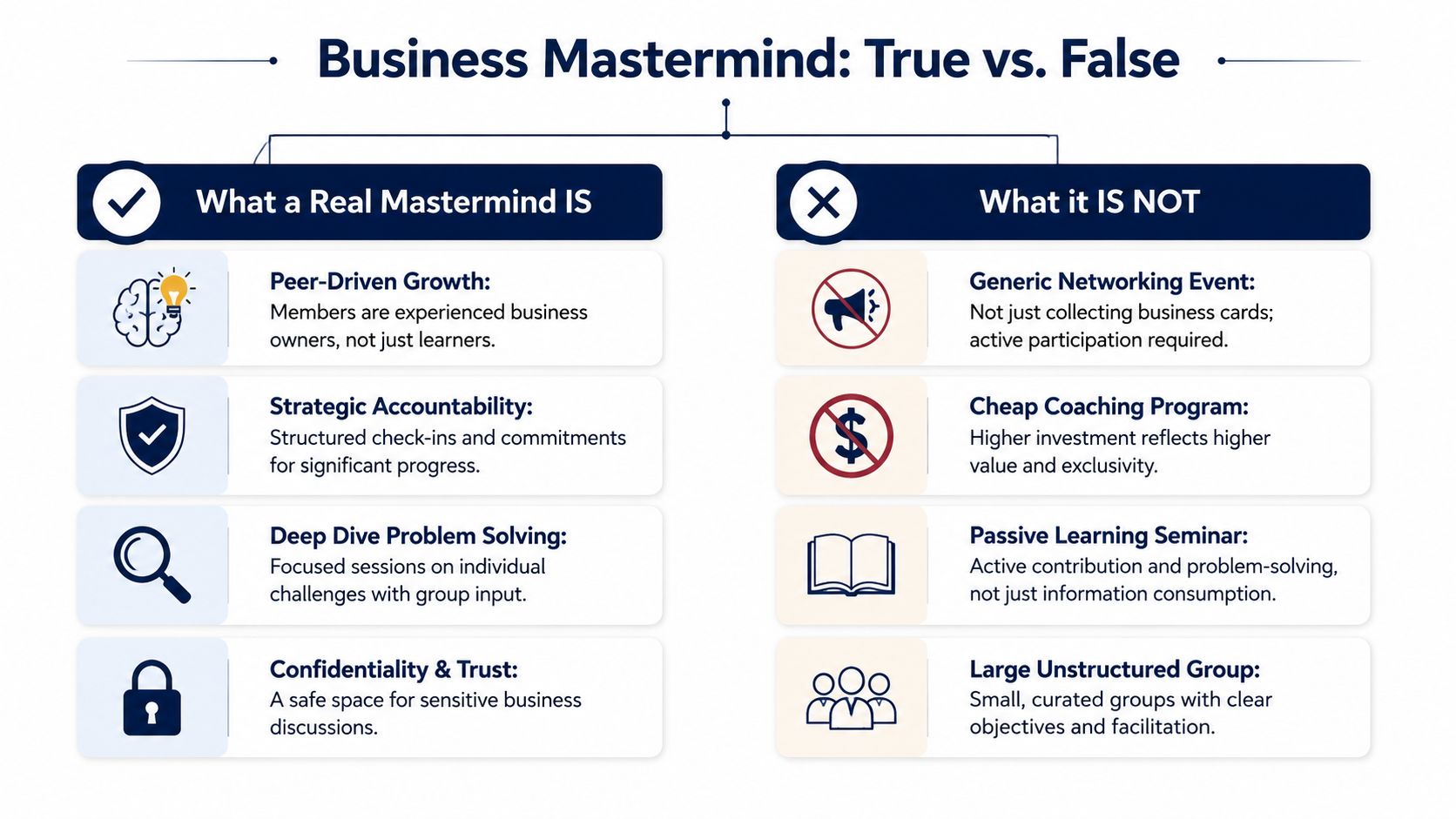
A business mastermind for a serious operator is not a cheap community, a broad networking club, or a content subscription with a Slack channel attached. It's a premium peer-learning format designed for founders who can already execute and now need sharper decision support. Independent guidance notes that a solid 12-month mastermind commonly costs $20,000 to $50,000+, with some programs reaching $100,000, and many founders are advised to join only after reaching the $250,000 to $500,000 revenue level, with the strongest fit often after hitting 7 figures in annual revenue, according to Lean Scaling's guide to choosing the right business mastermind.
You're not paying for information. Information is everywhere.
You're paying for access to relevant operators, tighter accountability, and a room where the conversations start closer to the level you're already playing at. That barrier to entry is useful. It filters out casual participants, tourist behavior, and people who want to consume but not contribute.
Here's the practical distinction.
| Real business mastermind | Not a real mastermind |
|---|---|
| Curated peer group of operators | Open-door networking room |
| Repeated exposure to the same members | One-off event energy |
| Hard conversations about execution | Motivation and broad inspiration |
| Confidential sharing of real numbers and decisions | Surface-level brand talk |
| Accountability tied to action | Passive content consumption |
A good mastermind also has a clear reason for existing. It might be built around ecommerce operators, channel-specific operators, or founders at a similar stage. But it should be obvious why these people belong in the same room.
It isn't a rescue plan for a founder who won't execute.
It isn't a substitute for knowing your numbers, hiring adults, or building internal systems. And it isn't therapy disguised as strategy. Founders do need support, but the best business mastermind groups stay anchored to operating decisions, trade-offs, and follow-through.
Practical rule: If the pitch sounds like transformation, alignment, abundance, or vague breakthroughs, keep your wallet closed.
The right framing is capital allocation. You're deciding whether the cost buys faster learning, better judgment, and fewer expensive errors than your alternatives.
If you're still trying to sort through the category itself, this breakdown of how to find a mastermind group is useful because it separates curated operator rooms from the many looser formats that get labeled the same way.
High price alone doesn't make a group valuable. But low price often signals the wrong mechanics.
Cheap groups usually fill the room by increasing headcount. Once that happens, airtime falls, candor drops, and the conversation gets diluted. You don't need more people reacting to your issue. You need a small number of people who understand the stakes and can challenge the plan.
For a founder in the 7 to 9 figure range, that difference matters. A bad decision in inventory, team design, channel mix, or supplier strategy can cost far more than the price of admission.
The value of a business mastermind isn't "community." That's too vague to be useful.
The value shows up in three levers that affect how a scaling company operates. When those levers move, growth gets easier to sustain and mistakes get cheaper to catch.
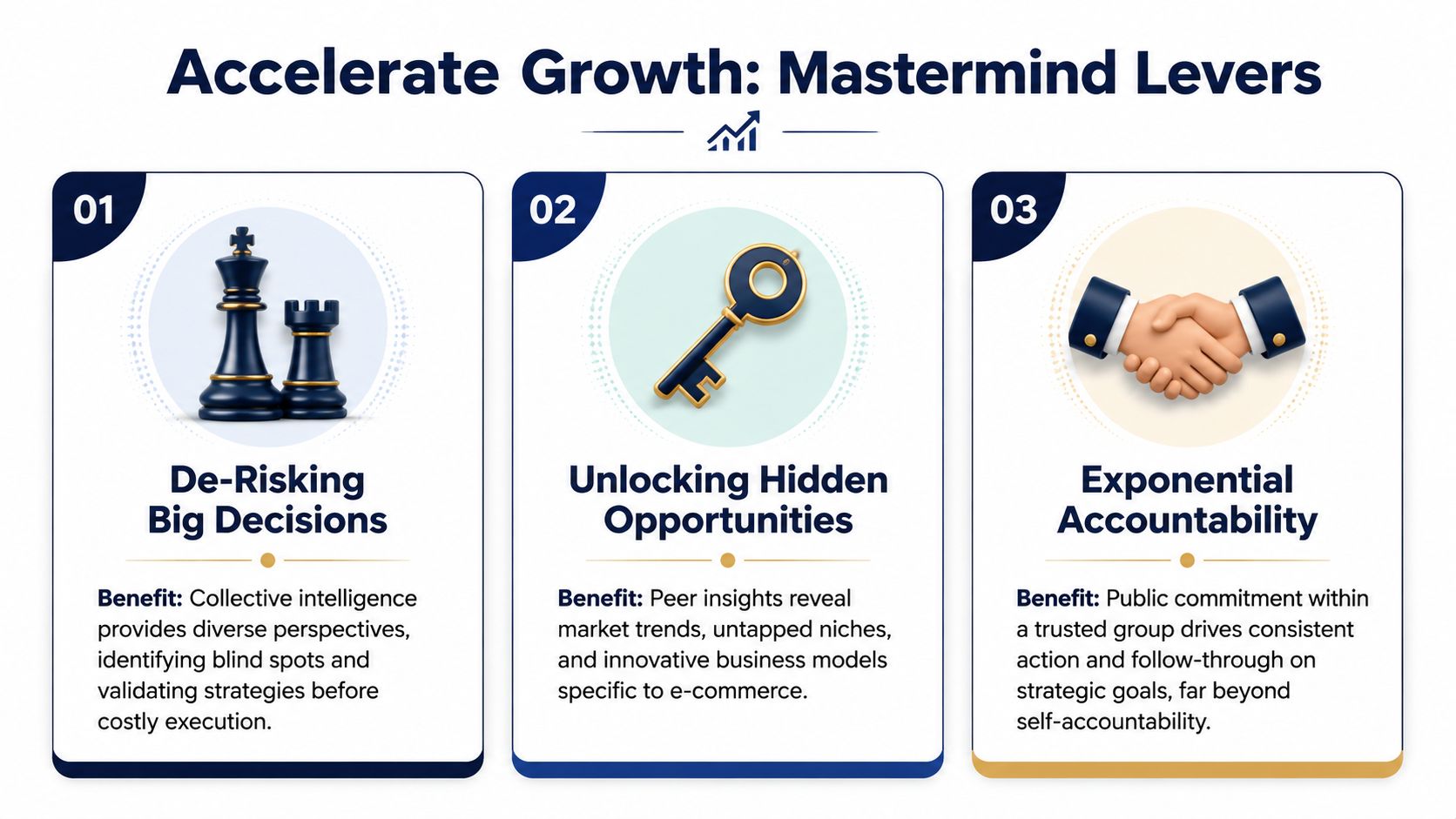
Founders stall when the downside of a bad decision rises faster than their confidence. That's normal. More scale means more second-order effects.
A strong peer group shortens that loop. You bring a live decision to people who've dealt with adjacent versions of the same problem. They can tell you what they missed, what they overcomplicated, and where the key risk resides. That doesn't remove judgment from the founder. It improves the quality of judgment under pressure.
This is especially useful in ecommerce, where operators routinely face calls around channel dependence, pricing architecture, retail expansion, inventory planning, hiring, and tech stack sprawl.
Most founders see a shift after it starts hurting them.
The advantage of a good mastermind is that someone else in the room may see it earlier. One operator notices margin compression from a vendor change. Another sees a retention issue tied to offer structure. Another has already learned that a shiny growth tactic attracts the wrong customer cohort.
That collective pattern recognition is hard to replicate inside your own company because your team sees your business through your current incentives and internal narratives.
A real peer group broadens your field of view. It helps you spot what may be coming before your P&L forces your attention.
A useful example sits outside the mastermind category itself. Many ecommerce brands exploring technical advantages don't need another general consultant. They need execution capacity tied to a specific bottleneck. That's why resources like AI staff augmentation can be relevant in the conversation. Not as a universal answer, but as the kind of vetted operator-level solution that often surfaces inside a high-trust peer room.
Advice without accountability turns into entertainment.
The best masterminds create a rhythm where members commit to specific actions, report back, and get challenged when they drift. That pressure matters because most founder bottlenecks aren't about ignorance. They're about delay, avoidance, or scattered focus.
Here, structure matters more than inspiration. The group doesn't just ask what you're working on. It asks what changed, what got done, what slipped, and why.
This short video captures the broad appeal of mastermind-style learning for operators who need direct, practical input rather than abstract business theory.
Good groups don't let you hide behind activity. They push for decisions, owners, and deadlines.
When those three levers are active, a mastermind stops being a calendar item and starts acting like infrastructure.
A mastermind works or fails based on operating design.
If the structure is loose, the loudest person dominates. If the room is too large, everyone leaves with generic advice. If the cadence is inconsistent, nothing compounds. The mechanics matter because the core asset is repeated, honest, relevant conversation.
A high-functioning business mastermind is typically optimized for 3 to 5 members, and many use a weekly or biweekly cadence to keep feedback loops short and preserve decision velocity, according to Due's overview of what a business mastermind is and why it matters.

Three to five is small enough for accountability and large enough for perspective. Everyone gets airtime. Everyone gets known. People can remember your context without needing a full recap every session.
Weekly or biweekly also forces relevance. If meetings are too far apart, updates become historical. The group's advice lands after the decision has already been made, or the issue has gone stale.
This usually works.
Facilitation doesn't have to mean a guru at the front of the room. It means someone owns the process.
That person keeps the discussion tight, prevents rambling, pushes for specifics, and stops one member from turning the session into a monologue. Peer-led groups can work well if one person still plays operator on the meeting itself.
The strongest groups usually run on a few essential principles:
The quality of a mastermind rises or falls on candor. Candor rises or falls on trust. Trust rises or falls on structure.
A good session has some friction to it. Not hostility. Precision.
Someone presents a problem with enough context to matter. The group asks clarifying questions. People challenge assumptions. Someone points out the hidden cost, the weak operator, the unrealistic timeline, or the channel risk being ignored. The founder leaves with a narrower set of actions and a clearer view of what to do next.
A bad session feels like smart people taking turns talking.
Most founders often get burned. They hear the word mastermind, assume quality, and buy into branding.
A good business mastermind should survive serious diligence. If the organizer can't answer direct questions about member fit, process, confidentiality, and outcomes, that's not a premium room. It's a dressed-up group chat.
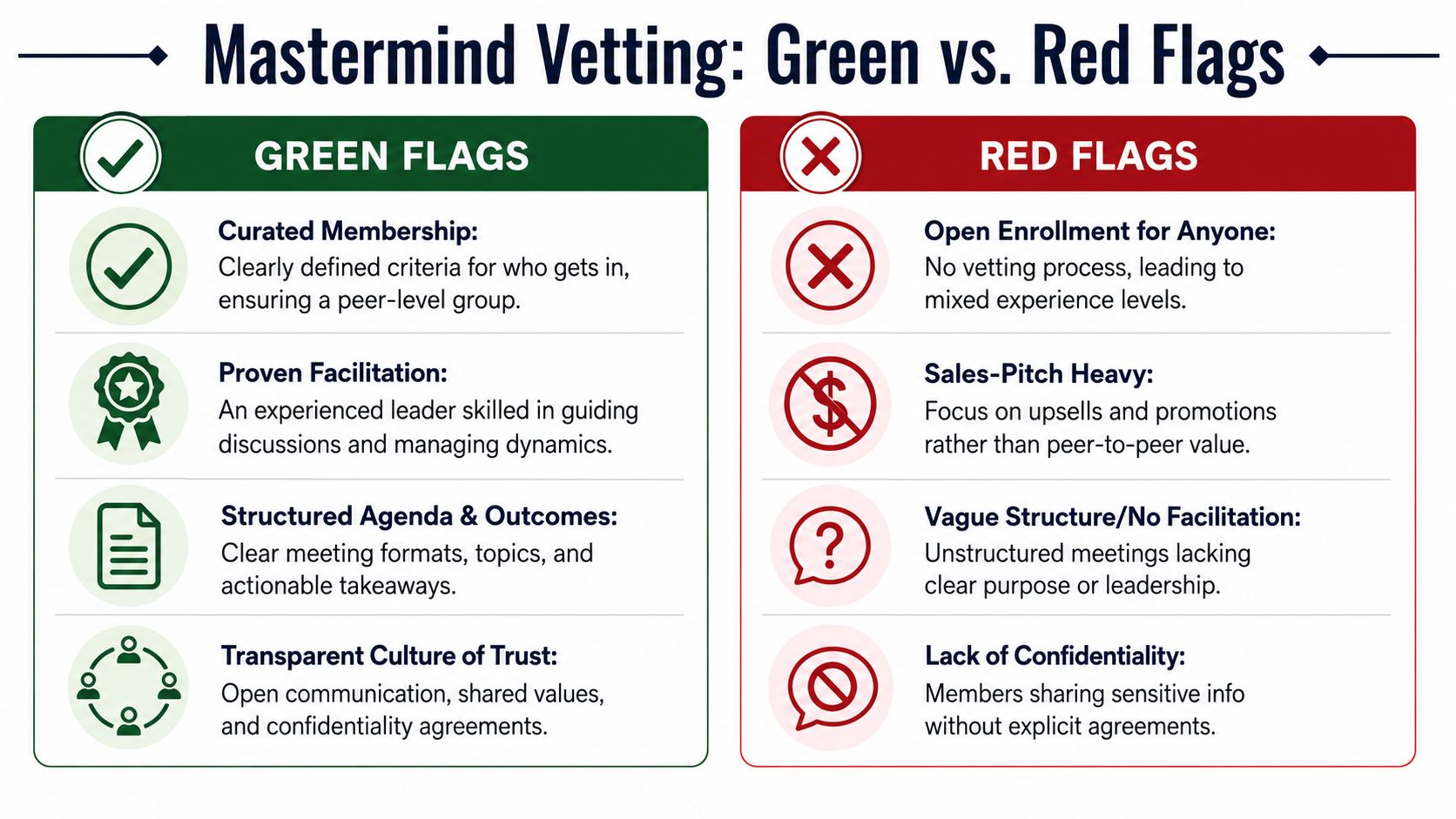
Guidance on mastermind selection puts real weight on homogeneity of business stage. Some facilitators recommend members be at least $250K+ in revenue so the group can exchange tactically relevant problems, and they advise a written confidentiality clause to improve disclosure quality and the usefulness of peer feedback, as noted in Live Your Message's guidance on selecting the right business mastermind.
The first green flag is a real filter.
If anyone can join, the room won't hold. Strong groups protect relevance by screening members for business stage, operator mindset, and willingness to contribute. In ecommerce, that often matters more than personality fit. You need people facing comparable complexity.
The second green flag is operational clarity. Ask how meetings run, who facilitates, what members are expected to prepare, and what happens when someone repeatedly shows up without substance. Sharp answers are a good sign.
Look for these signals:
One useful lens here is whether the format is designed for the kind of operator you are. A founder-focused room with ecommerce depth is very different from a broad executive network. That's part of why some sellers find why ecommerce founders can't get real value from YPO or EO to be a useful comparison when they're evaluating where peer time pays off.
Red flags usually show up in the sales process before they show up in the room.
If the pitch leans on status, exclusivity theater, or personal transformation language, be careful. If the organizer dodges direct questions about who else is in the group, be careful. If the room mixes beginners with experienced operators, leave.
Here are the common failure patterns.
| Green flag | Red flag |
|---|---|
| Clear criteria for membership | Open enrollment with no filter |
| Direct explanation of format | Vague promise of access or energy |
| Confidentiality in writing | "We trust our members" with no agreement |
| Members at similar stage | Wide spread in maturity and complexity |
| Real accountability | Endless talking with no consequences |
If you can't tell how the group creates business value before you join, you probably won't be able to tell after you pay.
Don't ask whether members are successful. Ask whether they're relevant.
Ask the organizer:
The quality of the answers tells you a lot. Strong groups answer directly. Weak groups sell the vibe.
If you need the mastermind to justify itself only through directly attributable revenue, you'll miss a large part of the return.
That doesn't mean you should get fuzzy. It means you need a more operational definition of ROI.
Entrepreneurs have many peer-based options beyond masterminds, including BNI with 333,000 members across 11,562 chapters globally and Vistage serving executives up to $5M ARR, which is why the better question is whether a specific group is worth it compared with a board, advisory group, networking chapter, or coaching program, as outlined in GrowthMentor's discussion of mastermind groups.
A serious founder should track a few categories.
Those are all economic, even if they don't show up as a neat line item on the same day.
A consultant can go deeper on a narrow issue. A coach can create structure and pressure. An advisory board can help with governance. A networking organization can widen your surface area.
A mastermind sits in a different slot. It's for live operator comparison. It helps answer questions like, "How are other founders handling this exact class of problem?" That's why the right benchmark isn't "Did I enjoy the calls?" It's "Was this the best use of capital and time relative to my other options?"
If you want a simple framework for that thinking, this primer on how ROI calculation works helps clean up the way founders evaluate non-obvious returns.
One more point matters. Some of the highest-value returns in a mastermind don't happen on the official agenda.
Trust compounds faster in person. Founders share more when the environment is tight and off-record. That's one reason in-person gatherings often create stronger downstream action than another digital touchpoint. The same logic shows up in VIVARA insights on IRL loyalty, which is useful context if you're weighing the value of peer relationships that deepen outside a screen.
A mastermind is worth it when it changes how you operate. Faster decisions. Cleaner judgment. Better resource allocation. Fewer preventable mistakes.
If it only gives you inspiration, it was overpriced.
Million Dollar Sellers is an invite-only community for serious ecommerce founders who want peer access at operator level, including curated mastermind formats, strategy sharing, and direct conversation with 7, 8, and 9 figure sellers. If you're evaluating whether a peer group can help you scale with more precision, you can learn more at Million Dollar Sellers.
Join the Ecom Entrepreneur Community for Vetted 7-9 Figure Ecommerce Founders
Learn MoreYou may also like:
Learn more about our special events!
Check Events