Chilat Doina
November 22, 2026
Your ads look sharp, the logo matches across channels, and shoppers still choose the cheaper lookalike. Meanwhile, your Amazon team wants a coupon, your designer wants new packaging, and nobody can explain which change will make the product more profitable.
Brand management is accountable ownership of product preference. One person decides who a product line serves, what it can credibly promise, and whether customers' preference shows up in revenue and margin. That person doesn't need to execute every task, but they need authority to resolve conflicts between creative, merchandising, finance, and channel teams.
Say you sell insulated lunch bags. Your agency wants lifestyle imagery, your marketplace manager wants capacity callouts, and operations wants to substitute a cheaper lining. The brand owner evaluates those requests against the same buyer promise rather than approving each department's preferred version.
The operating model isn't new: as Campaign's history of brand management explains, P&G's Neil McElroy proposed a dedicated brand manager in 1931 to track shipments, investigate weak territories, build corrective plans, and check results while Camay competed with the company's own Ivory.
| Job | Owner's work | Not this |
|---|---|---|
| Positioning | Choose the buyer and the job the product should win | A tagline workshop |
| Performance | Track price, margin, shipments and share by market | An awareness score with no owner |
| Customer evidence | Read reviews, returns and dealer or marketplace feedback | A one-off survey |
| Sibling separation | Keep sister SKUs from stealing the same buyer | One house style on every product |
| Corrective plans | Change the offer or creative, then remeasure | A rebrand every season |
| Distinctive assets | Lock the cues shoppers retrieve in a thumbnail | Pretty packaging that was never tested |
On Amazon, DTC, and retail shelves, shoppers encounter fragments: a thumbnail, product title, carton, or review snippet. The owner's job is to make those fragments support the same purchase decision, not merely display the same logo.
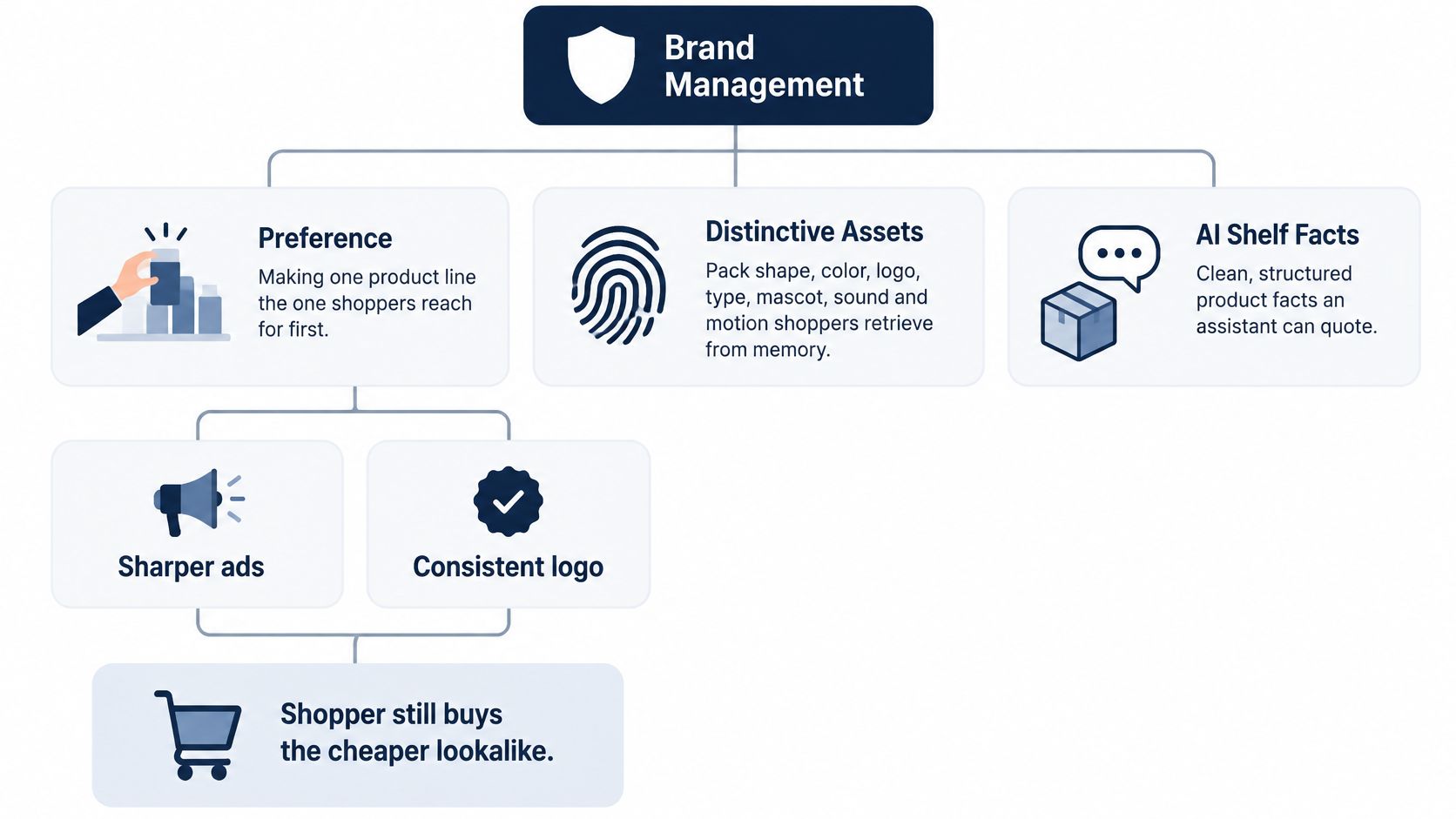
This ownership spans preference, recognizable assets, and reliable product facts.
Delegate evidence collection, not accountability. If your team needs help gathering review themes or checking listings, LatHire's resource to hire latin american virtual assistants is relevant to that execution layer. Give support staff a checklist and escalation rules; keep positioning, claims approval, and financial decisions with the brand owner.
Start with revenue premium, not follower growth. Compare the realized revenue of your branded product with a comparable private-label or unbranded alternative, controlling for distribution, availability, pack size, promotions, and ratings. Run that comparison at category, product, and channel level rather than blending everything into a company-wide average.
The Review of Marketing Science paper on brand-equity measurement treats revenue premium as an economic measure of brand equity and discusses evidence across 47 U.S. markets showing that price premium can align with more complex measures when comparisons are appropriately defined.
For an operator, the distinction matters. Revenue premium captures monetizable preference, while price premium tells you whether the product can sustain a higher realized price. Neither measure is useful if your comparison product has disappeared from stock or your pack contains materially more product.
| Metric | What to compare | Healthy signal | Trap |
|---|---|---|---|
| Revenue premium | Branded revenue versus a matched private-label or unbranded alternative after controls | Premium rising | Traffic up while the premium falls |
| Price premium | Offer price versus that same comparison set | Premium holds without heavier discounting | Scarcity or a better spec mistaken for brand |
| Repeat purchase | Buyers who repurchase inside the category window | Repeat rising at a stable price | Repeat that exists only with coupons |
| Branded-search share | Branded queries as a share of category search | Share rising | Generic rank with no demand for the name |
| Contribution margin | Profit after ads, fees and discounts | Margin funds the next brand investment | Equity growth that lives only in paid clicks |
Read each row as a decision. If repeat purchase improves only among customers receiving aggressive retention offers, test the offer economics before calling it loyalty. If branded-search share increases while contribution margin weakens, inspect paid branded-search spending and discount dependence.
For contribution margin, agree with finance on which variable costs belong in the calculation. Include product costs, fulfillment, returns, marketplace fees, discounts, and attributable advertising consistently. A channel team shouldn't be able to improve its reported result by moving an expense outside the dashboard.
Say your storage containers outperform a generic set during a promotion. Before crediting the brand, check whether the generic set was available, whether the quantities matched, and whether your discount created the entire difference. When the comparator changes, annotate the break rather than presenting a clean trend.
The commercial chain you want is straightforward: customers perceive greater value, accept your price with less coupon support, and leave more gross profit to fund product improvements and future demand. That's different from buying enough traffic to conceal a weakening offer.
Use the guide to measuring brand equity to structure the measurement work, then assign someone to explain movements rather than merely export charts.
Operating rule: Keep the comparison set stable through each review period. Don't celebrate more sessions when the revenue premium deteriorates.
A falling premium with stable conversion deserves investigation. Your existing traffic may still buy, but only because you've narrowed the price gap until the brand no longer earns its keep.
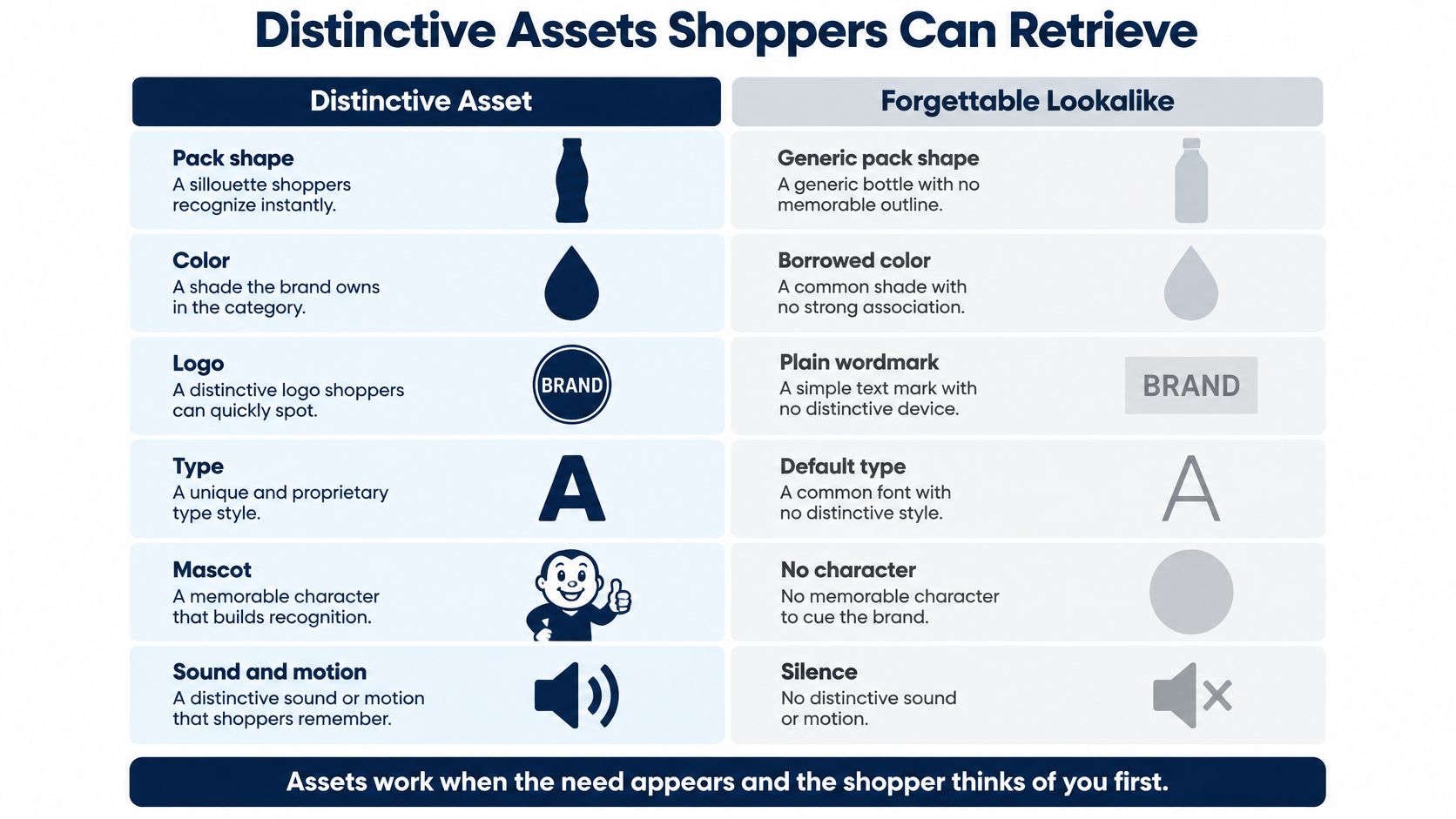
A shopper scanning lunch bags shouldn't need to read every title to find yours. Distinctive assets are the cues they retrieve from memory: packaging shape, color, logo, typography, mascot, sound, or motion. Treat those cues as purchasing infrastructure, not decoration.
Test fame and uniqueness separately. Fame measures whether category buyers recognize an asset as belonging to your brand; uniqueness measures whether they attribute it correctly and exclusively, rather than also assigning it to competitors.
The brand-equity paper discussing the global Ipsos/JKR study reports that among more than 26,000 consumers, only 15% of tested brand assets were distinctive. Attractive design isn't the same as ownable design.
Remove the brand name, show the asset, and ask category buyers which brand it belongs to. Record incorrect answers and competing-brand associations, not just correct responses. A familiar green pack that shoppers assign to the category leader isn't helping you establish independent recognition.
Apply the test to actual buying surfaces:
Use the comparison below to challenge generic design choices, but let shopper attribution decide which assets deserve protection.
Keep a short approved asset set and standardize it across markets, adapting where local law or cultural meaning requires it. Agencies can change the scene, crop, or supporting message without replacing the recognizable cue every campaign.
A familiar pack won't rescue an undifferentiated product. Web Mage's discussion of business differentiators customers actually feel is useful for separating a visible identifier from a purchase reason, such as easier cleaning or a better fit. You need both.
Use the brand identity guide to document how winning cues work together. Include thumbnail examples and incorrect applications, not just large-format logo layouts.
Don't approve a redesign because the internal team has become bored. They see the assets far more often than a shopper does. If a cue repeatedly fails uniqueness testing, retire it even when the creative team loves it; if it works, require evidence before replacing it.
AI is a new shelf, not just a writing assistant. L.E.K.’s analysis of AI-assisted shopping reports that AI-referred traffic grew 176% annually over the previous two years, while search, social, and direct traffic were flat or declining; 94% of AI-assisted shoppers still validate recommendations before buying, and only 8% complete a purchase entirely through an AI agent.
That means a recommendation isn't the end of the selling process. Your product facts must be accurate enough for an assistant to quote and clear enough for a shopper to verify through search, reviews, or a retailer.
The catalog checklist starts with facts, not prompts.

Assign a master record to each product and map channel fields back to it. Amazon bullets, DTC specifications, marketplace feeds, and structured product content shouldn't be separately maintained versions of the truth.
An insulated bottle described as leakproof in an ad but spill-resistant on its product page creates a verification problem. Don't solve it by copying the strongest wording everywhere. Resolve which claim the product can support.
Sample a stable set of buying questions and record recommendation accuracy, share of relevant AI answers, and citation quality. Check whether citations support the actual recommendation, not merely mention your brand.
For AI-referred visits, monitor abandonment and use optional post-purchase or exit questions to understand cross-checking. Analytics alone won't reveal every off-site verification step, so don't report an inferred validation rate as an observed fact.
If a claim cannot survive a neutral restatement, it doesn't belong in the catalog.
Conventional ad copy can emphasize a benefit, but exaggeration and inconsistent specifications can undermine both an assistant's answer and the shopper's subsequent check. Stale inventory and fragmented catalog records create that problem even when every logo is correct.
More personalization isn't automatically better brand management. A useful recommendation helps someone finish a task. A message that appears to infer their health, income, or family circumstances can make the same customer question how closely you're watching them.
Adobe's 2026 global consumer research found that 51% of customers selected value for price as a leading trust factor, while only 18% said they buy exclusively from brands they fully trust even when cheaper or more convenient alternatives exist. Trust matters, but it doesn't excuse weak value.
Use this as an internal approval policy, not a statement of universal legal requirements. The disclosure and review gates should be stricter where a tactic could expose sensitive information or change what an individual pays.
| Use | Data involved | Disclose | Human review |
|---|---|---|---|
| Accurate sizing | Measurements the shopper provided | Yes, on the tool | Only for safety or medical claims |
| Replenishment reminder | The brand's own purchase history | Yes, in the message | No |
| Relevant product education | Category intent the shopper stated | Yes | No |
| Inferred traits | Predicted health, income or family status | Required by internal policy, and usually not worth it | Yes |
| Person-level dynamic pricing | Behavior or predicted willingness to pay | Required by internal policy | Yes |
| Automated persuasion | Generated claims tuned to each shopper | Required by internal policy | Yes, before send |
Routine sizing, replenishment, and education flows still need approval before launch. The absence of per-message human review doesn't remove responsibility for their rules, source data, or failure handling.
Say a shopper browses loose-fitting clothing. An email recommending similar cuts may be useful; copy implying pregnancy crosses into an unsupported personal inference. The extra specificity isn't necessary to offer relevant products.
Track opt-outs, complaint themes, perceived intrusiveness, and deletion requests alongside revenue. After an automation error, monitor whether affected customers resume normal purchasing and engagement, rather than declaring recovery when support closes the ticket.
Preserve a recognizable voice across generated messages. Lock approved claims, restrict sensitive topics, and give customer-service staff a clear way to stop an automation rather than merely apologize for it.
Trust test: Would you explain the targeting logic plainly on the product page?
Less personalization can create more trust when the alternative feels like surveillance or an opaque price game. A straightforward message based on information the shopper deliberately supplied is often the cleaner choice.
Before launch, disclose the data used, require human review for sensitive inferences, and remove tactics you wouldn't explain openly. If you promise not to sell shopping data, make sure your actual vendor arrangements support that promise.
Consider these as operator scenarios, not reported case studies. Each isolates a decision a catalog owner can make and a metric that would show whether it worked.
For a home-goods brand, the test begins with the pack customers receive.

Say a dinnerware seller uses the same pack color, product claim, and hero-image composition across Amazon and its own site. When an agency proposes a refresh, the owner changes supporting scenes but preserves the cues buyers already recognize.
The principle is memory. If branded-search share rises after the team aligns the presentation, that's the metric to investigate, while accounting for changes in campaign spending. A new logo isn't the intervention.
Consider a supplement catalog whose sister SKUs all promise daily energy. The owner gives each a distinct buyer and purchase occasion, such as morning focus, post-workout recovery, and a value multipack, but uses benefit language only where product evidence supports it.
Different main images and keyword assignments make the intended choice clearer. The principle is separation, and the decision metric is product-line contribution margin, not whether each SKU's ad manager can claim more attributed sales.
This video provides an additional brand-management perspective.
Now take an apparel seller whose click rate looks healthy while opt-outs increase after hyper-specific browsing emails. The owner removes inferred personal traits, keeps shopper-provided sizing preferences, and makes the data-use explanation easy to find. The principle is trust, with opt-out rate as the immediate diagnostic.
For apparel imagery, WearView's ai photoshoot for clothing brand resource is relevant to production planning, but faster image creation doesn't justify changing the garment's apparent fit, fabric, or color. Review generated assets against the actual item before publishing.
None of these scenarios requires a new identity system. Each requires an owner willing to reject a plausible request: another refresh, another overlapping SKU promise, or another invasive email segment. Pick the scenario closest to your catalog and write the equivalent change for a product line, including the metric that would justify keeping it.
A brand guide should answer the questions that block publishing. If a listing editor still needs a meeting to decide which claim or image is approved, the guide isn't finished.
Write the positioning sentence. State the buyer, the job the product performs, the supporting proof, and the alternative it beats. The brand owner signs off; an agency can help write it but shouldn't decide the business's target buyer.
Create the claims register. List approved wording for listings, packaging, and ads, plus the evidence file and any required qualifier. Give each claim an approver and a status so expired or incomplete substantiation can't pass as permission.
Lock the core assets. Store the approved logo lockup, color specifications, type family, hero-image style, and any sound or motion files. Include working exports, thumbnail examples, and usage restrictions, not only presentation slides.
Define the voice through examples. Choose a concise set of attributes, such as direct, reassuring, and specific. Show approved product-title and email examples alongside banned phrasing such as unsupported superlatives or invented urgency.
Set change control. Name who approves a replacement asset and what testing must precede it. Keep ordinary execution changes separate from identity changes; review the guide on a scheduled cadence rather than reopening positioning whenever a campaign underperforms.
Publish from a master location. Connect listing editors, agencies, and marketplace tools to the same approved files and fact sheet. Log local legal and cultural adaptations against the master so a regional exception doesn't become the global standard.
The guide to creating brand guidelines can help organize the documentation. Keep the operational version searchable, permission-controlled, and close to the publishing workflow.
Approval gate: Every live claim and core asset should have an identifiable approved version.
The brand owner handles exceptions. Editors shouldn't have to guess whether an old sales deck outranks the current product record.
Make this a 30-day assignment for the person who owns the product line's P&L. The deadline is an operating target, not a promise that customer preference will change within that window.
Confirm authority before starting. Name the brand owner and verify that they can change claims, the main image, price posture, and creative without waiting for disconnected departmental approvals. If they can only recommend changes, leadership still owns the unresolved decision.
Freeze the baseline. Select the comparison products, document exclusions, and record the dashboard measures using consistent definitions. Ask finance to approve the cost treatment before anyone presents an improvement.
Test the most-used cues. Remove identifying text where needed and test whether category buyers recognize and correctly attribute the assets. Keep the strongest performers and document what happens to weak cues already printed on inventory.
Reconcile the catalog. Audit specifications, compatibility, contents, claims, price, and availability across Amazon, DTC, and assistant-facing feeds. Correct customer-facing contradictions before funding another campaign.
Inspect live personalization. List the data inputs, messages, disclosures, and review rules for each active flow. Pause sensitive or inferred-trait targeting that lacks an accountable approval process.
At the deadline, leadership should have an owner with decision rights, a documented baseline, an approved cue set, and a clean master fact sheet. The owner should also have delivered the first scoreboard reading, including uncertainties and the next corrective action.
Don't accept a redesigned presentation as completion. Ask which decision changed, who approved it, and where the operational record lives. If the answer remains scattered across agency emails and channel spreadsheets, the assignment isn't complete.
At MDS, our members are brand founders and leaders, not gurus or info marketers. Our community focuses entirely on ecommerce operators, unlike general founder organizations such as YPO or EO, and members have collective TTM revenue of $15B+. That makes ownership, economics, and execution the relevant language for this work.
Keep the first assignment narrow enough to finish. A product line with clear authority and usable records is a better starting point than a company-wide brand initiative nobody can enforce.
Million Dollar Sellers offers an ecommerce-focused peer community where founders and leaders exchange operating strategies through private discussions, calls, and hands-on workshops. Visit Million Dollar Sellers to explore a community where you can pressure-test brand ownership, catalog decisions, and margin trade-offs with other operators.
Join the Ecommerce Community for Founders Scaling from 7 to 9 Figures
Learn MoreYou may also like:
Learn more about our events!
Check Events