Chilat Doina
November 28, 2026
If you paused every paid ad campaign tomorrow, would shoppers still type your brand name into Amazon or Google and pay full price? Most ecommerce founders treat rising top-line revenue as proof that they're building a brand, when their numbers often reflect rented traffic and aggressive discounting instead.
That blind spot is why the phrase brand management group causes so much confusion. Founders use the exact same three words to describe two completely different structures: an internal team that owns a brand's profit and positioning, and an external peer community where brand owners trade benchmarks and pressure-test major calls. Both exist for the same reason, yet neither pays off unless you tie its work to a testable brand-equity scorecard that proves customers prefer your name over an identical alternative.
Before you hire a director or apply to a mastermind, you need to separate the two structures hiding behind one label. An internal brand management group is the dedicated team inside a company that owns a single brand's positioning, consumer research, packaging, promotion, pricing, and long-term profit. An external peer group is a vetted community of brand founders and executives who run separate companies, yet meet to share strategy, operating benchmarks, and vetted introductions.
Think of the distinction this way: the internal group is the brand's owner, and the peer group is its board of advisors. Both hold one brand accountable to a distinct customer proposition and a durable profit model, though they step in at different points in a company's life.
The visual below maps how both structures grow out of the same core discipline.
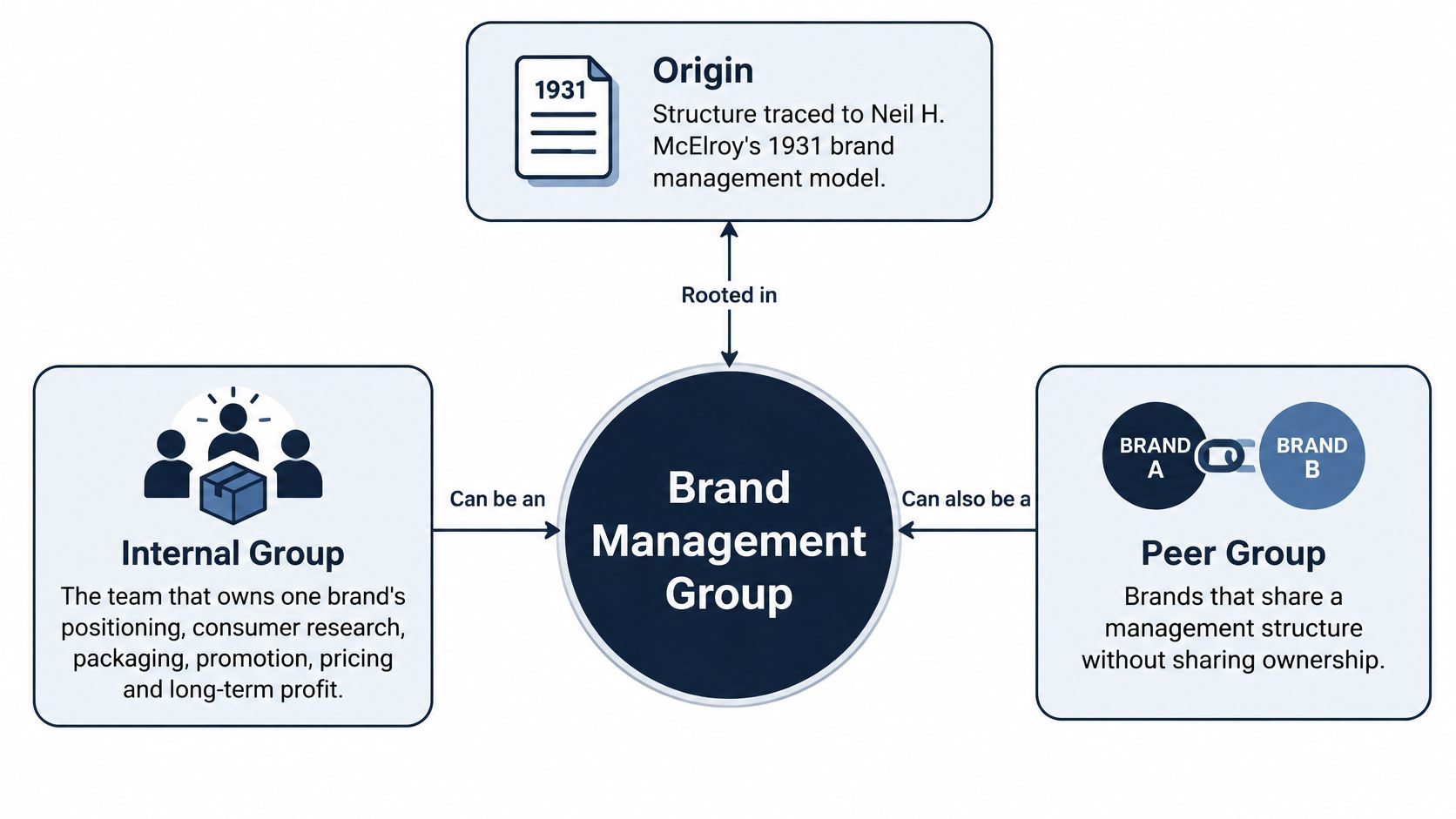
The internal model isn't a modern marketing trend. According to Wikipedia's history of brand management, Neil H. McElroy wrote a 1931 internal memorandum at Procter & Gamble arguing for dedicated managers assigned to individual brands, and by the 1950s companies including General Foods, Procter & Gamble, and Unilever had institutionalized the structure inside their marketing organizations. That shift turned the brand manager into the owner of a business-like profit center rather than an advertising coordinator.
You can run a quick diagnostic to see which version solves your current bottleneck. If you're hiring, restructuring departments, or watching your Amazon and DTC teams argue over pricing and creative, you need an internal brand management group. If you're scaling alone and second-guessing high-stakes calls on channel expansion, executive hiring, or margin protection, you need a peer group.
Diagnostic rule: A peer group pays off when founder judgment is the bottleneck, not when your team simply lacks execution hours.
Not every founder network deserves your time or dues. Generic executive organizations like YPO or EO offer broad leadership camaraderie, but they aren't built around marketplace fees, ad attribution, or retail wholesale terms. Unlike general founder organizations such as YPO or EO, we focus entirely on ecommerce operators at Million Dollar Sellers.
When you evaluate an external peer group, check four core standards:
| Question | Internal brand management group | External peer group |
|---|---|---|
| Who it is for | Brand doing enough volume to justify a dedicated owner | Founder or brand leader scaling alone |
| Core problem solved | Accountability for positioning, equity and channel decisions | Judgment, benchmarks and trust in high-stakes calls |
| Typical structure | Brand manager with P&L ownership and a small team | Vetted members, small moderated squads, mastermind calls |
| Best signal it fits | Channels overlap and no one owns the brand | You are the bottleneck on pricing, hiring or expansion |
| Main risk | Structure without real authority over pricing or product | Advice from people who do not run similar brands |
Once you decide to formalize brand ownership inside your company, build the responsibilities in sequence rather than hiring for creative output first. A brand management group exists to keep customer demand, product differentiation, and commercial execution moving in the same direction.
Here's the order in which a founder should establish the five core functions.
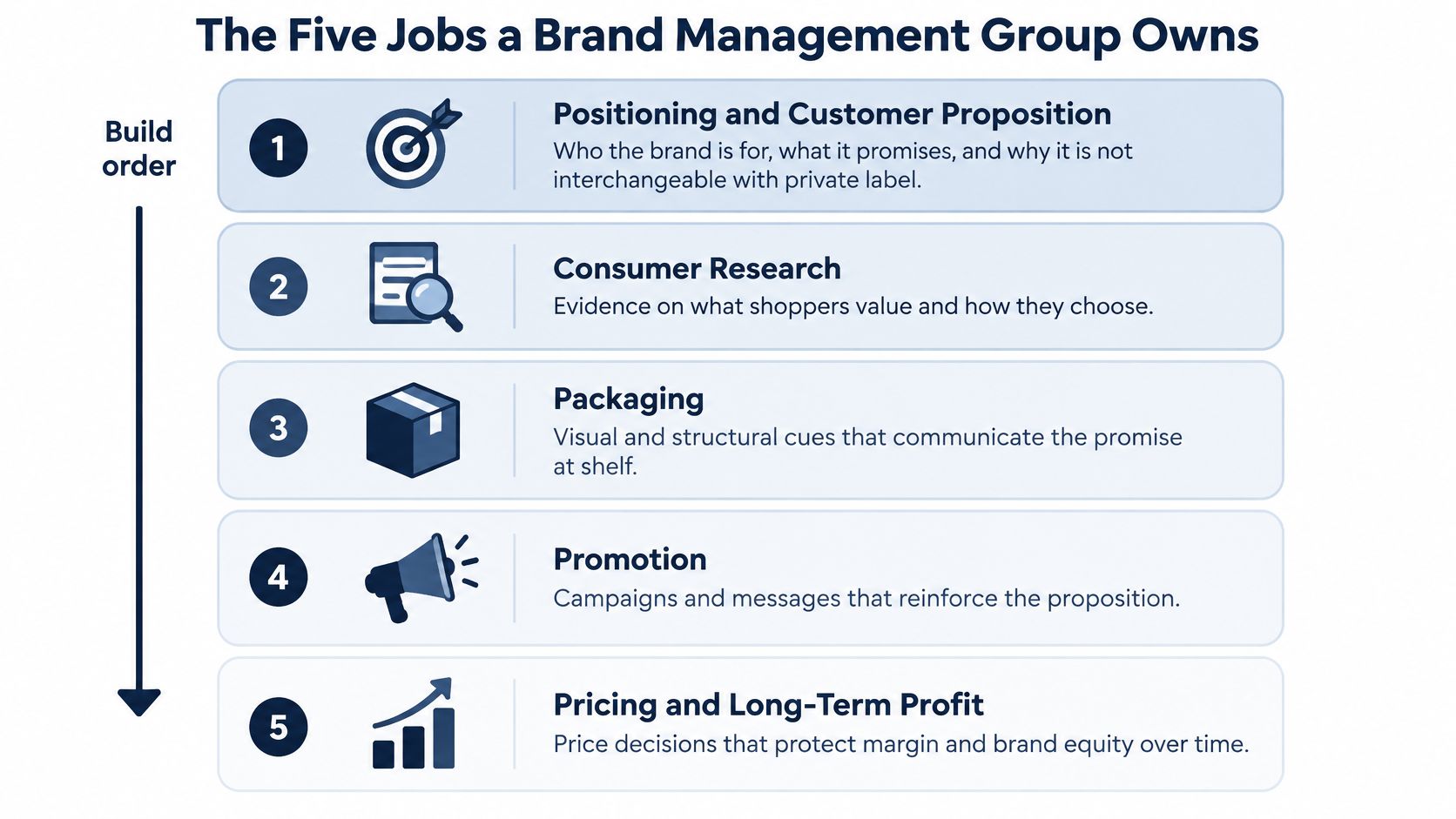
1. Positioning and customer proposition. This function answers the foundational question: who is this brand for, what specific outcome does it promise, and why isn't it interchangeable with a cheaper store-brand version? Your positioning is the commercial asset that survives even if you switch factories, lose a distributor, or move into a new retail chain. When this job goes unowned, discounting becomes your only differentiator.
2. Brand equity measurement. Too many marketing leads report impressions and reach while ignoring whether the brand name itself pulls weight. Equity measurement answers a harder question: does putting your brand name on an offer change shopper behavior? At this stage, your group names and installs four core behavioral metrics: branded-search conversion, direct traffic, repeat-order rate, and price elasticity. Skip this function, and rising revenue from paid placement will mask stalling organic demand until ad costs squeeze out your margin.
For a practical look at how brand managers balance these commercial responsibilities day to day, watch this breakdown of the role.
3. Portfolio and channel architecture. As soon as you add a second product line or expand beyond one sales channel, someone must decide which SKUs belong on Amazon, which stay exclusive to your Shopify store, and which enter wholesale retail. This function prevents your own channels from undercutting each other on price or confusing repeat buyers. Operators expanding marketplace reach often pair internal channel rules with an integrated Amazon brand strategy guide from Online Brand Growth so catalog architecture, content, and advertising reinforce one price ladder. Without clear architecture, a marketplace promotion will cannibalize your direct-to-consumer margins.
4. Creative and asset governance. Governance isn't about policing fonts for vanity's sake. It answers whether every product box, A+ Content module, retail display, and paid social video delivers the exact same promise and compliant claims. Growing teams often use template platforms like Marq or brand portals like Frontify to lock logos, color palettes, and required legal disclaimers while letting local marketers swap approved copy or imagery. When governance breaks down, shoppers see conflicting claims across listings and lose confidence before they reach checkout.
5. Cross-functional accountability. Someone has to sit at the intersection of marketing, product development, and channel management with real authority over contribution margin and customer retention together. Clarifying this seat inside your broader ecommerce team structure stops growth marketers from running heavy coupons that destroy the lifetime value your product team worked to earn. If no single owner holds the P&L together, marketing, product, and channel targets will pull the business in opposite directions.
| Function | Question it answers | Typical owner | Failure when missing |
|---|---|---|---|
| Positioning and proposition | Who is this brand for and why choose it | Brand lead | Discounting becomes the only differentiator |
| Brand equity measurement | Does the brand name change response | Analyst or brand lead | Revenue growth masks weak branded demand |
| Portfolio and channel architecture | Which brands run where | Group director | Channels cannibalize each other on price |
| Creative and asset governance | Is every touchpoint consistent | Brand lead with design | Inconsistent listings and claims across channels |
| Cross-functional accountability | Who owns margin and retention together | Brand manager with P&L ownership | Marketing, product and channel targets conflict |
Naming metrics is only half the job. A brand management group earns its keep by proving the causal link between what shoppers remember about your brand and what they're willing to pay at checkout.
In his foundational framework published in the Journal of Marketing, Kevin Lane Keller defines positive customer-based brand equity (CBBE) as consumers responding more favorably to the exact same marketing mix when it carries the focal brand name than when it's presented as unnamed or fictitious. The mechanism is causal: familiarity paired with strong, favorable, and distinctive associations changes how a buyer interprets identical product specs, photos, and prices.
That causal mechanism gives ecommerce operators a clean experiment you can run without hiring a traditional market research agency. Hold your product, price, offer, imagery, and delivery promise constant across two test variants, changing only whether the listing or landing page carries your brand name and visual identity versus a neutral, unbranded presentation.
Measure the resulting lift in click-through rate, conversion rate, repeat purchase, or willingness to pay. That gap estimates the commercial contribution of the brand itself, stripped of ad placement or promotional discounts. It's an essential check across Amazon, DTC, and retail channels, where last-click attribution tools routinely over-credit paid search ads and understate the memory-based demand that made the buyer click in the first place.
A rising revenue curve with flat branded search doesn't mean you're building a brand. It means you're renting demand from ad auctions.
Relying on a single awareness KPI hides cracks until sales suddenly stall. Empirical research published through the University of Miami's customer-based brand equity study identifies five distinct equity dimensions: performance, perceived value, social image, trustworthiness, and commitment, noting that brands scoring higher on the scale generally command higher prices. The same paper cites a separate study of 3,928 consumers across 15 brands and four industries linking equity to brand loyalty, perceived quality, and awareness or associations, while a 304-survey sportswear study cautioned that quality and name recognition alone don't guarantee strong brand equity.
To turn those dimensions into an operating system, connect each one directly to a behavioral or financial metric you already pull from Shopify, Amazon Seller Central, and your helpdesk. You can dig deeper into weighting and tracking these inputs in our guide on how to measure brand equity.
| Equity dimension | Metric that proves it | What a decline signals |
|---|---|---|
| Performance | Conversion rate at constant price and creative | Product advantage is eroding |
| Perceived value | Review sentiment and warranty claim rate | Quality perception is drifting from reality |
| Social image | Unaided recall and branded search volume | Associations are weakening against competitors |
| Trustworthiness | Refund and complaint rates | Promise and delivery are misaligned |
| Commitment | Repeat-purchase cohorts and price elasticity | Loyalty is conditional, not durable |
Assign weights to each dimension and validate them against contribution margin or 90-day retention rather than guessing which score matters most. Review the scorecard monthly at the leadership level and slice it quarterly by country, sales channel, and customer cohort. Slicing by channel matters because a brand can hold strong trustworthiness on its own website while third-party resellers erode perceived quality and review sentiment on Amazon.
Brand management groups don't look the same across every revenue tier. Comparing an asset-light licensing giant with a lean ecommerce team shows how the underlying discipline scales up or down without changing its core purpose.
Large brand-management groups separate intellectual property from manufacturing and retail stores, monetizing recognition through licensing agreements across categories and countries. Iconix Brand Group's historical profile on Wikipedia traces the company's origins to the 1993 acquisition of Candie's and shows how far that operating model can reach. At its reported 2011 scale, Iconix generated approximately $400 million in revenue and $80 million in net income with about 120 employees, managing a portfolio that included Starter, Umbro, Rocawear, Lee Cooper, London Fog, Candie's, and Bongo.
Treat those 2011 figures strictly as a dated illustration of the licensing model, not as a profit benchmark for a modern ecommerce founder. The operational takeaway isn't the headcount ratio; it's the structural separation. Because Iconix owned the brand names rather than factories or physical storefronts, its managers could preserve consumer recognition even when manufacturing partners or retail channels changed, diversifying across geographies instead of betting everything on one SKU.
You don't need a portfolio of legacy apparel labels to run a brand management group. Say a founder-led home fitness brand sells twelve SKUs across Amazon and Shopify. Instead of letting its ad agency dictate discounts while a sourcing agent tweaks packaging, the founder forms a three-person internal group: a brand strategist (often the founder at first), a performance marketer, and a product developer.
Every Monday morning, that trio reviews one shared dashboard covering all five functions. When the product developer spots a recurring defect in one-star reviews, the group pauses ad scaling on that ASIN until packaging inserts and supplier specs fix the issue. When the marketer proposes a sitewide flash sale, the strategist checks price elasticity and repeat cohorts first to make sure the promotion won't train existing buyers to wait for coupons.
Both models solve distinct commercial goals:
Both structures also share one fatal trap. Whenever a company adds a second brand or sub-line without naming a distinct owner for each proposition, the lines drift into overlapping claims and end up competing against each other on price.
Many founders assume that sharp packaging and a lifestyle story are enough to keep store brands at bay. Current shopper behavior tells a much blunter story.
According to Deloitte's Q3 2025 retail and consumer trends analysis, 72% of consumers can't distinguish private-label products from national brands in side-by-side comparisons, and 84% trust private-label quality as much as or more than national-brand quality. The same analysis cites NIQ data showing that while 72% of consumers view private labels as strong alternatives to national brands, 62% still default to familiar branded products and 59% trust store brands because retailers endorse them.
Those numbers don't mean brands are dead. They mean the bar for earning preference at a higher price just moved sharply upward.
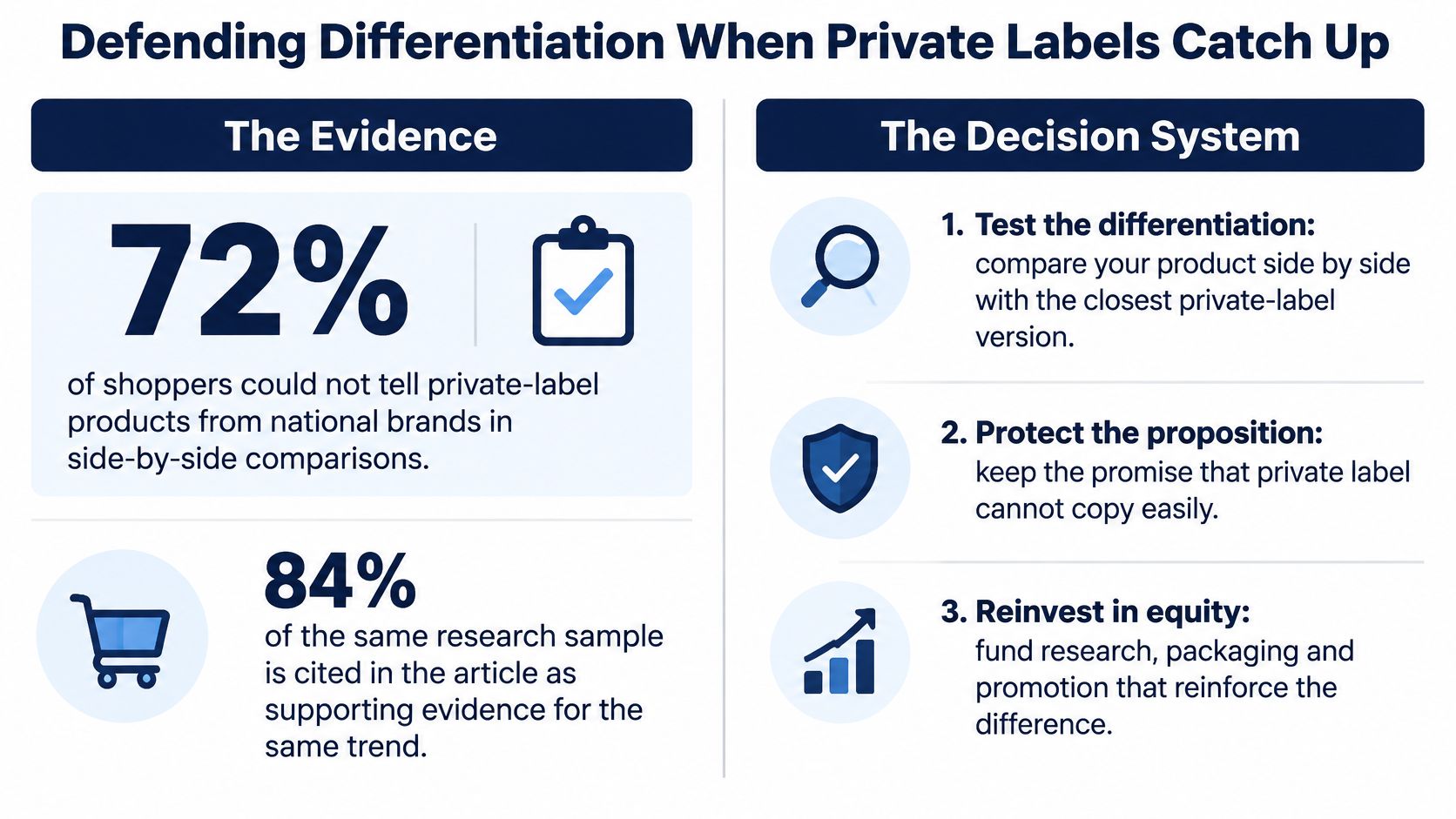
Instead of guessing how to look "more premium," put your brand management group through a three-step decision filter:
Where superiority is real and measurable, concentrate your R&D, packaging, and ad spend on proving it. Where side-by-side performance is close, stop piling on vague claims. Simplify your value proposition and compete on availability, fulfillment speed, and consistent trust across every channel. Maintaining that tight visual and verbal discipline is especially tough across global storefronts, which is why resources like Sprello's guide on avoiding regional drift in fashion campaigns focus on locking down core brand cues before local teams adapt creative.
Traditional brand playbooks assume shoppers discover your product through an ad, visit your website, and buy directly from you for years. Today, an AI assistant, marketplace search algorithm, or short-form creator often sits between your brand and the buyer.
Data from Shopify's 2026 ecommerce trends summary shows how quickly that shift is reshaping buyer behavior: unwavering brand support fell from 34% in 2024 to 29% in 2025. At the same time, 73% of surveyed consumers used AI to learn about brands and products, 61% used AI to compare products or services, and 57% used it for personal recommendations.
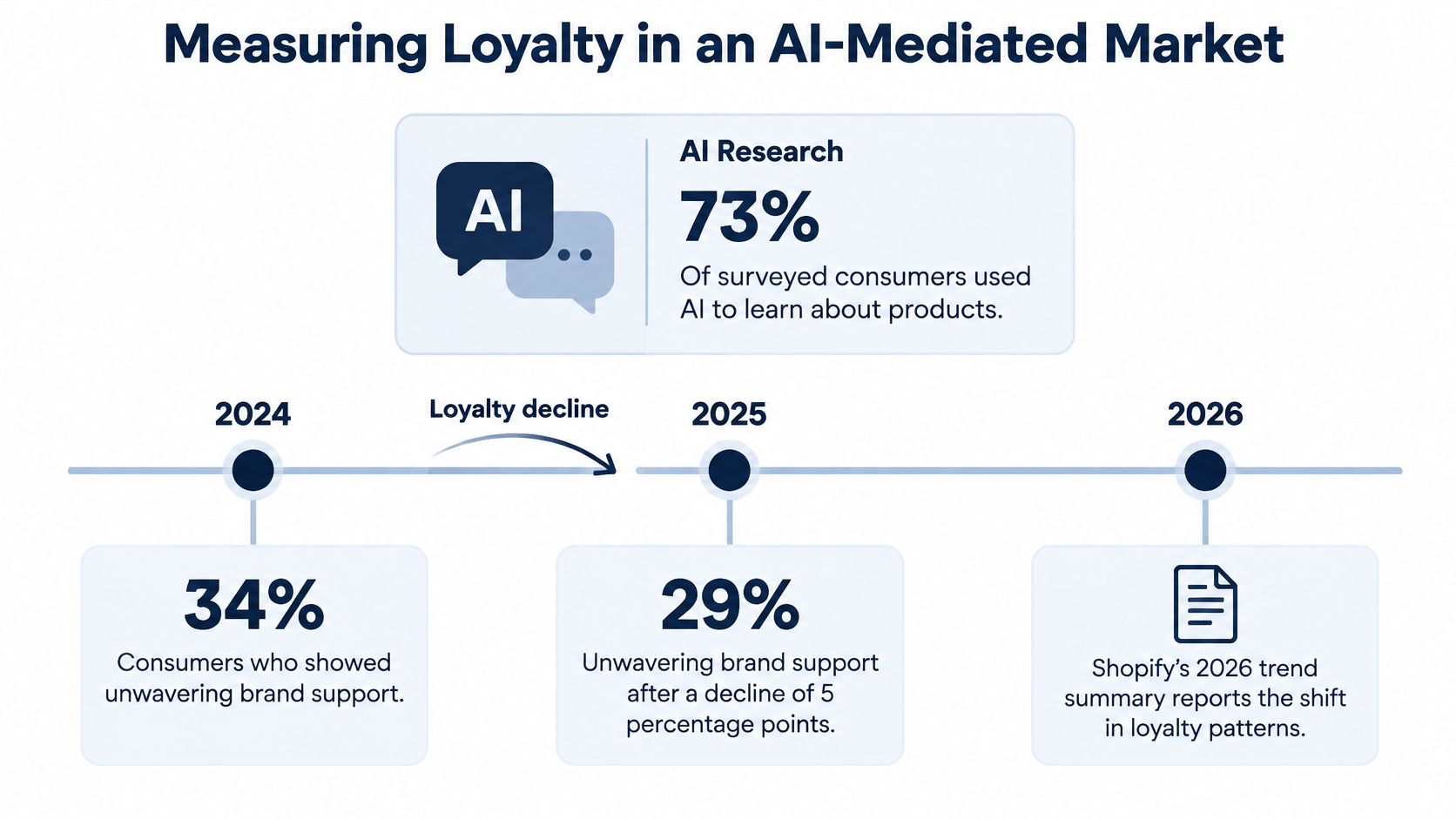
Brand discovery now moves along a three-stage maturity ladder:
Because loyalty is more conditional than it used to be, your brand group should schedule a dedicated discovery and retention audit every quarter. Run four concrete checks:
1. Audit AI product representation. Prompt ChatGPT, Perplexity, and Google AI Overviews with the exact buying questions your customers ask ("best electrolyte powder without artificial sweeteners," "most durable hard-shell carry-on for frequent flyers"). Check whether your brand appears in recommendations and whether the model states your specs, pricing, and key differentiators accurately. Because AI models heavily weight candid community discussions when building shortlists, operators increasingly examine third-party visibility tactics, including reviewing Reddit citation services from AY Rank, to understand how authentic product mentions influence where models pull brand facts.
2. Run a paid-pause resilience test. Pause non-branded paid search or trim top-of-funnel spend in one test geography for two weeks and watch whether branded search volume holds steady. Sharp drops expose heavy ad dependency.
3. Separate creator-driven conversion from last-click attribution. Track creator promo codes, post-purchase survey responses, and branded-search spikes following influencer pushes so you don't cut high-trust creators just because a branded Google ad took the final click.
4. Stress-test repeat rates against price changes. When you test a small price increase or remove an automatic discount code on a returning-customer cohort, track whether reorder velocity survives.
Stronger loyalty no longer means exclusive emotional attachment. It means being repeatedly selected across contexts even when an algorithm puts three cheaper substitutes right next to your product.
Tie your quarterly brand budget to inclusion in AI recommendations, factual accuracy across third-party sources, branded-search resilience, repeat rate, and contribution margin instead of chasing impressions.
You don't need a corporate reorg or six months of consulting workshops to put this discipline to work. Start this week with five concrete moves.
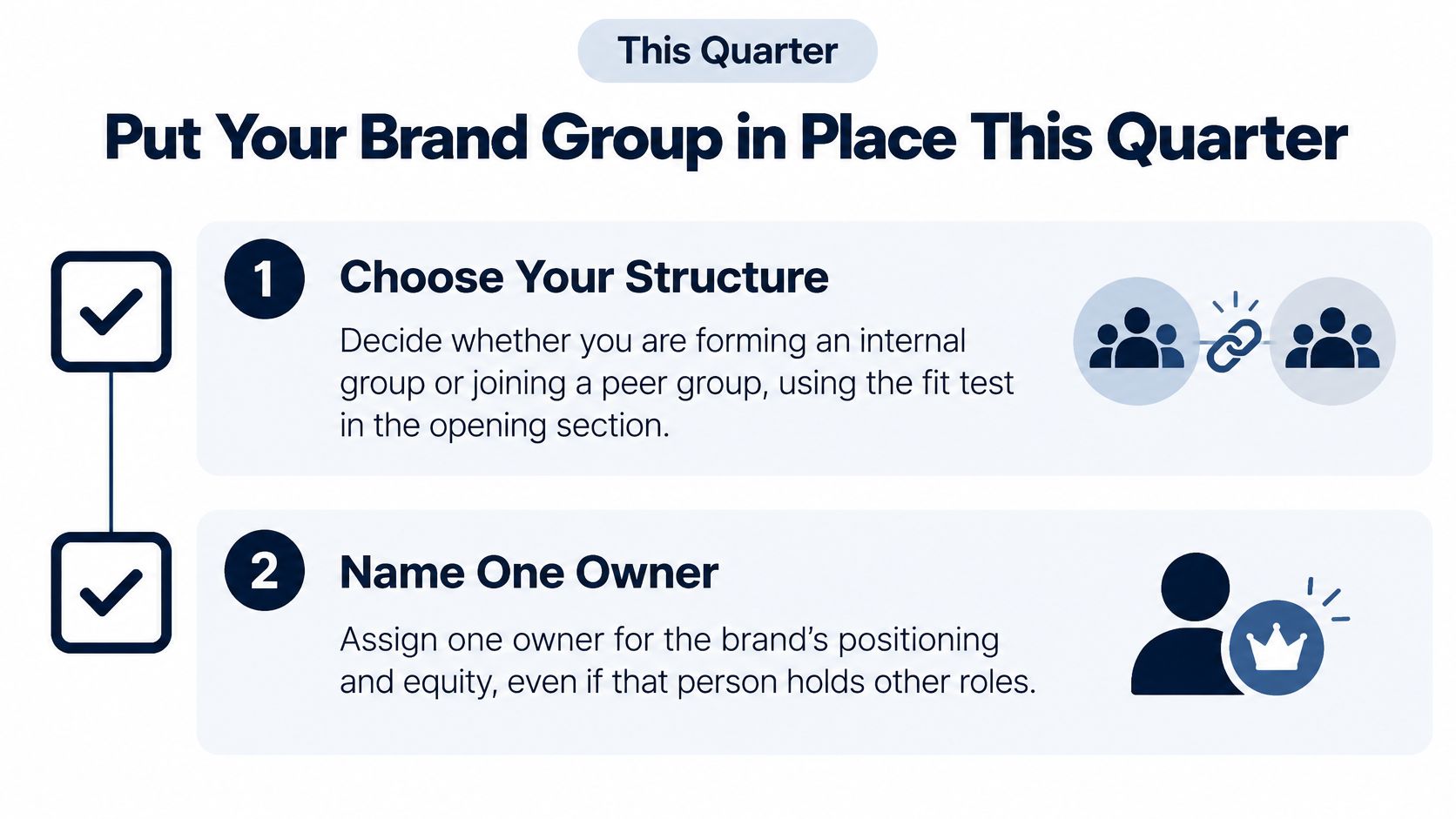
Hold every hire, agency, and community to one standard: a brand management group is worth its cost only if it makes your brand measurably preferred at the same price, not merely better promoted.
If you're an ecommerce founder scaling past seven figures and want a trusted peer board to pressure-test your brand positioning, pricing, and channel expansion, Million Dollar Sellers connects vetted Amazon, DTC, and omnichannel operators through private forums, moderated monthly Squads, and hands-on mastermind workshops. Every member runs a real brand with P&L ownership, so the feedback you get comes from founders solving the exact same margin and differentiation challenges. Explore membership and apply at Million Dollar Sellers.
Join the Ecommerce Community for Founders Scaling from 7 to 9 Figures
Learn MoreYou may also like:
Learn more about our events!
Check Events