
Chilat Doina
July 13, 2026
A strong quarter creates a deceptively hard problem. Cash hits the account, inventory is moving, contribution margins look healthy enough, and suddenly every team has a compelling use for the next dollar.
The ops lead wants deeper inventory to avoid stockouts. The Amazon team wants more budget for branded search and category expansion. Your DTC lead wants a site rebuild, better retention flows, and cleaner attribution. You may also have a smaller brand on your radar that could fold neatly into your catalog. All of those can sound right at the same time.
That's why capital allocation separates disciplined founders from busy founders. Most brands don't stall because they stop finding opportunities. They stall because they spread money across too many good ideas and starve the few great ones.
If you're running a 7, 8, or 9 figure brand, this question doesn't show up once a year. It shows up every quarter, often every month. You're not deciding whether to invest. You're deciding where to deny investment.

The mistake is treating every surplus dollar like “growth capital” with no rules attached. In practice, every dollar has a job. It either buys more revenue, buys better efficiency, reduces downside risk, or preserves optionality for a future move. When founders skip that framing, cash gets pulled toward whichever department argues hardest.
Early on, intuition can work because the founder still has direct visibility into almost everything. Past a certain size, intuition gets noisy. You have more channels, more inventory complexity, more vendor pitches, more debt decisions, and more partial data. That's exactly why over half of CFOs, 56%, said their capital allocation strategy needs to be completely rethought according to Simon-Kucher's analysis of capital allocation strategy.
That should feel familiar. A lot of e-commerce brands still allocate capital based on momentum, politics, or channel bias. The Amazon team points to immediate sales velocity. The DTC team points to brand equity and customer ownership. Finance points to working capital pressure. None of them are wrong. But they're speaking different languages.
Practical rule: If two teams can't compare their asks using the same decision framework, you don't have a capital allocation process. You have internal lobbying.
The job isn't to eliminate uncertainty. It's to create a repeatable way to rank trade-offs under uncertainty. That means deciding, in advance, what qualifies for capital and what has to wait.
For most brands, the immediate competing uses look something like this:
Founders who scale cleanly don't ask, “What sounds exciting?” They ask, “Which use of cash creates the most durable value relative to the alternatives?”
That sounds obvious. It isn't common.
Most founders are operators first. That's an advantage until it becomes a blind spot. Operators optimize the machine in front of them. Investors compare uses of capital across the whole system.
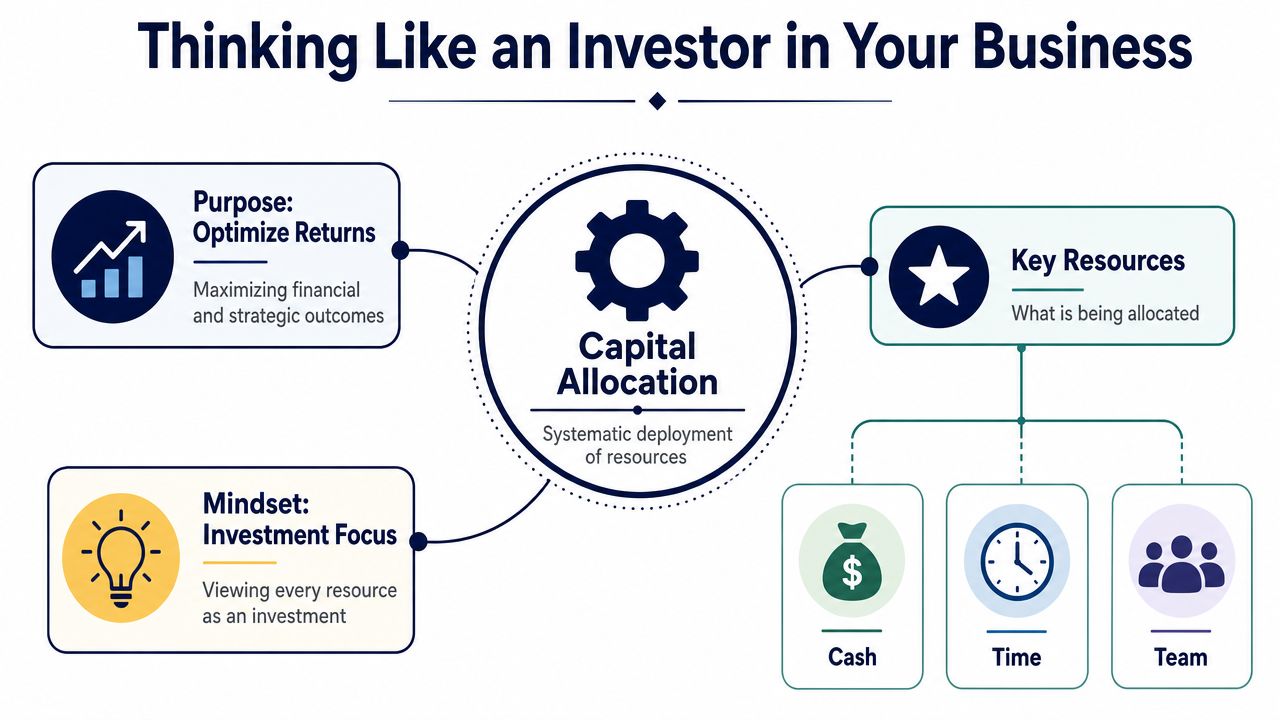
Think about your brand like a high-performance engine. Capital is the fuel. You can send that fuel into speed, efficiency, protection, or entirely new capabilities. But once you burn it in one direction, you can't burn the same dollar somewhere else.
That's why opportunity cost matters more than optimism. Every ad dollar you scale is a dollar you didn't use to improve retention. Every warehouse automation project is money you didn't use to launch a new product line. Every acquisition talks you out of some amount of organic investment.
Capital allocation revolves around five core pillars: organic growth, mergers and acquisitions, debt payments, dividend payments, and share buybacks. For operating brands, the first three matter most day to day. The bigger strategic lesson is that external moves can matter more than internal reshuffling. University of Phoenix's overview of capital allocation notes that 85% of the total value generated in asset sales comes from selling a division to another company, which is one reason smart founders keep M&A on the table rather than treating growth as purely organic.
Here's how those pillars translate in e-commerce:
A good founder doesn't treat all projects as equal. They categorize them by role. Some projects defend the base business. Some expand the base. Some improve efficiency. Some create options.
A lot of teams also need stronger planning discipline before they can make those calls well. That's where more structured financial planning helps. This advanced financial planning guide is useful because it forces a cleaner link between strategic goals and the cash you're committing.
To anchor the mindset, this short clip is worth watching:
Your business isn't one investment. It's a portfolio of investments competing for the same pool of cash, time, and management attention.
That shift changes everything. Once you start viewing every project as an investment with alternatives, low-quality spending becomes much easier to spot.
Most e-commerce dashboards are too crowded. They track platform metrics, campaign metrics, operations metrics, and channel metrics. Useful, yes. Decisive, not always.
When you're making capital allocation decisions, three measures cut through the noise: IRR, WACC, and ROIIC.
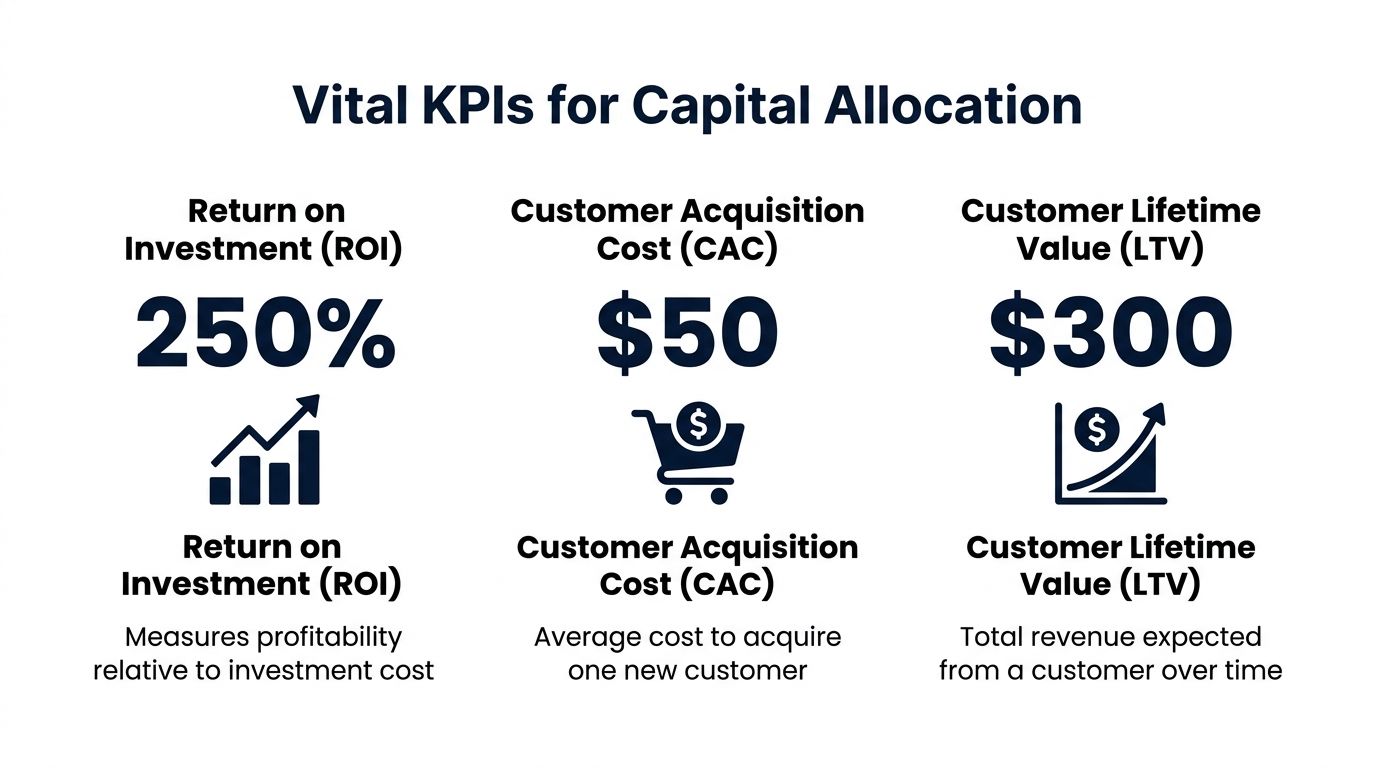
For 7 to 9 figure founders, the cornerstone metric is Internal Rate of Return, or IRR, and it should exceed your weighted average cost of capital, or WACC. That's the core standard laid out in this capital allocation guide for long-term business growth. If a project can't beat your cost of capital, it may grow activity without creating value.
You don't need a banker's model to use this principle. You need a practical one. If you're considering a new warehouse system, a retention platform migration, a retail launch, or a category expansion, ask one simple question first: Will this use of capital earn more than the capital costs us?
If the answer is unclear, the project isn't ready.
IRR helps on larger investment decisions. Return on Incremental Invested Capital, or ROIIC, tells you whether the next dollar is productive. That makes it brutally useful for growth brands.
A channel can look great in aggregate and still be a bad place for incremental capital. That's common with paid media. The first dollars often perform far better than the next dollars. The same issue shows up in inventory depth, team hiring, and software stacks. Good historical performance can hide weak incremental returns.
A clean KPI stack usually looks like this:
If your team is still overloaded with vanity reporting, this guide on tracking online store performance is a useful complement to a more finance-led view. It helps strip reporting back to measures that influence decisions.
Most founders don't need more metrics. They need a different hierarchy of metrics. The top layer should answer whether capital is creating value. The second layer should explain why.
A practical review rhythm is:
For a more channel-specific framework, this e-commerce KPI resource is a good operational companion.
If a project needs six supporting metrics to defend itself, it usually doesn't deserve more capital.
Good capital allocation strategies need structure. Otherwise, marketing absorbs the oxygen, operations gets funded only after pain appears, and strategic bets happen whenever the founder gets inspired.
The cleanest operating model I've seen is a four-bucket system with target allocations. A rigorous framework assigns 40% to Growth Engines, 30% to Efficiency Plays, 20% to Risk Mitigation, and 10% to Strategic Options, with quarterly rebalancing rather than static annual planning, according to this capital allocation framework overview.
The reason this works is simple. It prevents one strong internal voice from hijacking the whole budget. Growth matters. But so does efficiency. So does protection. So does preserving room for the next opportunity.
| Investment Bucket | Target Allocation | Purpose | E-commerce Examples |
|---|---|---|---|
| Growth Engines | 40% | Expand revenue and market reach | Shopify rebuild for conversion, new product launches, Amazon category expansion, better retention systems |
| Efficiency Plays | 30% | Reduce cost and improve EBITDA quality | Inventory planning software, warehouse process improvements, customer support automation, returns optimization |
| Risk Mitigation | 20% | Protect the downside and preserve operating continuity | Cybersecurity, compliance work, backup suppliers, fraud controls, operational safeguards |
| Strategic Options | 10% | Buy future flexibility | Small market tests, exploratory channel pilots, early M&A conversations, limited proof-of-concept initiatives |
Don't treat those percentages like sacred law. Treat them like guardrails. A founder with heavy supply chain risk may lean harder into mitigation for a period. A brand entering a new category may give Growth Engines more room. What matters is that you make those choices deliberately.
A few execution rules make the framework useful:
Three patterns show up repeatedly.
The framework forces sharper language. More important, it forces sharper trade-offs.
The hardest capital allocation decision in e-commerce is often channel tension. Amazon throws off volume and speed. DTC builds customer ownership, merchandising control, and brand equity. Both can deserve more capital. Usually, only one should get the next meaningful tranche.
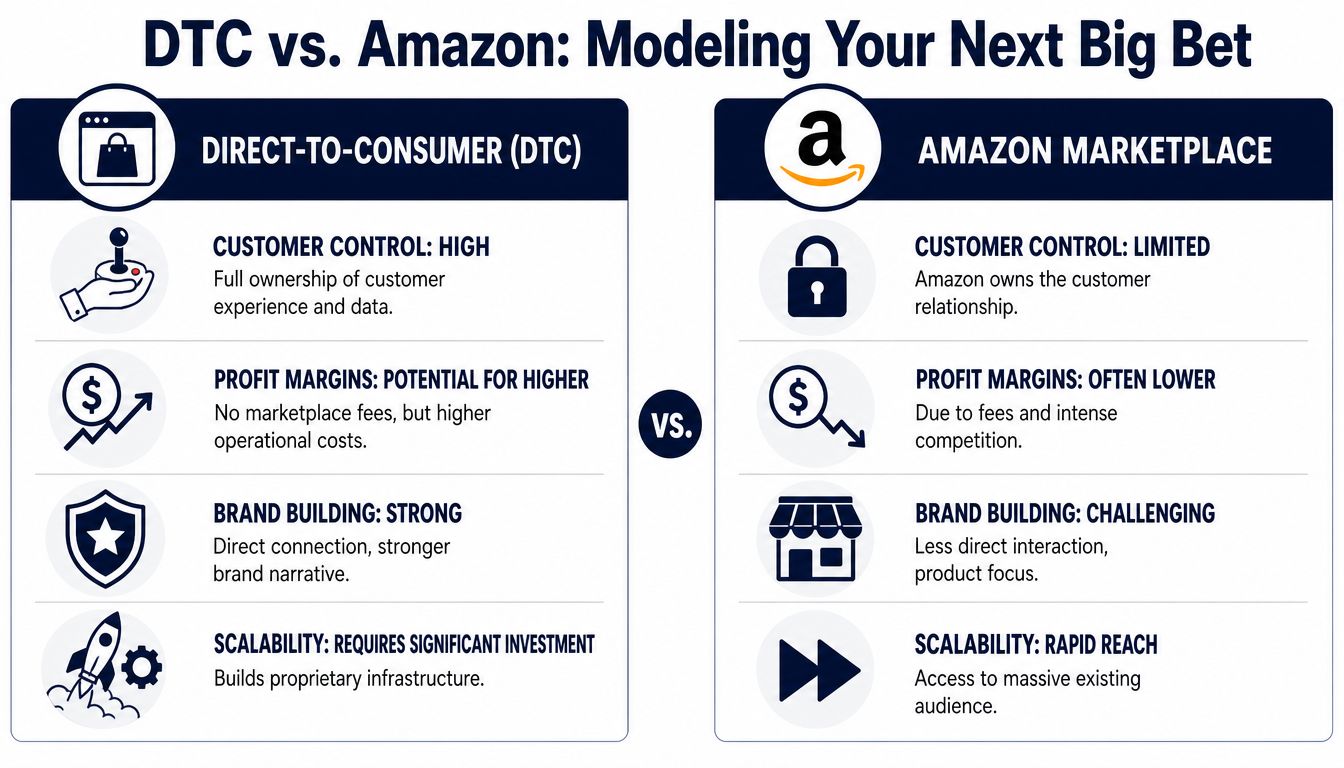
A useful way to handle this is scenario modeling. Not an overbuilt spreadsheet. A disciplined comparison of assumptions, upside, downside, and strategic fit.
Say a brand has capital available for one major move. Option one is to strengthen DTC through a site upgrade, better landing pages, retention flows, and a more serious first-party data stack. Option two is to push harder on Amazon through category expansion, more aggressive ad coverage, and deeper inventory support.
Many brands default to Amazon because the feedback loop is tighter. Sales show up faster. Attribution feels clearer. The team knows what to do next.
But speed can hide a weaker long-term return. McCracken Alliance's analysis of growth-stage capital allocation says 68% of Amazon-focused brands underinvest in DTC infrastructure, despite DTC showing 2.3x higher incremental ROIC over 3 years.
That doesn't mean DTC always wins. It means founders need an explicit model rather than a channel instinct.
You don't need perfect forecasting. You need to pressure-test the few assumptions that drive the outcome.
For a DTC bet, focus on:
For an Amazon bet, focus on:
A strong unit economics model is the backbone of this analysis. This unit economics breakdown is a good lens for forcing channel comparisons onto the same footing.
Sometimes the issue isn't just where to invest. It's how to finance the move without creating unnecessary fragility. If you're evaluating layered financing approaches, this resource on how to finance business expansion with capital stacking is worth reviewing before you commit.
The right channel decision isn't the one with the fastest payback on paper. It's the one that still looks smart when your core assumptions get worse.
That's the true test. Model the base case. Then model the painful case. If the investment only works in a flattering scenario, pass.
Most capital allocation strategies fail in execution, not design. The framework looks good in a slide deck. Then a vendor pitch lands, a stockout scare hits, one channel has a strong month, and discipline disappears.
The fix is governance. Not corporate theater. Just enough structure that money goes where evidence is strongest.
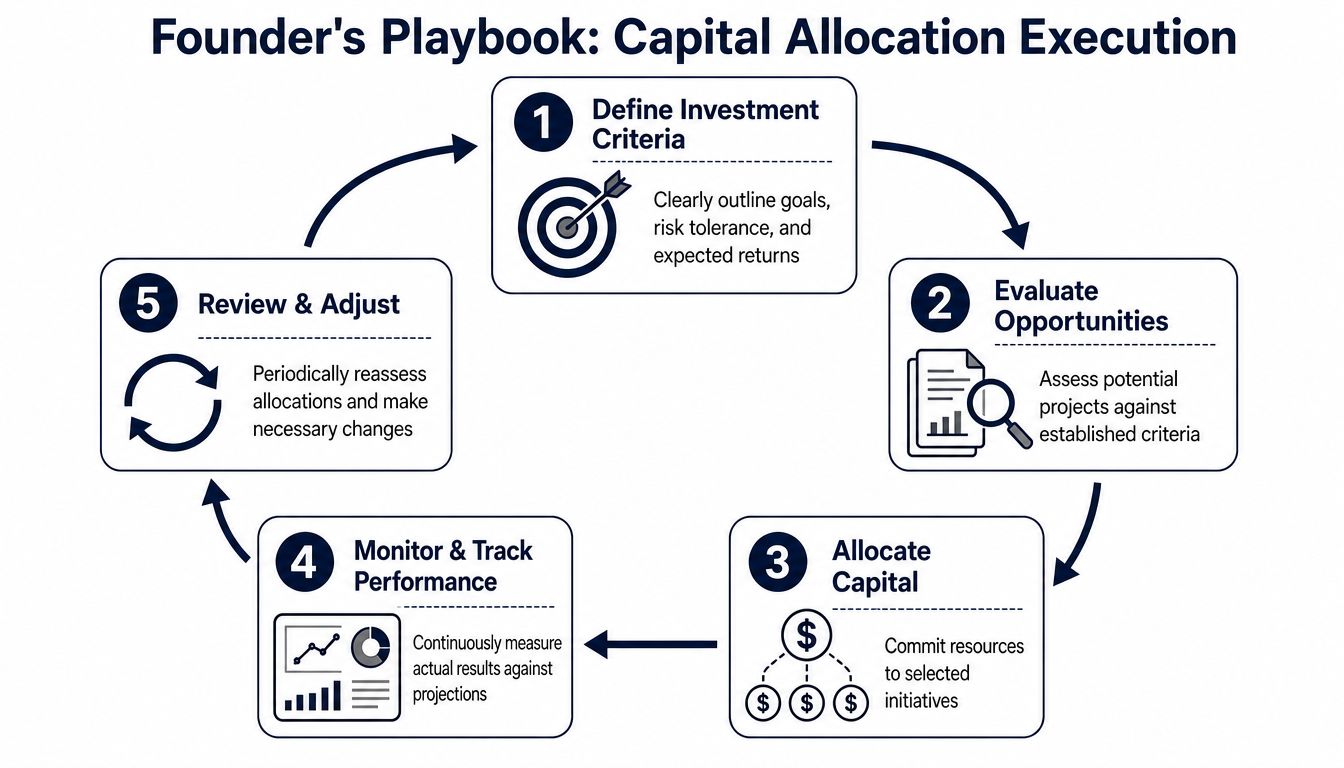
According to this capital allocation framework from Umbrex, superior discipline correlates with 15% to 20% higher Total Shareholder Return, and the operating ingredients are straightforward: a formal investment committee, clear approval thresholds, stage-gated funding, and enforceable kill or redirect rules.
For an e-commerce brand, the committee doesn't need to be large. It can be the founder, finance lead, operator, and the executive owning the initiative. What matters is consistency.
A useful review process usually includes:
Many brands save themselves a lot of wasted cash by employing this strategy. Don't fully fund uncertainty on day one. Break it into stages.
For example:
This works well for new channels, product launches, software migrations, and operational changes. It's also the best antidote to founder enthusiasm. Excitement can fund discovery. Evidence should fund scale.
Founders hesitate to kill projects because it feels like admitting a mistake. In practice, refusing to cut weak projects is the bigger mistake. Dead money blocks better uses of capital.
Set stop conditions in advance:
Operator note: Teams respect kill rules more when the rules are written before funding starts, not invented after results disappoint.
A brand that does this well becomes faster, not slower. Decisions get cleaner because people know what qualifies for funding and what doesn't.
Most founders can source products, run ads, negotiate with suppliers, and improve conversion. Fewer can allocate capital with discipline. That's one of the reasons some brands stay noisy and fragile while others compound.
The shift is subtle but powerful. You stop acting like a manager of departments and start acting like an investor across a portfolio of opportunities inside your own company. Inventory, Amazon ads, DTC infrastructure, automation, hiring, M&A, and risk controls all compete for the same finite pool of cash and attention. Once you see that clearly, reactive spending gets much harder to justify.
An edge isn't just picking good opportunities. It's building a system that keeps redirecting capital toward the best ones and away from the rest. That means using shared decision criteria, judging bets against the cost of capital, reviewing incremental returns instead of total activity, and enforcing governance even when the business feels busy.
That discipline isn't glamorous. It won't get celebrated the way a new product launch or a viral campaign does. But it's one of the few skills that improves every other part of the business. Better capital allocation produces stronger margins, cleaner growth, better resilience, and more strategic freedom.
If you want a brand that lasts, don't just optimize the funnel. Optimize where the next dollar goes.
If you want to sharpen how you make these decisions alongside founders operating at serious scale, Million Dollar Sellers is where that level of conversation happens. It's an invite-only community for top e-commerce entrepreneurs who share real numbers, real operating decisions, and the kind of capital allocation lessons you usually only learn the hard way.
Join the Ecom Entrepreneur Community for Vetted 7-9 Figure Ecommerce Founders
Learn MoreYou may also like:
Learn more about our special events!
Check Events